
It’s the zeitgeist, stupid

There has always been a dance between local and national politics, a dance that can appear to take place in a maze of funhouse mirrors. That’s how Santa Monica politics in 2024 look to me. The electorate here is much different from that of the nation, but to a great extent I can’t differentiate between what I’m seeing on the local candidate mailers and the political commercials interrupting the baseball playoffs and the analysis that the national commentariat is producing.

Let’s begin with realignment. Nationally realignment of the political parties has been underway since the “Reagan Democrats,” but it accelerated when Donald Trump came down the escalator. In Santa Monica, realignment came abruptly with the 2020 City Council election, picked up steam in 2022, and this year was fully realized.

Realignment in Santa Monica means that the anti-development side, epitomized by Santa Monica Coalition for a Livable City (SMCLC), is no longer allied with its previous great benefactor, Santa Monicans for Renters Rights (SMRR). SMRR enabled candidates supported by SMCLC, such as Kevin McKeown and Sue Himmelrich, to get elected to City Council. But now after realignment, SMCLC has joined with business groups supporting candidates under the “Safer Santa Monica” banner (namely, incumbents Phil Brock and Oscar de la Torre, and newcomers John Putnam and Vivian Roknian) against the SMRR-backed candidates.

As a longtime participant in and observer of Santa Monica politics, the most, may I say, amusing manifestation of this break between SMRR and the anti-development crowd has been the dispute between McKeown, still a SMRR-loyalist, and SMCLC over the question about who is responsible for the housing development that’s coming to Santa Monica after the Change Slate-controlled City Council failed to file a compliant Housing Element. After McKeown wrote a letter to the Lookout blaming Changer Slaters Brock and De la Torre, Diana Gordon responded with one slamming McKeown. Breaking up is hard to do.

Meanwhile SMRR has formed an alliance with traditional liberal/progressive groups (the Santa Monica Democratic Club, Santa Monica Forward, Unite HERE Local 11, and Community for Excellent Public Schools) to support a “United Slate” of Dan Hall, Ellis Raskin, Barry Snell, and Natalya Zernitskaya.

Much of the national realignment – the part where working-class whites joined with hedge fund billionaires and military-adventurist neocons – never made sense to me, but there is a logic to the realignment in Santa Monica. Fundamentally, local politics changed when California largely took over planning for housing from cities. The development wars, which defined most of Santa Monica politics for 35 years, are over, or at least no longer have any reason for being (regardless of any residual rhetoric). There is nothing SMCLC can do now to stop housing development in Santa Monica, and they know it.

It is logical that a realignment occurs after fundamental issues change. What is uncanny to me is how Santa Monica’s quintessentially local, fine-grained, often personality-based politics reflect, even through a funhouse mirror, the national zeitgeist. I want to be clear that I am not saying that anyone running for City Council this year is a Trump supporter; so far as I can tell, all the candidates are Democrats who stress their Democratic credentials and support Kamala Harris. But consider these parallels when it comes to the rhetoric, if not the issues, of this election.

Crime and crisis. From the very name of the slate Brock and De la Torre put together after their former Change Slate running mate Christine Parra decided not to run for reelection, the “Safer Santa Monica” slate, you know that they are simultaneously feeding on and stoking the public’s fear of crime and disorder. In Santa Monica this includes feeding frustration about homelessness and stoking anxiety that Santa Monica is a failed city — much as Donald Trump describes every city north of Richmond or west of Ft. Worth.

(Side note: since the Change Slate has more or less had majority control of the City Council since McKeown quit the council in 2021, to be replaced by Change Slate-adjacent Lana Negrete, Brock and De la Torre might have thought that continuing with “Change Slate” would have caused confusion. Better to play the crime card and blame someone else. “Safer Santa Monica” indeed. Meanwhile, you can’t live in today’s zeitgeist without someone invoking “take back the city” rhetoric.)

Yes, there is crime in Santa Monica. There always has been crime – Santa Monica has every characteristic, good and bad, of American cities. Crime is significantly less frequent now than it was in 2019, but has steadily (but slightly) increased since the pandemic. Coincidentally that increase occurred during the years the Change Slate has been in control, but I am not blaming them. Honestly, the City Council has little to do with how much crime there is Santa Monica. Fortunately crime is rare enough here that when there is a violent act, it is still newsworthy, which of course is what sticks in one’s mind. Think of how Trump reduces the complex issue of immigration to isolated cases of violence perpetrated by immigrants.

But is Santa Monica a hellscape like the Safer Santa Monica candidates and their supporters would have us believe? I don’t think so.

Folks enjoying themselves on the Promenade on a recent night.

In at least one important respect Santa Monica is safer now. It wasn’t that long ago – I wonder if Oscar de la Torre ever reflects on this – that there were gang shootings here every year. In those days De la Torre believed in using social services, as opposed to heavy-handed policing, to end gang violence. He and the police union were foes. I remember that time well: I almost didn’t receive the union’s endorsement when I ran for City Council in 2014 because of a column I’d written in support of De la Torre when the police were investigating him in 2010. Now – talk about realignment – the police union has endorsed De la Torre and he is running on a law and order platform.

Homelessness is the shame of California, of our “civilization.” However, is it worse in Santa Monica because Santa Monica has been a leader in creating programs and, to some extent, in building supportive housing, to address homelessness? Absolutely not. Do the Safer Santa Monica people ever cross the border into Los Angeles? Where encampments are all over the place? We don’t have them in Santa Monica. Why? Because as I understand it, the Grants Pass Ninth Circuit case did not affect us, because we could offer shelter to unhoused people who would try to camp on our streets.

Does tougher policing reduce homelessness? The police in Santa Monica arrested twice as many unhoused people in 2023 (1840) as they did in 2021 (981); have you noticed any impact? Both crime and homelessness are societal problems that can only be solved with social change. Reactionary sloganeering will not generate beneficial change.
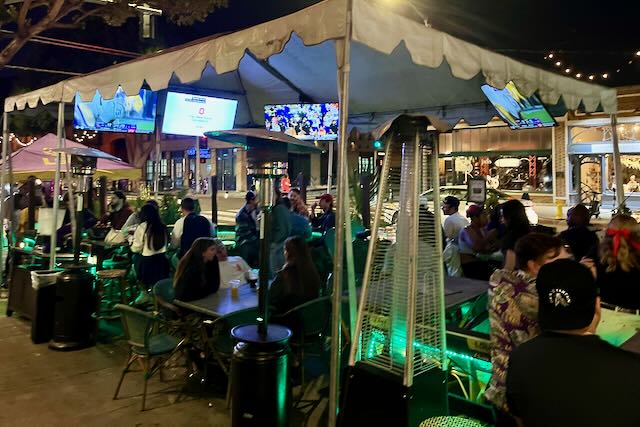
Young people on a recent night enjoying life on Main Street

As for the economy, sure, there are empty storefronts on the Promenade. Much of Santa Monica’s economy is based on hospitality and retail, sectors that the pandemic hit hard. Retail here and around the country is reeling from the disruption of e-commerce.

However, today Santa Monica is a magnet for hundreds of millions of dollars of investment. Look at all the cranes around town, with more on the way. Large apartment buildings, now permitted under state law, are planned or under construction. Google is bringing one of its first brick and mortar stores, and the first in the L.A. area, to the Promenade.

One of the first Google stores in the world coming to the corner of Broadway and the Promenade.

One of our major Ocean Avenue hotels has been undergoing a huge upgrade, and another, the Miramar, received its final approval for its complete upgrade Monday night at the Landmarks Commission.
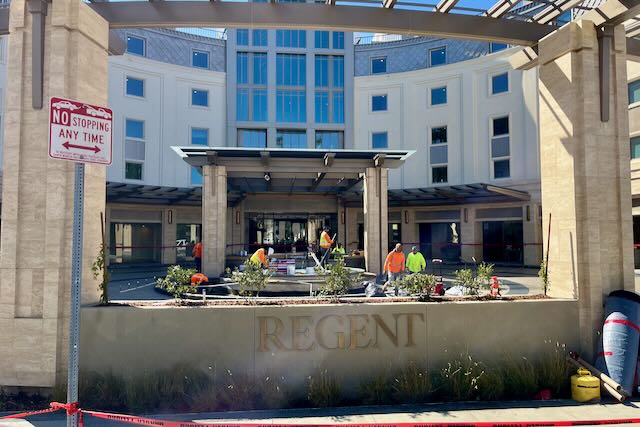
Workers putting finishing touches on the renovations at what will now be the Regent Hotel on Ocean Avenue.

Failed cities don’t attract investments like these.

And Cirque du Soleil is coming back to the beach.

Governmental competency. Switching over to an argument from the other side, the “United Slate” candidates charge that Brock and De la Torre, and their “Change Slate” colleague from 2020, Christine Parra, are not serious when it comes to governing; that they come to council meetings unprepared, not having read the staff reports, and waste everyone’s time in meetings that go on to the wee hours. Unfortunately, this is true. City Council meetings have become a mess. Instead of legislating, the Change Slate councilmembers like to grandstand, bringing to the vote hot button issues that the council has no power to act on, like distribution of clean needles. The obvious parallel is to the current Republican-controlled (meaning “controlled-chaos”) and unproductive House of Representatives.

The ”Deep State”/the “Establishment.” The MAGA universe uses the “Deep State” the same way it attacks journalism as “fake news.” There is a parallel in Santa Monica when the Change Slate candidates, now running under Safer Santa Monica, and their supporters like SMCLC refer to the United Slate candidates as the “Establishment.” This is consistent with decades of attacks on city staff from the anti-development side of Santa Monica politics. Experts are to be distrusted; only the wisdom of an imaginary consensus of “residents” counts (even if real residents consistently vote contrary to how the imaginary residents are supposed to vote).

I get it that since SMRR-endorsed candidates have usually had a majority on City Council for the past 45 years, and since during that time these majorities have molded City government to reflect a set of (liberal) values, that it is tempting to call SMRR and anyone it supports, or even other groups representing local institutions, like the School District, as the establishment. Sure, go ahead.

But using “establishment” as a political pejorative in 2024 in Santa Monica misses the point; doing so ignores who the candidates are. The candidates running this year with the endorsement of SMRR – Hall, Raskin, Snell and Zernitskaya – are insurgents within SMRR. They don’t consider themselves part of any establishment.

Other than Snell, who has served as an elected School Board and College official for years, the three other candidates are all a generation (or two?) younger than the leadership of SMRR. The four candidates could only get the SMRR endorsement after the collapse of the SMRR alliance with SMCLC and other anti-housing types, which effectively controlled the City Council for most years since the early 1990s. (The collapse was complete two years ago, when SMRR endorsed Jesse Zwick, Caroline Torosis, and Raskin.)

As younger Santa Monicans, the 2022 SMRR candidates and the candidates this year are running “post-development wars.” They take the need for more housing as a given, since they and their generational cohort need more housing options. They are in sync with the national zeitgeist on that, too: Kamala Harris has made building three million homes a major plank in her platform. These candidates represent a new generation of liberals, with high ideals about making Santa Monica work better for everyone.

I guess you know for whom I am voting: Hall, Raskin, Snell and Zernitskaya.

However, let me conclude on a less confrontational note. Sure, there is overheated rhetoric in this election – again, matching the national zeitgeist. But as Kamala Harris might say if she lived in Santa Monica rather than in Brentwood, we Santa Monicans have more in common with each other than we have differences. Santa Monica voters are going to vote overwhelmingly for Kamala Harris and Tim Walz. There is a lot of “narcissism of small differences” going around. As someone who has been involved for more than a decade in turning Santa Monica Airport into a great park, it is good to know that all the candidates running in the two slates support closing the airport and building the park. If you haven’t done so already, be sure to complete the current survey on the future of the airport land. It’s accessible here, and needs to be completed by Sunday the 20th. Be advised that the survey is a little complicated, but give yourself 15 or 20 minutes and you will be able to get through it.

Thanks for reading.


Better late than never

I have been attending the endorsement conventions of Santa Monicans for Renters Rights (SMRR) for decades. I joined the organization nearly 40 years ago. Even after I had resigned from SMRR when I was writing my column for the Lookout, I attended the conventions as a journalist. I rejoined SMRR when I quit the column to run for City Council. For all those years, until two years ago, it was frustrating. Starting in the late 80s the organization, which purportedly represented the interests of apartment renters, would include among its endorsements candidates who represented the anti-housing, anti-development, often anti-everything elements of Santa Monica politics. A purportedly progressive, renter-oriented organization promoted a homeowners’ association agenda and contributed to our chronic housing shortage.

Arguably, SMRR created the no-growth movement in Santa Monica politics. Certainly SMRR enabled it. Until 2020 no one supported by the anti-development faction in Santa Monica won election to the City Council without SMRR’s endorsement: Ken Genser, Kelly Olsen, Kevin McKeown, Richard Bloom, Mike Feinstein, Ted Winterer, Sue Himmelrich, all elected with SMRR support. Feinstein was defeated when he ran without SMRR’s endorsement 2004.

SMRR leadership contended it had to support candidates who represented anti-development groups like the Santa Monica Coalition for a Livable City (SMCLC) to enable SMRR’s more progressive candidates to win. There was no evidence for this. Progressive candidates Paul Rosenstein (1996), Pam O’Connor (2014), and Terry O’Day (2016), won election without the SMRR endorsement. Candidates who were more conservative but not categorically opposed to development, such as Bob Holbrook, Herb Katz, and Bobby Shriver, also regularly won. But again, no anti-development candidate won without the SMRR endorsement until the election of 2020. Not only that, but all anti-development initiatives no-growthers put on the ballot, starting with the 1994 challenge to the Civic Center Specific Plan, lost, and a rare pro-affordable housing measure won when it was on the ballot. The anti’s never created an effective political organization. Instead they relied on SMRR. (Yet they always claimed at public meetings that they alone represented “the people.”)

That brings us to 2020, that fraught year of the pandemic and the disturbances after the murder of George Floyd. In that election the “Change Slate” ran on a platform of restoring order to Santa Monica. Development was not the main issue for the Change Slate, but SMCLC and other anti’s endorsed the four Change Slate candidates. That SMCLC abandoned SMRR should not have been a surprise, as the anti’s had previously turned on council members whom they had initially supported but who had voted for any development: examples are Richard Bloom, Ted Winterer and even Kevin McKeown, the anti’s long-time hero. In the election, three of the Change Slate candidates (but not the most anti-growth candidate they ran) won and incumbents previously endorsed by SMRR lost. (You can read my detailed analysis of the 2020 election here.)

No need to go into it here in detail, but the Change Slate council members, including Oscar de la Torre whose entire political career was enabled by SMRR, have shown not only that they don’t care anything about the progressive elements of the SMRR agenda, but also that they don’t take governing seriously. Aside their habitual unpreparedness that results among other things in meetings that go into the wee hours, the best example of their lack of seriousness was how they ignored the need to get a certified Housing Element and thus enabled Builders’ Remedy projects.

The Change Slate council members don’t even pretend to reflect Santa Monica’s overall liberalism. Recently at a council meeting Council Member Christine Parra referred to Gleam Davis, Zwick and Torosis as the council’s “liberal minority.” By implication Parra must consider herself part of a conservative majority.

Losing to the Change Slate in 2020 may turn out to have been the best thing that could have happened to SMRR and, by extension, to liberal politics in Santa Monica. That and the inevitability of generational change. Because finally the leadership of SMRR realized that they got nothing from their decades of support of the no-growthers—nothing but ingratitude, that is. When the 2022 election came around, SMRR endorsed three true progressives, all young: Caroline Torosis, Jesse Zwick and Ellis Raskin. They all would have won, but for the fact that a fourth terrific young progressive, Natalya Zernitskaya, also ran and she and Raskin split the vote for the third seat that year.

At the SMRR convention on Saturday, everything came together. The SMRR leadership, still dominated by Baby Boomers, finally recognized the generational change happening in the city’s politics. By necessity, they also recognized the organizing abilities of the new generation. Starting last year the progressive and mostly young organizers, who have their own organization, Santa Monica Forward, put together a slate of four candidates for the four seats being voted on this year: Dan Hall, Barry Snell, and now running together, Raskin and Zernitskaya.

The four candidates worked hard to come into the SMRR convention with important endorsements for the whole slate, including an extraordinary endorsement from eight former mayors who themselves had often disagreed with each other over development and other issues.

The SMRR endorsees after the convention, L-R, Dan Hall, Barry Snell, Natalya Zernitskaya and Ellis Raskin

There was a fifth candidate, Rent Board Chair Ericka Lesley, whom SMRR Co-Chair Denny Zane had at one point promoted. Ahead of the convention, however, Zane and the rest of SMRR leadership had backed off in the face of the inevitable. The SMRR Steering Committee endorsed all five candidates but recommended that the top four vote-getters get the endorsements and the fifth wait until 2026. That was a de facto endorsement of the slate. When the votes were counted, all four members of the slate received at least 100 of the 117 votes cast. As SMRR Co-Chair Patricia said, as quoted in the Lookout, “It may have been the easiest convention ever.”

At this point it is not known who of the Change Slate council members will run for reelection. But based on the 2022 election results, the Hall/Snell/Raskin/Zernitskaya slate have a good chance of taking three or even all four of the seats. The liberals only need to win two seats to regain a majority.

Thanks for reading.

Progression to the mean: Santa Monica voters renew their liberal vows

There may be more votes counted next week, but the results of the Santa Monica elections are clear. What is most clear is that the reactionary turn in 2020 is old news, an artifact of the unique events and despair of that year. The city’s liberal majority has reconstituted itself. I say, “reconstituted itself” and not “returned” because there were notable developments in the liberal vote.

For one thing, the election showed that liberals don’t need alliances with no-growthers to win.

There were four candidates running for Santa Monica City Council who represented traditional, jobs-housing-education-environmental liberalism – Caroline Torosis, Jesse Zwick, Natalya Zernitskaya, and Ellis Raskin. Unfortunately, as I wrote in a previous post, they were competing for only three seats. Collectively the four liberals dominated the vote, but the split vote meant that they won only two of the three.

Two candidates, appointed incumbent Lana Negrete and Residocracy founder Armen Melkonians, were the candidates associated with the “Change Slate.” Three Change Slate candidates won in 2020 running against Santa Monica’s traditional liberal consensus, shocking everyone.

I am not, by lumping Negrete together with Melkonians and the Change Slate, expressing any opinion whether and to what extent Negrete herself identifies with the Change Slate or will vote along with them as a council member. Negrete received endorsements in the election from various organizations (such as Community for Excellent Public Schools) and local political notables who have over the years been on the liberal side. Negrete presents herself as an independent; I doubt if anyone knows how she will vote on the dais. (Perhaps it is significant that she doesn’t list no-growth organizational endorsements on her endorsements page.) However, independent expenditure (I/E) groups more than the candidates created the landscape on which the 2022 election took place. Liberal groups supported Torosis, Zwick, Zernitskaya and Raskin. Grievance-based, reactionary, and no-growth groups and I/E campaigns, such as Santa Monicans for Residents Rights (note the deceptive use of “SMRR”), Santa Monicans for Change, and the Santa Monica Coalition for a Livable City (SMCLC), as well as the no-growth SMa.r.t. group of columnists and Daily Press columnist Charles Andrews, all endorsed Negrete along with Melkonians. They created a de facto slate of the two of them. That’s how the election was fought—those two versus the four liberals. We all got the mailers.

Let’s look at the votes. In the City Council election, Torosis and Zwick, who were endorsed by all the main liberal organizations (Santa Monicans for Renters Rights (SMRR), the Santa Monica Democratic Club, Santa Monica Forward, and UNITE Here Local 11) dominated. By the most recent count (all the vote numbers here are from the totals posted on the County website as of Nov. 25), Torosis has received 17,709 votes and Zwick 16,117. Their totals far surpass the third winner, Negrete, who has only 11,627. Not far behind Negrete is Zernitskaya with 10,667. The top six are rounded out by Melkonians with 10,190 votes and Raskin just behind him with 10,181. None of the other six candidates have received much more than 4,000 votes.

Top vote getters in the City Council election as of Nov. 25

Based on vote totals for the ballot measures, it seems that about 37,000 Santa Monicans voted in the municipal election. That means that Torosis and Zwick each received close to 50% of the vote. Historically that is a good showing. In contrast, Negrete received only about 31% of the vote and Melkonians 28%.

NOTE WELL: The next time you hear someone say or read some column or letter to the editor or Facebook post saying that Residocracy or SMCLC or other NIMBYs represent the people of Santa Monica, remember that Melkonians, with probably at least $100,000 of independent expenditure backing, only got 28% of the vote.

Negrete and Melkonians also had the advantage that their supporters could bullet vote for only the two of them or give their third vote to candidates who had no chance of winning. The four liberals split the vote, but the average vote of the four of them was significantly more than the average vote for Negrete and Melkonians: 13,669 versus 11,147. (Remember also that Negrete had some liberal support, particularly from the education community.) If only three liberals had run they would have won all three seats. (I.e., if the votes of any one of the four had been divided among the other three, all of those three would have won election.)

There was the same result in the School Board election. The three establishment liberal candidates, Laurie Lieberman, Richard Tahvildaran-Jesswein, and Alicia Mignano, all won easily against a grievance slate. Once again, the voters approved an education bond, this time for Santa Monica College.

The main takeaway is the return of the liberals, but what other conclusions can we draw from the vote?

The 2022 vote showed that liberals don’t need NIMBY votes to win elections in Santa Monica. This is contrary to what the leadership of Santa Monicans for Renters Rights (SMRR) has been saying for 40 years. While the positions of the four liberal candidates on housing and development vary somewhat, none of them are what I used to call “Santa Monicans Fearful of Change.” Therefore, it is not surprising that none of the candidates endorsed by SMRR, UNITE Here Local 11, and the Santa Monica Democratic Club (whose endorsements collectively cover all four liberal candidates) also received endorsements from the anti-housing, anti-development element of local politics.

Forgive me a personal note, but I feel vindicated by this. Ever since I have been active in Santa Monica politics, I have been saying two things: that the liberals didn’t need the NIMBYs, and that the NIMBYs had no loyalty to the liberals.

The latter point was easy to prove. As soon as a council member previously supported by the NIMBYs voted for more housing development, the NIMBYs would turn on him or her, something experienced over the years by many council members, including Richard Bloom, Kevin McKeown, Ted Winterer, and most recently Sue Himmelrich.

I couldn’t prove the first point, however, that the liberals didn’t need the NIMBYs, because there were no examples. SMRR always endorsed one or two candidates who also had support from the no growth side. In fact, SMRR’s support for those candidates, which got them elected, was the only reason the no-growth side has had so much power over the decades. SMRR enabled its most virulent haters. Cracks in this façade should have been evident when pro-houser Gleam Davis was the only SMRR endorsed candidate to win reelection in 2020, but it was not until this year’s election that a group of liberals ran against the NIMBY’s active opposition.

The second takeaway from this election is that Santa Monicans love the Democratic Party. Of the four liberals, the two who won, Torosis and Zwick, were the only two endorsed by both SMRR and the Santa Monica Democratic Club. As for Zernitskaya and Raskin, what was the most obvious reason that Zernitskaya did better? Zernitskaya was endorsed by the Democratic Club and not SMRR, and Raskin was endorsed by SMRR and not the Democratic Club. Historically SMRR and the Dem Club have been in sync, with the Club following SMRR’s lead, but this year they diverged, and the Dem Club endorsed Zernitskaya. Turns out that in in Santa Monica in 2022, mirroring the national mood, party loyalty was crucial.

This was borne out also by how every candidate, and/or the I/E campaigns supporting them, wanted to show what good Democrats they were. Resulting in some hilarious mailers, but no need to go into that.

Thanks for reading.

Moving goal posts and new players: the plight of anti-development politicians

After last night’s City Council meeting Councilmember Sue Himmelrich might understandably have a “no good deed goes unpunished” feeling. You see, Himmelrich proposed that council direct staff to prepare a ballot measure for November that would be an alternative to Residocracy’s LUVE initiative. Himmelrich, whom Residocracy endorsed when she ran for council in 2014, proposed a measure that would give voters the right to approve large projects, but one that would not be as draconian as LUVE and therefore (presumably) have a better chance of passing. Residocracy, however, slammed her and her proposal even before the meeting began.

On Monday, on Residocracy’s Facebook page, Residocracy’s Tricia Crane derided Himmelrich’s proposal, calling it “an attempt to confuse voters,” and one that showed the “desperation” of councilmembers (presumably Himmelrich) “to retain power and defeat the LUVE initiative.” Ouch. (Later Crane, I suppose to make sure her sentiments were not limited to Facebook users, forwarded the Facebook exchange to her neighborhood group, Northeast Neighbors—that email must have gone viral, because even I received it.)

Crane was right about the potential confusion. (If not about Himmelrich’s motivations, which seem sincere.) As pointed out last night by, of all people, Residocracy-nemesis Councilmember Terry O’Day, having two similar measures on the ballot would create confusion. If the anti-development vote were split, probably both would lose. The cynical thing would have been if the councilmembers opposed by Residocracy had supported Himmelrich’s motion. (Neither they nor any other councilmembers did, and the motion died without a second.)

As for Crane’s attack on Himmelrich, the first-term councilmember is not the first anti-development politician to engage the wrath of anti-development constituents feeling scorned. Even Councilmember Kevin McKeown, over many years the most consistent anti-development voice in Santa Monica politics, is now enduring nasty attacks because of his opposition to LUVE.

There’s a pattern. History repeats. (Not sure just when the attacks might have been tragic, but certainly, with the attacks on McKeown and Himmelrich, we’ve now reached farce.) For reasons that I’ll get into below, at some point anti-development politicians and their anti-development constituents tend to part ways. Consider what happened the first time Santa Monica elected a City Council majority consisting of members who had all been elected with anti-development support.

That was in 1999, when after a special election Richard Bloom joined councilmembers McKeown, Michael Feinstein, and the late Ken Genser, all of whom had been elected with anti-development support. In short order the four proceeded to replace the entire Planning Commission with anti-development activists drawn from neighborhood associations. Long-term planning in the City came to a stop, as the new commissioners, led by former councilmember Kelly Olsen, browbeat planning staff, whom they accused of being in the pocket of developers.

But the anti-development majority began to fall apart in 2001 when Genser, Santa Monica’s original anti-development councilmember, voted in favor of Target; the other three were opposed. Then in 2003 Feinstein infuriated the anti-development side by voting against reappointing Olsen to the Planning Commission. Not entirely coincidentally, Feinstein lost his bid for reelection in 2004.

As for Bloom (today, of course, Assembly Member Bloom), his views evolved as he became more involved with social and environmental issues. Although Bloom’s original political base was among anti-development homeowners in Sunset Park, by 2005 or so he had become a strong supporter of housing and economic development. By 2008, both Bloom and Genser opposed the RIFT initiative, and were on the outs with their original anti-development supporters.

So why do anti-development councilmembers and their constituents become estranged? The anti-development side will tell you it’s because all politicians are corrupt and ultimately get bought off by developers, but empirically that’s not true. The real reasons are more complex.

Briefly put, when it comes to the goals of the anti-development side, as soon as one goal is achieved, a new, more extreme goal is created. In Santa Monica, where everyone involved in politics wants to regulate development to some extent (we’re all Democrats, right?), this means that a politician elected on a platform advocating one level of regulation soon finds, after voting for regulating development at that level, that some aggrieved constituents want him or her now to adopt higher levels of regulation, levels that the politician might not be comfortable with, whether because he or she is aware of legal restrictions or simply because he or she doesn’t want to go that far in preventing change.

Consider what’s going on now. In 2004 City Council began the LUCE process, and responded to anti-development sentiment (i) by pushing nearly all new development into commercial and industrial districts comprising a small fraction of the City’s land area (a good idea) and (ii) by making nearly all significant development discretionary (not such a good idea). In 2010 the LUCE was finally adopted—with the support of the anti-development community.

But when, a few years later, City staff was drafting the new zoning ordinance, suddenly there was a new target: the largest projects allowed under LUCE, discretionary projects called “Tier 3.” Last year when the zoning ordinance finally came to a vote, the new anti-development majority (McKeown, Himmelrich, Tony Vazquez and Ted Winterer) voted to eliminate nearly all Tier 3 projects.

McKeown, Himmelrich, Vazquez and Winterer retained, however, LUCE’s Tier 2, the zoning standard that allows the continued building of the kind of housing (apartments over ground floor retail) that has been the standard in Santa Monica since the ’90s. Moreover, the four have voted several times to approve more of these apartments. These votes have infuriated the extreme anti-development element represented by Residocracy, i.e., those Santa Monicans who insist that new apartments are incompatible with the character of a city that is 70% renter. Which is why Residocracy has now brought forward LUVE, which would for all practical purposes eliminate Tier 2.

So there you have it, anti-development mission creep: limit development to commercial areas and make nearly all of it discretionary; eliminate Tier 3; eliminate Tier 2. If you don’t follow us every step, you’re a paid stooge for developers.

There’s another factor, too: the constant entry of new people into the political process from the anti-development side, people who don’t necessarily have knowledge of the anti-development battles that preceded their involvement. Ten years ago, after more than 25 years of anti-development politics (and policies, many good, to control growth), the new group in town was the Santa Monica Coalition for a Livable City. SMCLC, acting as if no one had ever noticed traffic before, came up with the RIFT initiative in 2008, but SMCLC now takes a backseat as Residocracy drives the agenda. It’s telling that the three key leaders of Residocracy—spec mansion developer Armen Melkonians, North of Montana realtor Kate Bransfeld, and Tricia Crane, who formerly directed her activism to the School District’s special education programs—did not participate in any significant way in local development politics until three or four years ago.

It’s this combination of shifting goal posts and new players, not developer money, that causes the inevitable disconnect between anti-development politicians and their original anti-development base.

Thanks for reading.

Riel Politics, Part 3: Going beyond the record?

In the wee hours last Wednesday, after a long City Council meeting dealing mostly with the crucial issue of the minimum wage, the council spent more than an hour agreeing to hire independent counsel to review the firing of Elizabeth Riel. This is well and good, as the episode was a costly fiasco, and one hopes the independent counsel will identify lessons to be learned to avoid such calamities in the future. (The counsel will also make recommendations about how to enforce the Oaks Initiative, the law that restricts what relationships city officials may have with persons or entities that they bestow benefits on.)

The independent counsel’s review will take place concurrently with a review by the L.A. County District Attorney’s office to see if any criminal laws were broken. According to City Attorney Marsha Moutrie violations of the City Charter are misdemeanors, and if the D.A. determines that there is evidence that then-Mayor Pam O’Connor violated the charter by directing then-City Manager Rod Gould to fire Riel, O’Connor could face a criminal charge.

While these reviews and investigations might have occurred anyway (and at least the City review should have), they stem directly from charges that the Santa Monica Coalition for a Livable City (SMCLC) started making in July after the City settled with Riel for $710,000. Give SMCLC credit, they were the first to obtain the relevant documents through a document request to the City, and for a while they were the only outside parties with the documents. In August, not long after receiving the documents, SMCLC announced its conclusion that O’Connor had “relentlessly pressured” Gould to fire Riel.

By the time the City Council voted last week to authorize the outside review, more people had had the opportunity to review the evidence, however, and SMCLC started hedging. (For my review of the evidence, see Riel Politics, Part 1.) For instance, the Lookout quoted Diana Gordon of SMCLC as saying the outside review would have to “go beyond the record in the Riel lawsuit,” because it (the record) “was developed for a different purpose.” I.e., SMCLC was admitting that the record unearthed so far did not show that O’Connor had told Gould to fire Riel.

Similarly, last week when SMCLC presented the council with a list of nine questions that the group wanted the independent counsel to review, only one of the questions directly concerned O’Connor. The phrasing of that question, which included another caveat about the criminal investigation (“Did Mayor Pam O’Connor improperly intervene in and attempt to influence the City Manager’s decision to fire Elizabeth Riel? (This differs from the criminal matter concerning whether she violated [City Charter] Section 610 beyond a reasonable doubt.)”) is further indication that SMCLC has doubts that the evidence will show a violation of the charter.

But it turns out O’Connor is just an appetizer. The other eight questions (in fact, counting sub-questions, there are at least 14 other questions) concern the conduct of staff—not only Gould, but also “senior staff whom Mr. Gould sought advice from” and City Attorney Moutrie. These questions extend to, among other things, the process used for the hiring of Riel’s replacement, the quality of Moutrie’s legal advice to Gould, and highly speculative questions like whether the matter could have been settled sooner. (For that last question, does the SMCLC intend that Riel and her lawyers be put under oath to tell the independent counsel what they would have settled for and when?)

If words like “fishing expedition” or “Benghazi” are coming to mind, there’s an irony to that. Riel’s association with SMCLC, which ultimately sank her employment by the City, began in 2006 when the then newly-formed SMCLC launched a fishing expedition against City staff. This was in connection with the plans of Macerich to re-do Santa Monica Place with three tall buildings. The plans never had a chance to be approved (for various reasons, including that the City would have had to spend too much money on new parking), but SMCLC feared the worst and assumed that the plans could not have been developed without improper connivance between the developer and City staff.

SMCLC made a big deal about suing the City to get copies of emails and other documents. The city ultimately not only produced the documents but also had to pay the group’s $36,000 in legal fees. After all that, however, SMCLC never released any documents showing the malfeasance they assumed had been committed. Apparently there were none.

As I’ve written before, SMCLC has been all about power. Its well-heeled and sophisticated leadership condescends to the political process in Santa Monica and acts as if everyone involved (or nearly everyone—they do have their favorites) must be incompetent and/or corrupt. The group has always had a special animus against O’Connor, who culturally—she’s the daughter of a Chicago cop, and doesn’t hide it—must epitomize everything that the SMCLC’s fastidious and pious leadership doesn’t like about government.

O’Connor, who has no money of her own, hasn’t helped herself by having to finance her campaigns with contributions from business interests, including developers. She doesn’t suffer fools too well, either. All this has made her prone to attack, but for 20 years O’Connor has been one of the most respected political leaders in Southern California, serving on and often chairing numerous powerful regional boards that you can’t get elected to unless you have the respect of officeholders from other cities. It’s ludicrous that she gets picked on by a group of self-appointed watchdogs like SMCLC.

Having said that, the City didn’t have the right to fire Elizabeth Riel, and I’ll discuss why not in the next installment of Riel Politics.

Thanks for reading.


“Are we there yet?”

With the Santa Monica City Council’s action last week approving the new zoning ordinance, leaving only a pro forma second reading to finalize the new law, it looked like eleven long years of planning would soon come to an end. The light at the end of the tunnel was finally more glare than glimmer.

Slow down. We’re not there yet. Just when you think it might be safe for Santa Monica government to spend more time and resources on something other than responding irrationally to bad traffic, the anti-development group Residocracy is contemplating, dare I say threatening, a referendum on the zoning ordinance.

That glare that looked sunny turns out to be oncoming headlights.

According to a Lookout article headlined “Santa Monica Slow-Growth Groups look to Public Vote on Development Issues,” Residocracy is polling its members on whether they want to take to the street to gather signatures to overturn the new zoning law, and the group’s founder Armen Melkonians expects they will say yes. (Who’s going to say no?)

Melkonians told the Lookout that the new zoning, though approved by the council’s anti-development majority, “‘still creates density.’” “‘Are we going to grow Santa Monica,’” he asked, “‘so it doubles its population?’”

Well, the answer to that question is no, or at least not until a few generations or even centuries have passed. I mean, even if Santa Monica adds all of the 4,955 housing units predicted under the LUCE by 2030, that’s only about a 10 percent increase in the city’s stock of housing units. That’s unlikely even to result in a 10 percent increase in population, however, because for decades the average number of people living in each housing unit in Santa Monica has been in decline.

Even if—as Melkonians fears—Santa Monica should add more than 4,955 units, say, twice that many, by 2030, a 20 percent increase, and even if each percentage point increase in units translated into a percentage point increase in population, well, can someone do the math? How long would it take to double the number of housing units if there was a 20 percent increase every 20 years?

In any case a while, but any significant population increase is unlikely. To give some perspective, Santa Monica’s population in 1970 was 88,289. In 2010, after decades of purported “massive overdevelopment,” it was 89,736. (I know that estimates since the 2010 census have added a few thousand more residents, but the history of those population estimates is that they get debunked when the decennial census comes around. The estimates focus on the number of housing units, but historically haven’t take into account how many young Santa Monicans leave town each year rarely to return.)

Okay, I get it—surely Melkonians was being rhetorical. But that’s what happens when you start asking people to sign petitions. If the first casualty of war is truth, then the first casualty of a local referendum campaign must be any sense of reality.

Residocracy isn’t the only group talking about going to the voters. The Santa Monica Coalition for a Livable City (SMCLC), Santa Monica’s more establishment, less populist, anti-development group, is considering a Version 2.0 of the “Residents’ Initiative to Fight Traffic (RIFT), their unsuccessful 2008 initiative. SMCLC wants to give voters a veto over “large projects.”

Based on an open letter to supporters that SMCLC leadership published last week, it does not appear, however, that SMCLC wants to join in an effort to overturn the zoning ordinance. For now at least, based on the letter it appears that SMCLC leadership is celebrating the new law, and especially the reductions in the scope of the LUCE, as the product of the anti-development majority SMCLC helped elect last November.

This makes sense, since the SMCLC leadership has long ties to councilmembers Kevin McKeown and Ted Winterer and they view the new zoning law as an achievement.

But indications are that SMCLC wants to bring back a new version of RIFT. SMCLC has never trusted the City Council or planning staff, and according to the letter to supporters, “large projects must be subject to a resident vote.” SMCLC’s co-chair of SMCLC, Diana Gordon, told the Lookout that the group would support a measure like RIFT. SMCLC touted the fact that RIFT garnered more than 18,000 votes in 2008. (The problem for SMCLC was that nearly 51,000 Santa Monicans voted that year.)

Of course, as Melkonians acknowledged to the Lookout, the point of having votes on developments is to scare developers away. While according to him, “only the best projects would go through,” the opposite is true. Developers and landowners will build to the lowest common denominator, slicing and dicing their projects to slip under whatever the voter-approval threshold is. It’s strange to hear a group like SMCLC, which I believe honestly wants better projects to be built, promote voter control as a way to get them.

SMCLC blames RIFT’s loss in 2008 on, as Gordon told the Lookout, its being “‘outspent in a deceptive opposition campaign.’” “Deceptive” is in the eye of the beholder, but the last several elections, notably the votes in 2014 on Measures D and LC, if anything show that money doesn’t mean much in Santa Monica elections. Beyond the merits of any thing or person on the ballot, endorsements are what count. In 2008 most of the well-respected elected officials in and around Santa Monica opposed RIFT, and SMRR was neutral.

Promoters of new anti-development referendums, whether to overturn the zoning law or to make developments subject to popular vote, would no doubt base their campaigns on their conviction that the views of voters have changed.

We’d find out.

Thanks for reading.

Housing the next generation: whose side are you on?

Let’s see, a few days ago I was complaining about how the leadership of Santa Monicans for Renters Rights (SMRR) is, by allying SMRR with anti-development groups like Residocracy and the Santa Monica Coalition for a Livable City, turning the organization into something closer to a typical homeowner protection association than a cutting edge progressive organization. In that connection there was something else that struck me when, as reported in the Lookout, SMRR Co-Chair Patricia Hoffman told the Santa Monica Democratic Club that “‘[w]e have a lot more work to do . . . . If we can work together and spend the next few years selecting candidates, that, I think, can make our City Council even better.’”

Note that Co-Chair Hoffman says selecting candidates. Not electing them, but selecting them. It reminded me of the (in)famous Boss Tweed line, “I don’t care who does the electing, as long as I get to do the nominating.” Well, the people who got to do the nominating in the 2014 election were Hoffman and a handful of her co-generationalists on the Steering Committee.

So what did Hoffman mean? Make the council “even better” by replacing progressives like Terry O’Day and Gleam Davis with candidates, like Susan Himmelrich, co-endorsed by anti-development groups? The Steering Committee’s endorsement of Himmelrich meant that for the first time SMRR endorsed a slate of candidates who were all running on anti-development platforms.

Maybe I shouldn’t be surprised that Hoffman and her colleagues have allied SMRR with anti-development organizations. They were all on the barricades in the ’60s, but we all get older. Should we expect them to care about housing or jobs for anyone who has the misfortune of being young in an era when government cares much more about the old? (From all of this calumny I exclude one Steering Committee member, former mayor Judy Abdo, who still believes in the future and stays forever young in part by living with a rotating cast of under-30 housemates. It probably doesn’t hurt that she spent a career in early childhood development.)

Let’s be clear: to be anti-development today in Santa Monica (assuming you’re not delusional) is to be anti-housing because hardly anything new but housing, and only a modicum of that, has been built in Santa Monica for 20 years, and nearly all the developments in the planning pipeline are residential (and not in existing neighborhoods). For two decades there’s been little commercial development, and a lot of what there has been is ground-floor retail in apartment projects. The idea that Santa Monica has seen a lot of recent development is, as Mayor Kevin McKeown himself has recently written, rhetoric. The facts, as McKeown has been reminding people, show a city that for more than two decades has controlled development quite effectively. (Which means, by the way, that if you believe traffic has got worse and you want to do something about it, you’d better look elsewhere than controlling development, because that doesn’t work.)

This isn’t about affordable housing. The Steering Committee members are for affordable housing, I know that. Hoffman herself is a long time board member of Community Corporation of Santa Monica, and they all supported H and HH. There are, however, people in Santa Monica who advocate for increased affordable housing requirements only to thwart the building of market-rate housing (which ultimately means less affordable housing, too). This is not a unique phenomenon: there are also people, many of the same people in fact, who support living wages for hotel workers only to thwart hotel development, and people who support historic preservation only to thwart the building of anything new.

SMRR is allying itself with people who are never in favor of building housing. It’s remarkable how eclectic they can be. Equally bad are single units for young tech workers and SMC students, spacious condominiums that hotels want to build for rich people, or family apartments that CCSM wants to build for poor people; biggish projects like 500 Broadway or small projects like 802 Ashland; or any other kind of housing you can think of. For the anti-housers, it’s not that the perfect is the enemy of the good, but that when it comes to building something for people to live in, whatever it is is never good enough.

The regional housing crisis, the worst in decades, one that includes skyrocketing rents in Santa Monica that put pressure on tenants in rent-controlled apartments, is only partially a crisis about affordability. Fundamentally it’s a crisis of supply at all price levels. The huge Millennial generation coming up doesn’t primarily need affordable housing—they need alternatives to moving to the Inland Empire.

Another commendable thing that Mayor McKeown has been doing for a while is to remind people that we need to provide housing for those who graduate each year from Samohi if we expect any of them to live here. But not many of those graduates will qualify for affordable housing, in part because they are graduating from a good school, with the vast majority of them going on to college, and because there are so many good jobs in Santa Monica that they can come back to. It is, by the way, good news that they won’t qualify for affordable housing, but it means that we’re going to have to rely on the market, i.e., developers, to build homes for them and their future families. And those homes won’t be single-family, detached houses, because there’s no land for that.

So—whose side will SMRR be on?

Thanks for reading.

Following some money

The headline in the Lookout for the article about the final financial reports for the 2014 City Council election was “Himmelrich Spent $160,000 of Her Own Money to Win Santa Monica Council Seat,” but even though $160,000 was a record for self-financing a City Council campaign here, I was less interested in how much money Susan Himmelrich spent to win election and more interested in how she spent some of it.

What the article did not report was that Himmelrich paid nearly $30,000 to Dennis Zane and to PZ Associates, an entity that Zane formed. Here’s the breakdown: Himmelrich paid Zane $15,000 for political consulting, plus $4,475 for office expenses, including one flat $3,000 payment. She paid PZ $9,255 partly for consulting services and partly in a category called “campaign paraphernalia/misc.” (PZ is known for running door-to-door campaigns.)

These payments are not out of line for these kinds of services. Why am I focusing on them? For one reason: the payments were breaches of Zane’s fiduciary duty to Santa Monicans for Renters’ Rights (SMRR). As a member of the SMRR Steering Committee, Zane was guilty of self-dealing, by taking money from a candidate seeking the SMRR endorsement. Self-dealing cannot be made good by disclosure or recusal (not that Zane in fact recused himself).

The SMRR endorsement is crucial to getting elected, especially for anti-development candidates, as no candidate for City Council running on an anti-development platform has ever been elected without the SMRR endorsement. As a follow up to my post in January where I wrote about how Himmelrich finally got the endorsement from the Steering Committee (in a deal where Himmelrich got the committee votes she needed in return for her supporters voting to endorse Andrew Walzer for College Board), I can report that I received a message from Walzer the next day defending the “trade off in voting for [him] and Sue.” Apparently, according to Walzer, it was “complicated,” which naturally made me feel better about it. But in case you had doubts, it did happen.

I’m not the only one still taking a look back at the election, although not everyone has the same motivations. The Santa Monica Democratic Club (SMDC) had a panel discussion last week about it. I didn’t go, but according to the Lookout, the gist of the meeting was that the election of the anti-development Himmelrich had, in the words of SMRR Co-Chair Patricia Hoffman, “‘flipped the balance of power on the City Council.’”

Apparently, though, the struggle continues. Hoffman went on to say that “‘[w]e have a lot more work to do . . . . If we can work together and spend the next few years selecting candidates, that, I think, can make our City Council even better.’”

“Even better.” Given that all seven city council members were elected at least initially with the SMRR endorsement, I guess Hoffman is saying that the old SMRR, the one that based its progressive politics on issues beyond blocking development, is history. And I expect that if the Steering Committee, given its demographics, continues to make the endorsements, the old SMRR will be history.

That’s right, let’s throw out all those bums we supported before who care about housing for all, including the middle-class, and good union jobs and city and social services and childcare and public transportation, etc. You know the ones who understand that Santa Monica is not an island. They’re not sufficiently deferential to our new friends in the Santa Monica Coalition for a Livable City and Residocracy.

* * *

Given the record-breaking $160,000 Himmelrich spent on her campaign, one might wonder why her husband, Housing Commissioner Michael Soloff, had to make campaign contributions, each of $10,000, to SMRR and the SMDC. Why didn’t Himmelrich make the contributions herself? The reason is based on campaign finance law: SMRR and SMDC were running independent campaigns on Himmelrich’s behalf, and because there is a contribution limit for City Council races, the campaigns could not coordinate with Himmelrich. Otherwise, contributions an individual or company might make to SMRR and the SMDC could be counted against the contributor’s limit. Giving money to an independent campaign is a form of coordination, and so Himmelrich couldn’t write the checks. Both she and Soloff are attorneys, and so one expects that they did legal research (but separately, not coordinated!) to satisfy themselves that it’s not coordination if the money comes from a spouse. But let’s face it—even if it’s legal, it’s a dodge. I wonder if the Santa Monica Transparency Project will investigate?

There’s another aspect to this. The old SMRR prided itself on a policy of rarely accepting individual contributions that were more than the limit for council races, which is now $325. The new SMRR not only accepted Soloff’s $10,000, but also $10,000 from the Huntley Hotel, the primary bankroller of anti-development campaigns in the city. Back in July, before the SMRR convention where she’d be seeking the SMRR endorsement, Himmelrich herself gave $1,000. There is no law limiting the amount of contributions to SMRR, and the limit was voluntary, but the limit was once a point of pride. So much for that.

* * *

One footnote: the Lookout piece I quote from above about campaign expenditures got the numbers for my campaign wrong. The article said that I contributed $20,000 and my total campaign expenditure was $75,000, but those numbers are incomplete. The reason the reporter was mistaken is that my campaign accountant had us wrap up our finances in 2015, and the final numbers are in a statement for the period Jan. 1-5 that we filed a few weeks ago. The complete numbers are that I contributed $36,920.90 to my campaign and the total expenditure was $96,128.90. I understand the Lookout will be running a correction, but I wanted the record to be correct.

Thanks for reading.


More on the City Council election: why two attack campaigns failed

After my posts last week, I don’t have too much more to say about the City Council election, but I do want to write about at the least one thing: the failure of attack advertising.

But first—there’s nothing wrong with negative campaigning. Candidates want to let voters know that their ideas, values and, yes, their characters are better than the ideas, etc., of their opponents. To do that it’s okay for candidates to say why they believe that the ideas, etc., of their opponents are not-so-good.

Negative campaigning can be untruthful or unfair, but that goes for positive campaigning, too. Civility is good, sure, but exaggeration is part of politics, and it would be a danger to democracy to elevate civility over robust debate. My purpose in this post is not to moralize about negative campaigning, but to analyze the effectiveness of attack campaigns in Santa Monica.

There were two significant attack campaigns in the November City Council election, both run by independent campaigns. (By campaigns I mean mail or phone campaigns, not just criticisms that candidates might make of each other at forums, etc.) The first, chronologically, was the campaign by the Santa Monica Coalition for a Livable City (SMCLC) against Pam O’Connor. The second was by the Miramar Hotel against Sue Himmelrich.

At my house we received five mailers from SMCLC and only one was positive about the three candidates (Kevin McKeown, Richard McKinnon and Himmelrich) that SMCLC supported. The other four were hits on O’Connor.

SMCLC’s hits on O’Connor were hard. The mailers had headlines like “Pam O’Connor has NEVER voted against a large development in 20 years on City Council,” “Pam O’Connor is funded by Developers,” “Pam O’Connor rewarded a developer with millions for destroying our homes” (words attributed to elderly and disabled residents of the Village Trailer Park), “O’Connor approved Expo line at street level in Santa Monica, which will worsen our already terrible traffic,” or “700 new pack-and-stack apartment units – APPROVED.”

When I received the mailers I thought they would be effective. They pushed a lot of buttons. As it happened, however, although we’ll never know if SMCLC’s attacks had marginal impact, they didn’t stop O’Connor from winning reelection. I have two theories why.

One is that the attacks were over-the-top. The mailers ranged from misleading to scurrilous to nutty. Blame O’Connor for “pack-and-stack” apartments? Putting aside that unflattering description, nearly all apartments built in Santa Monica for 20 years fall under zoning that was passed 20 years ago (I’m not even sure O’Connor was yet on the council) to satisfy a court judgment against the City requiring it to allow housing to be built; in response City Council enacted an ordinance that encouraged housing development in downtown instead of neighborhoods, and where it could replace traffic-generating commercial development. Blame O’Connor for Expo at ground level? That was a decision that the council made to avoid having a giant viaduct over downtown and a station at Fourth and Colorado 35 feet in the air. O’Connor takes money from developers? Attacks on a candidate’s campaign funding are rarely successful—voters know money is part of politics. O’Connor is personally responsible for evicting tenants from the Village Trailer Park? That’s where the campaign finally jumped the shark.

I doubt that SMCLC is looking for advice from me, but the attacks might have had more credibility if SMCLC had focused on one or two particular votes that they didn’t like. It’s better to pound on one point rather than take a scattershot approach; by the time I received the fourth mailer, the campaign looked kooky. Which leads to my second theory why the attacks didn’t work, namely that O’Connor did the smart thing: she ignored them.

Ignoring an attack would likewise have been a good policy for the Miramar Hotel, which overreacted to a brilliant piece of campaign mail that Himmelrich’s campaign sent out in late October. This was her four-page “Miramar ’Zilla” piece that attacked the Miramar’s plans for redevelopment, a mailer that put Himmelrich in the forefront of a crowded field of candidates running on anti-development platforms.

The Miramar responded with a massive counterattack in the last week of the campaign, accusing Himmelrich and her husband of multiple campaign indiscretions and various hypocrisies. If you’ve read my posts last week, you know that I don’t believe that everything Himmelrich did (or had done for her) to win the election was “transparent,” but like SMCLC’s charges about developer contributions to O’Connor’s campaign, these are the kinds of attacks that voters tune out. The Miramar people may have been righteously angry about the ’Zilla attack, but in retrospect the mailer warranted an indignant press release, not Armageddon.

In response to the attacks, Himmelrich did the exact opposite of O’Connor—she counterattacked in force, mostly with robo-calls from people defending her. In her case, however, a vehement response made sense. While there was some risk of amplifying the Miramar’s charges, Himmelrich by counterattacking was able to reiterate and reinforce her original attack on the Miramar’s project. By depicting herself as a victim of corporate attacks she further strengthened her anti-development credentials.

So what’s the takeaway? Probably not much. In hindsight, O’Connor with her long history in the community and Himmelrich with her SMRR endorsement seem destined to win. But Santa Monicans who like their politics to be civil can take satisfaction in the fact that two virulently negative independent campaigns didn’t work.

Thanks for reading.


Popularity Contest; and the Winner is . . .

For more than 30 years Santa Monicans for Renters Rights (SMRR) has been the dominant political organization in Santa Monica. I’d argue that now it’s more popular than ever.

Why do I say this at a time when residents are supposed to be so angry? Start with the last election, when SMRR candidates ran the table and for the first time won every race for City Council, the School Board, the College Board and the Rent Board. SMRR has by far the most powerful brand in Santa Monica politics. The power of that brand is based on performance: residents know that Santa Monica, notwithstanding the issues we have, is among the best-governed cities in the region, one that provides excellent services.

When it comes to the development issue, which these days generates the most headlines, Santa Monica, among the cities in the region that have historically been employment centers, is the one that has best managed development. Notably, when nearly every other Southern California city subsidizes development, Santa Monica requires that developers subsidize city services and capital investments. This has been the case ever since SMRR took charge in 1981 — when, in the words of William Fulton, Santa Monica was the first Southern California city to “confront the growth machine.” Since the ’60s population has boomed in Southern California, but for 50 years Santa Monica’s population has hardly budged.

As population has turned over in Santa Monica, and as the battles of 30 years ago over rent control faded into history, many have predicted that SMRR’s popularity would wane, but that hasn’t happened. Newcomers have high opinions of SMRR precisely because they have come from elsewhere and know in comparison just how well Santa Monica is governed (and they know that traffic is just as bad outside of Santa Monica as in it).

What I’m saying is contrary to the narrative that we read about in the local papers and online, but I don’t know any place where politics is about happy people expressing gratitude for their happiness — nor should it be. Everyone and every government makes mistakes, and that goes for Santa Monica, too. But according to a decade of consistent scientific polling, the real people who live here — not necessarily the people who purport to speak for them — are happy with their city and with local government. Even the critics appearing before the City Council or the Planning Commission typically preference their criticisms with “I love it here, but . . .”

In this context it was a shocker to read a column last week in the Daily Press written by longtime local activist Tricia Crane for a column-writing collective called “Our Town” that consists of Crane and fellow anti-development activists Ellen Brennan, Zina Josephs and Armen Melkonians. In the column, entitled “Taking from the poor, giving to the rich,” the Our Towners lit into “the people who run Santa Monica” who did “not care what residents want.”

According to Our Town, Santa Monica’s vaunted public development review process, one of SMRR’s achievements, was “a method used to keep people distracted from the hidden agenda of a group of politicos and developers who are working together to overbuild Santa Monica in a way that profits them while destroying the quality of life for residents.”

The immediate instigation for the column was the Rent Board’s decision to grant developer Marc Luzzatto a removal permit to allow him to proceed with his development on the site of the Village Trailer Park (VTP). According to the Our Town column, the failure of SMRR leadership to get the board members to ignore the advice of their attorneys (who advised that it was unlikely the board would prevail against Luzzatto in a lawsuit) and deny the permit was evidence for “just how far from its original values SMRR has wandered as it uses its political clout to forward the interests of the wealthy while leaving the neediest of Santa Monica further and further behind.”

Ouch.

And it’s not just the Our Town writers; the mantra of the Santa Monica Coalition for a Livable City (SMCLC) is, “Take back our city!” Take it back from whom?

A couple of things. For one, do you believe that the anti-development opposition to the VTP project (which will consist nearly entirely of workforce and affordable housing) is based on the plight of the trailer park tenants? (Who, by the way, could have been evicted seven years ago under state law if the City and Luzzatto had not reached a deal to keep them there.) I’m not doubting that Santa Monica’s anti-development activists feel bad, as we all do, for people losing their homes, but I suspect that if there had been a tannery there instead, and Luzzatto wanted to replace that with 400 apartments, the Our Town writers and SMCLC would have protested and argued that Santa Monica needs to preserve its tanneries.

While declaring that they are not against “all development,” the anti-development side conveniently finds “special” arguments to use against any specific development (for example, while condos are too big and luxurious and serve the rich, workforce apartments are too small and austere and the tenants can’t afford them), but the real problem is that they never tell us what development they would support. Development needs to be regulated, but anyone who argues that there shouldn’t be, or won’t be, any development can’t be taken seriously.

For two, what about the bite-the-hand-that-feeds-you angle? The anti-development faction in Santa Monica has never elected anyone to City Council without an endorsement from SMRR, and even those they have elected have at least been in favor of building housing. The anti-development forces who use SMRR every two years to pursue their agenda reject the members of SMRR, and the SMRR council members, who support regulated economic development and investment in Santa Monica. SMRR’s strength, however, and the ability to achieve its goals, depends on respecting a range of views within.

SMRR prides itself on being a “big tent” organization, and that strategy has worked well. You have to wonder what are the limits to that strategy. “Big tent” can easily become “battered political organization syndrome,” where disproportionate efforts are spent trying to accommodate a faction that plainly doesn’t like SMRR and won’t be happy until it has the whole tent.

Thanks for reading.