Getting philosophical about water

In California it’s hard to stop writing about water once you start, and after I posted last week’s piece about water rates, more thoughts bubbled to the surface. (Sorry.)

For one, what about the fact that opponents of the rate increase persuaded about a quarter of the city’s property owners to file protests against the rates? Under Prop 218, if a majority of them had protested, the rate increases could not have gone into effect. What if the organizers of the “no” campaign had succeeded?

It’s frightening. The Water Division would have gone into deficit. What might have happened then? It’s like in Washington where people play politics with shutting down government. It’s nihilism.

By any measure, Santa Monica is a well-run municipality. Elected representatives have made responsible choices over the decades, particularly in connection with infrastructure and essential services, like water. Going back more than a century we have had a citizenry with admirable public spirit that has voted time and again to tax itself to pay for what the city (and schools) need. What’s with all this anger and spite? You’re telling me that because traffic is bad Santa Monicans don’t want to pay what it costs to keep their water running?

And no, it’s not about enabling development and yes, Council Member Sue Himmelrich was correct when she said that water was underpriced.

Another thing that I thought more about since last week is whether the City should borrow money, by issuing bonds, to pay for water system capital expenditures. This is a possibility that the City Council left open when it increased rates.

I support municipal borrowing for infrastructure, but debt is not always appropriate. It’s like with any enterprise. Borrowing makes sense when a city needs to make large expenditures, too large to be paid for with current income or accumulated savings, to build assets that will have a long lifespan. Santa Monica voters did the smart thing a century ago when they approved bonds to pay for buying water rights and for the initial building of the system, because they didn’t have the cash.

But that’s not the case now: the system is built and for the most part capital expenditures are needed only to maintain it. It’s not a good idea to borrow money for routine expenditures, and that includes maintenance. The current capital plan, according to a staff report to City Council from last June, is to spend about $3.5 million each year, about 11 percent of the Water Enterprise Fund, to replace aging water mains.

The City has about 250 miles of water mains. Some pipes, made of cast iron, go back to the 1920s. Old cast iron pipes not only might burst, but they also rust inside and that reduces water pressure and flow. Typically it costs $3.5 million to replace 9,000 linear feet of pipe, a little less than 2 miles, with pipes made of more advanced materials, such as ductile iron or polyvinyl chloride (PVC).

This pace may not be fast enough. Water mains may last a century, but replacing less than two miles per year will not recycle a 250-mile system in 100 years. As the pipes from the system’s big expansion in the 1920s hit the century mark, the Water Division may need to pick up the pace. But even so, it’s unlikely that the City will need to spend tens of millions of dollars at any one time. Is it going to make sense to borrow? We’ll have to see, but I doubt it.

Last week the City Council was considering rates for the next five years, and chose not to raise rates in years two through five by the 13 percent that Water Division staff had recommended. I agree with those council members who expressed caution about spending $6 million over five years on new water meters, money that makes up much of the difference between 13 percent and the 9 percent increase that council approved. I suspect, however, that the realities of maintenance will mean that higher rates will be required in the future.

Some opponents of the rate increases who want the city to borrow to pay for capital expenditures say that it’s not fair for them to have to pay for infrastructure that will be used by future generations. I discussed this argument in my last column, but the more I think about it the question raises philosophical issues. I have to ask: what are we doing here, in this city (and in this world), if not to leave it (or both) a better place?

When I moved to Santa Monica more than 30 years ago I received the benefit of all the investments prior generations had made not only in our water system, but also in streets, parks, schools, etc. It’s our turn.

And so what if we leave better public facilities for future generations? In my view, that’s something I’d be proud of, not resentful about.

Thanks for reading.
The pipes, the pipes, are calling: “Maintain us!”

I can’t guarantee that I heard every word uttered during Tuesday night’s City Council hearing on water rates, but two words that I didn’t hear were “deferred maintenance.” Too bad, because that’s what this is mostly about. Yes, we are doing good by using less water, and yes, that paradoxically causes a cash crunch for the Water Division that means we need to pay more for the water we do use. That loss in revenues, however, only accounts for a portion of the deficits the Water Division is facing.

The fundamental reason we need to raise water rates is that our system is aging and needs fixing. Even if we weren’t conserving water, rates would need to increase substantially to pay the costs of deferred maintenance.

The numbers are that with only rate increases equal to inflation (the baseline), the projected loss in revenue from 2013 levels over the next six years (through fiscal year 2020) is about $14.3 million. Over the same six years, the Water Division’s capital needs are projected at about $37 million. (The data comes from the Kennedy/Jenks “Water Rate and Revenue Plan” presented to City Council this month.) If you review the Water Division’s $37 million capital budget for fiscal years 2015 through 2020 (Table 4 in the Kennedy/Jenks report) you’ll see that relatively few bucks are for special projects, like a new booster pump station. Most of the expenditures are for maintenance, such as water main replacements and similar improvements, along with routine costs like vehicles and sidewalk repairs.

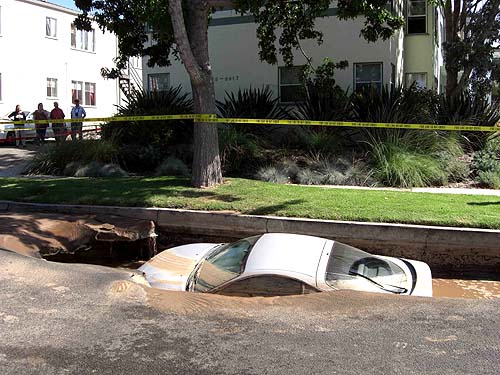
As has been typical with public infrastructure in America for the past 40 years, Santa Monica’s water system has been starved for maintenance because voters don’t want to pay for what they’re wearing out. Cast iron pipes are now nearing a century of use and need to be replaced. We shouldn’t be surprised. Santa Monica had a major water main break in 2002 and a serious sinkhole in 2007.

City of Santa Monica photo

City of Santa Monica photo

Unfortunately I wasn’t surprised, watching the video of Tuesday’s hearing, to hear members of my own Baby Boomer generation complain about having to pay more, and call for a bond issue to pay for this catch-up maintenance. They said it wasn’t fair that they might have to pay for a system that future generations would use. But then we boomers have never worried about getting a cheap ride on investments preceding generations paid for, without paying to maintain them and without making investments for the future. Hey, we’ve saddled the next generation with student loan debt; why not give them some water debt, too?

Speaking as one boomer, I don’t want my water rates to include interest on a bond for work that we can and should finance as we go if our rates include reasonable amounts for maintenance and replacement, and I’d like to invest reasonable amounts of money (piggybacking on state money that might be available, not to mention the settlement money the City receives from polluters) to increase our flow from wells and the reuse of gray water so that we can reduce the relatively costly (but still cheap!) water we buy from the MWD.

Of course, no one likes to pay more for anything, especially for something we all take for granted. The monthly increases are going to be trivial for a middle-class family (according to Table 8 in the Kennedy/Jenks report, the increase after five years will be about $11 per month for a typical single-family house, assuming a 20% reduction in usage and the 9% annual rate increases the City Council adopted), but certainly there are low-income people for whom even a small increase would be painful. The problem is, however, that you can’t build high-quality infrastructure if one requirement is that the actual cost must be affordable to people with the lowest incomes. You need to find another way to subsidize their water, or, even better, find a way to increase their incomes.

The rate increase naysayers did make some good points, however. One was that with everyone trying to reduce usage, both by investing on water-saving improvements and changing behaviors, it’s going to get harder in the future to respond to droughts by lowering consumption. This causes frustration from people who, after all, are doing the right thing. What it means, however, is that we’re going to need more investment, both public and private. In gray water systems, for instance. The good news is that if people make investments to reduce water usage, their usage will remain lower even when the drought is over, and they will not feel the full impact of higher rates.

Another point I agreed with, one made by Diana Gordon from the SMCLC and others, is that the City’s goal of achieving water self-sufficiency by 2020 is artificial and should not drive any policies. The goal is admirable for both ecological and financial reasons, but it is artificial not only because of the arbitrary date, but also because “self-sufficiency” is an artificial concept. What does self-sufficiency mean when much of the City’s “own” well water doesn’t lie under Santa Monica? Even to the extent it does, the water is part of a regional pool of groundwater that is replenished by regional surface water.

Santa Monica’s water needs and resources, now and in the future, are part and parcel of the water needs and resources of a still growing region. It’s artificial to think that Santa Monica could be self-sufficient in water or anything else.

Thanks for reading.

Turns out that when it comes to local politics we’re not so exceptional

In the last couple of posts I’ve been trying, mostly by means of rereading Mike Davis’s City of Quartz, to put anti-development politics in Santa Monica into a regional context. I’ve recently read, however, another book (and reviewed it on Huffington Post), that gives a national context for politics that we think of as quintessentially local.

The book is Dead End: Suburban Sprawl and the Rebirth of American Urbanism, written by Benjamin Ross, who is, among other things, a transportation activist from Maryland. In the book Ross traces the history of how America, which celebrates few concepts as highly as private property and democracy, paradoxically created a regulatory system for land that (i) subordinates an individual property owner’s rights to the rights of the group (either neighbors through a homeowner’s association or government through zoning), and (ii) reserves power over real property to only a few citizens.

Adding irony to paradox, this red-blooded American system of land control has its origins in proto-socialist ideas and ideals of pre-Civil War communalist utopians. After various false starts these ideas coalesced into a replicable format in a New Jersey suburb called Llewellyn Park laid out in 1857. The formula included controls on what individual owners could build on their properties.

As one of the first purchasers of a home site in Llewellyn Park put it (as quoted by Ross), “[e]ach Llewellyn Park property owner . . .‘possesses the whole park in common, so that the fortunate purchaser of two or three acres becomes a virtual owner of the whole five hundred.’” As Ross describes the impact of this, “[h]ere in germ is the belief of today’s suburban homeowner that property rights include a veto over building on neighbors’ land – an understanding shared by even the most ardent defenders of private property.”

From 19th century private covenants evolved 20th century zoning, which developers and governments used to assure purchasers of home sites that their neighbors would be just like them, to the exclusion of anyone else. Restrictions on the use of one’s property, Ross finds, were primarily for the purpose of preserving status, although they were also marketed as a way to preserve property values. (In classical economics, however, let alone American ideology, property values are maximized when the property owner is free to exploit the property to its highest potential.)

Clearly, citizens have an interest in regulating all uses of property and, in many cases regulation can enhance the value of property. These decisions about regulating property, however, are supposed to be made through a democratic process. What Ross finds objectionable is that decisions about real property are typically made by the property owners themselves, either through private covenants or because most land use decisions are left to local governments that only represent the people already living there.

Citizens who are affected by these decisions—such as people needing places to live—have no vote or say in the matter. If you think that this didn’t apply to Santa Monica, note that much of Santa Monica’s residential land was developed with restrictive covenants that kept out minorities. The covenants were outlawed more than 60 years ago, but to this day few minorities live where there were restrictive covenants. The minority citizens never got to vote on the restrictions.

Ross finds that people invested socially and economically in the way things are find ingenious ways to rationalize their self-interest in the status quo—specifically in the exclusion of newcomers. In his words,

Unwilling to admit – and often unable to recognize – the status-seeking motivations that lurk behind their agenda, opponents of development search for any convenient excuse to oppose something that might be built nearby. Traffic is a perennial objection, blessed by the Supreme Court in Euclid v. Ambler [the 1926 case that found zoning to be constitutional] and never since out of favor. Another common tactic is to go after the builder rather than the building. Homeowners appeal to the sympathies of the uninvolved, presenting themselves as innocent victims of oppressive developers.

Now, does this describe Santa Monica anti-development politics or what? Everyone here likes to think of our beautiful town as special, exceptional in its loveliness as well as its traffic problem, but it turns out that people all over the country have been using traffic to justify exclusionary zoning since (at least) the 1920s. (As someone who hates traffic, I wish they’d come up with something that worked.)

“[T]o go after the builder rather than the building.” So it’s not only in Santa Monica that whenever there’s no fact-based or logical argument against a development, the opponents play the “greedy developer” card (that is unless the developer is a non-profit, in which case they can play the “neighborhood character” card). Developers want to make a buck, and because they typically take big risks and work in a cyclical industry they want to make big bucks, but are they are any more greedy than, say, movie producers, who also work in a high risk industry? Or restaurant owners? Or anyone else in business?

Meanwhile, who in Santa Monica (aside from a few apartment owners) benefit from the housing crisis, which causes property values to skyrocket? In an era of scarcity of homes to buy, who benefits from restricting development of market-rate housing, particularly condominiums? Keep in mind that it’s not like anyone is proposing to build apartments or condos in single-family zones.

Homeowners “presenting themselves as innocent victims.” Hmmm. It’s been breathtaking to hear recently the kvetching from some Santa Monica homeowners about increased water rates, and mandatory 20% reductions in water use that will be imposed on some of them. And of course all that’s been turned into another rhetorical tool against building (water-efficient) apartments. Look—it’s hard to think that life has treated unfairly folks who own homes in Santa Monica, whether they’ve been sitting on their capital gains and low Prop. 13 tax rates for years or have enough dough to have bought in recently.

There’s more in the book than I can describe here. Ross shows how every well-intentioned movement you can think of, from environmentalism, to historic preservation, to growth boundaries, to expanded public participation in the planning process, to negotiating for community benefits, etc., etc., gets twisted to become yet another exclusionary tool. He even points out that residents who manage to move into apartments or condos in desirable places then often want to raise the drawbridges themselves.

However, Ross ends on optimistic note. For various reasons Americans are becoming more comfortable with city living, and these cultural changes are driving an urban renaissance.

Like in Santa Monica.

Thanks for reading.

Santa Monica and the Great L.A. Late 20th Century Transfiguration

For my last post I reread parts of Mike Davis’ City of Quartz to give me some perspective on what’s going on today in Santa Monica with anti-development politics. As perceptive as Davis was, however, it was also interesting to see, in hindsight, what he missed. For all of Davis’ insights, City of Quartz missed the biggest story of the time, which was the massive immigration that was changing the region.

Immigration hardly comes up in City of Quartz, but the year the book was published, 1990, was the highpoint of a demographic wave that started in the early ’70s, accelerated in the ’80s, and then subsided in the ’90s. In 1970 about 11% of L.A. County’s then seven million residents were foreign born; by 2000 the figure was 36% and the county’s population had increased to 9.5 million. Today, still about 36% of county residents are foreign born, but also about 21% of county residents have at least one foreign-born parent. This means that well over half of county residents are directly tied to what should be called the Great L.A. Late 20th Century Transfiguration. (These numbers come from the research of Dowell Myers and John Pitkin at USC.)

Often when you read accounts from the middle of the immigration era—even from activists who tried to remedy the multiple crises that massive demographic change caused, involving housing, jobs, schools, gangs, etc.—you get the sense that people were too close to the phenomenon to be able to perceive it. As if, for example, it should be surprising that things will get a bit chaotic if you drop millions of mostly impoverished and poorly educated immigrants (who don’t speak English for God’s sake!) into a place that wasn’t expecting them.

It didn’t have to be this way. A century ago it was the nightmare of the Lower Eastside and similar places that led to demands to reform and redesign cities, as well as massive investments in social services, infrastructure and education. But many here in southern California for different reasons wanted to act as if nothing unusual was happening. On one hand you had activists who acted as if it was a profound failing of government, capitalism, etc., that we suddenly had millions more poor people to house, employ and educate, and on the other you had conservatives who wanted to ignore the whole thing and who certainly didn’t want to spend any money to deal with the situation.

The region survived the immigration wave, and may even prosper because of the work force it left behind, but the wave left us with two crucial social issues. One is a housing crisis for not only the working class, but also the true middle class. The other is low wages for working people—a crisis made more acute by the housing crisis. The native-born children of the immigrants of the ’70s and ’80s, along with other Millennials, are now adults and working, making their way forward, but even those making good money can’t find places to live. For a while the regional solution was to send them out into the sprawl, to the Inland Empire, etc., but that model blew up in the Great Recession. Now, like everyone else, they want to live near their jobs and not go into unsustainable debt to do so.

So how does this relate to Santa Monica, which, of course, is still overwhelmingly Anglo and native-born? Flash back to 1979 when young activists in SMRR joined with elderly renters, many with radical backgrounds from the ’30s, ’40s and ’50s, to save them from eviction when in Housing Crisis I rents skyrocketed and there was huge pressure to tear down apartments to build condos and offices. This coalition brought progressive government to Santa Monica. The sad fact is that today, however, many of those same SMRR activists, now grown old themselves, instead of harking back to their youthful radicalism and idealism to join with today’s young activists to build housing for the next generation, have joined with their age and economic cohort of (some, by no means all) boomer homeowners to keep young people from moving into Santa Monica.

It’s particularly ironic because the anti-housers today use rhetoric like that which homeowners back then used against renters when renters awoke from their slumber and got involved in local politics. Yes, why should we allow the building of apartments for young “transients” without “roots” in the community? You wonder if people today who use “preserving community character” to block the building of apartments know anything about how that phrase has been so identified in the past with racial and ethnic exclusion. (Thankfully, I don’t believe they do.)

Thanks for reading.


When history repeats as farce it’s not always funny

“If the slow-growth movement … has been explicitly a protest against the urbanization of suburbia, it is implicitly—in the long tradition of Los Angeles homeowner politics—a reassertion of social privilege.” —Mike Davis, City of Quartz: Excavating the Future in Los Angeles (1990).

In an attempt to remind myself of the historical context behind the anti-development politics I’ve been writing about, I went back and reread the famous 60-page chapter, called “Homegrown Revolution,” that Mike Davis wrote in City of Quartz 25 years ago about the homeowner movements of the ’70s and ’80s. Davis, if you haven’t read the book, takes no prisoners. He’s equally rough on Anglo homeowners, enriched by the rapid increase in property values of the late ’70s, who banded together to enact Prop. 13 and keep apartments (and not incidentally minorities) out of their neighborhoods, and the Growth Machine developers and their kept politicians whom the would-be “sunbelt Bolsheviks” so feared.

At a certain point Davis refers to Karl Marx’s essay “The Eighteenth Brumaire of Louis Bonaparte” to make the point that for all their fervor, and with the notable exception of the Prop. 13 campaign, the slow-growthers were usually disorganized, like the peasants whose potential for revolution Marx dismissed. Reading this reference 25 years later I found a retrospective irony. Notwithstanding what Marx said about the peasants the most famous line in Eighteenth Brumaire is the one where he, in comparing the Emperor Napoleon and this nephew Napoleon III (Louis Bonaparte), says that history repeats itself, “the first as tragedy, then as farce.” When you compare the issues that provoked anti-development activists in the ’70s with those that fuel anti-development fires today, farce is what comes to mind.

So many people newly involved in anti-development politics in Santa Monica, and I’m thinking of many in Residocracy and the Santa Monica Coalition for a Livable City, act as if they’ve discovered things that no one else knew about. Did you know that traffic is congested and that developers want to make money? What a shock!

I hate to play the old baby boomer card, but we’ve been through this before. There’s a reason that freeways don’t cut up the Santa Monica Mountains, and that was because in the ’60s Marvin Braude and others formed the Hillside Federation to stop them. There are reasons that downtown Santa Monica doesn’t look like downtown Glendale, that there are only two apartment towers on the beach in Ocean Park, and that thousands of apartments have been saved from destruction, and that’s because when Santa Monicans for Renters Rights (SMRR) took power in 1981, Santa Monica became, as described by William Fulton, another great chronicler of L.A. (in The Reluctant Metropolis), the first city to confront the Southern California Growth Machine.

SMRR arose because of a real crisis, not something ginned up. The reason analysts label today’s regional housing crisis as the worst in decades is because the crisis of the late ’70s was even more dramatic. L.A. housing prices, which early in the decade were slightly lower than the national average, increased 30 to 40 percent a year, and rents exploded, too. Oh, and by the way, people complained about traffic back then, too. Locally developers had big plans to turn industrial areas into office parks, as had happened on Ocean Park Boulevard with the Douglas Aircraft site, creating many more jobs per acre, which would mean more commuters. And let’s not forget other serious problems, like homelessness and gang violence, and decaying infrastructure.

Not everything worked out—there was the matter of the approval in the ’80s of twice the office square footage predicted in Santa Monica’s 1984 land use plan—but the worst damage was averted and there were many positive achievements. I’m tempted to say that there were giants in those days, but in any case movements against genuine ills create big ideas and powerful language. The tragedy comes when those ideas and words are applied to more trivial circumstances. Then they become farcical.

That’s not to say we don’t have problems today, they’re just not the ones complainers in Santa Monica complain about. They’re still acting as if Santa Monica is a “Leave It to Beaver” suburb, when in fact it’s part of the central core of a megalopolis. Longtime residents (the only ones who are supposed to have standing to complain) have a lot to be thankful for—high property values and low, Prop. 13 taxes if they are homeowners, rent-controlled rents if they are renters, convenient access to whatever services they need, shorter commutes than average. What drives them crazy is traffic, but traffic is bad all over, it’s been bad for a long time, and it’s not necessarily getting worse. The reality today is not about how to preserve a suburb, even an industrial suburb like Santa Monica once was, but about how to make a city work.

Here’s a fact to chew on from the Housing Element of Santa Monica’s General Plan: in 2013 82.8% of all housing in the city was more than 30 years old—built before 1983. The development that the anti-development crowd should actually be complaining about took place in the era they have the most nostalgia for. But if nearly 30,000 units (of 50,000 total today) hadn’t been built in the ’50s, ’60s, and ’70s, most Santa Monicans wouldn’t have a place to live.

Thanks for reading.


Housing the next generation: whose side are you on?

Let’s see, a few days ago I was complaining about how the leadership of Santa Monicans for Renters Rights (SMRR) is, by allying SMRR with anti-development groups like Residocracy and the Santa Monica Coalition for a Livable City, turning the organization into something closer to a typical homeowner protection association than a cutting edge progressive organization. In that connection there was something else that struck me when, as reported in the Lookout, SMRR Co-Chair Patricia Hoffman told the Santa Monica Democratic Club that “‘[w]e have a lot more work to do . . . . If we can work together and spend the next few years selecting candidates, that, I think, can make our City Council even better.’”

Note that Co-Chair Hoffman says selecting candidates. Not electing them, but selecting them. It reminded me of the (in)famous Boss Tweed line, “I don’t care who does the electing, as long as I get to do the nominating.” Well, the people who got to do the nominating in the 2014 election were Hoffman and a handful of her co-generationalists on the Steering Committee.

So what did Hoffman mean? Make the council “even better” by replacing progressives like Terry O’Day and Gleam Davis with candidates, like Susan Himmelrich, co-endorsed by anti-development groups? The Steering Committee’s endorsement of Himmelrich meant that for the first time SMRR endorsed a slate of candidates who were all running on anti-development platforms.

Maybe I shouldn’t be surprised that Hoffman and her colleagues have allied SMRR with anti-development organizations. They were all on the barricades in the ’60s, but we all get older. Should we expect them to care about housing or jobs for anyone who has the misfortune of being young in an era when government cares much more about the old? (From all of this calumny I exclude one Steering Committee member, former mayor Judy Abdo, who still believes in the future and stays forever young in part by living with a rotating cast of under-30 housemates. It probably doesn’t hurt that she spent a career in early childhood development.)

Let’s be clear: to be anti-development today in Santa Monica (assuming you’re not delusional) is to be anti-housing because hardly anything new but housing, and only a modicum of that, has been built in Santa Monica for 20 years, and nearly all the developments in the planning pipeline are residential (and not in existing neighborhoods). For two decades there’s been little commercial development, and a lot of what there has been is ground-floor retail in apartment projects. The idea that Santa Monica has seen a lot of recent development is, as Mayor Kevin McKeown himself has recently written, rhetoric. The facts, as McKeown has been reminding people, show a city that for more than two decades has controlled development quite effectively. (Which means, by the way, that if you believe traffic has got worse and you want to do something about it, you’d better look elsewhere than controlling development, because that doesn’t work.)

This isn’t about affordable housing. The Steering Committee members are for affordable housing, I know that. Hoffman herself is a long time board member of Community Corporation of Santa Monica, and they all supported H and HH. There are, however, people in Santa Monica who advocate for increased affordable housing requirements only to thwart the building of market-rate housing (which ultimately means less affordable housing, too). This is not a unique phenomenon: there are also people, many of the same people in fact, who support living wages for hotel workers only to thwart hotel development, and people who support historic preservation only to thwart the building of anything new.

SMRR is allying itself with people who are never in favor of building housing. It’s remarkable how eclectic they can be. Equally bad are single units for young tech workers and SMC students, spacious condominiums that hotels want to build for rich people, or family apartments that CCSM wants to build for poor people; biggish projects like 500 Broadway or small projects like 802 Ashland; or any other kind of housing you can think of. For the anti-housers, it’s not that the perfect is the enemy of the good, but that when it comes to building something for people to live in, whatever it is is never good enough.

The regional housing crisis, the worst in decades, one that includes skyrocketing rents in Santa Monica that put pressure on tenants in rent-controlled apartments, is only partially a crisis about affordability. Fundamentally it’s a crisis of supply at all price levels. The huge Millennial generation coming up doesn’t primarily need affordable housing—they need alternatives to moving to the Inland Empire.

Another commendable thing that Mayor McKeown has been doing for a while is to remind people that we need to provide housing for those who graduate each year from Samohi if we expect any of them to live here. But not many of those graduates will qualify for affordable housing, in part because they are graduating from a good school, with the vast majority of them going on to college, and because there are so many good jobs in Santa Monica that they can come back to. It is, by the way, good news that they won’t qualify for affordable housing, but it means that we’re going to have to rely on the market, i.e., developers, to build homes for them and their future families. And those homes won’t be single-family, detached houses, because there’s no land for that.

So—whose side will SMRR be on?

Thanks for reading.

Get to know MetroQuest and help save the Santa Monica Civic

Santa Monicans: you need to spend a little time this weekend or next week participating in the interactive and dynamic “trade off tool” called MetroQuest that the City’s Community and Cultural Services Department is using to consider and evaluate alternatives for the future of the Civic Auditorium and its surrounding area, including financial implications. Here’s a link to the on-line version of the program; if you weren’t at last weekend’s two-day workshop (which I previewed here), you’ll have a little bit of a learning curve, but it’s worth it—for one thing, I predict that this a tool Santa Monica will use often in the future for public process. One thing about the program, it allows you to go back and forth revising as you learn more, but be sure to get to the end. There is a place for you to leave comments, which I assure you will be considered by the Civic Working Group. The tool can’t handle all alternatives, but we on the CWG intend to, so don’t be shy in listing data and ideas you don’t believe the software takes into account. And one thing — try to use up all the land that’s available. If you don’t want to build on all the land, use the variously sized park options to fill in the acreage. Anyway, for the link click here — and have fun!

Following some money

The headline in the Lookout for the article about the final financial reports for the 2014 City Council election was “Himmelrich Spent $160,000 of Her Own Money to Win Santa Monica Council Seat,” but even though $160,000 was a record for self-financing a City Council campaign here, I was less interested in how much money Susan Himmelrich spent to win election and more interested in how she spent some of it.

What the article did not report was that Himmelrich paid nearly $30,000 to Dennis Zane and to PZ Associates, an entity that Zane formed. Here’s the breakdown: Himmelrich paid Zane $15,000 for political consulting, plus $4,475 for office expenses, including one flat $3,000 payment. She paid PZ $9,255 partly for consulting services and partly in a category called “campaign paraphernalia/misc.” (PZ is known for running door-to-door campaigns.)

These payments are not out of line for these kinds of services. Why am I focusing on them? For one reason: the payments were breaches of Zane’s fiduciary duty to Santa Monicans for Renters’ Rights (SMRR). As a member of the SMRR Steering Committee, Zane was guilty of self-dealing, by taking money from a candidate seeking the SMRR endorsement. Self-dealing cannot be made good by disclosure or recusal (not that Zane in fact recused himself).

The SMRR endorsement is crucial to getting elected, especially for anti-development candidates, as no candidate for City Council running on an anti-development platform has ever been elected without the SMRR endorsement. As a follow up to my post in January where I wrote about how Himmelrich finally got the endorsement from the Steering Committee (in a deal where Himmelrich got the committee votes she needed in return for her supporters voting to endorse Andrew Walzer for College Board), I can report that I received a message from Walzer the next day defending the “trade off in voting for [him] and Sue.” Apparently, according to Walzer, it was “complicated,” which naturally made me feel better about it. But in case you had doubts, it did happen.

I’m not the only one still taking a look back at the election, although not everyone has the same motivations. The Santa Monica Democratic Club (SMDC) had a panel discussion last week about it. I didn’t go, but according to the Lookout, the gist of the meeting was that the election of the anti-development Himmelrich had, in the words of SMRR Co-Chair Patricia Hoffman, “‘flipped the balance of power on the City Council.’”

Apparently, though, the struggle continues. Hoffman went on to say that “‘[w]e have a lot more work to do . . . . If we can work together and spend the next few years selecting candidates, that, I think, can make our City Council even better.’”

“Even better.” Given that all seven city council members were elected at least initially with the SMRR endorsement, I guess Hoffman is saying that the old SMRR, the one that based its progressive politics on issues beyond blocking development, is history. And I expect that if the Steering Committee, given its demographics, continues to make the endorsements, the old SMRR will be history.

That’s right, let’s throw out all those bums we supported before who care about housing for all, including the middle-class, and good union jobs and city and social services and childcare and public transportation, etc. You know the ones who understand that Santa Monica is not an island. They’re not sufficiently deferential to our new friends in the Santa Monica Coalition for a Livable City and Residocracy.

* * *

Given the record-breaking $160,000 Himmelrich spent on her campaign, one might wonder why her husband, Housing Commissioner Michael Soloff, had to make campaign contributions, each of $10,000, to SMRR and the SMDC. Why didn’t Himmelrich make the contributions herself? The reason is based on campaign finance law: SMRR and SMDC were running independent campaigns on Himmelrich’s behalf, and because there is a contribution limit for City Council races, the campaigns could not coordinate with Himmelrich. Otherwise, contributions an individual or company might make to SMRR and the SMDC could be counted against the contributor’s limit. Giving money to an independent campaign is a form of coordination, and so Himmelrich couldn’t write the checks. Both she and Soloff are attorneys, and so one expects that they did legal research (but separately, not coordinated!) to satisfy themselves that it’s not coordination if the money comes from a spouse. But let’s face it—even if it’s legal, it’s a dodge. I wonder if the Santa Monica Transparency Project will investigate?

There’s another aspect to this. The old SMRR prided itself on a policy of rarely accepting individual contributions that were more than the limit for council races, which is now $325. The new SMRR not only accepted Soloff’s $10,000, but also $10,000 from the Huntley Hotel, the primary bankroller of anti-development campaigns in the city. Back in July, before the SMRR convention where she’d be seeking the SMRR endorsement, Himmelrich herself gave $1,000. There is no law limiting the amount of contributions to SMRR, and the limit was voluntary, but the limit was once a point of pride. So much for that.

* * *

One footnote: the Lookout piece I quote from above about campaign expenditures got the numbers for my campaign wrong. The article said that I contributed $20,000 and my total campaign expenditure was $75,000, but those numbers are incomplete. The reason the reporter was mistaken is that my campaign accountant had us wrap up our finances in 2015, and the final numbers are in a statement for the period Jan. 1-5 that we filed a few weeks ago. The complete numbers are that I contributed $36,920.90 to my campaign and the total expenditure was $96,128.90. I understand the Lookout will be running a correction, but I wanted the record to be correct.

Thanks for reading.


How to help save the Civic Auditorium and have fun doing so

One of the many big projects going on in Santa Monica today is the effort to save and make functional again the Civic Auditorium. The City had a plan a few years ago that would have used about $50 million in redevelopment money to rehab and make necessary upgrades to the facility, but that went south when Gov. Brown terminated redevelopment in California. In response, the City Council formed a new, nine-person task force, called the Civic Working Group (CWG), to seek solutions, and I am honored to be a member of it.

This weekend, on Saturday and Sunday mornings, the CWG is hosting a two-day workshop where participants will work with innovative technology to evaluate possible scenarios for saving the Civic. Participants will use software on iPads to make “tradeoffs” among wants, costs, and physical constraints. It’s going to be demanding but exciting, and I hope we get a great turnout. (For details of the workshop, click here.)

I was not a fan of the City’s plan to use redevelopment money to save the Civic. It wasn’t that I didn’t like the architectural or programming proposals, but I didn’t believe that the deal the City made with the Nederlander Organization to run the facility made sense. In my opinion, the deal didn’t provide a realistic long-term solution, because the City would likely continue to lose significant money on operations without any guarantee that the Nederlanders would continue to operate the facility. It was a deal the City made in the aftermath of the Great Recession—if we had redevelopment money today I suspect the deal would be better.

As it happened, the loss of the redevelopment money had a side effect that could be the key to saving the Civic. When the redevelopment money evaporated, City Manager Rod Gould advised the City Council, and the council agreed, that the Civic could not be opened to the public in its present condition. That led to the council taking the drastic step of terminating the employment of the Civic’s staff.

It is gut wrenching when good people, in this case city workers who had lovingly taken care of the Civic, lose their jobs. The City was able to find new work for most of the workers (and some took retirement), but the hard fact was that the City’s overhead at the Civic made it difficult to make operations there financially viable. Now with a “clean slate” it may be possible to devise a plan that works.

Participants at the workshop this weekend will explore and choose among possibilities for future use of the Civic. Using the new software they will continually evaluate their choices against costs (both capital and operating) and other constraints (such as acreage and parking capacity). The program, called “MetroQuest,” is interactive and dynamic, and participants will be able to revise their models as they gather more information.

Since CWG members will serve as facilitators, we had training on MetroQuest this week. I have to say that I’m excited. MetroQuest will allow participants (using iPads that will be provided) to make choices for what they would like to see in and around the reborn Civic and then juggle the financial and other implications of those choices to see how they can make their plans work. (After the workshop, the software will be on the Web for two weeks for anyone to use, but come to the workshop, learn the software, and have fun.)

Over the decades that the City has been trying to figure out what to do with the Civic Auditorium one problem has been that the various public processes have ended up emphasizing what people want at the Civic, and not how to pay for it. As often is the case with a public process, the tendency has been to try to please everyone. MetroQuest forces participants to focus their desires by requiring them to make tradeoffs to get to plans that can work. The workshop should bring the public closer to the actual process that decision makers will ultimately have to go through.

The workshop will not be exhaustive. Not all future possibilities for the Civic and the surrounding area could be included in MetroQuest, because alternatives need to have backup research into costs and benefits. The program will, however, incorporate the most popular ideas that came out of a previous public workshop in September, and various alternatives to pay for those public uses that would need subsidy. Hopefully the exercise will lead to even more creative thinking—the ultimate solution for saving the Civic might not resemble anyone’s final model on Sunday, but I’m sure a solution will depend on what happens this weekend.

I hope to see you Saturday.

Thanks for reading.

2014: A historic election in Santa Monica

Going back in history, there have been some big elections in Santa Monica, elections that made Santa Monica what it is.

In 1916 Santa Monica voters approved a water bond to create a municipal water system. In 1917 they voted down annexation by Los Angeles. In the ’20s Santa Monica passed another bond issue to acquire the Charnock wells in West L.A. and, armed with their own water, voters again defeated annexation. In 1939 voters prohibited oil drilling in the city. In 1954 voters prohibited oil drilling in the bay.

We may not remember the identities of the politicians from back then, but those votes and their consequences reside deep in the collective civic unconscious of all Santa Monicans.

Fifty years from now, if the Santa Monica election of 2014 is remembered, it’s not likely to be remembered for the elections (and machinations) I’ve been writing about the past two weeks. More likely it will be remembered (occasionally) when someone enjoying the big park that the City is going to build on the site of the Santa Monica Airport will reflect back, and recall how Santa Monica voters in 2014 overwhelmingly passed Measure LC, which for all practical purposes mandates that a park will replace the airport, and defeated Measure D, the aviation industry’s measure designed to prevent the City from closing the airport.

The aviation industry’s well-funded effort to subvert normal political process in Santa Monica had the result of making it more likely that the airport will close. The landslide, where roughly 60 percent of voters rejected the industry’s desperate attempt to preserve the airport, creates a political context for closure by invalidating any aviation arguments about what “the people really want.” This will reverberate up the political ladder—even to the Federal Aviation Administration (FAA) and to Congress.

And when the airport closes, LC, because of its requirement of a vote on any development other than a park, means that the land now being used for aviation purposes, in the range of 160 or 170 acres, will become a park.

On a personal note, losing my campaign for City Council wasn’t fun, but it was a great privilege to serve on the Executive Committee of the Committee for Local Control of Santa Monica Airport Land (CLCSMAL), the grassroots political committee that raised money and coordinated the campaign to pass LC and defeat D. Participating in that campaign was the highpoint of 20 years of activism.

So where now? How do we get from the 2014 vote to closing the airport and building a park? Where’s the cup, where’s the lip, and where are the slips between?

The big date is July 1. That’s the day after the 1984 Settlement Agreement, and all the aviation leases, expire. Based on the City’s interpretation of its rights as owner of the airport land, that’s the day the City can close the airport.

But the City’s rights are in dispute. While there are various legal issues, ultimately there is one: the FAA claims the City can’t close the airport because of a “perpetuity” clause in a 1948 agreement. It’s unlikely the FAA will abandon that claim, and the City and the FAA are going to need their dispute adjudicated.

The key factor will be in what forum that litigation takes place. The City wants its claims heard in federal court, where it will stand on comparatively equal footing with the FAA. To that end the City sued the FAA in 2013, seeking “declaratory relief”—i.e., a declaration of the City’s rights ahead of its taking action to close the airport. The FAA wants the issue determined in its own administrative proceedings, where it controls the pace of the proceedings and benefits from certain presumptions. To stay out of federal court, the FAA argued that the relevant procedures did not allow for the City’s suit. The judge agreed and dismissed the case.

The City has appealed that decision to the Ninth Circuit Court of Appeals. The City filed its brief in October and the FAA filed its reply brief last week. It does not appear that the Appeals Court has set a date for oral argument. Possibly we’ll have a decision by July 1. If the City wins the appeal, and sends the case back to District Court, then there will be a trial—no doubt followed by an appeal by whomever loses.

If the Ninth Circuit upholds the dismissal of the City’s suit, tactics will be more complicated. District Court Judge John Walter, when he dismissed the City’s suit, declared that although he “would like to address the merits of the City’s claims,” he had to conclude, “reluctantly,” that under the Constitution he didn’t have jurisdiction because the City’s claims were not ripe for review.

To make the conflict ripe, the City would need to close the airport, or at least take action that would lead to closure unless the FAA intervened. (In the words of the FAA’s brief, “If, in the future, the City ceases to operate Santa Monica Airport as an airport, and if the United States opts to exercise its right of reversion, the underlying dispute may be litigated in an action brought by the federal government.”)

But aye, there’s the rub, because if the FAA takes action to stop the City, it’s likely at least to try to do so with administrative proceedings. The situation is tricky. The City shouldn’t do anything that calls into question its right to close the airport July 1, but it needs to be careful that it doesn’t trigger a FAA proceeding when it could still get the case into federal court.

In the meantime, the City is not powerless. Most significant, all the leases on the aviation land expire June 30. (Not to be confused with leases on non-aviation land that the City has controlled since 1984; these should be dealt with separately.) The City needs to take control of the properties it owns at the airport and collect market-rate rents from tenants and subtenants. Even if the City defers closing the airport for an interim period while its rights get sorted out, it will be informative to see how many aviation businesses can survive at the airport without the twin subsidies of below-market rents and the money they make by subleasing property at market rates.

These issues will be the subject of much discussion in upcoming months. For now what I wanted to do was to remind folks about what an important election 2014 was for the future of Santa Monica.

Thanks for reading.