SB10: not so scary

It is hard to break bad habits. One habit that is hard to break in Santa Monica is fearmongering about development.

The latest instance comes from supporters of the “Safer Santa Monica” slate. As reported in the Lookout, a “small army of volunteers from the Northeast and Sunset Park neighborhoods has been busy blanketing their single family areas with an urgent message,” namely that if the candidates backed by Santa Monicans for Renters Rights (SMRR) are elected, they “would implement SB10, a State law that allows as many as 14 units to be built on a single family lot.”

SB10 was passed by the legislature and signed by the governor in 2021. I’ll wager that few laws have been more misunderstood than SB10. SB10 is a rather limited housing law that people opposed to housing development use to frighten people like a storyteller uses a ghost story to frighten children at Halloween.

SB10 does not mandate anything. It gives local governments the authority to override voter approved limits on development, and permit up to 10 units (yes, theoretically this number could be increased if ADU’s are included) on a parcel, but only if certain restrictions are satisfied. Here is the operative language, but you can read the whole statute here:

“Notwithstanding any local restrictions on adopting zoning ordinances enacted by the jurisdiction that limit the legislative body’s ability to adopt zoning ordinances, including … restrictions enacted by local initiative, a local government may adopt an ordinance to zone a parcel for up to 10 units of residential density per parcel, at a height specified by the local government in the ordinance, if the parcel is located in [a transit-rich area or an urban infill site].”

Note that SB10 doesn’t require local governments to do anything. It does expand the power of local governments to upzone, but only in cities or counties subject to “restrictions on adopting zoning ordinances.” SB10 did not expand the power of the Santa Monica City Council because Santa Monica does not have any such restrictions. The only zoning restriction relevant to housing enacted in Santa Monica is Measure LC. LC limits development of airport land (when the airport closes) to park and recreational purposes, but SB10 explicitly excludes from its scope “[a]ny local restriction enacted or approved by a local initiative that designates publicly owned land as open-space land … or for park or recreational purposes.”

Note that if the RIFT measure in 2008 or Measure LV in2016 had passed, SB10 would expand the power of City Council to override those measures, but voters defeated both RIFT and LV handily. SB10 therefore did not give the council more power than it already had. (There is a provision in SB10 that an upzoning enacted pursuant to SB10 would not be not subject to CEQA review, but CEQA review would not ultimately prevent an upzoning for housing in Santa Monica.)

But even if SB10 had expanded the Santa Monica City Council’s power, SB10 only gives authority to upzone if the local legislative body can make a finding that doing so “is consistent with [its] obligation to affirmatively further fair housing.” Readers may remember how the issue of “affirmatively furthering fair housing” (AFFH) was a factor when the City was adopting the Housing Element in 2021. (I wrote a number of posts back then about the Housing Element and AFFH; here is a link to one of them.)

Back then, the state rejected the City’s submission of a draft Housing Element because the council’s “Change Slate” majority had ignored warnings from Councilmember Gleam Davis and voted to approve a plan that didn’t take the AFFH requirement seriously. This led to Santa Monica becoming Ground Zero for Builder’s Remedy projects. Now that Santa Monica has an approved Housing Element, no matter who is elected to council it is unlikely that any zoning changes will be made other than those required by it.

I suppose the people distributing the SB10 flyers could have ignored SB10 and without reference to specific legislation simply generically mongered fear about what the United Santa Monica slate candidates might do to single-family neighborhoods. But they wouldn’t have been able to cite an immediate threat. Ever since Sen. Scott Wiener proposed SB10, the law has been a lightning rod for anti-housing panic. People should read the law and realize how limited it is.

There is the adage attributed to Georges Clemenceau that generals are always fighting the last war. In this case, we have some people in Santa Monica who keep fighting a war that’s over, the development war that so consumed Santa Monica politics for 30 years. The war is over because the state, reacting to California’s housing crisis, has taken over land use planning when it comes to housing.

The expanded legality of ADUs under state law, as well as SB9, have already upzoned urban R1 districts to some extent. While SB10 does not apply to Santa Monica, SB1123, which the governor recently signed into law, does. The new law, among other things, allows development of up to 10 units (plus ADUs) on vacant lots in single-family zones. Because it’s a state law, there is nothing the Santa Monica City Council has to say about it.

Yet, changes under all these laws are slow and incremental. No R1 neighborhoods, nor anyone’s “quality of life”, nor, for that matter, property values, have been destroyed. (Speaking as someone who lives in the delightful, very much housing heterogenous neighborhood of Ocean Park, my prediction is that in 20 or 30 years when traditional R1 neighborhoods have more of a mixture of housing types, residents then will be quite happy with where they live. Let’s plan for them.)

You may wonder: why did the state taken over land use planning (when it comes to housing)? Because cities like Santa Monica up and down the coast, and inland too, for so long blocked reasonable growth in the housing supply.

You reap what you sow.

Thanks for reading.

It’s the zeitgeist, stupid

There has always been a dance between local and national politics, a dance that can appear to take place in a maze of funhouse mirrors. That’s how Santa Monica politics in 2024 look to me. The electorate here is much different from that of the nation, but to a great extent I can’t differentiate between what I’m seeing on the local candidate mailers and the political commercials interrupting the baseball playoffs and the analysis that the national commentariat is producing.

Let’s begin with realignment. Nationally realignment of the political parties has been underway since the “Reagan Democrats,” but it accelerated when Donald Trump came down the escalator. In Santa Monica, realignment came abruptly with the 2020 City Council election, picked up steam in 2022, and this year was fully realized.

Realignment in Santa Monica means that the anti-development side, epitomized by Santa Monica Coalition for a Livable City (SMCLC), is no longer allied with its previous great benefactor, Santa Monicans for Renters Rights (SMRR). SMRR enabled candidates supported by SMCLC, such as Kevin McKeown and Sue Himmelrich, to get elected to City Council. But now after realignment, SMCLC has joined with business groups supporting candidates under the “Safer Santa Monica” banner (namely, incumbents Phil Brock and Oscar de la Torre, and newcomers John Putnam and Vivian Roknian) against the SMRR-backed candidates.

As a longtime participant in and observer of Santa Monica politics, the most, may I say, amusing manifestation of this break between SMRR and the anti-development crowd has been the dispute between McKeown, still a SMRR-loyalist, and SMCLC over the question about who is responsible for the housing development that’s coming to Santa Monica after the Change Slate-controlled City Council failed to file a compliant Housing Element. After McKeown wrote a letter to the Lookout blaming Changer Slaters Brock and De la Torre, Diana Gordon responded with one slamming McKeown. Breaking up is hard to do.

Meanwhile SMRR has formed an alliance with traditional liberal/progressive groups (the Santa Monica Democratic Club, Santa Monica Forward, Unite HERE Local 11, and Community for Excellent Public Schools) to support a “United Slate” of Dan Hall, Ellis Raskin, Barry Snell, and Natalya Zernitskaya.

Much of the national realignment – the part where working-class whites joined with hedge fund billionaires and military-adventurist neocons – never made sense to me, but there is a logic to the realignment in Santa Monica. Fundamentally, local politics changed when California largely took over planning for housing from cities. The development wars, which defined most of Santa Monica politics for 35 years, are over, or at least no longer have any reason for being (regardless of any residual rhetoric). There is nothing SMCLC can do now to stop housing development in Santa Monica, and they know it.

It is logical that a realignment occurs after fundamental issues change. What is uncanny to me is how Santa Monica’s quintessentially local, fine-grained, often personality-based politics reflect, even through a funhouse mirror, the national zeitgeist. I want to be clear that I am not saying that anyone running for City Council this year is a Trump supporter; so far as I can tell, all the candidates are Democrats who stress their Democratic credentials and support Kamala Harris. But consider these parallels when it comes to the rhetoric, if not the issues, of this election.

Crime and crisis. From the very name of the slate Brock and De la Torre put together after their former Change Slate running mate Christine Parra decided not to run for reelection, the “Safer Santa Monica” slate, you know that they are simultaneously feeding on and stoking the public’s fear of crime and disorder. In Santa Monica this includes feeding frustration about homelessness and stoking anxiety that Santa Monica is a failed city — much as Donald Trump describes every city north of Richmond or west of Ft. Worth.

(Side note: since the Change Slate has more or less had majority control of the City Council since McKeown quit the council in 2021, to be replaced by Change Slate-adjacent Lana Negrete, Brock and De la Torre might have thought that continuing with “Change Slate” would have caused confusion. Better to play the crime card and blame someone else. “Safer Santa Monica” indeed. Meanwhile, you can’t live in today’s zeitgeist without someone invoking “take back the city” rhetoric.)

Yes, there is crime in Santa Monica. There always has been crime – Santa Monica has every characteristic, good and bad, of American cities. Crime is significantly less frequent now than it was in 2019, but has steadily (but slightly) increased since the pandemic. Coincidentally that increase occurred during the years the Change Slate has been in control, but I am not blaming them. Honestly, the City Council has little to do with how much crime there is Santa Monica. Fortunately crime is rare enough here that when there is a violent act, it is still newsworthy, which of course is what sticks in one’s mind. Think of how Trump reduces the complex issue of immigration to isolated cases of violence perpetrated by immigrants.

But is Santa Monica a hellscape like the Safer Santa Monica candidates and their supporters would have us believe? I don’t think so.

Folks enjoying themselves on the Promenade on a recent night.

In at least one important respect Santa Monica is safer now. It wasn’t that long ago – I wonder if Oscar de la Torre ever reflects on this – that there were gang shootings here every year. In those days De la Torre believed in using social services, as opposed to heavy-handed policing, to end gang violence. He and the police union were foes. I remember that time well: I almost didn’t receive the union’s endorsement when I ran for City Council in 2014 because of a column I’d written in support of De la Torre when the police were investigating him in 2010. Now – talk about realignment – the police union has endorsed De la Torre and he is running on a law and order platform.

Homelessness is the shame of California, of our “civilization.” However, is it worse in Santa Monica because Santa Monica has been a leader in creating programs and, to some extent, in building supportive housing, to address homelessness? Absolutely not. Do the Safer Santa Monica people ever cross the border into Los Angeles? Where encampments are all over the place? We don’t have them in Santa Monica. Why? Because as I understand it, the Grants Pass Ninth Circuit case did not affect us, because we could offer shelter to unhoused people who would try to camp on our streets.

Does tougher policing reduce homelessness? The police in Santa Monica arrested twice as many unhoused people in 2023 (1840) as they did in 2021 (981); have you noticed any impact? Both crime and homelessness are societal problems that can only be solved with social change. Reactionary sloganeering will not generate beneficial change.

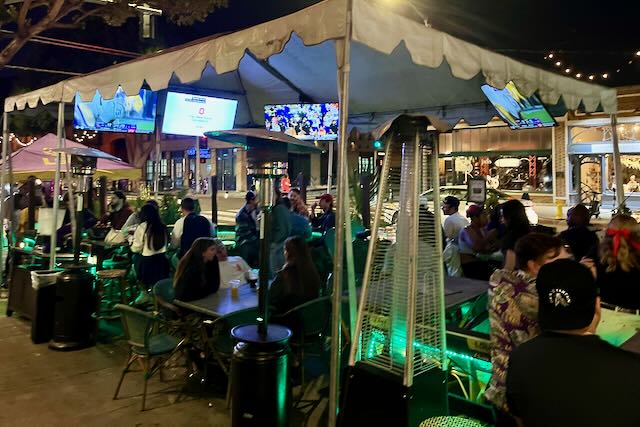
Young people on a recent night enjoying life on Main Street

As for the economy, sure, there are empty storefronts on the Promenade. Much of Santa Monica’s economy is based on hospitality and retail, sectors that the pandemic hit hard. Retail here and around the country is reeling from the disruption of e-commerce.

However, today Santa Monica is a magnet for hundreds of millions of dollars of investment. Look at all the cranes around town, with more on the way. Large apartment buildings, now permitted under state law, are planned or under construction. Google is bringing one of its first brick and mortar stores, and the first in the L.A. area, to the Promenade.

One of the first Google stores in the world coming to the corner of Broadway and the Promenade.

One of our major Ocean Avenue hotels has been undergoing a huge upgrade, and another, the Miramar, received its final approval for its complete upgrade Monday night at the Landmarks Commission.

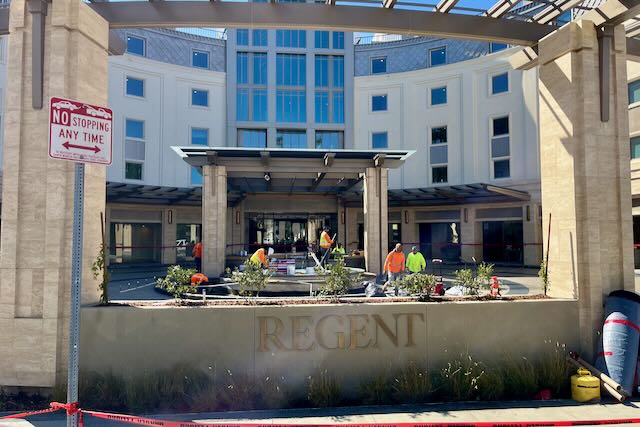
Workers putting finishing touches on the renovations at what will now be the Regent Hotel on Ocean Avenue.

Failed cities don’t attract investments like these.

And Cirque du Soleil is coming back to the beach.

Governmental competency. Switching over to an argument from the other side, the “United Slate” candidates charge that Brock and De la Torre, and their “Change Slate” colleague from 2020, Christine Parra, are not serious when it comes to governing; that they come to council meetings unprepared, not having read the staff reports, and waste everyone’s time in meetings that go on to the wee hours. Unfortunately, this is true. City Council meetings have become a mess. Instead of legislating, the Change Slate councilmembers like to grandstand, bringing to the vote hot button issues that the council has no power to act on, like distribution of clean needles. The obvious parallel is to the current Republican-controlled (meaning “controlled-chaos”) and unproductive House of Representatives.

The ”Deep State”/the “Establishment.” The MAGA universe uses the “Deep State” the same way it attacks journalism as “fake news.” There is a parallel in Santa Monica when the Change Slate candidates, now running under Safer Santa Monica, and their supporters like SMCLC refer to the United Slate candidates as the “Establishment.” This is consistent with decades of attacks on city staff from the anti-development side of Santa Monica politics. Experts are to be distrusted; only the wisdom of an imaginary consensus of “residents” counts (even if real residents consistently vote contrary to how the imaginary residents are supposed to vote).

I get it that since SMRR-endorsed candidates have usually had a majority on City Council for the past 45 years, and since during that time these majorities have molded City government to reflect a set of (liberal) values, that it is tempting to call SMRR and anyone it supports, or even other groups representing local institutions, like the School District, as the establishment. Sure, go ahead.

But using “establishment” as a political pejorative in 2024 in Santa Monica misses the point; doing so ignores who the candidates are. The candidates running this year with the endorsement of SMRR – Hall, Raskin, Snell and Zernitskaya – are insurgents within SMRR. They don’t consider themselves part of any establishment.

Other than Snell, who has served as an elected School Board and College official for years, the three other candidates are all a generation (or two?) younger than the leadership of SMRR. The four candidates could only get the SMRR endorsement after the collapse of the SMRR alliance with SMCLC and other anti-housing types, which effectively controlled the City Council for most years since the early 1990s. (The collapse was complete two years ago, when SMRR endorsed Jesse Zwick, Caroline Torosis, and Raskin.)

As younger Santa Monicans, the 2022 SMRR candidates and the candidates this year are running “post-development wars.” They take the need for more housing as a given, since they and their generational cohort need more housing options. They are in sync with the national zeitgeist on that, too: Kamala Harris has made building three million homes a major plank in her platform. These candidates represent a new generation of liberals, with high ideals about making Santa Monica work better for everyone.

I guess you know for whom I am voting: Hall, Raskin, Snell and Zernitskaya.

However, let me conclude on a less confrontational note. Sure, there is overheated rhetoric in this election – again, matching the national zeitgeist. But as Kamala Harris might say if she lived in Santa Monica rather than in Brentwood, we Santa Monicans have more in common with each other than we have differences. Santa Monica voters are going to vote overwhelmingly for Kamala Harris and Tim Walz. There is a lot of “narcissism of small differences” going around. As someone who has been involved for more than a decade in turning Santa Monica Airport into a great park, it is good to know that all the candidates running in the two slates support closing the airport and building the park. If you haven’t done so already, be sure to complete the current survey on the future of the airport land. It’s accessible here, and needs to be completed by Sunday the 20th. Be advised that the survey is a little complicated, but give yourself 15 or 20 minutes and you will be able to get through it.

Thanks for reading.


Time to settle this thing?

About a year ago, after seven years of litigation, the California Supreme Court issued a landmark decision in the case the Pico Neighborhood Association and Maria Loya brought under the California Voting Rights Act (CVRA) to challenge Santa Monica’s at-large voting for City Council. This was the first time the state’s highest court had ruled on the CVRA, and the decision clarified the meaning of certain significant undefined terms in the law.

I discussed the case and the court’s decision in detail in three blogs last summer. (Here and here and here.) To summarize, the court made it more difficult for a plaintiff to prove discrimination (i) when it held that plaintiffs must show that a current situation was discriminatory not in the abstract, but in comparison to alternatives, and (ii) because the court was skeptical about the use of new or revised voting districts to remedy discrimination where the population of the protected class is dispersed. The court, however, expanded the potential remedies available to plaintiffs to include remedies not as extreme as districts, so as to give plaintiffs reasonable alternatives against which to judge an existing system.

The court sent the case back, not to be retried, but to the California Court of Appeal for more action. That is where I thought the case would be adjudicated, and hopefully quickly, but the Court of Appeal sent the case back to a trial judge for more fact-gathering. The case’s original judge has since retired, and recently the new judge, Daniel M. Crowley, presided over his first hearing in the litigation.

According to press reports, Judge Crowley urged the parties to settle, predicting that if they don’t, the case will continue for another five to seven years. A sticking point in reaching a settlement is that if the City is found to have been in violation of the CVRA, the City will be obligated to pay the plaintiffs’ legal fees and costs, which according to papers filed in the case already totaled more than $20 million years ago. The City has not disclosed how many millions of dollars it has spent fighting the case, but the legal costs for both sides increase with every motion, every brief, and every hearing.

Given that I believe, as I have discussed in my blogs, that the plaintiffs cannot prove a crucial element in their case, namely that Santa Monica suffers from “racially polarized voting,” and that breaking Santa Monica into districts will not increase Latino voting and political power in Santa Monica), I have always supported the City’s defending the at-large system in court.

My views in favor of the City’s position have been reinforced by the fact that the plaintiffs have demanded, and apparently continue to demand, that the remedy must be to break Santa Monica up into voting districts. Plaintiffs stick to this position even though the California Supreme Court ruled that districts would not be an appropriate remedy in Santa Monica. Districts would not increase Latino voting power, but would mean that every voter here would lose the right to vote for all seven councilmembers over two years. Instead, voters would only get to vote for one councilmember every four years.

Nevertheless, it could be time to reach a settlement. The court decision opened up possibilities for settlement, provided that both sides would be willing to give something up. The court ruled that alternative remedies can be considered in CVRA cases where districts are not an appropriate remedy. These include ranked choice voting (RCV).

What makes sense is for the City to investigate how RCV would work in conjunction with citywide at-large elections. I want to give a shout-out to former mayor Michael Feinstein, a longtime proponent of RCV, for alerting me to an RCV variant called “Proportional Ranked Choice Voting” that has been used in at-large elections, including in voting rights cases. A public process to analyze how RCV would work would allow the public, including the plaintiffs or their supporters, to be informed and to weigh-in. The analysis would necessarily include what would be required legally to institute RCV: for instance would the change require a charter amendment, or could a judge order it? If RCV is workable and popular, then the City, for purposes of settlement and without admitting liability under the CVRA, could include it in a settlement proposal.

Such a settlement would require that the plaintiffs drop their demand for districts, but I hope that they would, given the Supreme Court’s ruling.

The parties would still need to work out a financial settlement over the legal fees. As a taxpayer in Santa Monica, what I would propose is that the City estimate what it would spend on its attorneys over another five to seven years of litigation and offer that amount as a settlement. If I were the plaintiffs’ attorneys, and considering the obstacles they face in the case after the California Supreme Court’s ruling, I would accept it.

Of course, a settlement and what it contains will depend on who is on City Council. The politics of the CVRA case have always been intriguing, particularly after Oscar de la Torre, husband of plaintiff Maria Loya, was elected to the council in 2020 as part of the Change Slate. De la Torre, of course, has always wanted the City to throw in the towel and agree to districts.

One recent news item that caught my eye was that, according to an article in the Lookout, at a Sept. 8 candidate forum all four Change Slate candidates (incumbents De la Torre and Phil Brock, and newcomers Vivian Roknian and John Putnam) indicated that they support changing from at-large elections to district elections. Wow; frankly, given the Supreme Court’s decision on districts, this would be a classic example of snatching defeat from the jaws of victory.

Voters have a lot of reasons for the choices they make when they vote; everyone has their issues and it’s probably usually a mistake to be a single-issue voter. But for me it will be hard to vote for anyone who wants to take away my right to vote for all seven councilmembers, which is what I have under at-large voting, given than my right to do so is not discriminatory. If district elections come to Santa Monica, my right and your right to vote for City Council will be reduced to one vote every four years.

Thanks for reading.

Better late than never

I have been attending the endorsement conventions of Santa Monicans for Renters Rights (SMRR) for decades. I joined the organization nearly 40 years ago. Even after I had resigned from SMRR when I was writing my column for the Lookout, I attended the conventions as a journalist. I rejoined SMRR when I quit the column to run for City Council. For all those years, until two years ago, it was frustrating. Starting in the late 80s the organization, which purportedly represented the interests of apartment renters, would include among its endorsements candidates who represented the anti-housing, anti-development, often anti-everything elements of Santa Monica politics. A purportedly progressive, renter-oriented organization promoted a homeowners’ association agenda and contributed to our chronic housing shortage.

Arguably, SMRR created the no-growth movement in Santa Monica politics. Certainly SMRR enabled it. Until 2020 no one supported by the anti-development faction in Santa Monica won election to the City Council without SMRR’s endorsement: Ken Genser, Kelly Olsen, Kevin McKeown, Richard Bloom, Mike Feinstein, Ted Winterer, Sue Himmelrich, all elected with SMRR support. Feinstein was defeated when he ran without SMRR’s endorsement 2004.

SMRR leadership contended it had to support candidates who represented anti-development groups like the Santa Monica Coalition for a Livable City (SMCLC) to enable SMRR’s more progressive candidates to win. There was no evidence for this. Progressive candidates Paul Rosenstein (1996), Pam O’Connor (2014), and Terry O’Day (2016), won election without the SMRR endorsement. Candidates who were more conservative but not categorically opposed to development, such as Bob Holbrook, Herb Katz, and Bobby Shriver, also regularly won. But again, no anti-development candidate won without the SMRR endorsement until the election of 2020. Not only that, but all anti-development initiatives no-growthers put on the ballot, starting with the 1994 challenge to the Civic Center Specific Plan, lost, and a rare pro-affordable housing measure won when it was on the ballot. The anti’s never created an effective political organization. Instead they relied on SMRR. (Yet they always claimed at public meetings that they alone represented “the people.”)

That brings us to 2020, that fraught year of the pandemic and the disturbances after the murder of George Floyd. In that election the “Change Slate” ran on a platform of restoring order to Santa Monica. Development was not the main issue for the Change Slate, but SMCLC and other anti’s endorsed the four Change Slate candidates. That SMCLC abandoned SMRR should not have been a surprise, as the anti’s had previously turned on council members whom they had initially supported but who had voted for any development: examples are Richard Bloom, Ted Winterer and even Kevin McKeown, the anti’s long-time hero. In the election, three of the Change Slate candidates (but not the most anti-growth candidate they ran) won and incumbents previously endorsed by SMRR lost. (You can read my detailed analysis of the 2020 election here.)

No need to go into it here in detail, but the Change Slate council members, including Oscar de la Torre whose entire political career was enabled by SMRR, have shown not only that they don’t care anything about the progressive elements of the SMRR agenda, but also that they don’t take governing seriously. Aside their habitual unpreparedness that results among other things in meetings that go into the wee hours, the best example of their lack of seriousness was how they ignored the need to get a certified Housing Element and thus enabled Builders’ Remedy projects.

The Change Slate council members don’t even pretend to reflect Santa Monica’s overall liberalism. Recently at a council meeting Council Member Christine Parra referred to Gleam Davis, Zwick and Torosis as the council’s “liberal minority.” By implication Parra must consider herself part of a conservative majority.

Losing to the Change Slate in 2020 may turn out to have been the best thing that could have happened to SMRR and, by extension, to liberal politics in Santa Monica. That and the inevitability of generational change. Because finally the leadership of SMRR realized that they got nothing from their decades of support of the no-growthers—nothing but ingratitude, that is. When the 2022 election came around, SMRR endorsed three true progressives, all young: Caroline Torosis, Jesse Zwick and Ellis Raskin. They all would have won, but for the fact that a fourth terrific young progressive, Natalya Zernitskaya, also ran and she and Raskin split the vote for the third seat that year.

At the SMRR convention on Saturday, everything came together. The SMRR leadership, still dominated by Baby Boomers, finally recognized the generational change happening in the city’s politics. By necessity, they also recognized the organizing abilities of the new generation. Starting last year the progressive and mostly young organizers, who have their own organization, Santa Monica Forward, put together a slate of four candidates for the four seats being voted on this year: Dan Hall, Barry Snell, and now running together, Raskin and Zernitskaya.

The four candidates worked hard to come into the SMRR convention with important endorsements for the whole slate, including an extraordinary endorsement from eight former mayors who themselves had often disagreed with each other over development and other issues.

The SMRR endorsees after the convention, L-R, Dan Hall, Barry Snell, Natalya Zernitskaya and Ellis Raskin

There was a fifth candidate, Rent Board Chair Ericka Lesley, whom SMRR Co-Chair Denny Zane had at one point promoted. Ahead of the convention, however, Zane and the rest of SMRR leadership had backed off in the face of the inevitable. The SMRR Steering Committee endorsed all five candidates but recommended that the top four vote-getters get the endorsements and the fifth wait until 2026. That was a de facto endorsement of the slate. When the votes were counted, all four members of the slate received at least 100 of the 117 votes cast. As SMRR Co-Chair Patricia said, as quoted in the Lookout, “It may have been the easiest convention ever.”

At this point it is not known who of the Change Slate council members will run for reelection. But based on the 2022 election results, the Hall/Snell/Raskin/Zernitskaya slate have a good chance of taking three or even all four of the seats. The liberals only need to win two seats to regain a majority.

Thanks for reading.

Final thoughts on the voting rights case: there’s no right without a remedy

To summarize my previous two posts about the California Supreme Court’s decision in the Santa Monica voting rights case, it seems that:

(i) To prove that an at-large voting system unlawfully discriminates against a protected class of voters under the California Voting Rights Act (CVRA), plaintiffs must prove (A) that racially polarized voting exists among both the protected class and the white majority; and (B) that the at-large system dilutes the political power of the protected class compared to what would be the case under a lawful alternative system;

(ii) If the proposed alternative is district elections, plaintiffs do not need to show that protected class voters need to be numerous enough and geographically compacted enough to be collected in a majority or near-majority district;

(iii) A proposed system would not be a reasonable alternative if it reduces the overall electoral power of all members of the protected class, regardless whether they would live within districts established to enhance the voting power of the protected class; and

(iv) Determining whether a valid CVRA claim exists entails a “searching evaluation” of the “totality of the facts and circumstances” in the jurisdiction where the case arises.

If you have read my first two posts on the case, you know that I do not believe, based on the facts and circumstances, that racially polarized voting exists in Santa Monica; and that therefore the Court of Appeal should dismiss the case. Furthermore, even if the plaintiffs can prove racially polarized voting, if the proposed remedy is district elections, then dilution cannot be proved because district elections would weaken the overall political power of Latinos in Santa Monica. If the only possible remedy is districts, then the Court of Appeal should dismiss even if it finds that there is racially polarized voting in Santa Monica.

However, what would be the case if plaintiffs can prove racially polarized voting and there are remedies other than district elections? It is under this scenario, which may or may not be the case in Santa Monica depending on whether there is a finding that racially polarized voting exists, that the court broke new ground and extended the possibilities of the CVRA.

When it comes to remedies for when an at-large system dilutes the political power of a protected class, the CVRA specifically refers to only one, district elections, but it leaves open the possibility that courts can be creative and find others. Here is the language from the statute: “[u]pon a finding of a violation [of the law] the court shall implement appropriate remedies, including the imposition of district-based elections, that are tailored to remedy the violation.”

The meat of the court’s decision revolves around the possibility of “tailoring” such remedies. In doing so, the court implicitly shows skepticism that district elections would work in many jurisdictions where majority-minority districts cannot be drawn (even as the court holds that under the CVRA it is not necessary for plaintiffs to show that majority-minority districts can be drawn). As if to counterbalance that skepticism, the court emphasizes the possibility of other remedies that counteract dilution of the protected class’s political power, but preserve at-large voting. (At least as evidenced by this article, the voting rights legal community seems to be seeing this decision by the California Supreme Court as a major milestone in voting rights jurisprudence because of its focus on alternative remedies. The case reminds me of an adage you hear constantly in law school: “there’s no right without a remedy.”)  

The court repeatedly mentions three voting systems that courts might use to remedy voter discrimination: cumulative voting (whereby voters can allocate some or all their votes to favored candidates); limited voting (whereby a voter has fewer votes than there are candidates to elect); or ranked choice voting (voters rank candidates in order of preference, and votes are added to candidates’ totals until candidates achieve majorities).

From the perspective of a potential plaintiff in a CVRA case, the court “taketh away and giveth.” On one hand, the court has made it more difficult to prove discrimination because by making dilution “comparative” it has made proving dilution more difficult, but on the other it has expanded potential remedies to give plaintiffs reasonable alternatives against which to judge an existing system. The court also took a more expansive view of political power, consistent with language in the CVRA, recognizing that the goal of CVRA litigation can be to enhance the power of protected classes through the use of alliances and coalitions even when electing members of the class is problematic, such as in jurisdictions where protected classes are small minorities or dispersed geographically.

While the court pointedly expresses no view about whether plaintiffs in Santa Monica have proven the elements of a CVRA case, and sends that determination back to the Court of Appeal, it seems as if the court is suggesting to the lower court that if it finds those essential elements, it could end the case by imposing an alternative other than district elections.

What about a settlement? This case has gone on a long time and cost the City a lot of money. I suspect that a reform like ranked choice voting would be popular among Santa Monicans. Many of us have been watching how ranked choice voting in places like Alaska has led to more moderate candidates being elected. Perhaps the City could agree to that and settle the case.

There are, however, obstacles to a settlement. One is attorneys’ fees. If the plaintiffs can win the case, proving racially polarized voting and dilution (compared to a remedy), then the City would be on the hook for what are now many millions of dollars in attorneys’ fees. The City is unlikely to agree to pay those fees if it still has a good chance of persuading the Court of Appeal to dismiss the case. There is also the question whether to settle a lawsuit the City can agree to amend its charter, something that would normally require a vote of the people.

For these reasons, I am not optimistic that the case will be settled. The next act of this drama will probably play out in the Court of Appeal.

Thanks for reading.

Next question: does racially polarized voting exist in Santa Monica?

The next step in an analysis of the California Supreme Court’s decision in the California Voting Rights Act (CVRA) case the Pico Neighborhood Association brought against the City of Santa Monica is to do what the court said was necessary: to undertake a fact-specific and “intensely local” evaluation of (i) whether a violation of the CVRA potentially occurred, and if so, (ii) whether a remedy can be tailored so that the remedy does not make the protected class “worse off.”

To prove a violation of the CVRA a plaintiff must prove (i) that “racially polarized voting” exists and (ii) that an at-large voting system dilutes the votes of a protected class of voters. In the Santa Monica case, the trial court determined that racially polarized voting existed, but the Court of Appeal never evaluated that determination. It dismissed the case without ruling whether racially polarized voting existed because it found that the plaintiffs did not prove dilution and that was enough to dismiss the case. As discussed in my previous blog, the California Supreme Court rejected the Court of Appeal’s interpretation of “dilution,” sending the case back to the Court of Appeal to consider both whether the plaintiffs showed that voting in Santa Monica was racially polarized, and whether, under the standard the court articulated in its opinion, dilution had occurred. Again, plaintiffs need to prove both polarized voting and dilution.

“Racially polarized voting” is a term that the CVRA defines with reference to case law under the federal Voting Rights Act (VRA). This is legislative malpractice: appellate decisions themselves need to be interpreted and case law changes. The legislature could have done everyone a favor by defining the term in the text of the law itself. I am not an expert on that VRA case law and therefore if you skip the next section of this blog, go ahead, as my views might have nothing to do with how the Court of Appeal will analyze the issue. However, I have been a close observer and participant in Santa Monica politics for more than 30 years and I can say with confidence that racial and ethnic identities play a minor role in Santa Monica elections.

Over the past 40 years many Latinos have been elected to office in Santa Monica. True, as the plaintiffs pointed out in their pleadings, until recently few had been elected to the Santa Monica City Council, but many had been elected to the boards of the school district and Santa Monica College. The frequent election of Latinos began when Santa Monicans for Renters Rights (SMRR) began running slates of candidates in the 1980’s. SMRR’s inclusionary tactics were a great example of how political communities (not only racial or ethnic communities, but also communities of interest, such as renters) that might not be able to win elections on their own can do so if they form alliances. This use of “crossover” voters is something that the court in its decision referred to as a reason not to require majority-minority districts in the definition of “dilution,” but crossover voting and coalitions also bespeak a lack of racially polarized voting, because coalitions prioritize issues.

A great example of the power of alliances in Santa Monica is the career of City Council Member Oscar de la Torre, who is, incidentally, the husband of Maria Loya, one of the plaintiffs in the current case. De la Torre was elected many times to the school district board as a SMRR-endorsed candidate. He ran for City Council in 2016 without SMRR support and lost. In 2020, however, after making new alliances, and joining the “Change Slate,” he won. So, tell me: when De la Torre won election to the school board with SMRR backing, voting in Santa Monica was not racially polarized; when he lost for City Council without SMRR backing, voting was polarized; but then when he won as part of the Change Slate, voting was not polarized?

Alliances with non-Latino voters have enhanced the power of the Latino community. These alliances were effective because Latinos, like all Santa Monicans, get to vote for all seven councilmembers. Candidates wherever they live need to pay attention to the needs of the Latino community.

De la Torre himself became a power broker in SMRR, bringing groups of constituents to the SMRR conventions to vote on endorsements. They were joined by other heavily Latino organizations, most notably the hotel workers union, Unite Here. SMRR-dominated city councils adopted policies that reflected these constituencies. Rent control and other tenant protections, such as anti-Ellis Act laws, benefited Latino renters. Pro-union policies benefited Latino workers. Support for affordable housing benefited Latino working families. Social and after-school programs, a new branch library, and new parks in the Pico Neighborhood; these and other progressive policies came about because of liberal coalition politics.

The Latino community in Santa Monica is itself divided over the same issues that divide the city as a whole: development, housing, homelessness, crime, etc. Arguably De la Torre became electable to City Council when he dropped his anti-police politics and joined the law-and-order Change Slate. De la Torre’s ethnicity didn’t change, only his politics. Not long before the 2020 election he received a late but timely endorsement from the anti-development group Santa Monicans for a Livable City when he expressed opposition to the proposed development at Fourth and Arizona and to development agreements.

To show in a voting rights case that racially polarized voting exists plaintiffs need to show that it exists in both directions, among the protected class and among the white majority. Anyone who has observed (or participated in) Santa Monica politics knows that the majority white population is (often bitterly) divided, and not over racial or ethnic issues.

Again, I don’t know if my practical analysis of Santa Monica politics would necessarily persuade a court looking at VRA precedents that racially polarized voting does not exist as a matter of law in Santa Monica. But a determination that there is racially polarized voting in Santa Monica would elevate form over substance.

If plaintiffs can prove the existence of racially polarized voting, then that brings on the second element that plaintiffs in a CRVA case need to prove: dilution. For reasons discussed in my previous blog, dilution requires that the remedy, the alternative to the existing system, must not make things worse for the protected class overall. (Remember, dilution “compared to what?”)

Whether this problem with the remedy would exist depends, needless to say, on the remedy. The CVRA case in Santa Monica has been all about replacing the at-large system with districts. With respect to districts, the court held that if the proposed remedy is to convert an at-large electoral system to districts, the plaintiffs “must show not merely that the protected class would have a real electoral opportunity in one or more hypothetical districts, but also that the incremental gain in the class’s ability to elect its candidate of choice in such districts would not be offset by a loss of the class’s potential to elect its candidates of choice elsewhere in the locality.” (Emphasis added.) This is particularly relevant in a jurisdiction like Santa Monica where the population of the protected class is a small portion of the whole. If you concentrate that population in one district—in Santa Monica, one of seven—the protected class will lose power in the other districts given that candidates will have many fewer constituents who are of the protected class.

Under the best district map the plaintiffs could come up with, most Latinos in Santa Monica would live outside the “Latino district.” Meaning that to give a minority of the city’s Latino population the ability to vote for one councilmember every four years in one district where Latinos comprised 30 percent of voters, they and all other Santa Monica voters, including all other Latino voters, would lose the right to vote for seven councilmembers over two election cycles. Would this be a fair trade? A trade that increases Latino voting power?

There is no way that district elections will enhance Latino electoral power in Santa Monica. However, the court’s decision emphasized the availability of other remedies besides districts. Looks like I’ll need a part 3 to discuss the implications of those possibilities.

Thanks for reading.

Progression to the mean: Santa Monica voters renew their liberal vows

There may be more votes counted next week, but the results of the Santa Monica elections are clear. What is most clear is that the reactionary turn in 2020 is old news, an artifact of the unique events and despair of that year. The city’s liberal majority has reconstituted itself. I say, “reconstituted itself” and not “returned” because there were notable developments in the liberal vote.

For one thing, the election showed that liberals don’t need alliances with no-growthers to win.

There were four candidates running for Santa Monica City Council who represented traditional, jobs-housing-education-environmental liberalism – Caroline Torosis, Jesse Zwick, Natalya Zernitskaya, and Ellis Raskin. Unfortunately, as I wrote in a previous post, they were competing for only three seats. Collectively the four liberals dominated the vote, but the split vote meant that they won only two of the three.

Two candidates, appointed incumbent Lana Negrete and Residocracy founder Armen Melkonians, were the candidates associated with the “Change Slate.” Three Change Slate candidates won in 2020 running against Santa Monica’s traditional liberal consensus, shocking everyone.

I am not, by lumping Negrete together with Melkonians and the Change Slate, expressing any opinion whether and to what extent Negrete herself identifies with the Change Slate or will vote along with them as a council member. Negrete received endorsements in the election from various organizations (such as Community for Excellent Public Schools) and local political notables who have over the years been on the liberal side. Negrete presents herself as an independent; I doubt if anyone knows how she will vote on the dais. (Perhaps it is significant that she doesn’t list no-growth organizational endorsements on her endorsements page.) However, independent expenditure (I/E) groups more than the candidates created the landscape on which the 2022 election took place. Liberal groups supported Torosis, Zwick, Zernitskaya and Raskin. Grievance-based, reactionary, and no-growth groups and I/E campaigns, such as Santa Monicans for Residents Rights (note the deceptive use of “SMRR”), Santa Monicans for Change, and the Santa Monica Coalition for a Livable City (SMCLC), as well as the no-growth SMa.r.t. group of columnists and Daily Press columnist Charles Andrews, all endorsed Negrete along with Melkonians. They created a de facto slate of the two of them. That’s how the election was fought—those two versus the four liberals. We all got the mailers.

Let’s look at the votes. In the City Council election, Torosis and Zwick, who were endorsed by all the main liberal organizations (Santa Monicans for Renters Rights (SMRR), the Santa Monica Democratic Club, Santa Monica Forward, and UNITE Here Local 11) dominated. By the most recent count (all the vote numbers here are from the totals posted on the County website as of Nov. 25), Torosis has received 17,709 votes and Zwick 16,117. Their totals far surpass the third winner, Negrete, who has only 11,627. Not far behind Negrete is Zernitskaya with 10,667. The top six are rounded out by Melkonians with 10,190 votes and Raskin just behind him with 10,181. None of the other six candidates have received much more than 4,000 votes.

Top vote getters in the City Council election as of Nov. 25

Based on vote totals for the ballot measures, it seems that about 37,000 Santa Monicans voted in the municipal election. That means that Torosis and Zwick each received close to 50% of the vote. Historically that is a good showing. In contrast, Negrete received only about 31% of the vote and Melkonians 28%.

NOTE WELL: The next time you hear someone say or read some column or letter to the editor or Facebook post saying that Residocracy or SMCLC or other NIMBYs represent the people of Santa Monica, remember that Melkonians, with probably at least $100,000 of independent expenditure backing, only got 28% of the vote.

Negrete and Melkonians also had the advantage that their supporters could bullet vote for only the two of them or give their third vote to candidates who had no chance of winning. The four liberals split the vote, but the average vote of the four of them was significantly more than the average vote for Negrete and Melkonians: 13,669 versus 11,147. (Remember also that Negrete had some liberal support, particularly from the education community.) If only three liberals had run they would have won all three seats. (I.e., if the votes of any one of the four had been divided among the other three, all of those three would have won election.)

There was the same result in the School Board election. The three establishment liberal candidates, Laurie Lieberman, Richard Tahvildaran-Jesswein, and Alicia Mignano, all won easily against a grievance slate. Once again, the voters approved an education bond, this time for Santa Monica College.

The main takeaway is the return of the liberals, but what other conclusions can we draw from the vote?

The 2022 vote showed that liberals don’t need NIMBY votes to win elections in Santa Monica. This is contrary to what the leadership of Santa Monicans for Renters Rights (SMRR) has been saying for 40 years. While the positions of the four liberal candidates on housing and development vary somewhat, none of them are what I used to call “Santa Monicans Fearful of Change.” Therefore, it is not surprising that none of the candidates endorsed by SMRR, UNITE Here Local 11, and the Santa Monica Democratic Club (whose endorsements collectively cover all four liberal candidates) also received endorsements from the anti-housing, anti-development element of local politics.

Forgive me a personal note, but I feel vindicated by this. Ever since I have been active in Santa Monica politics, I have been saying two things: that the liberals didn’t need the NIMBYs, and that the NIMBYs had no loyalty to the liberals.

The latter point was easy to prove. As soon as a council member previously supported by the NIMBYs voted for more housing development, the NIMBYs would turn on him or her, something experienced over the years by many council members, including Richard Bloom, Kevin McKeown, Ted Winterer, and most recently Sue Himmelrich.

I couldn’t prove the first point, however, that the liberals didn’t need the NIMBYs, because there were no examples. SMRR always endorsed one or two candidates who also had support from the no growth side. In fact, SMRR’s support for those candidates, which got them elected, was the only reason the no-growth side has had so much power over the decades. SMRR enabled its most virulent haters. Cracks in this façade should have been evident when pro-houser Gleam Davis was the only SMRR endorsed candidate to win reelection in 2020, but it was not until this year’s election that a group of liberals ran against the NIMBY’s active opposition.

The second takeaway from this election is that Santa Monicans love the Democratic Party. Of the four liberals, the two who won, Torosis and Zwick, were the only two endorsed by both SMRR and the Santa Monica Democratic Club. As for Zernitskaya and Raskin, what was the most obvious reason that Zernitskaya did better? Zernitskaya was endorsed by the Democratic Club and not SMRR, and Raskin was endorsed by SMRR and not the Democratic Club. Historically SMRR and the Dem Club have been in sync, with the Club following SMRR’s lead, but this year they diverged, and the Dem Club endorsed Zernitskaya. Turns out that in in Santa Monica in 2022, mirroring the national mood, party loyalty was crucial.

This was borne out also by how every candidate, and/or the I/E campaigns supporting them, wanted to show what good Democrats they were. Resulting in some hilarious mailers, but no need to go into that.

Thanks for reading.

Stay the course, Santa Monica, but …

We California voters are receiving our ballots in the mail this week. When I fill mine out, which will be soon, I’m going to mark it in favor of the five incumbents running for Santa Monica City Council: Gleam Davis, Ana Maria Jara, Terry O’Day and Ted Winterer, running for the four-year term, and Kristin McCowan running (unopposed) for the two years remaining in what was Greg Morena’s first term.

Three of these candidates, Davis, O’Day and Winterer, are long-time incumbents and I know them well. They are thoughtful and conscientious and work hard as members of the City Council in good times and bad. They deserve our support as the City faces challenges unprecedented in living memory.

Dealing with the three specifically:

Once upon a time I included Ted Winterer into the “Santa Monicans Fearful of Change” category, which he protested, and while Winterer can still be a bit nervous about zoning for more apartments, overall he’s a politician with real grace who listens to all sides of an argument and does his best to craft progressive solutions.

It shouldn’t be news to my readers that of all the council members, the views of Terry O’Day and Gleam Davis are most closely aligned with mine, particularly when it comes to housing development, supporting unions, environmental issues, and closing Santa Monica Airport.

The other incumbent running for a full, four-year term, Ana Maria Jara, has been in office for nearly two years. Since I’ve been less active in Santa Monica politics lately, I don’t know her personally as well as the other three. However, I have paid attention to her votes and what she brings to the council and the City. She is just what the City needs more of: a City Council member who is not defined primarily by her views about development. Jara comes out of the social and economic justice world, and her worldview is different from the “First World problems” orientation of so much of politics here.

I know Kristin McCowan only from what I’ve read about her, what I’ve seen her do on the (virtual) dais since her appointment, and what longtime Santa Monicans have told me about her and her family’s involvement in Santa Monica over the years. What I’ve seen, however, and learned about her, is inspiring and I hope she will become a beacon for the next generation of leadership.

You might think that with this excellent group of incumbents to vote for I would be happy about the state of politics in Santa Monica, but I’m not. The political status quo in our city is perilous. As happy as I am voting for the incumbents, because they’re good, it’s not healthy to have politics without a credible opposition, and a credible opposition is something Santa Monica lacks.

Back in May, with Juan Matute, I wrote two blogs about how obscure the finances of the City were. No one seemed to know how much money the City had available to it to help ride out the Covid-19 storm. Then at the end of May the civil disturbances after the murder of George Floyd broke out, with the twin fiascos of how police dealt with protestors (which also involved the City’s misuse of curfews that criminalized peaceful protests and caused more problems), and the looting that took place downtown.

Real life in the form of admittedly extreme events—the pandemic and the nation’s overdue response to systemic racism—exposed the reality that the City Council needs to supervise staff more closely. Santa Monica has a City Manager form of government, which means that the executive branch of our local government does not answer to the public in elections. The City Manager runs nearly everything and hires everyone except the City Attorney, yet the City Manager is not a mayor who answers to the people. The City Council must be not only a legislative body, but also the “electorate” that oversees the executive.

I believe that the incumbents running for reelection understand this, but what we lack in Santa Monica is an opposition that credibly questions how the City Council fulfills its role. This doesn’t mean that if there were such an opposition, I would not still in this case vote for the incumbents, but at least the important issues would be raised and there might be real alternatives.

Instead in Santa Monica the opposition has taken the form of the kind of nihilism that plagues so much of American politics today. I know three of the main candidates running against the incumbents well, and none of them would bring to City Council either policies or an approach that would serve Santa Monica constructively. Whatever their politics are outside of Santa Monica, their rhetoric within the city sounds like the Tea Party.

Mario Fonda-Bonardi, as a Planning Commissioner and columnist, has put forward a constant stream of phony progressive mumbo-jumbo designed to hide adamant opposition to building a city for the next generation. He is par excellence a Santa Monican Fearful of Change.

Phil Brock has a long history in Santa Monica public affairs, but it’s a long history of saying anything to please whomever he is speaking to, and then invariably catering to the squeakiest wheel.

I formerly was a strong supporter of Oscar de la Torre (even once drafting for him a long defense, to give to the City Council, of his management of the Pico Youth and Family Center), but he lost me somewhere between his careerism at the Center, his embrace of anti-housing policies, and then his joining with fee-seeking lawyers to bring the district elections lawsuit. Given the demographics of Santa Monica, district elections might benefit de la Torre personally, but they would diminish the clout of Hispanic voters rather than increase it.

I don’t know Christine Parra, and she seems to be a well-respected civil servant in Culver City, but there’s nothing in her campaign that goes beyond the usual “let’s keep them out” slogans.

It didn’t use to be this way in Santa Monica. Back in the 90s when I became actively involved in local politics, there was content in the political conflict we had, and real choices. Then as now Santa Monicans for Renters Rights (SMRR) was the dominate political force, and overall that was good for Santa Monica, but the platforms of the opposition politicians were more than various combinations of “Raise the Drawbridge!” and “Throw the Bums Out.” Whether you voted for them or not, council members like Bob Holbrook, the late Herb Katz, Bobby Shriver, and Paul Rosenstein cared about the city and its future in a changing world and brought constructive ideas to the discourse. There was pluralism within SMRR as well: “development skeptics” who received the SMRR endorsement, council members I often disagreed with such as the late Ken Genser and Michael Feinstein, had nuanced views, cared about social justice, and often surprised everyone (including themselves!) with their votes.

To reiterate: please join me and vote for all five incumbents. Happily. They’re good people. But here’s hoping for a rebirth of a principled opposition.

Thanks for reading.

New realities and housing policy in Santa Monica

Wednesday night there will be a joint meeting of the Planning and Housing Commissions to discuss the future of Santa Monica’s housing policies. (Don’t ask me why there is a joint meeting. The commissions have a total of 13 members, all of whom should have thoughts about those policies. Anyway – expect heat, hope for light.)

Events are moving fast when it comes to housing policy. Decades of chickens, in the form of resistance to building needed housing in coastal California, including in Santa Monica, have come home to roost. A devastating shortage of housing has jacked up rents (meanwhile making homeowners rich) and created unprecedented levels of economically-caused homelessness. Finally the State of California and regional authorities are doing something about it.

I highly recommend reading the staff report for Wednesday night’s meeting. The report does primarily two things: (i) it reviews state and regional actions since 2017 designed to stop local governments from preventing housing from being built and to require them to plan for, allow, and facilitate more housing, and (ii) it presents data from the consultants hired by Santa Monica showing that extending affordable housing inclusion requirements mandated two years ago on development in downtown Santa Monica to the rest of the city would make housing development outside of downtown infeasible (as it has largely become in downtown).

As for the new limitations on local government’s control over land use, California has enacted various laws since 2017, described in the staff report, encouraging and expediting housing development. When it comes to dramatic change, however, nothing beats what happened November 7 at the regional level. Responding to dramatic action from the governor to require plans for more housing development, and concerted action by housing activists, our regional planning authority, the Southern California Association of Governments (SCAG), made the overdue acknowledgement that the region needs a large number of new housing units, 1.3 million, and that the majority of those units need to be built, because of existing need, near concentrations of jobs and transit along the coast.

The new SCAG housing numbers, assuming they are approved by the California Department and Housing and Community Development (HCD) and survive the inevitable litigation from coastal cities, will require drastic revision of housing policies in Santa Monica if the City is going to avoid fines and other penalties. The new requirement for Santa Monica will be a net increase of about 9,000 units over eight years. To give you an idea of how dramatic this change is, over the past 24 years, the average number of new units built in Santa Monica was 217. (For more data about housing production in Santa Monica, see this post of mine from last spring.)

Still, lest anyone panic (I’m sure people are), 1,000 units per year would be only about a 2 percent annual increase in the number housing units in Santa Monica, and 9,000 units would be a less than 20 percent increase over about a decade. But the increase is overdue; from 1980 to 2018 the total number of units in Santa Monica increased only about 14 percent (from 46,393 to 52,871).  An increase to 60,000 units is nothing a city with Santa Monica’s resources can’t handle. (I won’t go into it now, because I’ve written so often about the real impacts of population growth in Santa Monica (as opposed to the mythical), but these new residents will not contribute to the traffic that results from commuters coming to Santa Monica and the Westside in the morning and leaving in the afternoon. In fact, to the extent the new residents have jobs on the Westside, they will reduce those trips.)

The rest of the staff report, including exhibits, is all about a financial analysis the City Council asked for regarding what would happen if the City extended the affordable housing requirements of the 2017 Downtown Community Plan (DCP) to the rest of the city. Why the City would consider extending the requirements is a mystery, since those DCP requirements have resulted in little housing, and virtually no affordable housing, being built downtown. (You can read more about the disaster of the DCP here.)

The reason for the analysis is, however, that there are a lot of “pseudo-housers” active in Santa Monica politics, including a large contingent in Santa Monicans for Renters Rights (SMRR). Yes, it’s ironic that an organization dedicated to the interests of apartment renters consistently supports the traditional antipathy of suburban homeowners against apartments. SMRR has always opposed the building of apartments unless they are deed-restricted affordable, which is another way of saying they don’t want apartments to be built, given that it’s difficult to find funding for subsidized, standalone affordable projects. SMRR is the best friend of apartment owners who want to increase rents when rent-controlled units are vacated, because SMRR fights the building of new units that would compete. The pseudo-housers like nothing more, however, than to enact laws that proclaim their “progressiveness” even while demonstrating their opposition to any change in the perfection they evidently find in Santa Monica. That’s why they are pushing an extension of the DCP requirements.

Genuine needs for genuine, not rhetorical, progress, however, are catching up to the pseudo-housers, not only because of high rents and homelessness, but also because of the broad recognition that to reduce carbon emissions it is going to be necessary to live more densely, closer to jobs and transit.

Regardless why the City decided to study extending the DCP requirements, I’m happy to report that the same consultants who too-optimistically found in 2017 that the DCP requirements would not impede housing development downtown have realistically determined that extending those requirements citywide would make nearly all housing development infeasible, especially when compared to the profits that can be made by commercial development. (I wrote about the financial advantages for commercial development in this post from 2017.)

Getting back to Santa Monica’s pseudo-housers, I can predict how they will respond to the new SCAG housing assessment of 9,000 units. About one-half of these units should, according to SCAG, be affordable to low-income households. This is undoubtedly correct (although I don’t believe SCAG has fully taken into account the impact of building new housing on the preservation of affordability in old housing). What I predict, however, is that Santa Monica’s pseudo-housers will seize on this data point and demand that all housing development in Santa Monica be 50 percent low-income affordable. Of course, this would kill private investment in housing, which is what the pseudo-housers want. (To the extent market-rate and moderate-income housing is not built, old, affordable housing stock will continue to be cannibalized and turned into higher-priced housing, but that has never bothered the pseudo-housers.)

So, with all this, where should the City go with housing policy? To me, the City should first return to prior tried-and-true policies that resulted in housing, including affordable housing, being built in Santa Monica over the past 25 years. Then the City should also build on policies, such as the new state law on additional dwelling units (ADUs), to encourage more housing. These policies would include:

• In all commercial zones, give residential housing a double FAR over commercial. This advantage for residential development resulted in around 2,000 units being built in downtown Santa Monica, and the conversion of commercial zoning to residential development means less traffic. It would also solve the “site” problem, since Santa Monica has lots of underbuilt commercially-zoned land.

• In general, increase the zoning envelope to the maximum allowed in the general plan, but at least by one story in all multi-family and commercial zones.

• Return to the moderate-income policy that existed under Measure R until a few years ago, by which a developer could build a 100 percent moderate income project without other requirements. This policy resulted in hundreds of deed-restricted moderate-income units, many of which are now occupied by Section 8 tenants, being built without a dime of public subsidy. A few years ago the pseudo-housers killed this unsubsidized moderate-income development by adding a low-income requirement.

• For the minimum of 15 percent of total units that need to be (and should be) low-income under Measure R, rely on and fund non-profit developers (such as CCSM and homeless service providers like Step Up or the People Concern) and require a small, perhaps 10 percent, inclusionary requirement on large market-rate projects (meanwhile charging a significant in-lieu fee on smaller market-rate projects).

• Look into ADU zoning that would allow ADUs big enough for families to be built in R1 zones.

• Reduce or eliminate parking requirements for housing.

But above all, dear planning and housing commissioners, follow Hippocrates. “First, do no harm.” Resist the pseudo-housers.

Thanks for reading.

Santa Monica in 2018: Are All Politics Still Local?

(Note: I haven’t written here about Santa Monica politics since my last blog last summer on the Downtown Community Plan, but I was invited to give a 20-minute talk to the Santa Monica Rotary International Club about the current state of politics here. I gave the talk last Friday, March 23. What appears below is a slightly edited version of my remarks to the Rotary. Much like the travelogues I wrote in the fall about my trips to Norway and Spain, my opinions about the current state of Santa Monica are illustrated—mostly with headlines, to prove to the Rotarians that what I was talking about truly happened.)

Greetings and thanks for inviting to share my thoughts about Santa Monica.

To review my credentials, I’m a former columnist, sometime blogger about Santa Monica, and twice-defeated candidate for City Council. Losing makes me, of course, an expert to talk about Santa Monica politics and issues. In fact, you’ll find during my talk today that losing city council election or two here is a basic qualification for anyone who think he knows how to make Santa Monica government better.

I’m going to start with an update on the development wars. Local governments in California have more control over land use that they have over most issues, and therefore it’s no surprise that development has often been the most contentious issue in local politics, especially in affluent communities where government otherwise does a good job delivering services. Santa Monica has been no exception.

02-Screen Shot 2018-03-21 at 10.17.08 AM

The most recent wave of anti-development activism crested in 2014 with the defeat of plans to redevelop the Paper Mate factory site. This came after a then new anti-development group, Residocracy, had gathered signatures to put the City Council’s narrow approval of the redevelopment plan on the ballot, and the Council revoked its approval rather than have the plan go to a popular vote.

Flush with that victory, Residocracy again gathered signatures, and put a restrictive development measure, Measure LV, on the ballot in 2016. The anti-development wave then, however, hit a seawall when Measure LV lost decisively.

03-Screen Shot 2018-03-21 at 10.21.54 AM

It shouldn’t have been a surprise that LV lost, given that a similar measure in 2008, the “Residents Initiative to Fight Traffic,” (“RIFT”), had also lost.

What the votes on both initiatives showed is that that while there is a large minority of Santa Monica voters who are motivated by the anti-development message—a bit less than 40 percent of all voters who show up at the polls—those voters are, nonetheless, a minority. It’s telling that no city council candidate running on an anti-development platform has ever won election on his or her own, meaning without an endorsement from Santa Monicans for Renters Rights (SMRR), the most powerful political group in the city.
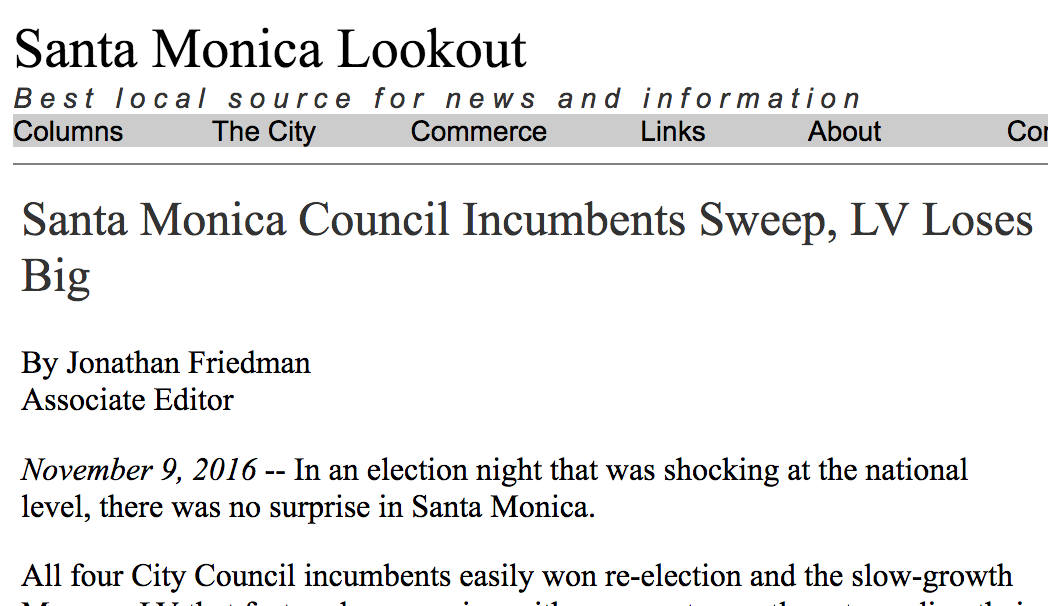
04-Screen Shot 2018-03-21 at 10.24.44 AM

In fact, what we’ve seen in the past two elections is that if SMRR withdraws its support from an incumbent it previously endorsed because SMRR’s anti-development wing sees the incumbent as too friendly to development, the incumbent — Pam O’Connor in 2014 and Terry O’Day in 2016 — nevertheless wins reelection. Meaning that following the views of SMRR’s anti-development wing has cost SMRR two seats on the City Council. It used to be that O’Connor and O’Day owed their election to SMRR; now they don’t.

05-Screen Shot 2018-03-21 at 10.28.14 AM

Getting beyond the politics of development and into the substance of development decision-making, the 13-year process—I have called it “Santa Monica’s long municipal nightmare” —to update the City’s land-use plans finally climaxed in 2017 with passage of the Downtown Community Plan, the “DCP.” We can at least hope that the DCP is the final major plan to come out of the process that started in 2004 with the update to the City’s General Plan. That process was supposed to take two years but took six. Then it took another five years to pass a zoning ordinance to implement the General Plan, then another couple of years for the DCP. Thirteen years—kind of amazing when you think that the plans themselves are supposed to guide the City’s development for only about 20 years. Not to mention that with the defeat of the Paper Mate project, which was the key project for redeveloping the old industrial properties near Bergamot Station, the most important parts of the General Plan update, which focused on the industrial zone, are now irrelevant. We may as well start over now, but the idea of another 13 years is frightening.

The DCP itself was an uneasy compromise. Pro-housing activists did in certain contexts get the theoretical possibility of more development, but by a 4-3 vote the council included financial burdens that developers say as a practical matter will prevent new construction.

In the context of the state and regional housing crisis, which has put on the spot anti-development politicians, especially who those consider themselves to be progressive, the council members who voted to impose the burdens on developers agreed to revisit the plan if it didn’t result in housing being built.

This has led to a de facto truce while people wait and see.

06-IMG_2001

In that regard, three hotel projects in downtown, including this one designed by Frank Gehry, are coming back with plans that conform to the DCP; but there is always discretion, and we’ll see if they get approved.

07-IMG_3454

At the moment there is considerable apartment construction going on under the old standards — this photograph shows the groundbreaking for an affordable housing apartment building on Lincoln that was financed by the developer of a market-rate project — but it’s still an open question whether anyone will build under the requirements of the new zoning ordinance and the DCP. So — stay tuned.

Going beyond the development wars, Santa Monica has a lot of purely political news recently.

For one thing, we’re seeing something that has not been much of an issue in Santa Monica for a long time, perhaps not since the days when Raymond Chandler channeled Santa Monica into his crime novels as the corrupt “Bay City.” I’m talking about political corruption, alleged, possible, and real.
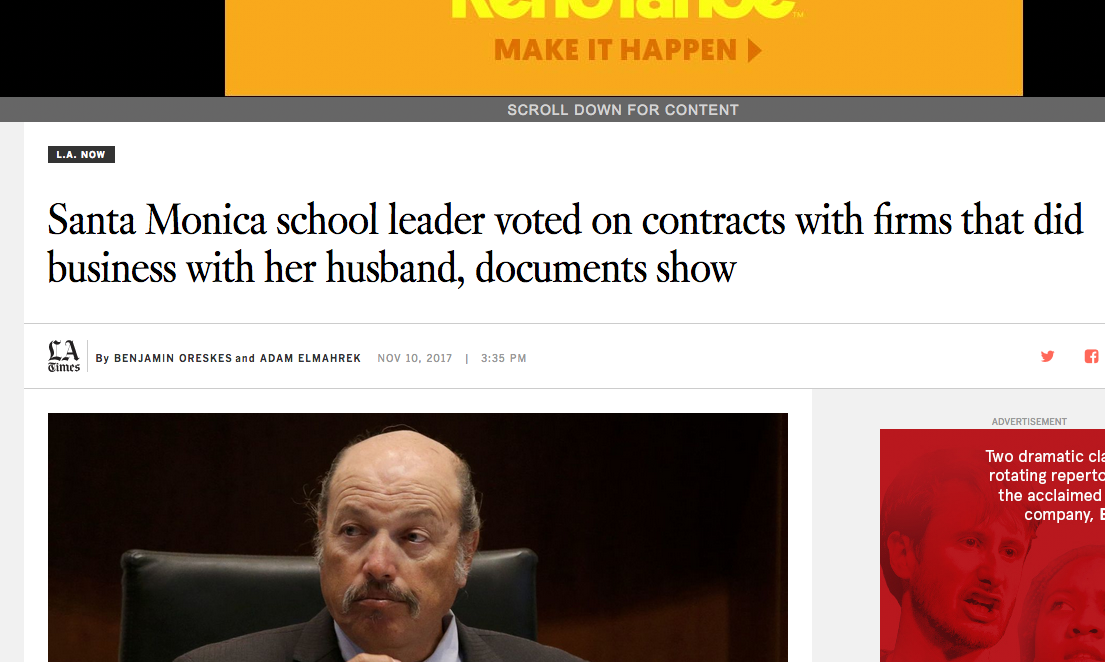
08-Screenshot 2018-03-20 14.55.02

One set of possible cases of malfeasance have been significant enough to garner coverage in the L.A. Times, not to mention investigations by the District Attorney, the California Fair Political Practices Commission (the FPPC), and the School Board. The allegations involve the Santa Monica power couple of City Council Member Tony Vazquez and his wife, School Board Member Maria Leon-Vazquez. While it’s been well known that Tony Vazquez has made his living as a political consultant and lobbyist, it was always assumed that he was careful enough to keep his day job out of Santa Monica. Well, it turned out that companies that he lobbied for to get school contracts applied for work in Santa Monica, and he at least neglected to tell his wife, the School Board member, so that she would recuse herself from voting on those matters, which she didn’t do.

09-Screenshot 2018-03-20 14.57.36

From there the investigation snowballed to include another school board member, and allegations of unreported income and gifts. It’s all being investigated now, so, again—stay tuned.
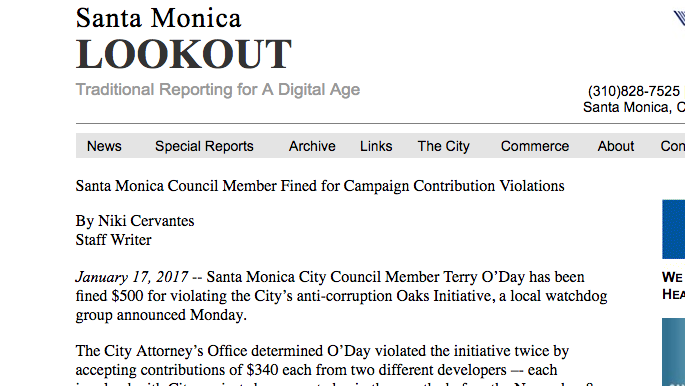
10-Screenshot 2018-03-20 16.14.56

Then there have been violations of the Oaks Initiative, a law the voters passed about 15 years ago that prevents public officials from benefiting from people or companies who received contracts or other benefits from the City while the official is in office. It’s like a retrospective, rearview mirror bribery law, and the law is complicated because it’s hard to keep track of who received benefits and the time frame for the restrictions. In the past few years the law has ensnared a couple of Council Members, Pam O’Connor and Terry O’Day, who received campaign contributions from disqualified contributors.

11-Screenshot 2018-03-20 16.05.24

But the most drastic impact of the Oaks Initiative was not on a politician, but on Santa Monica’s former City Manager, Rod Gould. After retiring from the City Gould accepted a job with a company that the City had hired while he was in City Hall, and Gould really paid a price for that. He was sued by the Santa Monica Transparency Project, a watchdog group that pays particular attention to the Oaks Initiative. Gould, saying he didn’t have the resources to fight the suit, settled the litigation by quitting his job and paying the Transparency Project $20,000 to cover their costs.

12-Screenshot 2018-03-20 16.22.50

The most manifestly illegal and corrupt political shenanigans, however, came from the Huntley Hotel, which sits on Second Street across from the Fairmont Miramar. The Huntley opposes the Miramar’s plans to rebuild and in 2012 the Huntley poured money into an extensive campaign to stop the Miramar project. Parts of the plan involved making illegal campaign contributions to City Council candidates and organizing and funding a fake grassroots residents group. It turns out that the FPPC was investigating, albeit slowly, and last year the FPPC hit the Huntley with penalties of more than $300,000: the second largest fine in the history of the FPPC. The Huntley’s scheme also involved the prominent law firm of Latham & Watkins as well as a former Santa Monica Malibu School Board member, Nimish Patel, who had his then law firm conceal illegal political contributions made by the Huntley. The FPPC fined Patel’s law firm $10,000, the maximum fine available to the agency.

I hate to say it, but from the Huntley’s perspective, the money, including the fine, was well spent. It’s six years later, and the Miramar has yet to get a rebuilding plan approved. The Huntley’s financing, organizing and energizing of the campaign against the Miramar revitalized the anti-development movement in Santa Monica, which, after the 2008 defeat of the RIFT initiative, had been relatively quiescent. The 2010 General Plan update had been approved by all the council members, including those from the anti-development side, and even the backers of RIFT generally accepted it. The plan update was the basis for the Paper Mate plan that Residocracy defeated in 2012, after the Huntley had fanned the flames over the Miramar plan.

Meanwhile, although it may seem like nothing ever changes in Santa Monica politics, two major changes to how Santa Monica chooses its elected officials are in the works. I’m referring to district elections and term limits.

13-Screen Shot 2018-03-21 at 10.34.33 AM

As for district elections, School Board member Oscar de la Torre has sued the City under the California Voting Rights Act saying that the City’s at large elections violate the voting rights of minorities, who, because of historical segregation, live predominantly in the Pico Neighborhood. (By the way, like me De la Torre has been a losing candidate for City Council.)

14-Screen Shot 2018-03-21 at 10.44.09 AM

Then this year activists from the Santa Monica Transparency Project—yes, the same group that sued Rod Gould over the Oaks Initiative—began a signature gathering campaign to put a term limits initiative on the ballot.

When it comes to these efforts to change the City Charter, I’m torn. Usually I’m in favor of district voting, so long as there isn’t gerrymandering, not only because it can diversify who is elected, but also because it’s easier for candidates to run in smaller districts. I usually oppose term limits, since in general I believe that anyone should have the right to run for office, and voters are better served by having more choices, not fewer. Also, as we saw was the impact of term limits on the California legislature, term limits can result in too much turnover, giving us legislators who lack experience and knowledge about how to govern.

So those are my usual positions. But as I said, I’m torn, because in Santa Monica the fact is that incumbents can stay on the council for as long as they want. This is not a one side or the other side issue: council members of all political persuasions have remained on the council term after term. So I’m thinking about term limits in a more positive way than usual, although I haven’t made up my mind.

But what about district elections? As I said, I usually favor districts, but I’m not sure we need them in Santa Monica. Why? Because those same council members who get elected over and over are so paranoid about not being reelected, that they try to please anyone who votes, and that includes, for all of them, residents of the Pico Neighborhood. In that sense, the neighborhood is well represented. And, if you include the school board and the college board along with the council, we have a good record of electing minorities. As a result, I don’t see the logic for the lawsuit, although if districting comes, it would make it less expensive and easier for new candidates to run, which would be a good thing in and of itself.

Now that there is, at least for a time, less of a political focus on development, what are the issues, more or less real, that face our community?
15-Screen Shot 2018-03-21 at 10.46.25 AM

How about crime? Rising crime is the issue that Residocracy and its leader, Armen Melkonians (also like me a two-time loser when running for City Council), are trying to use now to gain political power given that development didn’t work. Reported crime, particularly property crime, is up in Santa Monica over the past few years, and there have been some particularly violent crimes, including a murder and a home invasion, in normally low-crime, upscale neighborhoods that have people in those neighborhoods rattled.

16-Screenshot 2018-03-20 14.50.50

However, by historical standards, even with the uptick crime rates are down in Santa Monica. But the historical levels were quite high: I’m speaking as one whose homes have been burglarized twice. Yet I for one don’t sense that people are fearful as they move about the city, not as fearful as the cities I lived in before coming to Santa Monica, namely Philadelphia, Chicago and Boston. But maybe I’m missing something, and I don’t live in the Pico Neighborhood, where there has been gang violence going back decades. Significantly, however, gang violence has considerably decreased over the past four or five years, although in the past year or so there have been several shootings, including one murder, that have the hallmarks of gang violence although the victims are not necessarily gang members.

Let me make an aside here, which possibly ties local politics into national politics. Why is it that a political group that wants to gain power finds that it needs to focus on grievance? Residocracy is explicit that it’s looking for an issue that will motivate voters to vote based on fear. Yet by all measure, Santa Monica is a wonderful place to live — something the leaders of Residocracy will admit, given that they say they are trying to preserve Santa Monica the way it is. Let’s face it, the politics of fear and anger pervade our society, at all levels and, let me make this clear, all sides of every argument use the politics of fear, instead of promoting themselves on the basis of, dare I say it, hope and faith in the future.

17-Screen Shot 2018-03-21 at 10.13.29 AM

In any case, as for crime, the City has hired a new police chief, who was known to have reduced crime her previous job, in Folsom, and so stay tuned on that as well.

18-Screen Shot 2018-03-21 at 11.10.06 AM

Another issue is transit. In a certain sense, with the opening of the Expo line and its great success, this should be the new golden age of public transportation in Santa Monica. Those tens of thousands of Expo riders must mean that more people than ever are using transit in the city. However, those riders don’t count when the Big Blue Bus is tabulating its ridership, and that ridership is down.
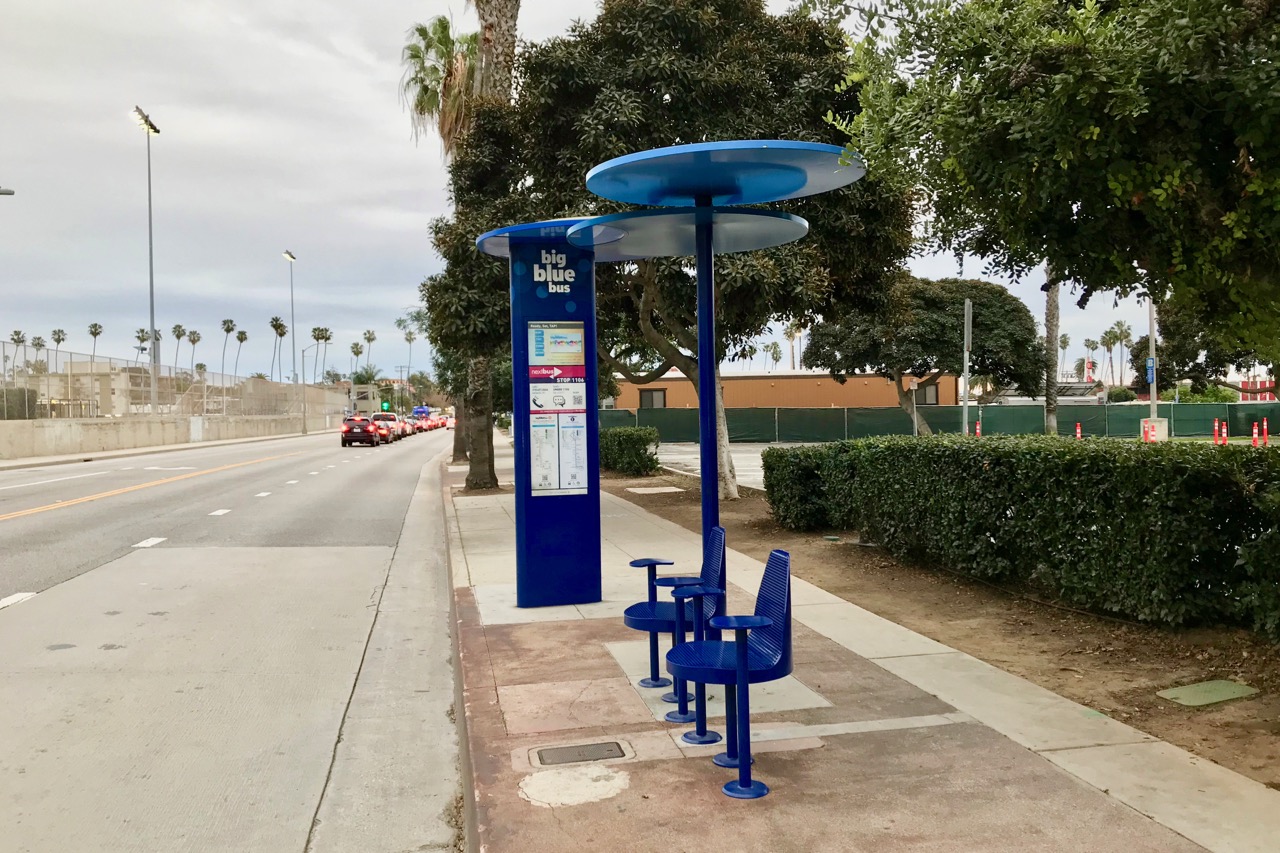
19-IMG_2147

This is a regional issue, as the same thing is happening with Metro bus service, but I can’t help being annoyed still whenever I see Santa Monica’ artsy bus shelters (if you can call them that), one of which you can see in this picture. Whenever I see them, which is all the time, I’m reminded that one of our council members, when voting for this design, said it was more important for the bus shelter design to be creative and—quote—whimsical than utilitarian. If you want people to ride the bus, you have to treat them like customers.

Another big issue is the future of Santa Monica Airport.

20-Screen Shot 2018-03-21 at 11.23.06 AM

The City and FAA entered into an agreement a year ago to close the airport in 2029. This timetable disappointed many opponents of the airport, including many like myself who want to turn the land into a big park, especially because if previous agreements with the FAA had been written less ambiguously, the City could have closed the airport in 2015. But as a settlement of confused litigation the deal made sense.

21-Screen Shot 2018-03-17 at 4.49.53 PM

And because the agreement allowed the City to shorten the runway, jet traffic has been drastically reduced—down about 80% from a year ago.

And another 12 acres have been opened up to park expansion. Because the City has taken over leasing at the airport, the City is making a lot of money from rents that will pay for some park construction and ultimately operating costs for the big park.

22-Screen Shot 2018-03-21 at 11.26.20 AM

But let’s face it, the big issue confronting Santa Monica as well as the rest of the region is homelessness, and that’s not getting better.

The title of this talk includes the question whether, as the immortal Tip O’Neil once said, all politics are still local. There’s no question that with homelessness you finally get the answer, which is — yes and no. Yes, because the attitudes of most voters are still made up most of all with how they see their own daily reality. But no, because those realities, whether they are homeless people living on the streets of Santa Monica, or abandoned factories in the Midwest, are products of decisions beyond the purview of any particular local government.
23-IMG_1774

Homelessness, which not only is a moral disgrace but also costs the City of Santa Monica millions in direct and indirect costs each year, is the product of a statewide housing crisis, state and national policies on treatment of, and funding for, the mentally ill, a catastrophic national policy on drugs, and other forces beyond the purview or pay grade of Santa Monica’s elected officials and staff.

Yet, the lack of ultimate power to effect change does not diminish our responsibility as citizens to continue to seek change. We need to solve the homeless crisis, or risk failing as a society.

Thanks for reading.