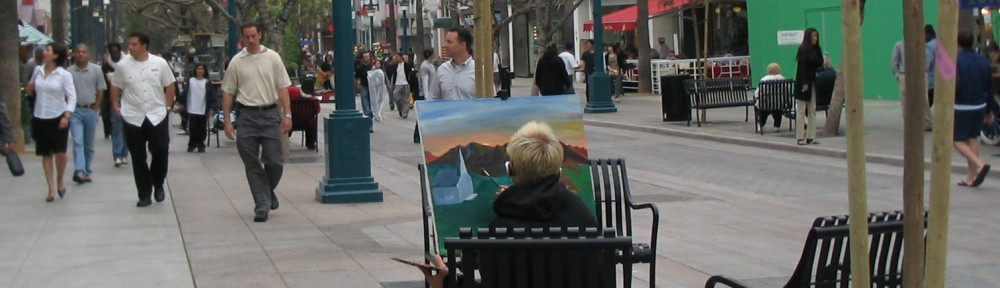
It’s the zeitgeist, stupid

There has always been a dance between local and national politics, a dance that can appear to take place in a maze of funhouse mirrors. That’s how Santa Monica politics in 2024 look to me. The electorate here is much different from that of the nation, but to a great extent I can’t differentiate between what I’m seeing on the local candidate mailers and the political commercials interrupting the baseball playoffs and the analysis that the national commentariat is producing.

Let’s begin with realignment. Nationally realignment of the political parties has been underway since the “Reagan Democrats,” but it accelerated when Donald Trump came down the escalator. In Santa Monica, realignment came abruptly with the 2020 City Council election, picked up steam in 2022, and this year was fully realized.

Realignment in Santa Monica means that the anti-development side, epitomized by Santa Monica Coalition for a Livable City (SMCLC), is no longer allied with its previous great benefactor, Santa Monicans for Renters Rights (SMRR). SMRR enabled candidates supported by SMCLC, such as Kevin McKeown and Sue Himmelrich, to get elected to City Council. But now after realignment, SMCLC has joined with business groups supporting candidates under the “Safer Santa Monica” banner (namely, incumbents Phil Brock and Oscar de la Torre, and newcomers John Putnam and Vivian Roknian) against the SMRR-backed candidates.

As a longtime participant in and observer of Santa Monica politics, the most, may I say, amusing manifestation of this break between SMRR and the anti-development crowd has been the dispute between McKeown, still a SMRR-loyalist, and SMCLC over the question about who is responsible for the housing development that’s coming to Santa Monica after the Change Slate-controlled City Council failed to file a compliant Housing Element. After McKeown wrote a letter to the Lookout blaming Changer Slaters Brock and De la Torre, Diana Gordon responded with one slamming McKeown. Breaking up is hard to do.

Meanwhile SMRR has formed an alliance with traditional liberal/progressive groups (the Santa Monica Democratic Club, Santa Monica Forward, Unite HERE Local 11, and Community for Excellent Public Schools) to support a “United Slate” of Dan Hall, Ellis Raskin, Barry Snell, and Natalya Zernitskaya.

Much of the national realignment – the part where working-class whites joined with hedge fund billionaires and military-adventurist neocons – never made sense to me, but there is a logic to the realignment in Santa Monica. Fundamentally, local politics changed when California largely took over planning for housing from cities. The development wars, which defined most of Santa Monica politics for 35 years, are over, or at least no longer have any reason for being (regardless of any residual rhetoric). There is nothing SMCLC can do now to stop housing development in Santa Monica, and they know it.

It is logical that a realignment occurs after fundamental issues change. What is uncanny to me is how Santa Monica’s quintessentially local, fine-grained, often personality-based politics reflect, even through a funhouse mirror, the national zeitgeist. I want to be clear that I am not saying that anyone running for City Council this year is a Trump supporter; so far as I can tell, all the candidates are Democrats who stress their Democratic credentials and support Kamala Harris. But consider these parallels when it comes to the rhetoric, if not the issues, of this election.

Crime and crisis. From the very name of the slate Brock and De la Torre put together after their former Change Slate running mate Christine Parra decided not to run for reelection, the “Safer Santa Monica” slate, you know that they are simultaneously feeding on and stoking the public’s fear of crime and disorder. In Santa Monica this includes feeding frustration about homelessness and stoking anxiety that Santa Monica is a failed city — much as Donald Trump describes every city north of Richmond or west of Ft. Worth.

(Side note: since the Change Slate has more or less had majority control of the City Council since McKeown quit the council in 2021, to be replaced by Change Slate-adjacent Lana Negrete, Brock and De la Torre might have thought that continuing with “Change Slate” would have caused confusion. Better to play the crime card and blame someone else. “Safer Santa Monica” indeed. Meanwhile, you can’t live in today’s zeitgeist without someone invoking “take back the city” rhetoric.)

Yes, there is crime in Santa Monica. There always has been crime – Santa Monica has every characteristic, good and bad, of American cities. Crime is significantly less frequent now than it was in 2019, but has steadily (but slightly) increased since the pandemic. Coincidentally that increase occurred during the years the Change Slate has been in control, but I am not blaming them. Honestly, the City Council has little to do with how much crime there is Santa Monica. Fortunately crime is rare enough here that when there is a violent act, it is still newsworthy, which of course is what sticks in one’s mind. Think of how Trump reduces the complex issue of immigration to isolated cases of violence perpetrated by immigrants.

But is Santa Monica a hellscape like the Safer Santa Monica candidates and their supporters would have us believe? I don’t think so.

Folks enjoying themselves on the Promenade on a recent night.

In at least one important respect Santa Monica is safer now. It wasn’t that long ago – I wonder if Oscar de la Torre ever reflects on this – that there were gang shootings here every year. In those days De la Torre believed in using social services, as opposed to heavy-handed policing, to end gang violence. He and the police union were foes. I remember that time well: I almost didn’t receive the union’s endorsement when I ran for City Council in 2014 because of a column I’d written in support of De la Torre when the police were investigating him in 2010. Now – talk about realignment – the police union has endorsed De la Torre and he is running on a law and order platform.

Homelessness is the shame of California, of our “civilization.” However, is it worse in Santa Monica because Santa Monica has been a leader in creating programs and, to some extent, in building supportive housing, to address homelessness? Absolutely not. Do the Safer Santa Monica people ever cross the border into Los Angeles? Where encampments are all over the place? We don’t have them in Santa Monica. Why? Because as I understand it, the Grants Pass Ninth Circuit case did not affect us, because we could offer shelter to unhoused people who would try to camp on our streets.

Does tougher policing reduce homelessness? The police in Santa Monica arrested twice as many unhoused people in 2023 (1840) as they did in 2021 (981); have you noticed any impact? Both crime and homelessness are societal problems that can only be solved with social change. Reactionary sloganeering will not generate beneficial change.
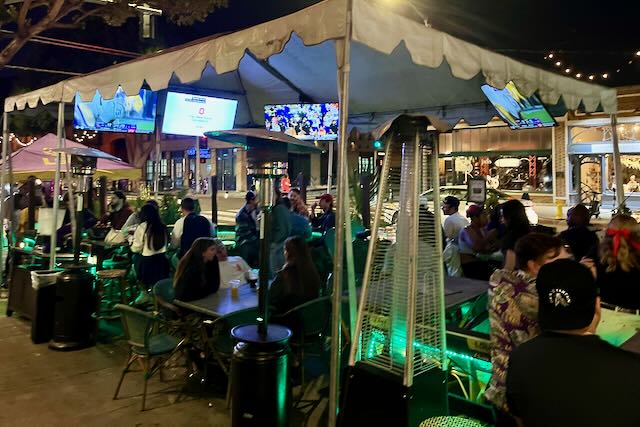
Young people on a recent night enjoying life on Main Street

As for the economy, sure, there are empty storefronts on the Promenade. Much of Santa Monica’s economy is based on hospitality and retail, sectors that the pandemic hit hard. Retail here and around the country is reeling from the disruption of e-commerce.

However, today Santa Monica is a magnet for hundreds of millions of dollars of investment. Look at all the cranes around town, with more on the way. Large apartment buildings, now permitted under state law, are planned or under construction. Google is bringing one of its first brick and mortar stores, and the first in the L.A. area, to the Promenade.

One of the first Google stores in the world coming to the corner of Broadway and the Promenade.

One of our major Ocean Avenue hotels has been undergoing a huge upgrade, and another, the Miramar, received its final approval for its complete upgrade Monday night at the Landmarks Commission.
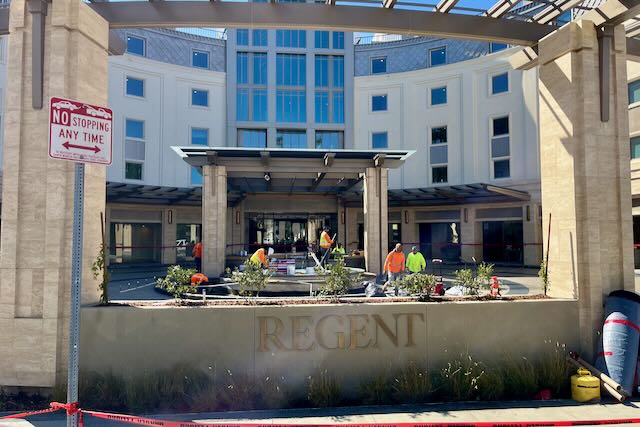
Workers putting finishing touches on the renovations at what will now be the Regent Hotel on Ocean Avenue.

Failed cities don’t attract investments like these.

And Cirque du Soleil is coming back to the beach.

Governmental competency. Switching over to an argument from the other side, the “United Slate” candidates charge that Brock and De la Torre, and their “Change Slate” colleague from 2020, Christine Parra, are not serious when it comes to governing; that they come to council meetings unprepared, not having read the staff reports, and waste everyone’s time in meetings that go on to the wee hours. Unfortunately, this is true. City Council meetings have become a mess. Instead of legislating, the Change Slate councilmembers like to grandstand, bringing to the vote hot button issues that the council has no power to act on, like distribution of clean needles. The obvious parallel is to the current Republican-controlled (meaning “controlled-chaos”) and unproductive House of Representatives.

The ”Deep State”/the “Establishment.” The MAGA universe uses the “Deep State” the same way it attacks journalism as “fake news.” There is a parallel in Santa Monica when the Change Slate candidates, now running under Safer Santa Monica, and their supporters like SMCLC refer to the United Slate candidates as the “Establishment.” This is consistent with decades of attacks on city staff from the anti-development side of Santa Monica politics. Experts are to be distrusted; only the wisdom of an imaginary consensus of “residents” counts (even if real residents consistently vote contrary to how the imaginary residents are supposed to vote).

I get it that since SMRR-endorsed candidates have usually had a majority on City Council for the past 45 years, and since during that time these majorities have molded City government to reflect a set of (liberal) values, that it is tempting to call SMRR and anyone it supports, or even other groups representing local institutions, like the School District, as the establishment. Sure, go ahead.

But using “establishment” as a political pejorative in 2024 in Santa Monica misses the point; doing so ignores who the candidates are. The candidates running this year with the endorsement of SMRR – Hall, Raskin, Snell and Zernitskaya – are insurgents within SMRR. They don’t consider themselves part of any establishment.

Other than Snell, who has served as an elected School Board and College official for years, the three other candidates are all a generation (or two?) younger than the leadership of SMRR. The four candidates could only get the SMRR endorsement after the collapse of the SMRR alliance with SMCLC and other anti-housing types, which effectively controlled the City Council for most years since the early 1990s. (The collapse was complete two years ago, when SMRR endorsed Jesse Zwick, Caroline Torosis, and Raskin.)

As younger Santa Monicans, the 2022 SMRR candidates and the candidates this year are running “post-development wars.” They take the need for more housing as a given, since they and their generational cohort need more housing options. They are in sync with the national zeitgeist on that, too: Kamala Harris has made building three million homes a major plank in her platform. These candidates represent a new generation of liberals, with high ideals about making Santa Monica work better for everyone.

I guess you know for whom I am voting: Hall, Raskin, Snell and Zernitskaya.

However, let me conclude on a less confrontational note. Sure, there is overheated rhetoric in this election – again, matching the national zeitgeist. But as Kamala Harris might say if she lived in Santa Monica rather than in Brentwood, we Santa Monicans have more in common with each other than we have differences. Santa Monica voters are going to vote overwhelmingly for Kamala Harris and Tim Walz. There is a lot of “narcissism of small differences” going around. As someone who has been involved for more than a decade in turning Santa Monica Airport into a great park, it is good to know that all the candidates running in the two slates support closing the airport and building the park. If you haven’t done so already, be sure to complete the current survey on the future of the airport land. It’s accessible here, and needs to be completed by Sunday the 20th. Be advised that the survey is a little complicated, but give yourself 15 or 20 minutes and you will be able to get through it.

Thanks for reading.


Approving a compliant housing element, post-Kevin?

Planning staff has released the first draft of Santa Monica’s Housing Element for 2021-2029, and tomorrow night the Planning Commission will have a hearing on the draft. The draft reflects input staff received from the Planning and Housing Commissions and the Rent Control Board, but primarily direction staff received from City Council at the council’s March 30 meeting. Even though the draft follows what the council said to do, people are speculating whether the council will ultimately approve the Housing Element in something like its current form.

That is because council’s direction to staff was approved on a 4-3 vote, and one of the 4 yes votes came from Kevin McKeown. Last week McKeown announced that he was quitting the council. He will be gone long before October 15, the date by which the council needs to approve a housing element and send it to the California Department of Housing and Community Development (HCD) for HCD’s review and, one hopes, its acceptance. If, as it looks now, we are headed to a special election to fill McKeown’s vacancy, the council will likely have only six members at that time. Even if the council appoints a replacement, it is, of course, unclear how the new council member would vote.  

Regarding the council’s direction to staff, the primary directive was to draft a “compliant” housing element. “Compliant” meaning a document that complies with, among other things, the City’s “Regional Housing Needs Allocation” (RHNA). The RHNA number is how many new housing units Santa Monica must find room for and allow to be built. For this housing element, the number is 8,895 residences of which 6,168 are to be affordable. As I discussed in a previous post, achieving this increase in housing units would entail an approximately 2% increase each year in the city’s housing stock. While the RHNA numbers have alarmed those in Santa Monica politics opposed to development, the draft Housing Element shows that this level of housing growth is something Santa Monica could handle easily. Financing the housing, particularly the affordable housing, is more problematic.

The RHNA numbers themselves, however, were not the reason that three council members voted against the motion directing staff to prepare a compliant housing element. Those three members, Phil Brock, Oscar de la Torre, and Christine Parra, seemed to be ready to vote for the motion (indeed de la Torre had already voted in favor of a slightly different prior motion that had failed), but they changed their minds at the last minute. That was when they realized that one part of the motion, an “affordable housing overlay,” would have allowed the construction of four-story deed-restricted affordable housing apartment buildings in single-family, “R1” zones.

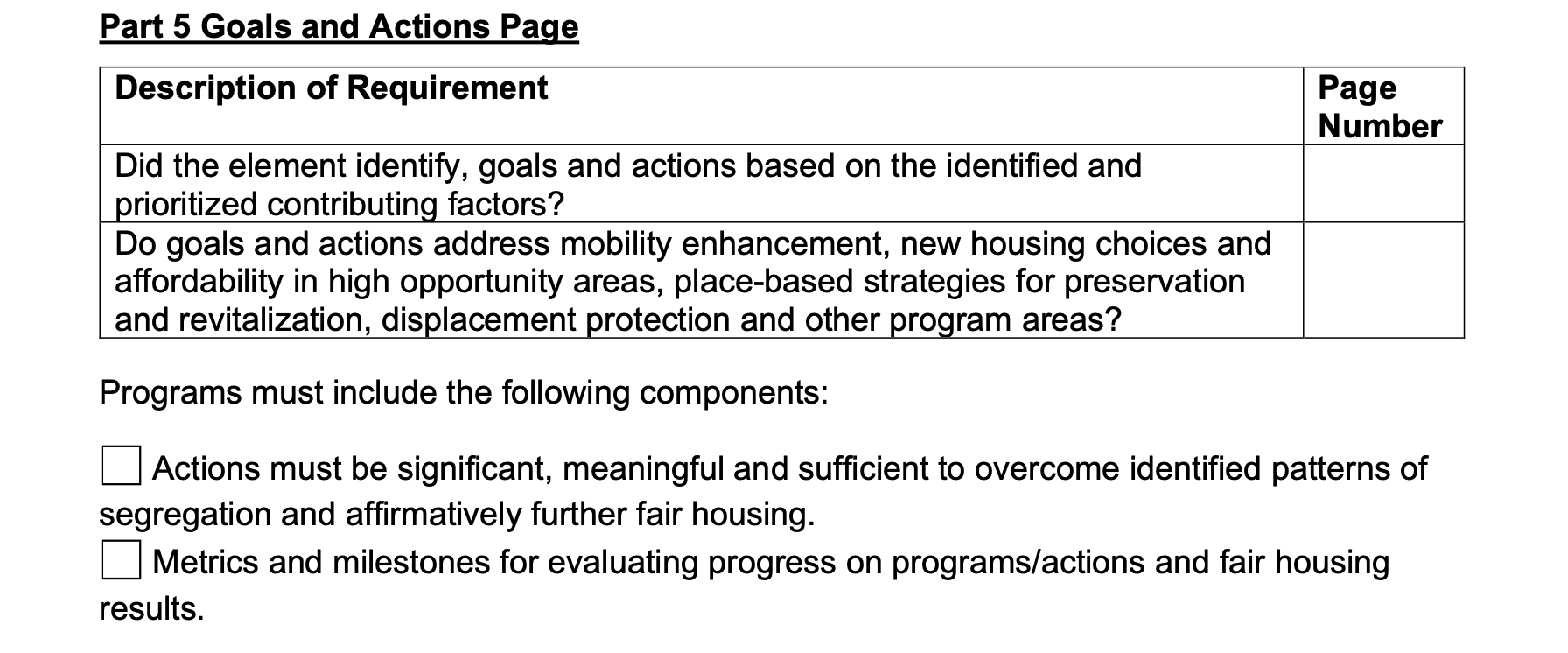
The opposition of the three to the affordable housing overlay could ultimately be a problem for approval of a compliant housing element. The overlay is part of a strategy to comply with a new requirement for housing elements. As of this year, housing elements must specify actions a city will take for “affirmatively furthering fair housing” (AFFH). In the context of Santa Monica, this means allowing for housing development, particularly affordable housing development, in districts where there are few people of color, which include the R1 districts. Thirty-five percent of Santa Monica’s area is zoned R1. That’s a lot of the city, and HCD is not likely to approve the housing element if it directs housing growth, especially affordable housing, everywhere but the R1.

Language from HCD’s checklist for preparation of housing elements relating to requirement for AFFH requirements, including providing “new housing choices” in “high opportunity areas” to “overcome identified patterns of segregation.”

After Mayor Sue Himmelrich made a motion with direction to staff that failed, Council Member McKeown made the motion, seconded by Himmelrich, that was ultimately successful. The motion included the overlay. Although McKeown said that he expected, because of the high cost of land in single-family zones, that it would be unlikely that affordable housing developers would build in the R1, when it came to the final vote on the motion, Council Members Brock, de la Torre, and Parra voted no. In the end it seemed that the image of a four-story affordable apartment next to a single-family house was something they could not stomach.

I will not try to predict how the Housing Element will ultimately deal with the AFFH issue and R1 zoning. However, and maybe this is surprising, I am optimistic that even a shorthanded council will approve something like the current overall proposal. Brock, de la Torre and Parra were elected last November on the “Change” slate. Although the slate did not run primarily on the issue of development, the slate’s candidates had (and still have) support from the most stringent anti-development factions in Santa Monica politics. Many in this faction still want to scrap the whole thing, RHNA numbers and all, and fight HCD. Nonetheless, based on what the three council members said March 30, they do not appear to want to challenge HCD with a noncompliant housing element. I hope not. Santa Monica passed an inadequate Housing Element in the early ’90s that was challenged in court. The City lost and ended up having to pay about $700,000 in the plaintiffs’ legal fees. No one should want to repeat that experience.

* * *

If someone had told me ten years ago that I would be unhappy if Kevin McKeown quit the council, I would have laughed. Now, however, I am sorry to see him go. As most liberals and people of good will who are elected to the Santa Monica City Council as no-growthers sooner or later do, McKeown ultimately found that his progressive values were inconsistent with the demands of increasingly shrill supporters who fear every change that might befall Santa Monica (other than the increases in their home values that come with limiting the housing supply). While McKeown never supported pro-housing zoning as much as I would have liked, in the last five or ten years he has opposed the worst of what the no-growthers proposed. Somewhat valiantly, against their opposition, he has supported efforts to expand the housing supply for the needs of today and the future. For this they have vilified him.

Still, I cannot resist a bit of schadenfreude. For his first 15 or 20 years in Santa Monica politics McKeown was among the crowd that besmirched anyone who believed in building more housing—people like me—as being “in the pocket of developers.” What should have been serious discussions about housing policy devolved into dime-store leftist tirades against “greedy developers.” Yet today McKeown is under attack from those same Santa Monicans Fearful of Change for whom he has carried so much water. And sorry, but I have to smile now to see the leadership of Santa Monicans for Renters Rights (SMRR), whose darling he was, whose Steering Committee he dominated, turn against McKeown. Who knows, but the last straw leading to McKeown’s resignation from the council might have been his motion to apply the affordable housing overlay to R1 districts. Apparently, at a meeting of the SMRR Housing Committee last Monday, the night before McKeown announced he was quitting the council, SMRR leadership rejected upzoning R1 to build affordable apartments.

Still, the last adjective I ever thought would apply to Kevin McKeown was “quitter,” and I’m unhappy he’s quit. Kevin McKeown as a council member was nothing if not conscientious. He showed up. The City Council, in dealing not only with the Housing Element but also with everything else post-pandemic and post-May 31, 2020, needs all the seriousness it can get. So does the city.

Thanks for reading.

Capitalists to the barricades!

This is another in my series of posts about the rationalizations that otherwise liberal voters use for supporting Measure LV. Of all of them, the one that is probably the most effective with voters tuning-in late to the issue is that LV must be progressive because those arch-capitalists, developers, are against it and spending big money to defeat it.

The reason is that after a century of ballot box governance Californians evaluate ballot measures by looking at “who’s for an’ who’s again’ ’em.” We all know that if tobacco companies or oil companies are against a measure, that tells you a lot.

With a progressive electorate here in Santa Monica, it’s always a bad sign if someone is going to make money one way or another. Although it’s generally okay here to make money producing movies, nearly every other capitalistic enterprise is suspect. The supporters of LV have made a big deal about developer profits, as anti-development activists have done for years. They’re constantly invoking the “greed” of developers, and they loudly denounce anyone who supports the building of anything as being “in the pocket of” developers.

But there’s no secret why developers are spending money to defeat LV. It’s because LV would put them out of business in Santa Monica. None of them are going to spend three or four years developing a project, only to put it up against the crapshoot of an election.

Say you had a business; what would you spend against a ballot measure that would close you down? Take this example: one of the founders of Residocracy is local realtor Kate Bransfield. What if residents, upset with how much they have to pay realtors when they sell their now multi-million dollar homes, put a measure on the ballot that would cap commissions at one half of one percent of selling price?

After all, back when homes in Santa Monica were bungalows owned by Douglas workers, realtors didn’t make nearly so much money. Realtors must be greedy if they want full commissions on the inflated prices of houses now. That money would better go into the retirement fund of the seller.

If such a measure got on the ballot, how much money do you think Bransfield and her fellow realtors would spend to defeat it?

Or here’s another example. Phil Brock, now a write-in candidate for City Council, last week wrote a S.M.a.r.t. piece for the Mirror (tellingly titled, “The Alchemy of Greed”) all about how developer “robber barons” had taken over Santa Monica, how they were spending big to defeat LV, and how voters had to pass LV to stop them. Brock’s day-job is running a talent agency, and presumably he runs it to make a profit. What if there were a statewide measure that would reduce talent agency commissions from the current regulated level of 10% to 5%? How much do you think Brock and his fellow agents would spend to defeat that?

It’s the shortage of housing in California that makes real estate development so profitable today, and the regulatory environment, including measures like LV, that make it so risky. It’s a perfect example of the risk/reward ratio in action. In America we rely on the capital raised by capitalists to build most housing, so if you get rid of developers, you’d better come up with a completely different system to house a growing population.

What’s incongruous about all this “to-the-barricades” anti-capitalist rhetoric from the LV camp is that it’s coming from capitalists, or at least from many people who are making money from the current housing crisis, namely homeowners in Santa Monica (and their realtors). It’s not only Bransfield: City Council candidate and Residocracy founder Armen Melkonians describes himself on the ballot as a “civil/environmental engineer,” but at at least one point in his life he was a developer of mansions in Bel Air.

It’s hard to take seriously any arguments the Residocracy camp makes against making money from real estate.

Thanks for reading.

How to build boxes on the boulevards

You may be familiar with the honor code of the Texas state legislature, as chronicled by the late Molly Ivins: “If you can’t drink their whiskey, screw their women, take their money, and vote against ’em anyway, you don’t belong in office.”

After reading the staff report for Wednesday’s Santa Monica Planning Commission hearing on certain proposed amendments to the land use and circulation elements of Santa Monica’s general plan (LUCE), I’m thinking that the Texas code is not sufficient for Santa Monica. Maybe we need to add another disqualifier:

“If you can’t ignore panicked reactions to angry residents, you don’t belong on the Planning Commission.”

After a six-year process overseen by the Planning Commission, a process that involved remarkable public involvement, the City Council unanimously approved the LUCE in 2010. Back then the LUCE was popular. Even anti-development organizations then involved in Santa Monica politics, normally skeptical of anything emanating from City Hall, approved it.

So what happened? New anti-development groups, notably Residocracy, emerged. New politicians, such as Richard McKinnon, John C. Smith, Armen Melkonians, Phil Brock, and ultimately Sue Himmelrich, none of whom had been active in the LUCE process, also emerged. They hitched their wagons to the anti-development movement.

At the same time, battles were being fought over downtown hotels, battles that didn’t involve anything in the LUCE, but which provided endless fodder for opponents of development. Poorly considered preliminary plans for the Miramar got the Huntley Hotel involved, and the Huntley became a financial and organizational resource for the new anti-development players.

Then in early 2014 the City Council approved the Hines Paper Mate project on a 4-3 vote. The Hines project followed the LUCE guidelines closely, but it was unquestionably large, and suddenly the anti-development forces had, literally, a big target. Worse, because the one big failing of the LUCE was that it allowed for too much commercial development near Bergamot Station, the Hines project would have placed a lot of jobs at a location that was already overwhelmed with commuter traffic.

After defeating the Hines project, the anti-development forces looked for more targets. They found some on the boulevards. Wednesday night the Planning Commission will consider stripping from the LUCE a few mild encouragements for building something other than retail boxes on our boulevards.

Specifically endangered are two potential “activity centers” on Wilshire, one at 14th and one at Centinela. There the LUCE would allow for small increases in development standards to encourage multiple property owners to join together to make better places for mixed residential and commercial developments by sharing parking, open spaces, etc. Pretty innocuous, really, especially since anything built under the activity center designation would be subject not only to the intensive public review of a development agreement, but also to the preparation, through a public process, of a separate area plan.

Similarly, development opponents want to eliminate, from most of the boulevards, “Tier 3” developments, which allow for more housing to be built but which require a development agreement.

The opposition to development along the boulevards from a few people, concentrated in neighborhood groups, has been fierce. The staff report includes euphemistic statements like “substantial community input has been submitted questioning the continued appropriateness of the Wilshire activity centers,” or that the LUCE’s tiers of development and development review, have “created community concern.”

“Questioning the continued appropriateness?” “Created community concern?” Now nice. But we’re not talking about a tea party—or maybe we are.

There’s a lot of anger in Santa Monica these days about development, but there’s no indication that the passion, though at times deep, is widespread. After all hubbub over Hines, the hotels, etc., leading up to the November election, turnout was abysmally low. Yes, the two candidates running for City Council who got the most votes, Kevin McKeown and Himmelrich, ran on anti-development platforms, but factors other than their anti-development support were more crucial to their victories. As it happens, neither one of them got even one-sixth of the registered voters in the city to vote for them.

No one in Santa Monica politics has a mandate and no one bestows them. Elected and appointed officials should vote according their own analysis of the facts, using their knowledge and expertise, not according to who yells loudest.

And they should respect the process. The LUCE isn’t perfect. It should be amended. The development standards in the old industrial areas should be changed so that all new development in excess of what’s there now should be residential. This would respond to the chief complaint about the Hines project, that it had too much office development and not enough housing. But if we’re going to amend LUCE, let’s have a real process, not just the Planning Commission and staff sending something to council in response to squeaky wheels.

Back in 2010 when some of us were arguing against how the LUCE encouraged office development around Bergamot, because we wanted to see more residential development, staff told us not to worry because residential development would be located on the boulevards.

Now with this possible capitulation to the anti-development side, the City might abandon the possibility of building significant housing along the boulevards. But in the “be careful what you wish for department,” the anti-development folks should consider what this would mean.

When properties on our boulevards turn over, as they surely will, if property owners build to Tier 1 standards (up to two stories, 32-feet high) to avoid discretionary review, what do you think they will build? There are two possibilities:

• Retail boxes on top of underground parking. On Wilshire, think Whole Foods or Staples.

• Or maybe two stories of offices, with a bank or brokerage on the ground floor.

If you’re concerned about traffic, what do you think generates more car trips, a bank or a store, or an apartment building?

Thanks for reading.