The local vote: preliminary post-mortem

Shell-shocked after the presidential vote, I’ve been slow putting my thoughts together on the local election. In fact, when analyzing local elections it’s a good idea to wait a few weeks until the final results are certified. The results rarely change (except occasionally in a close City Council race, as Ted Winterer will ruefully acknowledge), but until all the absentee and provisional ballots are counted, one can’t speak about important matters like total turnout, or how different neighborhoods voted.

But in the meantime I can make a few points.

The defeat of Measure LV. Again, the final numbers aren’t in, but it looks like LV, the “Land Use Voter Empowerment Initiative,” performed the same as its predecessor anti-development initiative, the “Residents Initiative to Fight Traffic (RIFT) did in 2008. RIFT got 44% of the votes cast on it, and right now LV is also at 44%. RIFT got about 36% of all votes cast—we won’t know that number for LV until we have the final returns.

While there are Santa Monicans who want no more development, and many residents who will vote yes on anything that promises to do something about traffic (and in a certain sense who can blame them?), there is a solid majority that does not want to plan by ballot box and/or will not arbitrarily restrict future development based on arguments about traffic or community character.

The vote was consistent not only with RIFT, but also with past votes to allow the development of affordable housing (in 1999) and to adopt the 1994 Civic Center plan. The last time a measure aimed against development passed in Santa Monica was the 1990 vote on Michael McCarty’s beach hotel. In the meantime, despite opposition from some elements of the anti-development side, Santa Monica voters have passed many bond issues and taxes, including this year’s Measures GS and V.

They want to manage change intelligently, but most Santa Monicans are not afraid of it.

The LV side has already blamed their loss on the big money spent against LV. But the 2014 vote on the competing airport measures showed that massive expenditures do not persuade Santa Monica voters. The aviation industry spent almost a million dollars, outspending the anti-airport, pro-park campaign by about six-to-one, but still lost overwhelmingly.

Santa Monica voters are sophisticated. Once they have enough information to make up their minds (which takes a campaign because most residents don’t pay attention to local politics), they make up those minds. The anti-development side can’t have it both ways – they can’t claim repeatedly and vehemently that only they represent the residents, and then consistently lose elections. Not, in any case, without implying that residents are ignorant dupes.

Perhaps Residocracy and the Santa Monica Coalition for a Livable City will take these results to heart and start describing themselves as speaking for “many” residents, which is powerful enough. I doubt it. Speaking for others is a hard habit to break. One might also hope that they would stop describing people who disagree with them as corrupt, but what was startling in this campaign was how viciously the LV’ers attacked opponents who had long been slow(er)-growth standard-bearers. All of a sudden stalwart controllers of growth like Kevin McKeown and Ted Winterer were the tools of developers, on the take. I tip my hat to them for taking the abuse; I hope that they are aware that they were only getting in the back what opponents of the no-change mindset get thrown in their faces everyday.

As for the City Council election, it was no surprise that the four incumbents won easily. The shocker was that Terry O’Day came in first. I assumed that since he was the only incumbent running without the endorsement of Santa Monicans for Renters Rights (SMRR), he would be the trailing winner. In my recollection, neither Bob Holbrook nor Herb Katz, the council’s longtime non-SMRR members, ever finished first. O’Day also voted for the Hines project. He came in first nonetheless.

This year SMRR didn’t endorse O’Day and two years ago SMRR didn’t endorse Pam O’Connor. Both were elected. But for elevating the development issue above all other issues affecting Santa Monica, SMRR would now be in a situation where all seven members of the council owed their election to SMRR, or believed they did. Instead, now SMRR is back to where it was when Holbrook and Katz were the two independents.

I’ll have more when all the votes are counted.

Thanks for reading.


LV: I take it personal

Over the weekend my son Henry wrote a note to his Facebook friends explaining why he felt so personally threatened by the candidacy of Donald Trump. Henry, who is getting a Ph.D. in Ancient History at an Ivy League university, has no personal reason to worry about Trump. He has a lot of “privilege,” which he’s well aware of, and he’s not going to need an abortion.

What he wrote was that he feels, however, that Trump is attacking him personally because Trump attacks the kind of place where he grew up, namely Santa Monica, part of greater Los Angeles, a dynamic, multi-ethnic metropolis. In his words, Henry “grew up in the America that Republicans fear, the America that Donald Trump attacks.”

Henry’s piece made me reflect on why I am viscerally opposed to Measure LV, here in Santa Monica. I’ve been writing about LV the past few weeks, focusing on the policy and political issues. Dry stuff. But as I thought about it, much of my reaction to LV comes not from my policy wonk side, but from my personal experience.

I consider LV an attack on two generations of Grubers: my father and my son.

Why? Well, as for my father, as my parents crossed into their eighties, they were living in Philadelphia, far from any of their three children. They were “getting up there,” but as always they were cleared-eyed about the future. They knew they would need help.

Based on new zoning Santa Monica had adopted for downtown in the ’90s, for the first time developers were building apartments downtown on land zoned commercial. I wrote a column about the new apartments after seeing a billboard advertising them. My folks read the column and asked me about moving here, into one of them. I encouraged them to do so, and in 2003 they became the first tenants in a new building on Sixth Street, a little north of Colorado.

The proponents of LV despise the apartments that have gone up in downtown Santa Monica over the past 20 years. They say they ruin the character of Santa Monica. But to my parents that apartment on Sixth Street has been a godsend. My mother died in 2007, but my father still lives there. At 95 he doesn’t get out much, and he has nearly 24-hour care, but the apartment has preserved his way of life.

The apartment has been a godsend for me, too. The apartment is three blocks from my office, and I have lunch with Dad three or four times a week, and brunch on Sunday. We go out to dinner often—one of our favorite places is a Japanese place, Ninjin, around the corner. I can’t imagine how things would have worked out if my parents couldn’t have moved here.

What about the other Gruber generation, i.e., Henry, that I say LV attacks? At some point in the hopefully not-to-distant future Henry is going to have his Ph.D. and, assuming universities are still teaching about the Romans, he’s going to be looking for a job. Little would make him happier than to get one in L.A.—because he loves L.A. and he’d love to raise his family in Santa Monica. Fortunately, there are many terrific colleges and universities here that might hire him.

But let’s face it—a generation ago, when many of the proponents of LV were buying their houses, a college professor could afford a house in Santa Monica, but today? Forget it: if you’re young and you’re not a tech millionaire, how are you going to buy a house here?

Okay, but Henry is “urban” enough that, like many in his generation, maybe he doesn’t need a single-family house. What about a condo, or a nice apartment? Under LV, those aren’t going to be built in Santa Monica. The City already, rightfully, does a lot to preserve our residential neighborhoods, and little will built in them. Our new zoning thoughtfully directs new housing to commercial zones, like along the boulevards and downtown, and on former industrial lands, where no residents are displaced and connections to transit are usually good.

LV, by design (its author, Armen Melkonians, told the City Council that Santa Monica doesn’t need more housing) will prevent that kind of housing from being built.

In the name of preserving the character of Santa Monica, a character that has been evolving for a century, and a character that for 60 years or so has seen most of the city’s population live in apartments, the proponents of LV wish my Dad’s apartment had never been built and wish that a future home for my son, a son of Santa Monica, will never be built.

Sorry if I take it personally, but LV is an abuse of the character of our city.

Please Vote No on LV.

Thanks for reading.

Truth and “The Truth We Know”

This week the Yes on LV campaign has distributed a flyer that itemizes the “lies” that the Yes campaign claims the No on LV campaigns have been saying about LV. The headline is “Don’t be Fooled by the Developers’ Lies!” The flyer has two columns, one listing the purported lies, and one listing the purported truths.

lv-flyer-column-heads

The wording of the second heading, “The Truth We Know,” is interesting.

Why isn’t the heading simply “The Truth”? If something is true, does it have to be qualified with “We Know”? Is a truth more true depending on whether we (or anyone else) know it? The answer is . . . no. Truth doesn’t depend on who knows it.

The use of “The Truth We Know” says something about the entire campaign for LV. LV and the support for it is all based on what the drafters and proponents of LV know, regardless whether what they know conforms with reality. When confronted with data that shows, for instance, that Santa Monica has limited development for 25 years, or with plain evidence, for instance, that City Council members do not always give developers what they want, or with eleven years of community process developing planning documents that carefully channel and restrict development, the LV supporters shake their heads: they know that the City Council gives developers whatever they want.

“Forget the birth certificate, we know he was born in Kenya.”

As it happens, though, most of the back-and-forth over what’s true in the campaign has to do with issues that are peripheral to the mess that LV would create. Take the contentious issues whether LV would require public votes on rebuilds of taller than 32-foot buildings after an earthquake, or on construction of various public buildings. Clearly it was an oversight that LV does not include exemptions for post-disaster rebuilds, etc., but even if LV included them, LV would still be a terrible way to plan the future of Santa Monica. But the No on LV campaign has made a big deal about these oversights because, let’s face it, LV looks pretty dumb because it doesn’t have them.

(I know that the LV campaign has a letter from the lawyer who drafted LV saying that LV does not conflict with the City ordinance that allows for rebuilds after disasters, but I’ve read that letter and it’s a classic case of “oops, let me try to cover my ass.” The lawyer tries to use language referring to “new development” in the pre-existing zoning law to make the argument that LV doesn’t apply to reconstruction, but that language is obviously superseded by LV language that applies the requirement for a public vote to “any project that exceeds the Tier 1 maximum limits.”)

It all gets back to “The Truth We Know.” The lawyer who drafted LV and her clients at Residocracy presumably know that LV contains a clause that gives LV priority over any existing law, including the one that allows for post-disaster rebuilds. Was she lying in her opinion letter, and were they lying in their flyer, when they wrote that the existing law would prevail over LV? I don’t think so. “Lying” requires a positive belief that one is not telling the truth, and by now it’s fairly clear that the Residocracy folks know what the truth is without caring about it. They know that the existing rebuild law would not conflict with LV, and for them that’s the truth.

For the rest of us, at least for those of us who follow philosopher Harry Frankfurt, what they’re saying isn’t the truth or a lie, it’s bullshit, because they don’t care if it’s true or false.

But then, bullshit is not unexpected or even out of place in politics. I haven’t reviewed all of the No on LV arguments, but it wouldn’t surprise me if the No campaigns have pushed arguments that are just that, arguments. Politics is an art, not a science.

But the Residocracy camp, which is responsible for LV in the first place, can’t complain when their outrage provokes more outrage (and more than $1 million of spending). It was their idea. To bring this to the first-grader level where it belongs, “they started it.”

They also can’t complain because their campaign is entirely based—every signature they got is based—on a huge, steaming pile of bullshit, namely that LV is an answer to traffic congestion.

“Tired of Traffic,” their lawn signs say, and I can’t improve on what former Planning Commission Chair Hank Koning wrote in a Daily Press guest column yesterday in response to that slogan. As I’ve written before, LV won’t stop development, instead it will channel it into by-right, get-the-permit-at-the-planning-desk, office and retail projects that fit into the Tier 1 envelope. These projects will provide no community benefits and they will create more traffic than the larger residential projects that LV will prevent from being built.

Architects tell me that this is happening already, as their clients are tired of multi-year contentious permitting processes, and instead building two-story office and retail projects. For instance, here’s a photo of the retail and office building going up now at Fourth and Broadway; originally, a mixed-use residential project was planned for this site.

4th-broadway-nov-2016

As for how much more traffic commercial projects generate, when it comes to research, I’m lazy, but Koning isn’t, and here are the numbers from his column:

[T]he 2 story, all-commercial option generates more traffic than the 4 story, mixed-use housing over retail. How is that possible? Let’s look at the Santa Monica PM peak hour trip generation rates for different uses per 1,000 [square feet]: Multi-Family Housing, 0.33 trips; Retail, 3.01; Office, 1.08; Medical Office, 2.98 (Santa Monica Transportation Impact fee nexus study April 2012).

In terms of traffic generated, it takes 3.27 floors of housing to equal 1 floor of office, and a whopping 9.12 floors of housing to equal a second floor of retail.

And you know what? We all know that these data confirm our own experiences, as we know that that more people enter and leave commercial buildings everyday than enter and leave residences.

Koning goes on to point out that in jobs rich Santa Monica, many of the new residents will have jobs here, and having them living here will reduce commutes into Santa Monica. By definition, since they will be residents, even if they commute to jobs outside of Santa Monica they will not contribute to Santa Monica’s worst traffic—commuters coming into the city in the morning and leaving in the afternoon.

What people in the no-growth community don’t understand is that people in the pro-urban community hate traffic more than they do. We not only hate being caught in traffic, we believe it’s a crummy way to live to be encased in steel for so much of the day, isolated from the community. We’re trying to reduce traffic, not only traffic congestion. The old ways you cling to increase both.

Thanks for reading.

Capitalists to the barricades!

This is another in my series of posts about the rationalizations that otherwise liberal voters use for supporting Measure LV. Of all of them, the one that is probably the most effective with voters tuning-in late to the issue is that LV must be progressive because those arch-capitalists, developers, are against it and spending big money to defeat it.

The reason is that after a century of ballot box governance Californians evaluate ballot measures by looking at “who’s for an’ who’s again’ ’em.” We all know that if tobacco companies or oil companies are against a measure, that tells you a lot.

With a progressive electorate here in Santa Monica, it’s always a bad sign if someone is going to make money one way or another. Although it’s generally okay here to make money producing movies, nearly every other capitalistic enterprise is suspect. The supporters of LV have made a big deal about developer profits, as anti-development activists have done for years. They’re constantly invoking the “greed” of developers, and they loudly denounce anyone who supports the building of anything as being “in the pocket of” developers.

But there’s no secret why developers are spending money to defeat LV. It’s because LV would put them out of business in Santa Monica. None of them are going to spend three or four years developing a project, only to put it up against the crapshoot of an election.

Say you had a business; what would you spend against a ballot measure that would close you down? Take this example: one of the founders of Residocracy is local realtor Kate Bransfield. What if residents, upset with how much they have to pay realtors when they sell their now multi-million dollar homes, put a measure on the ballot that would cap commissions at one half of one percent of selling price?

After all, back when homes in Santa Monica were bungalows owned by Douglas workers, realtors didn’t make nearly so much money. Realtors must be greedy if they want full commissions on the inflated prices of houses now. That money would better go into the retirement fund of the seller.

If such a measure got on the ballot, how much money do you think Bransfield and her fellow realtors would spend to defeat it?

Or here’s another example. Phil Brock, now a write-in candidate for City Council, last week wrote a S.M.a.r.t. piece for the Mirror (tellingly titled, “The Alchemy of Greed”) all about how developer “robber barons” had taken over Santa Monica, how they were spending big to defeat LV, and how voters had to pass LV to stop them. Brock’s day-job is running a talent agency, and presumably he runs it to make a profit. What if there were a statewide measure that would reduce talent agency commissions from the current regulated level of 10% to 5%? How much do you think Brock and his fellow agents would spend to defeat that?

It’s the shortage of housing in California that makes real estate development so profitable today, and the regulatory environment, including measures like LV, that make it so risky. It’s a perfect example of the risk/reward ratio in action. In America we rely on the capital raised by capitalists to build most housing, so if you get rid of developers, you’d better come up with a completely different system to house a growing population.

What’s incongruous about all this “to-the-barricades” anti-capitalist rhetoric from the LV camp is that it’s coming from capitalists, or at least from many people who are making money from the current housing crisis, namely homeowners in Santa Monica (and their realtors). It’s not only Bransfield: City Council candidate and Residocracy founder Armen Melkonians describes himself on the ballot as a “civil/environmental engineer,” but at at least one point in his life he was a developer of mansions in Bel Air.

It’s hard to take seriously any arguments the Residocracy camp makes against making money from real estate.

Thanks for reading.

LV does not stop gentrification—it encourages it

Of all the strained rationales that otherwise progressive Santa Monicans resort to for supporting Measure LV the one most difficult to understand is that LV will stop gentrification.

Measure LV is designed to stop the development that would be allowed under the general plan land use and circulation updates (LUCE) adopted in 2010 and the zoning ordinance passed in 2015. The proponents of LV argue that this amount and kind of development would cause gentrification. This development would mostly be, as most development over the past 20 years in Santa Monica has been, multi-unit housing downtown and in other commercial zones.

Under LUCE and the new zoning, housing development is expected to continue to occur at the rate of about 250 units per year, annually about a one-half of one percent increase over Santa Monica’s approximately 50,000 existing housing units. Under 1990’s Measure R, at least 30% of these units must be deed-restricted affordable to low- and moderate-income tenants. Under LUCE and the new zoning, nearly all of these units will be built on land zoned for commercial development, i.e., not in neighborhoods.

According to LV’s proponents, development of these residences would cause gentrification. Could this be true?

How to define gentrification has been the subject of much academic discussion, and the word is used in various circumstances. What people who fear gentrification in Santa Monica mean, however, when they use the term, and what they fear, is that previously low rents and housing prices in neighborhoods (chiefly the Pico Neighborhood) are increasing so as to be out of the reach of historically low-income residents. They fear that new residents with higher incomes are moving in, increasing pressure on housing costs, and displacing long-time residents.

The causes of this influx are Santa Monica’s increased attractiveness, such as has resulted from the rebirth of downtown over the past 30 years, the city’s good schools and other services, and the higher-paying jobs that came to Santa Monica as offices and post-production studios replaced factories. Residents concerned about gentrification even fear the effect of the Expo light rail (even as they welcome it): a neighborhood, Pico, that was once “across the tracks” now is “along the tracks” and near Expo stations, adding to the value of real estate and making apartments there more desirable.

There’s no question that housing costs have increased in Santa Monica, including in former low-rent districts like Pico. Rents and housing prices have been increasing all over the L.A. area, including in low-income areas, as a result of a housing shortage that has been much discussed, but Santa Monica has housing costs that are among the highest in California and thus in the country. (Santa Monica also has a lot of upscale apartments, which raise the average rent.)

These high rents have attracted developers. Starting about 20 years ago the City began encouraging developers to build apartments in commercial zones, particularly downtown. The purpose was to take development pressure away from neighborhoods. In the late ’80s and early ’90s developers were using the Ellis Act to tear down rent-controlled apartments and replace them with condos. The City made it more difficult to do that, and compensated (because state law said the City couldn’t block the building of housing) by encouraging residential development in commercial zones. The LUCE and the zoning ordinance continue these policies.

Do these developments drive gentrification? Do they increase rents in low-income neighborhoods, driving residents out? The answer is no, for several reasons.

For one, adding to the housing supply does not increase rents on old housing stock, even if high rents in new buildings raise the average rent citywide. This doesn’t mean that increasing the housing supply will necessarily lower rents, since rents are determined by many factors, including regional supply-and-demand and the attractiveness of a particular location, but if high-income people moving to Santa Monica have more choices for apartments, particularly new apartments, it’s less likely that these potential “gentrifiers” will seek to rent old apartments in historically low-income neighborhoods.

Conversely, not building new apartments, the purpose of LV, would increase the pressure on historically low-rent neighborhoods. If our theoretical gentrifiers can’t find housing in high-end neighborhoods, or in a “happening” area like downtown, they are more likely to look for something in Pico.

This is what has happened in Sunset Park over the past 30 years with single-family homes. Bungalows that once housed Douglas factory workers were purchased and upgraded and now go for millions of dollars. I.e., the neighborhood gentrified (to the financial benefit of anyone who held onto the old bungalow).

While there isn’t room in Santa Monica’s R1 zones to build more single-family homes, there remains room in commercial zones to build apartments and condos to take pressure off neighborhoods like Pico. (With the added benefit that replacing potential commercial development with residential reduces the growth in traffic congestion.)

There’s also a danger with LV that as single-family home prices continue to increase in Santa Monica, reflecting demand for home-ownership, and without the building of condominiums to absorb the demand, owners of rent-controlled apartment buildings will use the Ellis Act to tear them down and replace them with large, single-family homes, which can be built “by right” with no planning review. This is already happening in a few instances.

So, no, LV will not stop gentrification. Just the opposite.

Thanks for reading.


No denying: LV is anti-development

Last week I wrote about the disconnect from generally-accepted-progressive-urban-policies had by people who consider themselves progressive but who support restrictive development measures like Measure LV. These progressive policies, whether they come from the Sierra Club or the Obama Administration, promote “infill” development rather than sprawl, particularly in affluent urban areas like Santa Monica and the Westside where policies restricting multi-family housing and high housing prices have excluded low- and even middle-income households.

In reaction to this disconnect, supporters of LV who nationally support liberal politicians and progressive causes search for reasons to make LV fit into the progressive mold.

The most basic rationale is denial. Against all evidence, including the express intentions of Residocracy, there are people in Santa Monica who deny that LV would prevent development or, at least, deny that it would prevent good development (however that might be defined). This has been the basic argument of the “S.M.a.r.t.” group of (mostly) architects who now write a weekly column for the Mirror. They’re not against development they say, only “over” development that’s not “properly” planned, and they say there can be plenty of good development within the 32-36 foot height limit of LV.

This is usually expressed in hopeful generalities, such as this from a recent S.M.a.r.t. column: “For Santa Monica to continue to be a progressive, livable city, we must find a way to balance our priorities of growth and quality of life. Our transition to the future will be successful only if we can plan ahead properly and act with restraint.” (Apparently, the “way” to achieve this balance is to adopt an extreme measure that puts nearly all development over two stories to a vote.)

One problem with this argument, nice as it sounds, is that it runs up against Residocracy’s purpose, which to stop development. To my knowledge none of the key founders of Residocracy, Armen Melkonians, Tricia Crane, and Kate Bransfield, have ever supported any development other than single-family homes. Melkonians, going back to when he first ran for City Council in 2012, has argued that Santa Monica is a “full bucket,” to which nothing can be added. In May of this year, he told the City Council that Santa Monica doesn’t need additional housing.

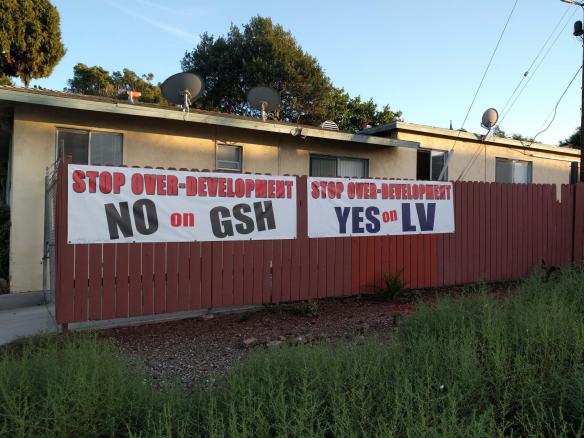
no-yes-photo

Not all supporters of LV consider themselves progressives: many oppose affordable housing as “over-development.”

Another problem with the S.M.a.r.t. argument is that LV is the opposite of “plan[ning] ahead properly.” Instead, LV is a nihilistic, fearful and angry reaction to good, forward-thinking and highly restrained, planning.

Residocracy created LV in response to 11 years of careful planning that began in 2004. The first six years were spent updating the land use and circulation elements (the “LUCE”) of Santa Monica’s General Plan. The LUCE directed new development away from neighborhoods, toward about five percent of Santa Monica’s land, land located downtown, along the boulevards, and in old industrial and other commercial zones. Talk about restraint. When City Council passed the LUCE in 2010, the slow-growth community in Santa Monica largely praised it. The next five years were spent drafting the zoning ordinance, which further reduced the amount of development allowed in the city.

All this planning resulted int policies and laws that would effectively convert land zoned for commercial development into residential development, thus providing needed housing and at the same time reducing the commercial development that generates traffic congestion.

Those eleven years involved much careful analysis, even more public input, and ultimately compromises that nearly everyone involved in Santa Monica politics, including politicians who had based their careers in opposing development, accepted. The only politicians who did not accept the outcome of this long process were those associated with Residocracy.

Residocracy’s response to the LUCE and the new zoning: We’re going to ignore all that, draft our own law, and get it on the ballot by telling people that they can sign here and stop traffic congestion. That’s planning ahead? Properly?

The result, if LV passes, would be the opposite of the “balance” that the S.M.a.r.t. writers say they want. Yes, many square feet can, and ultimately would, be developed under LV. But rather than go to the voters to get approval for a three or four-story apartment building on a boulevard, or a five or six-story apartment building downtown, development that would balance our priorities and improve our quality of life (by improving street frontages, improving walkability, etc.), any rational property owner or developer would slap up, by-right, with no review to speak of, a 32-foot tall retail or office development that would make the developer plenty of money and attract more drivers all day long.

Next: why opposing gentrification is not a reason to vote for LV.

Thanks for reading.

Local politics: disconnected

I spend too much time on Facebook, but I have learned a few things there. One is that there’s a disconnect between local politics and the other kind.

On Facebook there’s a daily conversation among a few hundred avid followers of and participants in Santa Monica politics. In the ocean of Santa Monica voters, we Facebook posters (and lurkers) are only a few fish, but the volume of the stream of consciousness can approach the flow of a river and the decibels of a waterfall.

The discussions can become, or even start out, heated. But what’s funny is that when it comes to national politics—namely, the presidential election—nearly all the Santa Monicans violently “commenting” at each other about the City Council, or Measure LV, or any other local thing, find themselves in agreement that electing Donald Trump would presage the apocalypse.

I might read a post from a Residocracy member that drives me crazy, but if I click on another link I might find out that this same person just posted a video about why Hillary Clinton should be president. This doesn’t mean that all Residocracy members or other supporters of Measure LV are liberals like me, as some of them don’t support affordable housing and from some of their posts one can detect various reactionary or libertarian views. Nor, by the way, are all opponents of LV liberals—it’s not surprising that there are  property or business owners, who oppose LV, who are conservative.

What one often notices from the pro-LV posts is an attempt to fit LV into a liberal, progressive ideology. Many LV supporters are convinced that stopping the building of market rate apartments will keep housing prices down. Their logic seems to be that because developers can charge high rents for the new units the rents on the new units will increase the average cost of housing in Santa Monica. That logic is convoluted, but okay, it’s a logic.

Then there is the greed of developers. There are times I’m on Facebook and I wonder if I’ve traveled back in time, to a Depression-era Leninist study group. Most pro-LV arguments ultimately devolve into calls to arms against those archetypal capitalists, real estate developers. It’s all about how obscene their profits are, or how high their rents are, ignoring the fact that they can charge high rents and make so much money because of the housing shortage restrictive zoning has created. (And anyone who opposes LV must be on the developer take.)

Hey, we live in a capitalist society. That’s how we assemble the capital it takes to build nearly all the housing in this country. Everyone in Santa Monica lives on a lot that was subdivided by a developer to make money, and most live in buildings built by them for the same purpose. (In Santa Monica many (but not all) of those who complain bitterly about the greed of housing developers also have opposed tax measures the City has put on the ballot to create public funding for housing, such as H and HH in 2014 and GS and GSH on this year’s ballot. Meaning that they are against both capitalist and socialist models of getting needed housing built. But then we also have residents who insist that they favor more housing, but who also insist that studio and one-bedroom apartments are too small and condominiums are too big. The privilege of the housed?)

I don’t doubt the liberalism of these anti-development Santa Monicans. The reason I don’t is that one can sense the anguish they feel when they are confronted with evidence that progressive opinion favors infill development in existing cities, like Santa Monica, to create livable, attractive cities that retain and attract investment that would otherwise go to sprawl. I.e., favors what LV opposes. There’s big cognitive dissonance when people who consider themselves progressive, especially Baby Boomers who were on the barricades in the ’60s, hear over and over that they are on the wrong side of history when they demonize urban development. On Facebook, you can practically hear the gnashing of teeth.

The progressive arguments favoring cities against sprawl began as a reaction against the negative consequences of suburban development. The Sierra Club, for instance, first adopted policies favoring infill development 30 years ago. Around the same time movements like New Urbanism and Smart Growth began to preach an anti-sprawl gospel that celebrated traditional urban neighborhoods. Like the proverbial ocean liner, the course of urban policies took a long time to correct, but the speed in the direction of good city building and away from sprawl is accelerating.

Our president, Barack Obama, has always favored urban investment as opposed to suburban development. Back in February 2009, shortly after taking office, he told an audience in Florida that, “[t]he days where we’re just building sprawl forever, those days are over.” Many of the President’s policies during his eight years in office have supported better urbanism, and last month his administration published a “Housing Development Toolkit” that combined explanations of many progressive urban policies in one document.

From a Santa Monica perspective, the toolkit reads like a manifesto against Measure LV and the “build it somewhere else” culture of restrictive zoning that spawned LV, with quotes that eerily describe the situation on the Westside in general and in Santa Monica in particular:

Local policies acting as barriers to housing supply include land use restrictions that make developable land much more costly than it is inherently, zoning restrictions, off-street parking requirements, arbitrary or antiquated preservation regulations, residential conversion restrictions, and unnecessarily slow permitting processes. The accumulation of these barriers has reduced the ability of many housing markets to respond to growing demand.

While the housing market recovery has meant growing home values . . . barriers to development concentrate these gains among existing homeowners, pushing the costs of ownership out of reach for too many first-time buyers.

Space constrained cities can achieve similar gains [in housing], however, by building up with infill, reducing the eyesores of empty lots and vacant or rundown buildings that go undeveloped in highly constrained regulatory environments.

Unsurprisingly, many cities with the highest local barriers [to building housing] have seen increases in homelessness in recent years, while nationwide homelessness has been sharply in decline.

The fact that liberals and progressives who support LV and similar anti-development policies are at odds with current liberal and progressive policies doesn’t mean that one should not be skeptical about those policies. One should always be skeptical; today’s pro-urban policies exist only because of skepticism about policies that were once considered progressive and had government support, such as urban renewal, modernist public housing blocks, and conventional suburban development.

Those policies created new problems, and those problems required new thinking. But to be progressive one has to believe in progress. You can’t be progressive if you favor nostalgia and fear change. But progress is conservative in that it must be based on trial and error, i.e., learning from one’s mistakes. Today’s progressive urban policies weren’t created from thin air. They arose from analyzing the mistakes of generations past, such as modernist planning (urban renewal, freeways, etc.) or conventional suburban development.

We can’t predict the future, but we can avoid making the same mistakes that previous generations made. One of those mistakes was building sprawl instead of investing in our cities.

Thanks for reading.

That boot dropped at SMO

Last week I asked whether the other shoe, namely an FAA boot, was about to drop with respect to the Santa Monica Airport (SMO), i.e., would the Federal Aviation Administration take action to stop the City of Santa Monica from further reducing aviation operations at SMO?

The answer came Monday, when the FAA served the City with a “Notice of Investigation,” accompanied by subpoenas. The FAA gave the City ten days to respond to questions as to whether City actions and policies, including a purported refusal to enter into leases with aviation businesses, eviction notices given to two “fixed base operators” (FBOs), and its own plans to take over FBO-type operations at SMO, violate federal requirements to operate the airport “on reasonable terms.” These requirements apply primarily because of the FAA’s own ruling that Santa Monica must keep the airport open until 2023 because of federal grants the City received in 2003 and “assurances” that go along with the grants. The City says the grant assurances expired in 2014 and has appealed the FAA’s ruling to the Ninth Circuit Court of Appeals.

What apparently motivated the agency to step in now, after the City has been chipping away at airport operations for more than a year, were eviction notices the City sent to Atlantic Aviation and American Flyers, the two FBOs that provide fuel at SMO, and the City’s plans to replace them with the City’s own operations, something the City, as owner of the airport, has the right to do. The City demanded that the two FBOs vacate by October 15. In its notice, the FAA “strongly recommends” that the City drop the eviction notices until everything is resolved with the FAA.

Based on language in the FAA’s notice of investigation, the investigation’s purpose is to provide the basis for the FAA to issue an order to the City to keep the airport running as it has been running, at least until the City’s litigation with the FAA has been resolved.

The FAA has also demanded that the City give the agency details about how the City plans to provide aviation services once the FBOs are gone. It’s the FAA’s position that the City must continue the same services as are provided there now, and that it must provide these services using its own employees. The City disputes that it has to provide the FAA with its plans, and it also disputes that it must provide the all the services that the FBOs currently provide. While it’s possible that these issues will be resolved informally with the FAA (the City told the FAA that it would “consult cooperatively” with the FAA), if the FAA issues an order based on its investigation, these issues will likely be litigated.

It’s presumptuous to suggest legal tactics without having access to all the information, but I can’t help but be reminded of the old tai chi adage that if you’re standing on railroad tracks and a train is bearing down, the way to stop the train from running you over is not to put your hands up and try to block it, but rather to step off the tracks. Meaning that it’s not in the City’s interests to find itself operating under the strictures of an FAA administrative order or, worse, an injunction. You never know how broadly an order or an injunction will extend.

It’s also going to take more than 16 days (Atlantic and American Flyers were told to vacate by Oct. 15) for the City to staff up for whatever FBO services it plans to provide. Many people want the City to close the airport immediately, but if the City evicts the FBOs and then offers nothing in the way of aviation services, that’s inviting an order from the FAA to freeze the status quo. If the City can’t go to court and show the judge a credible plan to maintain a reasonable level of aviation services, then there’s no way the City could get the order overturned.

It’s time for a little tai chi. The City should withdraw the eviction notices, as the FAA “strongly” recommends, to slow the FAA’s process down, and concurrently begin developing its plan to provide FBO services. The City can reinstate the eviction notices once it has its services plan ready to implement. One hopes this would forestall FAA direct action against the City during the time that the City is pursuing its Ninth Circuit appeal of the grant assurances case and as it gets ready for next summer’s trial in Federal District Court of the City’s action to confirm the City’s rights to close the airport.

* * *

In the good airport news department, Tuesday night the City Council approved concept plans for the expansion of Airport Park onto 12 acres of land that until 2015 were used to park airplanes. The park designers, Rios Clementi Hale Studios, will now proceed to develop detailed plans, with start of construction scheduled for 2018. City staff will now proceed to research funding options. Hint: Vote Yes on the County parks bond, Measure A on the November 8 ballot.

Thanks for reading.

SMO: Is a boot about to drop?

I became active in Santa Monica politics more than 20 years ago, and from the start of my involvement people told me that come 2015, the City would close Santa Monica Airport (SMO). That was when a 1984 agreement with the Federal Aviation Administration (FAA)—during which the City agreed not to close the airport—would expire. The City carefully timed the receipt of FAA airport improvement money so that its obligations (“grant assurances”) to operate the airport for 20 years afterwards would expire in 2014.

So much for plans. As 2015 drew closer, the FAA, which had told pilots and aviation businesses in 2000 that after 2015 the future of SMO would be a “local land use matter,” had a change of heart. In 2008 the agency told the City that the 1984 agreement had not altered an agreement the City had entered into in 1948 that said the City would operate the airport in perpetuity. Unfortunately, instead of immediately challenging the FAA on the 1948 agreement in court, the City pursued an aggressive but doomed strategy of trying to ban big jets, which ended in a costly defeat. Along the way, in 2003, the City accepted more money from the FAA, and failed to make it explicit that the new money did not extend the original 20-year period during with the City had to keep the airport open.

July 1, 2015, the final day of the 1984 agreement, rolled by and the City was not able to close the airport. For one thing, it was involved in an administrative action with the FAA concerning whether the 20-year grant assurances period had been extended from 2014 to 2023. After dragging its feet through its process, the FAA determined, unsurprisingly, that the City had to keep the airport open until 2023. The City has appealed that decision to the Ninth Circuit Court of Appeals, but that court is backed up and the City might not have a decision for two years.

With regard to the larger question whether the City would ever have the right to close SMO, it was only in 2013 that the City brought an action in federal court to clarify its rights under the 1948 and 1984 agreements. That case, after procedural setbacks and a then long wait while the Ninth Circuit Court of Appeals resolved the procedural issues, is now set to come to trial in August 2017, nearly four years after it was filed.

But the City has not done nothing since 2015. All the leases of City property (the City owns all land and buildings at the airport) terminated July 1, 2015, and since then the City has not entered into any leases with aviation entities, who therefore are operating under considerable uncertainty. The City has also made many aviation businesses at SMO much less profitable by taking from them the right to sublease space to other, often non-aviation, businesses. As a result of these and other factors, several important aviation businesses have closed up shop.

Since 2015 the City has had to explore an undefined boundary between what it could do to reduce operations at the airport and what actions the FAA would consider to be equivalent to closing the airport in violation of the grant assurances. At any time, the FAA could, or might, seek an injunction or take other actions to freeze operations at SMO until the courts had finally determined everyone’s rights, and that was something the City wanted to avoid. The City has done a good job avoiding FAA action so far, but we may have now come to the moment when the other shoe—an FAA boot—is ready to drop.

Recently—in August after the City Council announced its intention to close SMO as soon as it had the right to do so—the FAA sent the City a letter warning it not to do anything that would violate the City’s obligation to “operate the airport for public use on reasonable terms.” The agency warned that it had the right to issue orders against the City, or that it could go to court to seek an injunction.

The letter was a warning from the FAA, but by itself, without something triggering FAA action, it didn’t mean that much. After all, the FAA has held back so far, which I’ve interpreted as meaning they believed that there were risks in taking action against the City.

There may now be, however, the trigger. The City has now turned its attentions to the big fish at the airport, Atlantic Aviation, which is the FBO (“fixed base operator”) at SMO that handles the private jet traffic that has made SMO so unpopular. When the City Council announced last month its plans to close the airport as soon as legally possible, the council also voted to have the City become the FBO there, instead of Atlantic, by the end of the year. It’s not unlawful for the owner of an airport to be an FBO.

In response, last week Atlantic filed an administrative action with the FAA protesting the City’s failure to negotiate and conclude a lease with Atlantic to allow Atlantic to stay. The City responded to that by sending Atlantic an eviction notice. Then, on Monday of this week, Atlantic’s lawyers filed a motion with the FAA requesting that the FAA issue a cease and desist order to stop Santa Monica from evicting Atlantic.

What will the FAA do? Issue an order? Seek an injunction in court? Do nothing?

Thanks for reading.

When the sky isn’t falling

I’ve been mulling over an article I read in the Daily Press a couple of weeks ago. The article was about how the owner of Cars with Class, the classic car dealership in a storefront in the 1100 block of Wilshire, feared that he would have to close his business because the property had sold for $16 million, and he expected his rent would be raised to beyond what he could afford.

There are quite a few businesses I frequent near Cars with Class and I have often walked by and admired the merchandise—beautiful cars. If Grant Woods, the owner, does lose his lease, I’ll be sorry—not only for him, but also because Santa Monica will lose an interesting storefront.

IMG_2697

The showroom at Cars with Class

To be honest, though, it’s not worrying about Cars with Class that has kept me thinking about the article. Instead, there is a quote from Mr. Woods at the end of the piece that I found curious. Speaking to the reporter, Mr. Woods connects the possibility of losing his lease to the recent closure of another store in the area, J & T European Gourmet Food. J & T was famous for its Polish sausages and other meats and imported foods, and I often was a customer. I heartily agree with something Mr. Woods said, namely that “there are going to be a lot of people who miss it.”

But then Mr. Woods said something that was, as I said, curious. He said, “That’s the changing demographics we face.”

Changing demographics. Hmmm. What I found curious was, does anyone believe that the demographics of the customers at Cars with Class were the same as those of the customers of J & T? I’ve been in J & T a lot, and I don’t recall too many customers who looked like they were going to cross the street to buy a vintage Corvette or Jaguar.

This isn’t to say that the demographics of Santa Monica aren’t changing. They are. (In fact, the more people try to keep Santa Monica physically the same, the more its demographics change, but that’s a topic for another blog.)

But Mr. Woods’ explanation for why J & T moved and why he might have to move—“changing demographics”—exemplified a typical reaction these days to change no matter how routine. Maybe this has always been the case, but today it seems that everyone wants to explain every “micro” change, such as a business losing its lease, by placing it in the context of big, “macro” changes, like “demographics.” Call it creeping generalization leading to panic.

It’s like Chicken Little has become our national bird.

Businesses go out of business every day. The stretch of Wilshire from Lincoln to say, 17th Street, has dozens of bustling businesses of all kinds. The other businesses in J & T’s old building are still there. Put it another way: shouldn’t we expect that some properties are going to turn over each year?

IMG_2704

The building where J & T used to be; in the store third from the left.

There are other examples, too, in Santa Monica these days. Take the use of the Ellis Act to evict rent-controlled tenants. Every year some property owners use the Ellis Act to get out of the apartment-renting business. To some people concerned about gentrification, this has created a crisis. But is that the case?

First, let’s be clear—whether it’s a tenant losing an apartment today or a homeowner being foreclosed upon in 2008, it’s terrible to be displaced. It’s also unfortunate in a place like Santa Monica to lose old housing stock, which is typically in the form of fairly dense apartments, and for it to be replaced by either fewer units or even single-family homes. None of this is good, and we need policies that don’t make evictions easy and that provide evicted tenants with generous assistance with relocation, etc. We also need to build more apartments that displaced tenants can move to.

But in our society, where nearly all housing is privately owned, it’s not realistic that turnover can be stopped entirely. According to the most recent Housing Element of the City’s general plan Santa Monica in 2010 had 39,127 multi-family residential units, most of which were built before 1980. They are an unbelievably valuable housing resource, home to most of Santa Monica’s population, representing generations of investment by thousands of property owners, all of whom have their own financial goals and make their own decisions to achieve them. The tenants of 27,542 apartments are protected by rent control, yes, but most Santa Monica apartments were built with “sticks and stucco.” Is it realistic to believe that none will be replaced over time or in any given year?

Are we in an Ellis crisis? Again, that’s what some people say, but Ellis activity is down, way down. Here’s a graph from the Rent Control Board’s most recent (2015) annual report, showing Ellis activity from 1986 to 2015:

Fig 20 2015 Rent Board Rpt

The graph shows that other than the recession years of the mid-’90s, and one year (2010) that reflected the Great Recession, we are at an all-time low in Ellis activity. Fewer than 50 units in each of the past four years, out of nearly 28,000 rent-controlled units, have been removed under Ellis (and almost as many units previously Ellised were returned to rent-controlled status). All this at a time of booming investment in the building of apartments: the only conclusion to draw is that the City’s policies have successfully tamed Ellising (and steered real estate investment to commercial zones), but that, yes, no policy can be 100 percent effective.

This “sky is falling” syndrome has even infected Rick Cole, Santa Monica’s cool and calm City Manager. Recently, after some bad traffic days mostly associated with Pier Concerts and the street grid needing to “learn” to accommodate more pedestrians because of the success of the Expo line (i.e., good things), Mr. Cole wrote a blog about downtown Santa Monica traffic that was like a full-blown panic attack: “Our streets are jammed.” “We finally hit the tipping point.”

Come on. The tipping point to what? At least since the ’50s on big beach days Santa Monica has been jammed.

Beach_parking_on_July_17_1955_Santa_Monica_Calif

Beach parking in July 1955; courtesy Santa Monica Public Library Image Archives.

Ours is the most accessible beach for more people than the population of Pennsylvania. That beach defines who we are, who we have always been, and who we will be forever. I appreciate that City Manager Cole may have wanted to use his blog to list all the creative things the City is doing to deal with transportation, but our beautiful sky is where it’s always been.

Thanks for reading.