That other specific plan

Compared to other “specific plans,” such as the 1993 Civic Center Specific Plan, or the Downtown Specific Plan (DSP) currently being drafted, the Bergamot Area Plan (BAP), in the more than two years it has been in development, has not been controversial.

There are various reasons for this. One is that, in contrast to the DSP, the parameters for the BAP were included in the new land use and circulation elements of the general plan that City Council passed in 2010 (the LUCE). It also helps that those parameters make sense when it comes to converting an industrial district into a multifunction neighborhood surrounding a light rail stop located at a major cultural center (the Bergamot Station complex of art galleries). The BAP calls for breaking up super blocks with pedestrian- and bike-friendly streets and pathways and allows for moderate amounts of development.

Nonetheless, at the end of the day there are always issues, and when the City Council debates the BAP Tuesday evening, the council members will need to resolve certain matters. These aren’t challenges to the fundamental direction of the BAP, but they have to do with how the plan handles certain specific and important issues.

The issue that will likely engage council members most will be how to generate more affordable housing for people who work or will work in the Bergamot area. The council previously requested that planning staff study how to increase the affordability of housing to be built under the BAP. Staff responded with a report that largely defends the approach taken in the draft plan, which uses the standards in the city’s Affordable Housing Production Program (AHPP) for low-income housing, and other incentives, specifically development bonuses, to encourage developers to build workforce housing for households with incomes higher than AHPP levels but lower than the income levels needed to pay market rate rents in Santa Monica.

The council will likely want to see strategies for negotiating more affordability from developers. This is a good idea. The city is in a good position in these negotiations because the market to build housing in the region is profitable and stronger than the market to build offices.

However, because of the loss of redevelopment money, the city is in the bad position of needing to rely on developers to get affordable housing built. It is tempting to require that higher percentages of privately built units be affordable, but people don’t live in theoretical percentages of housing developments. A higher percentage of a smaller number of total units would mean fewer affordable units.

There is also a value to building market rate housing, which after all is housing that is also needed for people who work here. It’s one thing to talk about “market rate rents,” but if no one can build market-rate units, there isn’t a market for those units. If the higher end of the housing market can’t find housing, then that puts pressure on rents on existing units that might otherwise be affordable. This demand causes increases in rents throughout the city, but especially in neighborhoods near Santa Monica’s office parks, such as the Pico Neighborhood, the college streets, and Wilshire/Montana.

The council has the difficult task of finding the “sweet spot” that gives staff the power to negotiate for the highest levels of affordability, without at the same time preventing the building of housing.

Unfortunately, when the Council adopted the LUCE, it voted to limit housing to 50% or less of new development in the areas the BAP covers. Given that there are already so many jobs in the area and so little housing a better policy would have been to limit any increase in development standards above the existing commercial zoning to residential development. While the council is unlikely to amend the LUCE when passing the BAP, it might be a suitable moment to note that there’s nothing stopping a future developer who wants to build more housing to request a text amendment to the LUCE (and/or the BAP), much as the council said that downtown developers who wish to build higher than the height ultimately permitted under the DSP could ask for an amendment.

Related to this housing question is an aspect of the BAP that I can’t figure out, namely that it applies the lowest development standards in the district to the Bergamot Station area itself, i.e., the area that immediately surrounds the light rail stop on the south. The draft BAP had limited development in the whole area (which includes the area with the galleries, most of which the city owns, and two privately owned parcels on Michigan Avenue) to an FAR of 1.0. Furthermore, the BAP prohibits housing on both the city-owned and privately-owned parcels.

After pleas by Wayne Blank, who developed and operates the gallery center under lease from the city and who owns one of the Michigan Avenue parcels, the Planning Commission recommended increasing the FAR on the private parcels to 1.5. (In the rest of the BAP coverage area, maximum FARs range from 2.2 to 2.5.)

The BAP expresses the view that these low FARs protect the galleries, but I don’t see that. The BAP also calls for various enhancements to the area, including a structure for shared parking, and I wonder whether these can be paid for with the limited development allowed. (Although in a few weeks the city will receive proposals from Blank and other prospective developers of the city-owned property, and maybe I’m wrong.) We should protect the galleries by requiring that new development provide the same amount of square footage for galleries, at reduced rents, but the land nearest the station is not where we should have the lowest densities.

In the meantime, it is a waste of an opportunity to not include housing development in these areas nearest the Expo stop. In particular, the area on Michigan and near the galleries is a good location to encourage the building of student housing, given its proximity to Santa Monica College and the arts, culture and entertainment uses being developed in the area. Enrollment in the college, particularly from students outside the area, has increased over the past decades, but there never has been a strategy at the city level to develop housing for students.

Another issue that will come up Tuesday night is whether the BAP provides for parks and open space. The Recreation and Parks Commission, and some planning commissioners, argued that the plan did not do enough to secure parks, but I don’t agree. The plan has an excellent open space strategy, but one needs keep in mind that it is a plan and only a plan. What we’re dealing here with is private property, and until the owners of relevant properties want to develop, or until the city has money to buy property for parks, decisions to build parks have to wait.

At the present time the city already owns property that it has promised to turn into parks (Fisher Lumber and the Civic Auditorium parking lot). The issue is the money to build and operate the parks. In that context, the BAP articulates a good parks and open space strategy.

Thanks for reading.
Change is gonna come — no kidding

I don’t know about in your neighborhood, but in Ocean Park two “little free libraries” have popped up. These are boxes with roofs that hold books — people are free to take them to read, or they can drop off their own books for others to read.

Last week on a stroll I looked in one of them and grabbed a copy of Raymond Chandler’s The Lady in the Lake, his 1943 mystery that takes place all over Southern California, from the mountains above San Bernardino to Bay City, Chandler’s stand-in for Santa Monica. (Not coincidentally, the book was a “Santa Monica Reads” selection in 2012.) It’s been too many decades since I’d read my Chandler, and I thought it was time to brush up.

Great read, and I was as much gripped by Chandler’s take on Bay City as I was with private eye Phillip Marlowe’s solving the mystery. There’s no question Chandler uses poetic license — for instance, Marlowe gets thrown into jail on the twelfth floor of Bay City’s new city hall, but here’s what Marlowe says when he’s in that city hall:

It was a very nice city hall. Bay City was very nice place. People lived there and thought so. If I lived there, I would probably think so. I would see the nice blue bay and the cliffs and the yacht harbor and the quiet streets of houses, old houses brooding under old trees and new houses with sharp green lawns and wire fences and staked saplings set into the parkway in front of them. I knew a girl who lived on Twenty-fifth Street. It was a nice street. She was a nice girl. She liked Bay City.

She wouldn’t think about the Mexican and Negro slums stretched out on the dismal flats south of the old interurban tracks. Nor of the waterfront dives along the flat shore south of the cliffs, the sweaty little dancehalls on the pike, the marihuana joints, the narrow fox faces watching over the tops of newspapers in far too quiet hotel lobbies, nor the pickpockets and grifters and con men and drunk rollers and pimps and queens on the board walk.

Hey, when he’s talking about “the flat shore south of the cliffs,” that’s my Ocean Park — but Marlowe wouldn’t recognize it today. The City urban renewed the dives and the dancehalls off the map in the ’50s. (Chandler might get a smile from the Green Cross “marihuana” dispensaries across the line in Venice.)

I’m posting this because it makes me wonder once again — just when was it that Santa Monica was this “sleepy beach town” I keep hearing about? Certainly not when Marlowe was getting sapped on the head by the Bay City cops, which was also when the Douglas plant in Sunset Park was one of the biggest factories in the world, and I can’t think of any decade since when that description fits.

Or maybe even more significant, whatever Santa Monica was at any given time, whatever beach town characteristics it had or still has, I can’t think of any decade when it didn’t undergo significant change. It was never one, static thing.

I don’t know how many readers are among the 8,413 members of the “You know you are from Santa Monica if” page on Facebook, but I love the posts on it — people remembering what Santa Monica was like back then, whenever then was. What astonishes me, even as someone who has lived here 30 years, is how change happens all the time — yet you never quite perceive it. You can’t stick your hand in the same river.

Think of it — in the ’50s and ’60s came the big housing boom when thousands of apartments were built and Santa Monica reached its current population; the ’60s were when the freeway came in, and downtown Santa Monica declined, even after the City built parking structures and turned Third Street into a pedestrian mall; the ’70s were when, after Douglas Aircraft closed, Santa Monica’s economy began its move from manufacturing into offices, and office towers were built downtown; the ’80s were when new hotels were built, the Third Street Promenade opened, and single-family bungalows started selling to be torn down for mini-mansions; the ’90s were when the Promenade’s success remade downtown, and big office parks were built in the old industrial corridor.

Think about today, when the city continues to evolve. And, of course, the region around the city changes, too. And why not — as cities go, we’re young.

I can’t authoritatively say what form change should take, but I can authoritatively say that change will come because it has always done so, often in ways people don’t expect. One can’t argue against change by saying that there was ever an unchanging city.

Thanks for reading.

Who’s a Victim?

Development has been a big political issue in Santa Monica since the first SMRR-majority city council “confronted the Growth Machine” 30 years ago, but for a long time social issues, including rent control and the affordability of housing, and the multi-dimensional issues surrounding homelessness, were just as big.

Rent control and homelessness were hot button issues, but there are other issues, too, that were and are just as important as development. Poverty persists in Santa Monica, and a substantial number of residents, and even more of the workers here, classify as working poor. A decade ago the living wage was a huge issue in Santa Monica, and a real right to organize is still being fought for.

Then there’s what might be Santa Monica’s biggest problem — its persistent plague of gang violence. But 20 years ago not only gangs, but crime in general, and the perception of chaos (related to homelessness), were big political issues. (How many readers remember Ruth Ebner?

Education issues have also been big, including special education. Ten years ago Community for Excellent Public Schools led a virtual uprising to get more funding for the schools from the city.

You don’t, however, hear so much about these issues today, certainly when compared to all the talk about development. Yet, perhaps with the exception of the crime rate, which has declined substantially, no one can say that these issues are resolved. After years of debate, however, consensuses have emerged about how to deal with these issues (at least most of the time), and that’s why we don’t hear so much about them.

Why is it that development persists as the big, controversial issue? It can’t be because there has been “over-development” in Santa Monica, because, as I’ve written previously, there hasn’t been much development approved since The Water Garden 25 years ago.

Nor, rationally, could it be a matter of impacts on the city from development. When it comes to impacts, the marginal amount of development being argued about, compared to how much development there already is in Santa Monica and its surroundings, will have, even on a cumulative basis, impacts that are trivial at most.

There is a practical consensus to regulate development stringently, but unlike with the other issues, there’s never been a political consensus.

Why? Let’s face it — those who believe they are the victims of development are articulate and vocal, as compared, say, to the families who live in fear of gang violence, or the workers who can’t live here because of the lack of affordable housing.

The rhetoric of victimhood feeds on itself. Take this quote from a recent “Our Town” column in the Santa Monica Daily Press, where the column’s author (Ellen Brennan) defines for her readers the word “stakeholder” as the City’s planners use it to identify those who are consulted on development decisions:

“In Santa Monica real politick, stakeholders are developers and their allies, the Chamber of Commerce land use committee, and certain political cliques who exert undue influence behind the scenes.”

What’s missing here is any acknowledgement that the anti-development movement is the most powerful force in Santa Monica politics. I can understand the political strategy never to admit victory, so as never to let up, but when you consider that there has been hardly any new commercial development in Santa Monica approved for 25 years, at some point you would think that the people who accomplished that would celebrate.

(Yes, there has been a significant but modest uptick in the amount of residential development in Santa Monica (from about zero 20 years ago), mostly downtown, but housing development has not been controversial. The sensible center of the anti-development movement (and yes, there is a sensible center, and it has included nearly all the city councilmembers elected with anti-development support) has never opposed housing. For instance, the RIFT initiative in 2008, which sought to bring ballot box planning to Santa Monica, did not apply to residential development.)

Consider some of the victories the anti-development folks have had. I wrote a few weeks ago about how 450,000 square feet of development was removed from the voter-approved Civic Center plan after the city bought 11 acres from RAND. Then in 2001, there was the battle over the Target store proposed for downtown. The anti-development faction certainly won that battle: only two councilmembers, Pam O’Connor and the late Ken Genser, voted for it.

(Funny thing about Target, but these days it seems like nearly everyone wishes the council had approved it. Now that the department stores downtown are Nordstrom and Bloomingdales, there’s not much middle-class shopping in Santa Monica, and people don’t like to drive Lincoln Boulevard to Costco. Appreciation of convenience trumps fear of traffic. But this phenomenon of changing one’s views about development happens. Recently I have heard from people who say they opposed the building of the NMS apartments at Lincoln and Broadway (the complex with the Quonset hut), but now that the apartments have been built, with the little plaza and coffee shop at the corner, they like it. But changing one’s mind about a prior development controversy rarely changes one’s views about the next.)

And let’s not forget, the LUCE was an anti-development victory. When it passed, on a 7-0 vote at the Council, the anti-development faction was pleased overall. And why not? The LUCE protected 96 percent of the city from increased development and mandated heavy costs, and discretionary review, for any significant development in the other 4 percent. Now that there are plans to build some of what little can be built under the LUCE, the same people now say they were betrayed by it.

Yes, let’s have robust discussions about how much development should take place in Santa Monica. But it might improve the dialogue if the winners would stop claiming to be victims.

Thanks for reading.

In the wee hours . . . wisdom?

I’m inclined to consider it a missed opportunity for comprehensive planning, but the fact that both developers and the anti-development faction in Santa Monica politics seem happy with the City Council’s decision last week to limit environmental review of the Downtown Specific Plan to building heights not exceeding 84 feet might be a sign of clear-sighted wisdom on the council’s part.

What the council did was limit the scope of the EIR to 84 feet, but made it clear, and no one on the dais objected to this, that developers had the right to seek amendments to the DSP if they could show that their taller projects would be worth it to the city to approve.

I suspect that this suits the druthers of any given developer, who would rather argue the merits of his or her specific project than get caught up in an abstract (and emotional) discussion about building heights in general, and those of the anti-development community, who wouldn’t like it if (and note I said if) environmental review showed that taller buildings didn’t themselves create much in the way of environmental impacts, and then that shifted momentum in favor of heights before the issues of aesthetics and values could be discussed.

My initial reaction is that the council’s decision precludes the kind of comprehensive discussion we should have about a decision to allow taller buildings, but I can see two reasons (at least) why I could be wrong:

One is that maybe comprehensive planning is overrated. The most beautiful, livable and joyful cities of the world became such more often because of the accretion of many individual decisions rather than by the imposition of plans (although over time successive plans are themselves discrete decisions), and so perhaps focusing the review process on individual projects will be a good thing.

The other is that the crucial decisions about height are not evaluated in an environmental impact report (EIR), particularly one for a general plan. Consider the three criteria that Council Member Kevin McKeown has articulated as relevant to a decision about height: aesthetics, impact on the street level, and community values. None of these criteria, except possibly aesthetics in a cursory manner, would be part of the EIR for the DSP.

So maybe I’m wrong about the comprehensive environmental review — but I still say we should have a community discussion about the aesthetics of height and the values issues implicated by height that is independent of any given project.

Regardless how wise the council members were or might have been Tuesday night, they were admirable in how they handled the matter. There they were in the wee hours after hearing hours of conflicting and often passionate testimony, including accusations of some of them being corrupt, and they coolly and sensibly considered the matter before them.

Consider the surprising ways the discussion went. Gleam Davis, one of the council members unfairly vilified as a tool of developers by some members of the anti-development community, made the motion to limit environmental review to 84 feet. Terry O’Day, also a target, seconded the motion. Ted Winterer, one of the favorites of the anti-development side, proposed an amendment to extend an FAR bonus to projects that provide traffic mitigations, and anti-development stalwart Kevin McKeown forcefully reminded everyone (including those in the anti-development camp who don’t believe we need anything) that we “need housing.”

It was great. And what makes me even more happy? I don’t have to write about building heights for a while.

Thanks for reading.

Some are brave. I’m just curious.

In Santa Monica politics, you’ve got to be brave to support a planning staff recommendation, and I have to extend the profile in courage award to former mayor Mike Feinstein, who did precisely that last week when, in a Guest Opinion in the Lookout, he supported staff’s recommendations for what downtown heights to study in the environmental review for the Downtown Specific Plan (DSP).

Readers might remember that in June Feinstein and I sponsored a forum to discuss the height issue. We wanted to try to focus on the momentous decision whether to change Santa Monica’s 30-year policy banning tall towers, separating it from issues that relate to development in general.

In that connection I was pleased over the weekend to hear City Council Member Kevin McKeown express the matter succinctly and well. He said that when it came to height, there were three issues: the aesthetics of height in general, the impact of height, negative or positive, on urban design at street level, and the “values” issue, i.e., whether granting more height for one purpose or another (such as high-end condos or luxury hotels) violates the way a community looks at itself.

What are not issues about height are, for instance, traffic, since a square foot of X is associated with same amount of traffic whether it’s on the third floor or the 20th, or tax revenues, since successful hotels and businesses and residential developments can be built in buildings eight floors or less, too.

As I’ve written before, I believe City Council should direct staff to expand the heights studied in DSP environmental review. Why? Because I’m curious.

But first, how high should they study? Feinstein in his article makes the point that once you decide to study higher heights, there is no logic about where to stop. I disagree. The rationale I would suggest for the DSP is to study up to the heights of existing buildings, since it’s beyond unlikely that we would ever approve going higher than what is already here. This rationale is no more arbitrary than staff’s cutoff of 135 feet, which they said was chosen to preserve views of the Clock Tower Building; I call that arbitrary, because a short, squat building is going to block more views of the Clock Tower than a tall, skinny building of the same square footage.

In fact, for most of downtown, my measure would support the staff’s recommendations, or something close to them. There are few buildings north of Wilshire or east of Second Street that exceed the 135 feet (about 12 stories) that staff says it wants to study for the so-called opportunity sites. There are quite a few buildings around that height (including the existing tower at the Miramar) and a few higher than it (such as the Huntley Hotel), but I can’t think of a compelling reason to study higher than 135 feet in those areas of downtown. (Yes, this means that my instinct is that the Miramar should go back to its original idea of capping its new development at 12 stories — but it should move the new height (after replacing its existing tower) away from California and Second Streets to Wilshire.)

For the record, I’ve always been in favor of the 1980s’ height limits and in the five- to six-story downtown that’s been under construction since they were enacted. I like the “pre-elevator” look and scale of buildings that high. And I opposed the proposal to build 22-story towers at Santa Monica Place. So, what am I curious about now?

I’m curious about the area south of Wilshire and west of Second. This is where there is already a cluster of towers. Not that they are good buildings, and it’s understandable why 30 years ago in reaction to them the newly-elected SMRR majority on City Council enacted a ban on high-rises. But the problem with those towers (aside from, in most cases, unimpressive architecture) is more a matter of scale than height itself.

For instance, I just learned that the old GTE building, 100 Wilshire, designed by Cesar Pelli, has a floor-to-area ratio (FAR) of fourteen. Fourteen! By comparison, the whole Miramar development would have an FAR of 2.9, and the hotel/condo project Frank Gehry is designing would have an FAR of 2.6. It’s impossible that those projects could create a wall like the one that now exists on Ocean Avenue from Wilshire to Arizona.

In fact, architects and urban designers have learned a lot since the ’70s. They know now not to build towers in isolated parks, and we all have learned not to build massive towers that take up whole blocks.

When urban designer Stefanos Polyzoides spoke at the forum Mike Feinstein and I sponsored in June, the first thing he said you have to consider when deciding whether to build a tower is what would it replace. When I look at the blocks along Ocean south of Arizona, where two towers have been proposed, I see some sites where replacement would be good.

There’s the site of the Gehry-designed project, which is mostly a parking lot, and there’s the old Holiday Inn. The latter is not only a nondescript box, but access to it is going to be a problem when vehicles will have to cross the ultra-widened sidewalk of the new Colorado Esplanade to get to it. It’s a site that cries out for something new.

I don’t know how high the developers should be allowed to build, but I’d like to see higher heights studied because perhaps they will allow for the building of something better than we have now. And I’d like to see these heights studied as part of the DSP, because I’d like to see the cumulative impact two or more towers would have.

As I said, I’m curious.

Thanks for reading.

Santa Monica and Santa Barbara: Not the Same

The policy of mixing market-rate housing with affordable housing has been not only accepted wisdom nationwide since the debacles that standalone public housing created in the ’50s and ’60s, but also a policy goal in Santa Monica for a long time. Santa Monica voters enacted Prop. R in 1990 to require that 30% of all housing in the city be affordable and from the first ordinance that implemented the law Santa Monica has pushed the goal of building affordable housing with, or in close proximity to, market rate housing.

Surprisingly this “inclusionary” policy was challenged last week in a column, “Community benefits do nothing for the community,” from the “Our Town” collective at the Daily Press. In the column, Our Town writer Ellen Brennan argued that mixing low-income and luxury housing is “not a recipe for healthy neighborhoods.”

But maybe Brennan’s opposition to inclusionary housing is not surprising because in the column she also blasts three council members backed by Santa Monicans for Renters Rights (SMRR) for pushing for more development downtown because they believe in a SMRR “dogma” in favor of building affordable housing.

Note to Brennan: affordable housing is not dogma in Santa Monica, it’s the law, and it’s the law because the people passed Prop. R. And then in 1998 they passed another measure authorizing Santa Monica to spend money building affordable housing, and in the latest opinion survey Santa Monicans said that affordable housing was the top community benefit they wanted to see from development.

Before I criticize Brennan’s column more, however, let me say that I have a lot of respect for her. We’ve even agreed occasionally, and in any case she’s been an articulate and gracious participant in Santa Monica politics, which prompts a relevant digression.

Which is that readers may detect a trend. In the blog I posted last week I also took pains before disagreeing with Denny Zane and Mike Feinstein to say admiring things about them. You might be thinking, “Oh, Gruber, he’s just trying to make nice to people he’s going to bump into on the street.” Or worse, “Gruber – typical politician.” In fact there’s a substantive point I want to make, which is that despite the hyperbole to the point of vitriol and the wild accusations that can fly around (welcome to local politics anywhere), the level of discourse in Santa Monica is high. There are always intelligent and articulate people on all sides of any issue, and over the decades Santa Monica has been a well-governed and progressive city because people listen to each other and make compromises. It helps that anyone who gets involved in more than one issue knows that the person you’re violently disagreeing with today about X is your ally tomorrow about Y.

I say that this is a relevant digression because what’s happening in Santa Monica lately (although not by any means for the first time) is that the rhetoric has become the lead story, not the underlying decisions that have to be made. People are focusing on the box, not what’s in the box (let alone what’s outside the box).

Okay, end of digression, and having said that, I’ll say right away that I disagree with nearly every word of Brennan’s column.

Why? Because Brennan bases her reasoning on a false understanding of what Santa Monica is.

I first became acquainted with Brennan in the ’90s when I was on the Planning Commission. One night the issue before the commission was the hours of operation for Pacific Park on the rebuilt Pier: the amusement park wanted to extend its hours to later at night. Brennan appeared before the commission in opposition; she told us that she had moved two years previously to an apartment across from the Pier, and that she had expected that living on the beach there would be like Mendocino.

Mendocino? I remember wondering to myself, “When she looked at the apartment, did she notice the Pier? Or did she turn around to see a whole region that for a century or so had considered the sand in front of her apartment its favorite beach?

Mendocino?

A few weeks ago Brennan appeared before City Council – the issue was the Downtown Specific Plan – to complain that on a recent Saturday afternoon she had encountered terrible traffic and difficulty parking when she tried to use her car to accomplish a few errands downtown.

Hmmm. For getting onto a century Santa Monica has been a place where on a beautiful Saturday afternoon 500,000 people are going to be here. That’s what Santa Monica has been, is, and will always be. If you live near the beach summer Saturdays are not good days to drive to the bank and the grocery store.

Not only is Santa Monica the favorite beach for 10 million people, but its history also includes being a would-be great port with mile-long wharf, an industrial center with one of the world’s largest factories, a medical center with two big hospitals, a corporate office center (including a 300-foot high tower built for a phone company’s headquarters), etc. These are all histories not shared with any real or hypothetical sleepy beach town that Santa Monica isn’t.

In fact, the main thing that Santa Monica shares with Santa Barbara is traffic congestion (and complaints about it). Try visiting Santa Barbara on a nice weekend.

Thanks for reading.

For Poorer and for Richer

Two of my favorite Santa Monicans to argue or agree with are former mayors Denny Zane and Michael Feinstein. (But it’s better when they agree with you.) The two of them will always let you know exactly what they are thinking and back up their arguments with facts and/or honest perspectives, as well as deep historical and practical knowledge.

But I disagree with their opposition to including luxury condominiums in any towers that the City might allow to be built along Ocean Avenue, opposition they expressed in articles Jason Islas wrote recently for The Lookout.

There are good reasons to question the desirability of allowing new towers along Ocean Avenue (there are also good reasons to favor them), but I don’t include opposing high-end residences as one of them.

Both Zane and Feinstein argue that allowing tall buildings for the purpose of housing rich people would compromise Santa Monica’s character — in Feinstein’s words, “change our entire community standards,” or, in Zane’s, to do so would “transgress some pretty fundamental values.” But what values and standards? Rich people are part of Santa Monica and always have been. From the earliest days there were mansions along Ocean Avenue, and let’s not forget Marion Davies’ little place on the beach. Luxury homes and the people who live in them are part of the mix that makes up our special character.

Would Zane and Feinstein say that Santa Monica’s community standards are challenged because 31% of all the land in Santa Monica, comprising nearly 47% percent of all residentially zoned land, is zoned for single-family homes? While it’s true that back in the days when Santa Monica was a factory town workers and shopkeepers lived in and owned many of those houses, it’s been a long time since a truly middle-income family could buy a house here.

I suspect that many of the people who oppose building towers on Ocean enjoy the fact that so much of our city is lightly populated (as do I – cities shouldn’t be uniformly dense), but the fact is that a lot of Santa Monica, including some of the most beautiful parts leading up to Santa Monica Canyon and the Santa Monica Mountains, is already privatized (to use Feinstein’s word). Has this ruined the character of Santa Monica? I don’t think so.

Opposing high-end condos also begs the question of what might go in a tower that would be less objectionable. Land downtown is zoned commercial; personally, I would find it worse to allow more office towers (like the former GTE and “Café Casino” buildings), and offices would also generate more traffic than condos. Does anyone want to build high-rises with only affordable housing? That’s a strategy that progressives rejected a long time ago. And what’s wrong with mixing residences with hotels? That’s a tradition in cities all around the world.

All in all, it seems that if towers are going to be built, the best mix that could be proposed would be a combination of hotels, market rate condos and apartments (meaning luxury, yes, but there’s nothing stopping the City from trying to negotiate housing for a broader mix of incomes), affordable housing (which in a development agreement can be required to be built on-site or nearby), and public access to the views from the tops of the buildings.

Thanks for reading.

Popularity Contest; and the Winner is . . .

For more than 30 years Santa Monicans for Renters Rights (SMRR) has been the dominant political organization in Santa Monica. I’d argue that now it’s more popular than ever.

Why do I say this at a time when residents are supposed to be so angry? Start with the last election, when SMRR candidates ran the table and for the first time won every race for City Council, the School Board, the College Board and the Rent Board. SMRR has by far the most powerful brand in Santa Monica politics. The power of that brand is based on performance: residents know that Santa Monica, notwithstanding the issues we have, is among the best-governed cities in the region, one that provides excellent services.

When it comes to the development issue, which these days generates the most headlines, Santa Monica, among the cities in the region that have historically been employment centers, is the one that has best managed development. Notably, when nearly every other Southern California city subsidizes development, Santa Monica requires that developers subsidize city services and capital investments. This has been the case ever since SMRR took charge in 1981 — when, in the words of William Fulton, Santa Monica was the first Southern California city to “confront the growth machine.” Since the ’60s population has boomed in Southern California, but for 50 years Santa Monica’s population has hardly budged.

As population has turned over in Santa Monica, and as the battles of 30 years ago over rent control faded into history, many have predicted that SMRR’s popularity would wane, but that hasn’t happened. Newcomers have high opinions of SMRR precisely because they have come from elsewhere and know in comparison just how well Santa Monica is governed (and they know that traffic is just as bad outside of Santa Monica as in it).

What I’m saying is contrary to the narrative that we read about in the local papers and online, but I don’t know any place where politics is about happy people expressing gratitude for their happiness — nor should it be. Everyone and every government makes mistakes, and that goes for Santa Monica, too. But according to a decade of consistent scientific polling, the real people who live here — not necessarily the people who purport to speak for them — are happy with their city and with local government. Even the critics appearing before the City Council or the Planning Commission typically preference their criticisms with “I love it here, but . . .”

In this context it was a shocker to read a column last week in the Daily Press written by longtime local activist Tricia Crane for a column-writing collective called “Our Town” that consists of Crane and fellow anti-development activists Ellen Brennan, Zina Josephs and Armen Melkonians. In the column, entitled “Taking from the poor, giving to the rich,” the Our Towners lit into “the people who run Santa Monica” who did “not care what residents want.”

According to Our Town, Santa Monica’s vaunted public development review process, one of SMRR’s achievements, was “a method used to keep people distracted from the hidden agenda of a group of politicos and developers who are working together to overbuild Santa Monica in a way that profits them while destroying the quality of life for residents.”

The immediate instigation for the column was the Rent Board’s decision to grant developer Marc Luzzatto a removal permit to allow him to proceed with his development on the site of the Village Trailer Park (VTP). According to the Our Town column, the failure of SMRR leadership to get the board members to ignore the advice of their attorneys (who advised that it was unlikely the board would prevail against Luzzatto in a lawsuit) and deny the permit was evidence for “just how far from its original values SMRR has wandered as it uses its political clout to forward the interests of the wealthy while leaving the neediest of Santa Monica further and further behind.”

Ouch.

And it’s not just the Our Town writers; the mantra of the Santa Monica Coalition for a Livable City (SMCLC) is, “Take back our city!” Take it back from whom?

A couple of things. For one, do you believe that the anti-development opposition to the VTP project (which will consist nearly entirely of workforce and affordable housing) is based on the plight of the trailer park tenants? (Who, by the way, could have been evicted seven years ago under state law if the City and Luzzatto had not reached a deal to keep them there.) I’m not doubting that Santa Monica’s anti-development activists feel bad, as we all do, for people losing their homes, but I suspect that if there had been a tannery there instead, and Luzzatto wanted to replace that with 400 apartments, the Our Town writers and SMCLC would have protested and argued that Santa Monica needs to preserve its tanneries.

While declaring that they are not against “all development,” the anti-development side conveniently finds “special” arguments to use against any specific development (for example, while condos are too big and luxurious and serve the rich, workforce apartments are too small and austere and the tenants can’t afford them), but the real problem is that they never tell us what development they would support. Development needs to be regulated, but anyone who argues that there shouldn’t be, or won’t be, any development can’t be taken seriously.

For two, what about the bite-the-hand-that-feeds-you angle? The anti-development faction in Santa Monica has never elected anyone to City Council without an endorsement from SMRR, and even those they have elected have at least been in favor of building housing. The anti-development forces who use SMRR every two years to pursue their agenda reject the members of SMRR, and the SMRR council members, who support regulated economic development and investment in Santa Monica. SMRR’s strength, however, and the ability to achieve its goals, depends on respecting a range of views within.

SMRR prides itself on being a “big tent” organization, and that strategy has worked well. You have to wonder what are the limits to that strategy. “Big tent” can easily become “battered political organization syndrome,” where disproportionate efforts are spent trying to accommodate a faction that plainly doesn’t like SMRR and won’t be happy until it has the whole tent.

Thanks for reading.

Memo to Planning Commission: You can handle more knowledge

Tonight the Planning Commission will discuss the parameters for the environmental analysis for the Downtown Specific Plan (DSP). I previously wrote, when the issue came to the City Council last week, that the council should set parameters to cover a wide range of heights and densities, so that, consistent with the purpose of the California Environmental Quality Act (CEQA), the council, as the decision-maker, will have all the information it needs. (The council tabled any action on the question until August 13 because it only had four members present.)

Since the Planning Commission will consider and vote on the DSP before the City Council does, the same reasoning holds for the commission. The commissioners should have more information, not less.

One of the common criticisms of the development review process in Santa Monica that the anti-development community makes, at times with justification, is that individual projects are evaluated before the City has completed overall plans for a given area. In the downtown area, developers have proposed projects in advance of adoption of the DSP, but neither the Planning Commission nor the City Council can make decisions on those developments until after the DSP is adopted. This is a good thing; but if the staff’s recommendations are followed, and the Environmental Impact Report (EIR) for the DSP only studies heights up to 130 feet, then any proposals to build higher than that will be evaluated later, on a one-off basis. That would be a bad thing.

While any major development will have its own EIR, many of the issues, particularly aesthetic issues (environmental analysis includes aesthetics), implicated by higher heights need to be evaluated with respect to the whole district. That’s where the EIR for the DSP has a whole comes in.

Only if the DSP’s EIR evaluates what a series of new towers would look like will the commission and the council, let alone the public, have a chance to evaluate the implications of changing 30 years of policy to allow taller buildings. This is not an issue that should be considered on a site-by-site basis, as it is the skyline of the district as a whole that needs to be considered. Once taller heights are evaluated (in the EIR and otherwise), the commission and ultimately the council can make decisions how to “sculpt” that skyline.

Another issue that has come up is whether to delay the DSP’s environmental review until after the commission and the council approve a draft DSP. Again, what I have heard over the years, often from the anti-development community but not only from them (and it’s certainly a point I agree with), is that it defeats the purpose of CEQA to have environmental review only after a plan a project has been tentatively approved. The complaint is often, with justification, that environmental review is then used to justify decisions previously made.

Making decisions, even tentative decisions, prior to environmental review puts the cart before the horse: the purpose of environmental analysis is to give decision-makers the information they need before they make decisions.

Knowledge is power. The staff’s proposal, unless modified, would reduce the commission’s and the council’s knowledge and their power. If the commission and the council don’t believe they have enough wisdom to make choices based on more knowledge, then I wonder why they want to sit on the dais in the first place.

I hope the Planning Commission and the City Council have enough self-respect to accept the staff’s invitation, contained in alternative proposals 2 and 3 in the staff report, to expand the scope of the EIR.

Thanks for reading.

The Specific Plan Back Then

The Los Angeles Times ran an article in today’s paper about how developments at Santa Monica’s Civic Center, both public and private, are now coming to fruition. This has been evident to anyone who has recently traveled on Main Street or Ocean Avenue south of the freeway, but it’s worth noting that both the City’s two new parks, Ken Genser Square and Tongva Park, are going to open soon, as well as the Related Companies’ mixed condo and affordable housing developments south of Tongva Park and along Ocean Avenue.

It’s also worth noting that these projects result from 25 years of planning, planning that began in the late ’80s when the City formed a task force to determine how much of what kind of development to permit in the Civic Center. The task force’s conclusions led, in 1993, to a public design process and the creation of a “specific plan” for the Civic Center.

Reading the article in the Times, I couldn’t help but reflect on the current process to develop a specific plan for downtown Santa Monica.

One thing that was the same in 1993 as it is 20 years later was that the plans to develop the Civic Center engendered considerable controversy. People ask me if I have ever seen people in Santa Monica as “angry” as they are now about development, and my reaction is, “Hell yes.” The opposition to the Civic Center Specific Plan (CCSP) was fierce. People got so riled up that even when the City Council, which then included anti-development stalwarts Ken Genser (for whom the plaza in front of City Hall has now been aptly named) and Kelly Olsen, voted 7-0 to approve the plan, opponents, who were worried the development of the Civic Center would cause gridlock, gathered signatures and put the CCSP on the ballot.

In the June 1994 primary election, the voters of Santa Monica approved the plan in a 60-40 landslide. Opponents of the CCSP will tell you that they lost because they were outspent, but they had a lot of factors in their favor, including the fact that one of the chief opponents of the plan, Tom Hayden, who was then a popular local politician, was on the June ballot running for the Democratic nomination for governor, and the election was a primary with lower turnout than a general election. Going into the election the opponents expected to win, because in an election just a few years before they had successfully defeated a City Council-approved plan to allow restaurateur Michael McCarty to build a hotel on the beach.

But the development and passage of the CCSP is only half the story. What happened since, what happened in reality, tells us a lot about why planning is . . . well, planning.

Of the 45 acres covered by the CCSP about one-third were owned by the RAND Corporation. One motivation for developing the plan was to determine what RAND, one of the most important companies in Santa Monica, could do with its land. RAND wanted to rebuild its headquarters, but also wanted to make some money developing its property. For this purpose it joined forces with a developer, the Janss Corporation. (Janss had a long history – it was the original developer of Westwood.)

Santa Monica voters approved the CCSP in 1994, but the approval came late for RAND, which had begun the planning process with high hopes in the boom years of the ’80s. The ’90s were bleak years for Southern California, a time of riots and crime, a drastic drop in real estate values, and, yes, an earthquake. RAND and Janss tried to develop the property, but Janss fell into bankruptcy over losses from a development in downtown Santa Monica (in the real world, developers do go bankrupt), and RAND ultimately threw in the development towel and sold most of its land to the City.

This resulted in the City revising the voter-approved CCSP and a drastic reduction in the amount of development anticipated in the plan.

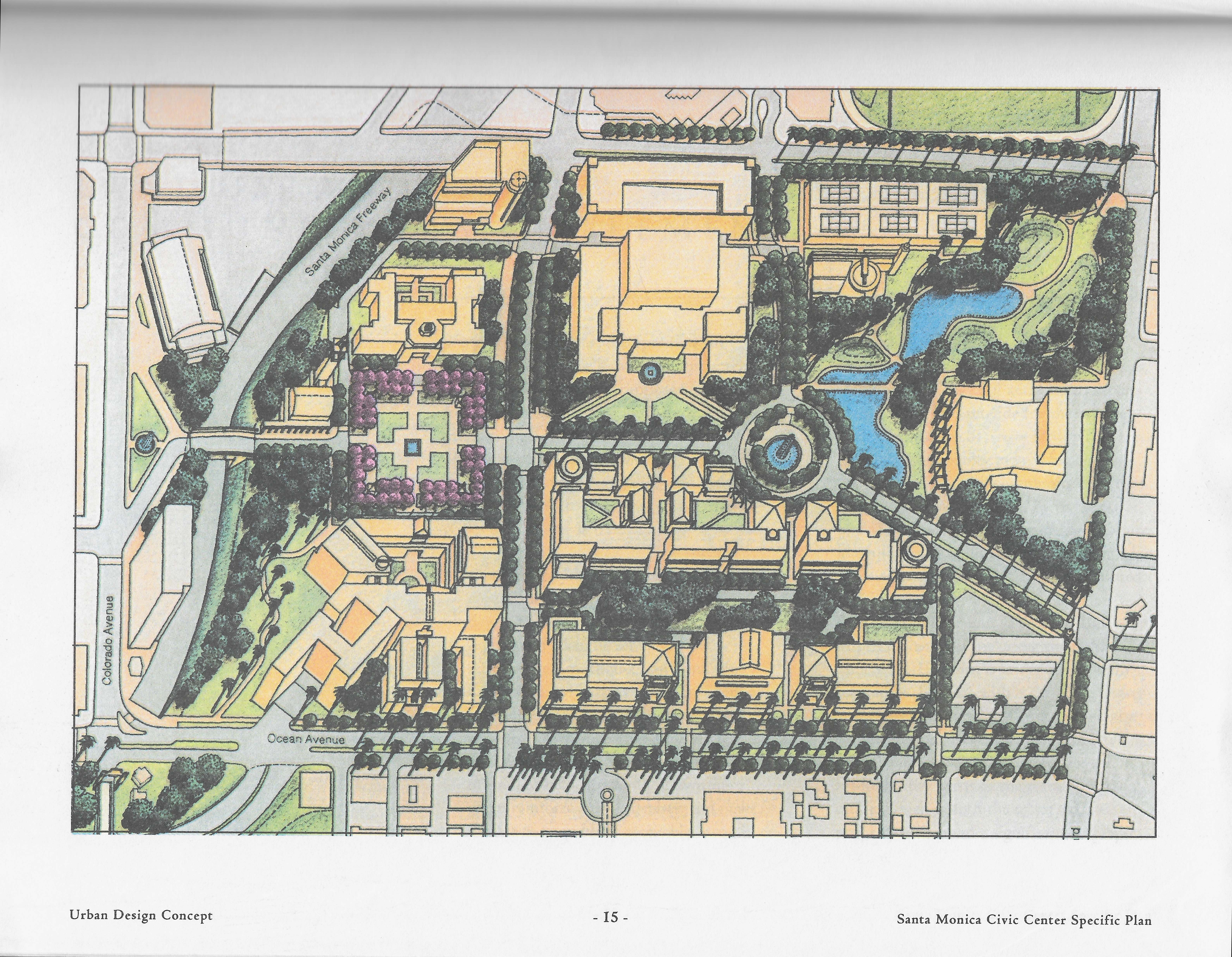
Below is a copy of the “Urban Design Concept” that was included in the CCSP (which was, in its entirety, sent to voters with their sample ballots) As you can see, the proposed development was much denser than what is being built today. The reason is that under the CCSP RAND had the right, under a development review process, to expand its facilities from its existing 300,000 square feet to 500,000, and to build another 250,000 square feet that could either be offices for rent or housing.

After the sale to the City of most of its land, RAND decided, for its own purposes, to build, on the land it retained, a new headquarters that was only a few thousand square feet bigger than the 300,000 square feet of its old buildings. The right to build the 250,000 additional square feet devolved to the City.

While at first during the process to revise the CCSP it looked like the 250,000 square feet would become housing, at the very end of the process, to please residents who wanted more open space, this housing was dropped from the plan. That’s why Tongva Park is so much bigger than the park that was originally intended to be a buffer between a new RAND headquarters and the freeway. (One reason the park was smaller in the 1993 CCSP with more development around it was that planners were worried that the park, given its location, would need help being “activated” – this may yet turn out to be a problem.)

Contrary to the popular narrative that against the will of the people politicians and planners have allowed Santa Monica to be overdeveloped, in the case of the Civic Center the opposite is true. Nearly 450,000 square feet of development, including around 250 units of housing, was dropped from a plan the voters approved overwhelmingly.

Thanks for reading.

1993 CCSP Design Concept