New music, Expo and me (and maybe you)

The Expo line will not reach Santa Monica for a year and a half or so, but I have already become a regular user — that is, if taking the train about once a month equals regular use. It all has to do with avant-garde music and the fact that my wife teaches at USC. You see, starting about eight or nine years ago we began attending the wonderful Jacaranda chamber music concerts at the First Presbyterian Church on Second Street. Jacaranda presents concert music going back centuries (check out tomorrow night’s concert with music from Mozart, Debussy and Arvo Pärt), but for Jacaranda the history of music didn’t end in 1900. Before Jacaranda, my wife and I didn’t pay much attention to new music, but now we’ve become addicted.

The L.A. Phil presents a prominent concert series, called Green Umbrella, for new music on Tuesday nights about once a month in Disney Hall, but we never attended those concerts because weeknight traffic is so miserable from Santa Monica is to downtown L.A. That changed, however, when Expo reached Culver City.

My office is in downtown Santa Monica. I board the Metro 534 bus on Fourth Street at Santa Monica Place around 4:30; from there the 534 travels non-stop on the freeway to the temporary Expo terminus in Culver City. The train takes me to USC in 14 minutes, where I meet my wife; she has her car there because she drives in in the morning. We drive to a restaurant downtown, and then go to the concert.

Obviously our circumstances are unusual and won’t apply to many others, but in taking Expo at least I’ve learned something about it.

To begin with I’ve learned whom Expo will serve when it reaches Santa Monica. The 534 originates in Malibu and when I board it at 4:30 it is full of workers returning to L.A. from jobs along the coast. I’ve been told the 534 is called the “nanny bus,” but nanny hardly encompasses all the people on it. Class defines transportation in L.A., yet it still surprises me when friends tell me they have never taken a bus here. (They have no problem with using transit in New York.) Some even confess that they are “scared” to do so, but when I’m on the 534 I feel like I am among 40 of the most dignified people in all of L.A.
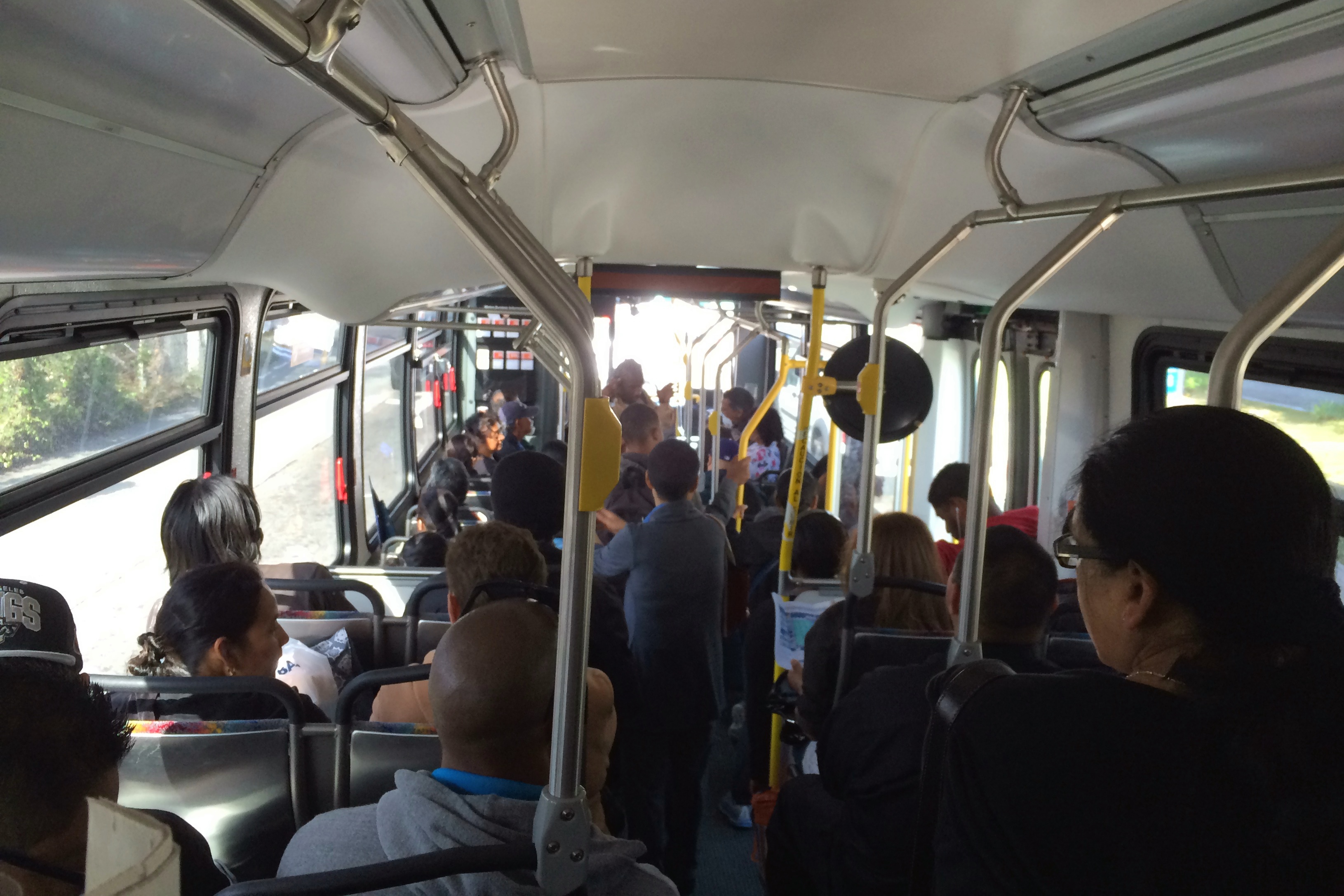
Passengers on the 534 bus returning home from work

Passengers on the 534 bus returning home from work

The bus I catch at 4:30 originates in Malibu at 3:28, and no doubt some of the people on it have been riding for an hour already when I board. When we get on the freeway, we are stuck in the same traffic as everyone else. (I guess that’s what equality means today — motorists in private cars get to travel as fast as a bus carrying 40 people.)

At that time of day the 534 takes between 30 and 60 minutes to travel from Fourth and Colorado to Culver City (it takes 10 minutes when there is no traffic). Typically, more than half the passengers exit in Culver City to get the train. When Expo opens in Santa Monica, the train will take about 15 minutes from downtown Santa Monica to Culver City. That means that all those 534 riders who connect with the train will do so in Santa Monica and save between 15 and 45 minutes each trip home.
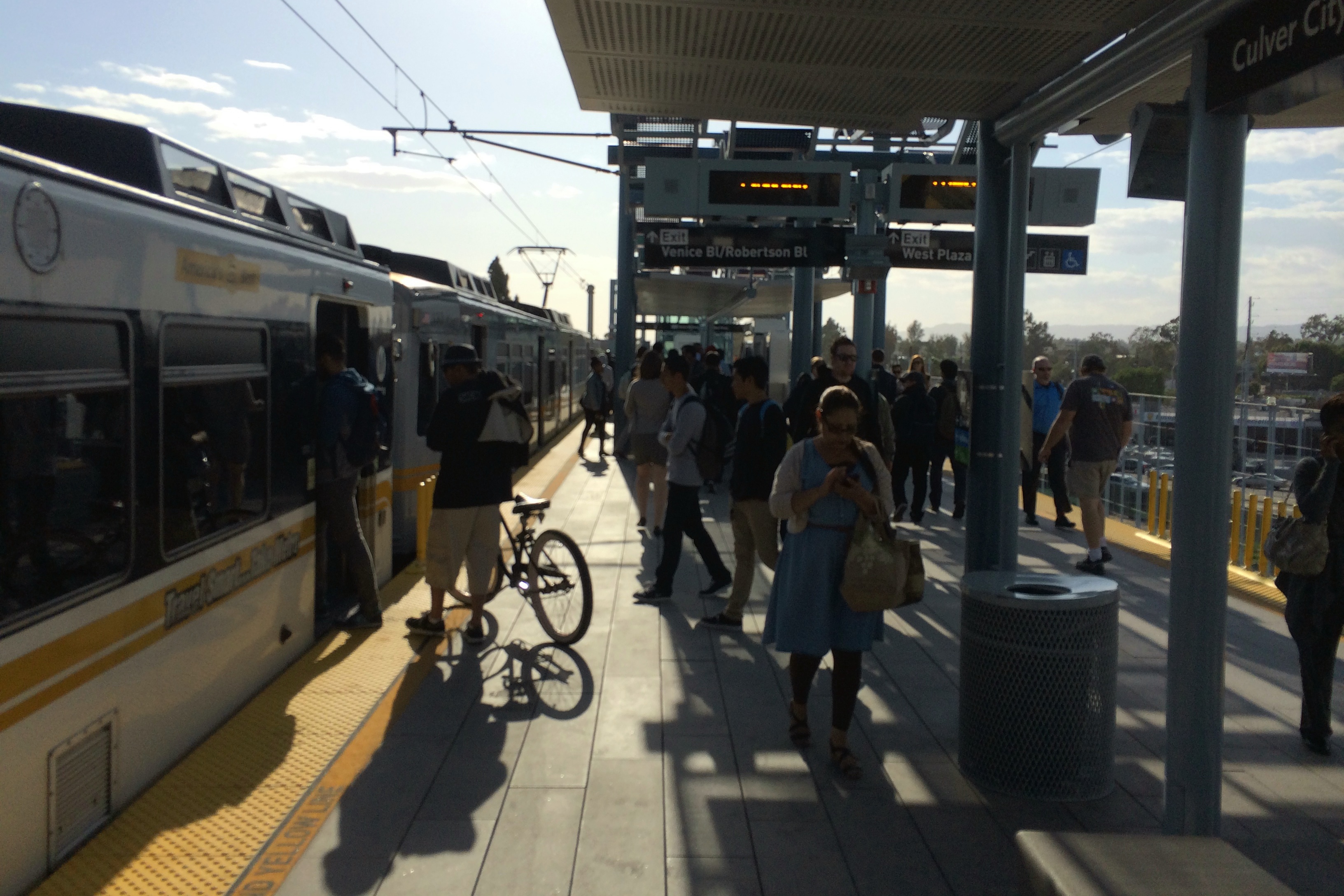
Boarding the Expo train in Culver City

Boarding the Expo train in Culver City

These workers and others like them are the people whom Expo will serve immediately. The primary purpose of Expo is to provide access to jobs on the Westside and in downtown L.A. to the vast middle of Los Angeles, home to much of L.A.’s working-class. By doing this, Expo (and the Crenshaw line scheduled to open in 2019) will help reverse half a century of dis-investment and decline in South Los Angeles. Already Expo is prompting investment in those areas, as the L.A. Times reported last week.

Indeed, another group of Expo users don’t even know who they are today – they are the people who will move to neighborhoods near Expo, or to apartment buildings and condos along the line that aren’t yet built. Economists and planners have long understood that transportation shapes land use and can create or destroy wealth. If you run a freeway through an existing city, it typically reduces property values along the way (while increasing them where the freeway reaches open land), while rail does the opposite – it increases property values along the route.

It’s through this increase in economic value that transit pays for itself at the macro-economic level. If you ride Expo, and look out the window, you’ll see many derelict properties that will be redeveloped over the years with new housing and businesses.
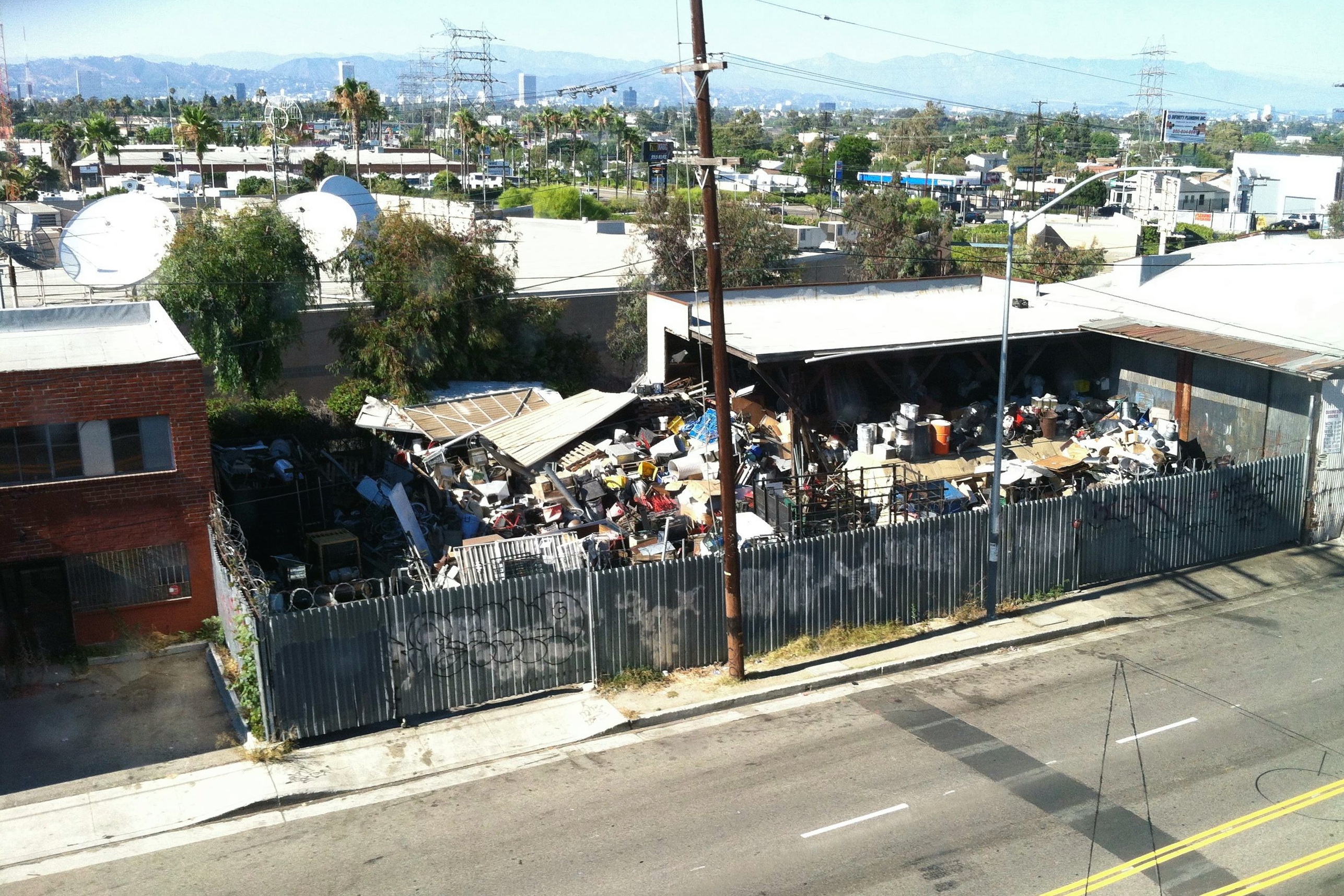
View from Expo of property that's become more valuable

View from Expo of property that’s become more valuable

These land use changes don’t happen overnight, but gradually new development gravitates toward transit. Thirty years from now, many riders on Expo will live in buildings that don’t exist today. It is changes in land use over time that result in a greater percentage of commuters and other travelers not driving.

Santa Monicans are asking themselves if they will use Expo. I hate to say it, but initially I doubt many will. This is for various reasons. Because the Exposition right-of-way originally passed through industrial areas of the city, few Santa Monicans now live with walking distance of Expo stations. In addition, because of the number of jobs in and near Santa Monica and how the traffic pattern now favors residents such as my wife who leave Santa Monica to work, Santa Monicans already have lower than average commute times and few Santa Monica commuters are likely to benefit from a switch to Expo.

Frankly, for people who already drive it’s going to be hard for Expo to compete with the convenience of driving for most of their trips. I have to ask myself the honest question – if we didn’t have my wife’s car to drive back to Santa Monica at 10:00 p.m. when the Green Umbrella concert ends would I take the train in? Even when the train reaches Santa Monica, that would involve getting from Disney Hall to the 7th/Metro train station and then a 45-minute ride back to Santa Monica, and then we’d have to get home from the station. Driving home at 10 o’clock never takes more than 25 minutes. (In the big scheme of things, probably taking the train in and a taxi home would make the most sense, and maybe I’ll evolve into that level of urban consciousness.)

Meanwhile the Big Blue Bus is exploring how to set up buses and shuttles to connect with Expo, and to do this Santa Monica has some advantages. Transit lines usually connect city centers with jobs to areas on the periphery with residents, and most riders go in one direction in the morning and the other later on, but Santa Monica has both residents and jobs. This means that connecting buses in the morning and afternoon rush hours can carry passengers in both directions, making them more efficient.

Which brings me to a simmering controversy in Santa Monica – should the City build parking at our Expo stations? The answer is no, or at least not much of it, and none of it subsidized.

There are many reasons for saying no to building parking at the train stations. One obvious one is traffic. Do we want to create more incentives for people to drive to downtown, the Memorial Park area, and Bergamot? “Park and ride” means “drive and ride.” But the most fundamental reason to oppose building parking is economic: parking costs too much, and let’s face it, when people say they want parking they mean free or heavily discounted parking.

The construction cost per parking space in the new Structure 6 on Second Street was about $50,000. Let’s say you wanted to build a five-story, 500-space structure near an Expo station. That would need a footprint of about 33,000 square feet. Land cost (at $400/square foot, typical for prime land in Santa Monica), plus construction cost would mean the structure would cost about $38 million, or about $75,000 per space. Assuming the City would pay for this with a 30-year, 5% bond, the monthly amortization for each space would be $403. Add a typical maintenance and operations budget of 15 percent, and the monthly nut that needs to be recouped is about $450 per space, or about $15 per day (including weekends).

Theoretically, I have no problem if Santa Monica built parking structures and charged enough to earn that back, but my guess is that if the City charged that much, there wouldn’t be much demand for the parking. (Conversely, there might be a demand for taxis and services like Uber and Lyft — but again, I haven’t evolved that far.) (To read how Metro has squandered public money to subsidize parking at train stations, read this.)

The cost of providing parking at stations is not only, however, a matter of dollars, but also a matter of opportunity. The land near the stations is prime land, and if it’s used for parking, it can’t be used for housing. There is much more social value in building housing near transit than there is in building automobile storage for people who already have housing and can afford to own and operate a car. Public dollars are better spent subsidizing housing, and much of the housing we need can be built without subsidy.

Thanks for reading.

Don’t. Sign. The. Phony. Airport. Initiative.

If you’ve bought groceries recently in Santa Monica, or if you will anytime soon, chances are you’ve been asked or will be asked to sign a petition for an initiative to “give the people the right to vote on the airport,” or to “stop overdevelopment at the airport.” Maybe a canvasser has come to your door.

Please, don’t sign the petition, and if you have signed it, please contact the City Clerk to withdraw your signature (details on that below).

Here’s the truth about the petition. The aviation industry, through its lobbying organization, the Aircraft Owners and Pilots Association (AOPA), is funding a sham initiative to change Santa Monica’s City Charter to keep Santa Monica Airport, which the City of Santa Monica owns, operating for their own private benefit. They’ve funded an army of paid signature-gatherers in a desperate move to derail 50 years of Santa Monicans’ trying to take control of the airport’s more than 200 acres of land, most of which residents bought and paid for with a parks bond nearly 90 years ago.

Back then, in the 1920s, flying was a still romantic thing, different from today. In what was basically an empty wilderness one could even think of a grass airstrip as park-like. In only a few years, however, accelerated by the run-up to World War II, aviation became an industry and the park became the site of Douglas Aircraft and one of the world’s largest factories — an arsenal of democracy.

Today, Douglas is long gone — it moved out when Santa Monica refused to condemn houses to extend the runway so that Douglas could build DC-8’s here — but the aviation industry remains, mostly in the form of private jet operators. The airport is a cash cow for them, subsidized by the City and made possible by low rents on leases dating back 30 years.

To take one example, according to data unearthed by the Airport Commission, Atlantic Aviation, the largest jet operator at the airport, pays the City rent of $200,000 per year, and then rents to sub-tenants for over $4 million per year. Meanwhile, the City has been subsidizing operations at the airport to the tune of $1 million per year. The average monthly rent aviation tenants pay the City is 6¢ per square foot — when the market rate is nearly $4!

All the residents of Santa Monica own the Santa Monica Airport and all of us should benefit from the airport land, not just a few.

Predictably, the industry has jumped on two popular themes in Santa Monica politics to create a smokescreen to cover the motives behind the initiative: the theme that the people need to take control over decision-making and the theme that the city is being over-developed. These themes were, of course, exemplified by Residocracy’s recent, successful campaign to get enough signatures to put the Hines-Paper Mate development to a referendum vote.

But there is no similarity between the Residocracy campaign — which was a genuine movement of residents, who did most of the signature gathering on a volunteer basis — and the aviation industry’s campaign, which has no roots among any community groups in Santa Monica and is funded entirely by the industry. In fact, community groups are lining up against the initiative — as of today, Santa Monicans for Renters Rights, Friends of Sunset Park, Mid City Neighbors and Northeast Neighbors have all come out against the initiative, with more opposition from more groups on the way.

The aviation industry’s initiative purports to be about giving the people the right to vote on the future of the airport, but that’s not what it’s about. Through the referendum process, as shown by the Hines petition, Santa Monicans can already bring any action the City Council takes about the airport to a vote.

Nor is the initiative about preventing overdevelopment. The City Council in a “wall-to-wall” unanimous vote at a meeting in March initiated a process to ensure that there will not be intensive development on the airport land, a process that can lead to building a great public park there. The fact is, as expressed by Mayor Pam O’Connor at the council meeting in March, the airport is not a good place for development, since it’s poorly connected to transit corridors and the street grid.

The initiative is about stopping any planning for alternatives at the airport. According to the AOPA website, the initiative“requires the city to continue to operate the airport in a manner that supports its aviation purposes and stipulates that the city cannot impose new restrictions that would inhibit…the full use of aviation facilities.”

The purpose of the initiative is to prevent any change at Santa Monica Airport.

Airport businesses have known since 1984 that Santa Monica would take control of the Airport land in 2015, and that it was likely that the City would close the airport. The airport businesses say it’s the residents who moved near the airport and who therefore should forever bear the burden of increasing jet traffic, yet it’s the businesses that have known for 30 years that their time was running out. Now they are using this phony initiative so they can keep feeding from the public trough.

You can expect to see a lot of signature-gatherers in the next couple of weeks. Although the AOPA has six months from April 10 to get the 9,000 or so signatures it needs to get the initiative on a ballot, to place the initiative on this November’s ballot, the AOPA needs to get those signatures by mid-May at the latest to cover the time it takes for the County to certify the signatures and the City Council to review the measure before it goes on the ballot.

If the AOPA doesn’t get the initiative on this November’s ballot, because the initiative calls for a charter amendment it could not be voted on earlier than the June 2016 statewide primary election. By then the AOPA knows that the City Council will have had plenty of time to craft a plan for the future of the airport land that the residents of Santa Monica will support. This is the aviation industry’s last chance to stop the City and its residents from taking control of their property at the airport.

Thanks for reading — and thanks for not signing the petition.

(If you have already signed the petition, and want to rescind your signature, call the Santa Monica City Clerk’s office at (310) 458-8211.)

Cosmic mysteries: the speed of light and young people

I am not sure why I took a little vacation from this blog, but it’s been almost three weeks since I last posted. It’s not that I haven’t been paying attention to things local, but I’ve found it hard to focus. For at least the first week or so of this malaise or funk, I’m going to blame the new version of Cosmos, the television series hosted by Neil Degrasse Tyson about the universe. The show is, to put it in scientific terms, blowing my mind.

I don’t have much physics or mathematical background, but I’m okay with concepts like antigravity. A few weeks ago astronomers released evidence supporting the “inflation” theory of the first moments after the Big Bang, when the universe expanded from a tiny speck to the size of a grapefruit (or a basketball – news reports were unclear about that), and I took it in stride, as in “sure, why not?”

But what got me was something that Tyson spoke about in one of the Cosmos programs, something he said almost in passing, namely that the speed of light was constant. I knew that light always traveled at 186,000 miles per second, but I never focused on a fact Tyson emphasized that always means always as in no time for acceleration. You turn on the light and the photons are immediately traveling at 186,000 miles per second.

Zero to 186,000 in zero seconds.

That threw me. I must have spent a week confused and I’m still perplexed. I mean, gravity — action at a distance – is crazy, but one has to accept it. It’s the law, right? But this no need for light to get up to speed seems like something that should defy the laws of . . . physics?

Maybe we are just stimulated neurons, like in The Matrix.

By the time I could focus once again on Santa Monica, the biggest story here was the controversy over science teacher and wrestling coach Mark Black and his takedown of a student in his classroom. That happened almost two weeks ago. At various times I was going to write about the incident and what it might mean, but then I’d think: since everyone is criticizing everyone else, particularly Superintendent Sandra Lyon, for commenting on what happened before knowing what happened, maybe this was a good time for me to do what everyone was saying to do and wait until I knew something.

Which is what I was going to do until I happened to read an editorial in the New York Times about “superpredators.” Remember them? About 20 years ago some criminologists and political scientists predicted that a tsunami of violent youths was about to wash over America. It goes without saying that these young monsters were assumed to be black and urban, thus tying into the three great traditional American loci for fear – young people, black people, and cities. (In one book promoting the theory, the authors wrote that the core problem was “that most inner-city children grow up surrounded by teenagers and adults who are themselves deviant, delinquent or criminal.” You have to forgive them, though: this was before “Breaking Bad.”)

It turned out that, beginning almost simultaneously with the promotion of the superpredator theory, the number of crimes committed by teenagers drastically declined and has continued to decline. The superpredator scare was one in an ongoing series of scares. You don’t have to sing “Gee, Officer Krupke,” or watch The Blackboard Jungle to know that when people say that kids today are rotten and schools are too lenient, they’re carrying on a tradition.

If anything, some of the problems we have today in schools are because schools are better. It used to be that troublesome kids were thrown out of school or dropped out after its being made clear to them that they were not welcome. Now we try to get them all to graduation, because there aren’t jobs for them in factories any more. It’s hard work, and yes, we should treat teachers and school administrators as heroes instead of blaming them for social problems that exist outside of school.

What was in the NYT editorial, however, that truly got my attention was a quote from a Supreme Court case about sentencing standards for juveniles. One result of the superpredator scare was that states passed laws that made it easier to try and punish juveniles as adults. Since 2005, however, the Supreme Court has been ruling that young people are “constitutionally different” from adults.

I never thought I’d look to nine black-robed lawyers for wisdom when it comes to understanding kids, but in a 2012 case (Miller vs. Alabama), the Court described the “hallmark features” of being young to include “immaturity, impetuosity, and failure to appreciate risks and consequences.” The Court has ruled that young people should not be sentenced the same as adults because – get this – young people can actually grow up. Sounds right to me.

Many Santa Monicans have rightfully rallied to the defense of Mr. Black, both because of his personal reputation and because they want to defend beleaguered teachers, and many of these Santa Monicans, and others, have rightfully rallied to the defense of Superintendent Lyon, also because of her personal reputation and because school administrators are beleaguered, too. But there’s been a lot of understanding for the students involved, too.

I like what School Board member Oscar de la Torre said at the rally for Mr. Black on Sunday, as reported in The Lookout. Speaking of Blair Moore, the Samohi senior now facing misdemeanor charges arising from the confrontation, De la Torre said, “[w]e’re a community that believes in redemption and young people make mistakes. While this young man might not be allowed to return to Samohi, he does deserve a second chance to be a part of our community in good standing.”

Thanks for reading.

Desperate Times, Desperate Measures, Desperate Companies that Rent Corporate Jets

I’ve already been quoted by Jason Islas in The Lookout calling the initiative that the Aircraft Owners and Pilots Association (AOPA) has filed to prevent the Santa Monica City Council from closing Santa Monica Airport a desperation move, but there is more to it than that.

The filing of the initiative to amend the City Charter to preserve the airport also shows that notwithstanding all the bravado coming from AOPA and the aviation industry it represents, and the Federal Aviation Administration (FAA), about the City’s purported obligation to operate the airport in perpetuity, they are all scared. Why? They know that the deal they made with the City in 1984 to settle that generation’s litigation over the airport was that the City could close it in 2015, that the 31 more years of flying they got then were the last they’d get, and they know that once the City gets them in court, the City’s rights over the land will be confirmed.

Even more than that, they know that when the City Council takes the actions — by the end of this year — that the council directed staff to analyze and put into policy form, that the path to closing the airport, or at least reducing its operations substantially, will be irreversible.

They also know that once the City embarks on developing the “concept plan based on low intensity use” that Council Member Kevin McKeown added to the actions the council adopted Tuesday night, they will lose their argument that the City will replace the airport with commercial or otherwise intensive development.

So AOPA had to act now. Loaded with money from the aviation industry, AOPA will try to persuade voters that all it’s doing is making sure the voters have ultimate authority over the decisions the City Council makes, but voters already have that authority – through the referendum process. As the recent signature-gathering for the referendum on the Hines development shows, if 10% of Santa Monica voters don’t like what the City Council decides to do with the airport, the council’s actions will go to a vote.

From the language in the proposed initiative, it’s clear that AOPA wants not only to pass an initiative requiring votes on airport decisions, but also to pass one that is vague and broad enough that any action the City would take in managing its property at the airport – an adjustment to a lease, for instance – would be subject to a lawsuit from aviation interests on the basis that the action, however ministerial, would need to be voted on.

AOPA, if it spends enough money, can obtain enough signatures to put the initiative on the ballot. Sure. But I for one am confident that the voters of Santa Monica will see through their plan and vote no.

In the meantime, however, it’s worth looking at some of the arguments airport proponents made at the City Council hearing Tuesday night.

Perhaps the most obnoxious argument airport defenders make is the one that homeowners near the airport bought into the area with knowledge of the airport, and that that disqualifies them from being concerned about their health and safety. But of course those residents don’t really care about their health and safety – they’re only fighting the airport for the big bucks they are going to make when they can sell their homes once the airport is gone.

Do they know how insulting this is?

Aside from ignoring the many people who want to close the airport who don’t fall into this category, this argument ignores important facts. One is that many homeowners bought their properties when jets were banned at the airport. Jets magnify the airport’s impacts, and the number of jet operations and the size of the aircraft have increased greatly over the years, so that the situation has become much worse for all residents, regardless when they moved in.

But truly the argument should be reversed – since 1984 it is the pilots and the aviation businesses who have known that the City would likely close the airport in 2015 and would certainly have the right to do so. It is they who should have been making plans for the future. These businesses lease their facilities from the City – businesses in the real world lose their leases all the time. (I still miss Broadway Deli!) What are these proud business people complaining about? They way they go on about the government’s obligation to keep their businesses going, you’d think they were socialists!

Another argument the pro-airport people make is that in the event of an emergency Santa Monica Airport will be the area’s lifeline. Okay, I don’t want to jinx things, but we had an earthquake in 1994 that was big enough to knock down the Santa Monica Freeway, and I don’t recall anyone re-staging the Berlin Airlift. The same goes for emergency flights. There is no reason that a park at the airport can’t have open ground sufficient to land emergency helicopters.

There’s no question that the most appealing uses of the airport are the Angel’s Flight medical flights. But given that there are other airports nearby, and given the benefits of the great park that replace the airport, are they sufficient reason to keep the airport open?

As for building a great park on the airport land, the airport proponents keep saying that the City wouldn’t have the money to build it. Where they get this, I don’t know. In the past 20 years the voters of Santa Monica have approved more than a billion dollars in school and college bonds. They have an unbelievable public spirit and they love their city. I have no doubt that they would approve a parks bond to cover construction costs that cannot be financed otherwise.

Lastly, the Daily Press ran a story by David Mark Simpson about concern among non-aviation businesses at the airport over extending their leases, focusing on Typhoon Restaurant. A representative from Typhoon also spoke at the hearing Tuesday night, asking for flexibility in leasing guidelines to justify his client investing in improvements in the now 20-year-old restaurant. I hope that staff can incorporate that kind of flexibility into its leasing guidelines, but more than that, I am sure that Typhoon will sell even more of its delicious whole catfish to even more customers once the restaurant’s big windows look out over a great park full of happy people rather than a runway with screaming jets.

Thanks for reading.

Santa Monica Airport

Santa Monica Airport

Turning Santa Monica Airport into a local land use matter

It’s rare when the Santa Monica City Council dedicates an entire meeting to one topic, but the council is doing that Tuesday night, when the sole item on the agenda (beyond the consent calendar) will be the future of Santa Monica Airport.

And why not? Fifty years from now, the council members will be remembered, if at all, for what they do with the airport (or forgotten for what they don’t do).

As someone involved in the movement to close the airport and turn it into a great city park, I frequently have friends telling me that what we at Airport2Park.org are doing is great, but futile, because “the FAA will never let the airport close.”

It’s not a matter of legal analysis. They don’t have views about that. When I ask them how the FAA can force the City to operate the airport if the FAA doesn’t have the legal right to do so (assuming, yes, that the City can prove that in court), they shrug or roll their eyes.

We’re talking about some deep cynicism about the feds and the powers of politically-insulated, self-perpetuating, industry-captured agency.

In many ways, the staff report for Tuesday night’s meeting is a response to this kind of thinking because it outlines a practical (if, in my view, a somewhat too cautious) approach to extricating the airport land from the FAA’s grip. If the City’s lawsuit against the FAA was a bold stroke on constitutional and other high-minded principles, the staff’s recommendations want to treat the airport land like any other piece of real estate — not only real estate that the City can regulate under its municipal powers, but real estate that it owns and with respect to which it also has “proprietor’s rights.”

It’s probably not a coincidence that these tactics echo a line in a ruling the FAA issued in a 1998 proceeding brought by airport tenants seeking to negotiate from their landlord (the City) lease extensions beyond the expiration in 2015 of the 1984 Settlement Agreement between the City and the FAA. In that case the FAA itself ruled that after the City’s obligations under the 1984 agreement to operate the airport expires, what happens to the airport land will be “a local land use matter.”

Simple as that — “a local land use matter.” When the City finally pins the FAA down in court, where the issue will be the intent of the parties when they made the 1984 agreement, i.e., whether the parties to the 1984 agreement intended for it to supersede the infamous “perpetuity clause” in the 1948 Instrument of Transfer (IOT), the FAA is going to have a hard time explaining away that line from one of its official rulings.

In framing the airport’s future within the language and concepts of local land use matters, City staff recommends a series of measures. These include the re-leasing of airport facilities the City owns at market rates for the purposes of ending the City’s subsidies of the airport (but which will also open the airport up to non-aviation tenants that can pay higher rents); taking back and removing from airport use a crucial parcel of land that is not subject to the 1948 IOT (which would incidentally mean reconfiguring the airport with a much smaller runway that larger corporate jets could not use); reducing (or eliminating) aviation fuel sales at the airport; and otherwise requiring that all uses at the airport are compatible with the uses in surrounding neighborhoods.

These recommendations also echo recommendations that anti-airport organizations and the Airport Commission have made to reduce the impact of the airport and its operations, without necessarily causing a direct confrontation with the FAA. The anti-airport organizations have been vehement in exposing the negative impacts of the airport, and want the whole airport closed, but they have also been cautious in the tactics they recommend.

Meanwhile, perhaps the most striking sentence in the staff report is this one: “For years, community members assumed that the City could close the Airport in 2015 when the 1984 agreement with the federal government will expire.” That simple statement, which recognizes that it has always been the community’s understanding that the 1984 agreement was meant to the be the last extension of Santa Monica Airport’s operative life, should establish the context for all of the City’s future actions regarding the land there.

Land that will be the location for a great park.

Thanks for reading.

Future park.

Future park.

It was 20 some years ago today

It’s impossible not to be impressed with the job Residocracy and its allies did collecting signatures for the referendum against the Hines Paper Mate project. In retrospect they didn’t need to hire canvassers, since the paid signature gatherers only accounted for 2,200 or so of the 13,440 signatures Residocracy collected. Volunteers were all over the city: I was approached at least five times to sign.

Okay, I wasn’t going to sign it, but congratulations to those who joined together to do something they believed in. (Armen Melknonians, the founder of Residocracy, called it — he told Jason Islas of The Lookout on Feb. 7 that they’d get twice the 6,100 signatures that were needed.)

So now what? The layers of speculation are many. Will City Council repeal the development agreement or put it to a vote? Will Hines fight the referendum or throw in the towel and submit plans to re-use the old building? Can anyone mediate a new plan that would be acceptable to both Hines and the referendum supporters?

I can’t analyze these possibilities because the answers depend on data and calculations (not to mention psyches and emotions) out of my reach. More analyzable, although not necessarily predictable, are the prospects for the referendum if it’s put to a vote. That’s because Santa Monica has had referendums on specific projects before.

The votes that seem most relevant were the 1990 referendum on City Council’s approval of the hotel that Michael McCarty wanted to build at 415 Pacific Coast Highway (now the location of the Annenberg Community Beach House), and the 1994 referendum on the Civic Center Specific Plan.

The ’90s may seem to be a long time ago, but you know about the more things changing. How about this quote, which opens an October 1990 Los Angeles Times article about how development had supplanted rent control as the big political issue in Santa Monica:

Santa Monica, as City Council candidate Sharon Gilpin sees it, has lost its way.

While pursuing the admirable goal of finding money to pay for an ambitious array of social services, she says, the progressive politicians who have been running the city have struck a “Faustian bargain” with developers. The city may get the money it needs, but the price is a steep one: Hotels, office and commercial developments are transforming the beach community into a congested urban center.

In October, when local reporters are writing about the election coming up, how many names of candidates will they be able to substitute for “Sharon Gilpin” in that passage and cut-and-paste it into their coverage?

At issue in 1990 was McCarty’s beach hotel, which would have been built on state-owned land and which would have replaced a beach club that was beloved by many. The hotel was voted down overwhelmingly — 62% to 38%. This was also the election where voters passed measures prohibiting new hotels in the coastal zone and requiring that at least 30% of housing built in the city be affordable to moderate and low income households (which some interpreted as a means of stopping condo and other housing development). Earlier in 1990, City Council had repealed its approval of a big office development at the airport when presented with enough signatures to put the project on the ballot.

These victories gave the anti-development side confidence that they could block large-scale developments. When the City Council approved the Civic Center Specific Plan in 1993, which allowed for the development of about one million square feet of offices and housing, they collected signatures to put the plan on the June 1994 ballot. This time, however, the voters approved the plan overwhelmingly, 60% to 40%, notwithstanding the rallying cry against it that it would generate an additional 22,000 car trips a day.

I suspect we can still learn something from these votes. As I see it, there were these major differences between the McCarty hotel project and the Civic Center plan:

Private vs. Public. The McCarty plan was going to allow a private developer to make money, and specifically allow him to make money on public land. In contrast the Civic Center plan put the profit-making development on private land, and the landowner — the RAND Corporation — was a local, well-respected nonprofit institution. With the Paper Mate project, this factor could go either way. The profits will come from private investment in privately-owned land, but the developer is seen as the archetypal big developer from out-of-town.

Politics. Perhaps the key factor in the voters’ approval of the Civic Center plan was that the anti-development side of Santa Monica politics was split. The City Council vote approving the plan was 7-0 and the yes votes included two of the staunchest anti-development politicians of the time — Ken Genser and Kelly Olsen. In fact, Genser was one of the plan’s strongest proponents and had been deeply involved in its preparation (one reason why the plan was appealing). In contrast, the anti-development community was united against the McCarty hotel — as it is today against the Paper Mate project, where it believes it’s been ignored in the planning process.

Plan suitability/quality. The McCarty hotel project was well-designed for what it was (and it included major public amenities), but it replaced a use, the beach club, that people liked, and building a luxury development on the beach is never going to have mass appeal. In contrast, the Civic Center plan promised to turn a superblock full of surface parking lots into something nice.

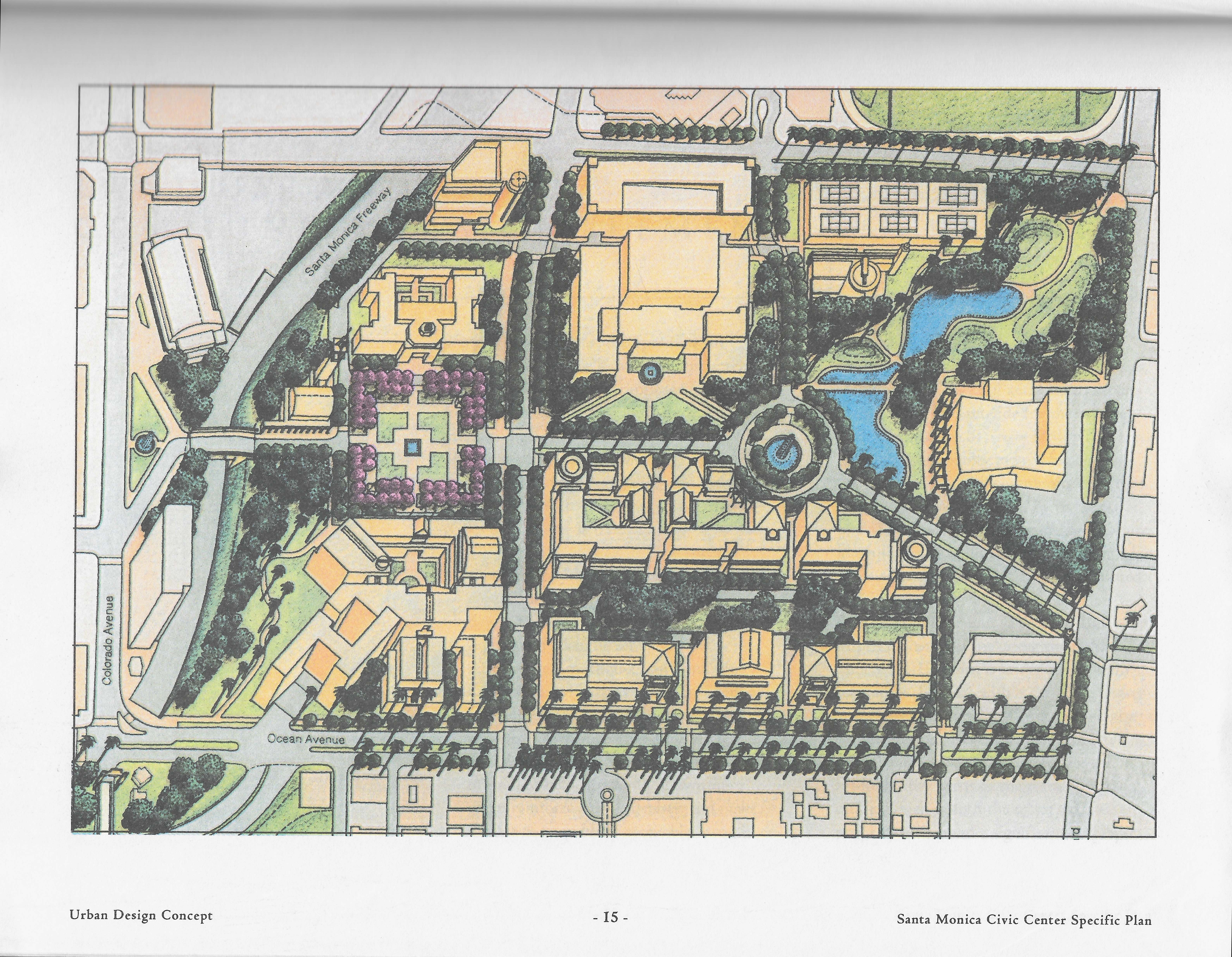
The 1993 Civic Center Specific Plan

The 1993 Civic Center Specific Plan

On this issue, I’d say the jury is out on Paper Mate: Hines will be able to give voters appealing “before and after” illustrations showing how they will turn the old factory into something better, but they’re going to be up against the reality that adding more office development to that gridlocked location seems instinctively wrong.

So who knows?

I also want to say something about the CEQA lawsuit the Santa Monica Coalition for a Livable City (SMCLC) has filed against the Paper Mate project. I haven’t read the complaint and in any case I’m not a CEQA lawyer, and so I have no opinion about whether SMCLC has a good case (except that good luck to anyone up against the redoubtable Marsha Moutrie, crosser of T’s and dotter of I’s). I have to applaud SMCLC, however, for suing on the grounds that the EIR did not “properly study reasonable project alternatives” — particularly alternatives with more housing and less commercial development. As I wrote in February, it was the narrow scope of the environmental review that at the end made it impossible for the City Council to try to negotiate a better project with more housing and less commercial development.

Thanks for reading.

The time for speculation is now

Signature gathering for the referendum against the Hines Paper Mate project wraps up soon, which means that I have little time remaining to speculate on the meaning of the referendum process before the result of the process complicates my analysis.

I suspect the referendum proponents at Residocracy will get the signatures they need, as I can’t recall a signature-gathering effort in Santa Monica that failed. Based on their having to hire paid signature gatherers, the process seems not to have gone as well as they predicted, but I assume all hands will be on deck to get the boat to the finish line.

The voters are there if they can reach them. The number of signatures needed, 6,100, is about the number of voters in Santa Monica (7,000 or so) who, at least by my computations, typically base their votes primarily on the issue of development, and of course there are even more voters who are willing to sign any petition against traffic.

But then, there are two things you can say about gathering signatures – it’s easy, and it’s hard.

It’s easy because signature-gatherers can always come up with a sound bite (“7,000 car trips!”) that simplifies the issue and sells it, and the fact that the gatherer is looking the potential signer in the eye in a real-life, not virtual, situation helps to close the deal. (Unless the target passerby is in don’t-bother-me mode.)

But gathering signatures is also hard. While 10% of voters, the threshold that needs to be reached, is only a small percentage of the electorate, it’s typically many more people than those who are active in the group promoting the ballot measure. It takes a lot of work to reach outside the core.

Consider Residocracy. As I recall, when the signature campaign started, Residocracy was saying it had about 400 members. To get 6,100 signatures one needs a cushion to cover invalid signatures, and so one needs something like 8,000 signatures. Meaning that each of the 400 needed to be responsible for an average of 20 signatures.

Sounds easy, right?

But think about it – think about your four closest friends; do the five of you know 100 different people you can get to sign something? I’m suspecting not – you probably know a lot of the same people. And the Residocracy 400 likely have overlapping Venn diagrams of friendships. So let’s say on average each of the 400 can get 10 signatures from their social circle. Now you’re up to 4,000 – which is a good base, but those are also the easy ones, the low-hanging fruit. The other 4,000 are harder.

As I mentioned above, the only definitive sign that the signature gathering has not gone as fast as expected is that Residocracy resorted to hiring paid signature gatherers, something Residocracy’s founder, Armen Melkonians, had said he didn’t want to do. Nothing wrong with that, but it does throw some reality onto the claims that those who signed up for Residocracy speak for residents collectively.

As for the meaning of the petition drive, it would be refreshing if what came out of the process is a recognition that no one in Santa Monica politics speaks for everyone, and that to win an argument one must make more of an argument than simply “this is what the residents want.”

I’m not going to hold my breath for that, but it appears that Santa Monica is in for some soul-searching. The City’s new survey on attitudes toward development is going to be chewed on quite a bit. I haven’t yet studied the survey in depth, but even looking at the numbers on the surface it’s apparent that people have much more complex attitudes toward local issues than are reflected in our political discourse.

Yes, people can want to make traffic flow better and also want more housing and good jobs.

Thanks for reading.

Creative Tensions vs. Blunt Instruments

So far two people I know and two I don’t have asked me to sign the referendum against the Hines Paper Mate project. The proponents are getting their message out. But I have declined to sign.

The Hines plan isn’t perfect, and I have standing to say that. As the plans for the Paper Mate site went through four years of gestation as the City wrote the LUCE and then adopted it in 2010, I argued in my Lookout columns that the City’s planners and consultants were calling for too much commercial development in the Bergamot area, which includes the Paper Mate site. My view was that all development in excess of existing zoning there should be residential.

Except for former mayor Paul Rosenstein, I don’t remember anyone from the public during the LUCE process arguing against the amount of commercial development — certainly not any of the key people who are today behind Residocracy.org, the organization that is sponsoring the referendum. This was odd, because in 2008 the RIFT initiative was all about limiting commercial development. At the end of the LUCE process, former mayor Dennis Zane appeared before the council to criticize the amount of commercial development, but by then it was too late.

Ted Winterer, then on the Planning Commission, and Kevin McKeown on the City Council, argued for less commercial development, and there was a small reduction in part of the area (not the part with the Paper Mate site) before the council passed the LUCE on 7-0 vote.

Yet today critics see the amount of office space in the Hines plan as the worst element of it – certainly the element that will contribute to gridlock.

Why does the LUCE call for more commercial development in the Bergamot area? In fairness, a lot had to do with the times. City Council finally approved the LUCE in summer 2010, and the LUCE was drafted in the aftermath of the 2008 financial crash, when governments everywhere, including here, were panicking about their budgets. The council received a financial analysis that pointed out, not surprisingly, that commercial development was better for the City’s bottom line than residential (more taxes, less services to provide).

We who predicted that more commercial development near the Water Garden, the Arboretum, and Colorado Center, would never pass a traffic smell test and that the city needed housing more than it needed “creative office” jobs, were told by planners that the traffic issue was moot because office development would attract more riders to the Expo line and that the housing that the city needs would be provided elsewhere — downtown and along the boulevards.

Three-and-a-half years later the City’s budget is on the mend, every housing development proposed for the boulevards is under attack, and folks who once said they loved the LUCE in part because of the community benefits it would link to development, now dispute even the concept of community benefits and proceed to attack City Hall for profligacy in the delivery of the exceptional services they demand.

Not to mention smell tests, but a more-or-less trivial (in the big scheme of things) increase in traffic predicted to be caused by the Paper Mate project has provoked a backlash that would not only stop the development, but also would likely kill the Bergamot Area Plan the City Council approved last fall.

So I understand why people support the referendum; indeed, Paul Rosenstein does, and that means a lot. But I don’t support it for two basic reasons.

The first is that while the plan that City Council approved is not perfect, it’s pretty good. It’s got the new streets that connect old industrial areas to the Expo line, it’s got housing in a good location, and it only adds about 150,000 square feet to the commercial development that is already there. The plan is so much better than the hulking factory that is there now, that it is unfathomable to me that anyone would risk having the place reoccupied. (Council Members Terry O’Day and Gleam Davis expressed this argument well in a letter they wrote to the Lookout.)

True, it would better if, as proposed by Ted Winterer at City Council and Richard McKinnon on the Planning Commission, those 150,000 square feet of office were converted to residential, and I wish that Hines had grabbed that deal. But Hines didn’t, and I don’t believe that 150,000 square feet of office development in a sea of millions of the same is worth having a war over and worth losing, quite possibly, the benefits of the plan that were worked out over seven years of planning and negotiations.

My second reason for opposing the referendum is that, as the referendum’s proponents say, the referendum is about “changing the nature of politics in Santa Monica.” If I can summarize my first reason for opposing the referendum as “don’t let the perfect be the enemy of the good,” then I can summarize the second as “if it ain’t broke, don’t fix it.”

I mean, look around – compared to the rest of the California, or the universe even, is Santa Monica poorly governed? For the past 30 years, haven’t politics-as-usual here, overall, done a rather good job? In 2012 did you wonder why Richard Bloom, when he won election to the State Assembly, practically ran on a platform of being “Santa Monica Mayor Richard Bloom?” When it comes to government, complain all you want, but for everyone else in the region, Santa Monica is the top.

Even looking at Santa Monica through an anti-development lens, how many people realize that for 20 years, since the Water Garden opened, there has been virtually no new (not counting re-habs and replacement projects) commercial development in Santa Monica? Nearly all the development has been housing, which we need at all income levels, and which does not cause the gridlock people complain about.

Where is this massive over-development I keep hearing about?

Yes, my soul too has been crushed as I sit in traffic (as if souls are less crushed elsewhere in Southern California), but consider this: if you’re a Santa Monica resident and you work, your average commute time is significantly less than elsewhere in the region.

Doesn’t it mean something that if you own a house here, your property held its value remarkably well during the Great Recession? That we have excellent services and great schools, which our residents and City support? That we’ve consistently added over 30 years more park acreage? And doesn’t it mean something that our rent control laws have resulted in a remarkably stable community?

For more than 30 years the creative tensions in Santa Monica politics – including tensions between SMRR and its opponents, tensions among the various elements within SMRR, tensions created by shifting alliances to achieve various important goals, such as those relating to education, good jobs, homelessness, and youth violence – have been just that, creative.

The referendum approach is a blunt instrument, and I fear that from it the city will sustain blunt instrument trauma.

Thanks for reading.

The Paper Mate factory

The Paper Mate factory

A Quiver Full of Arrows to Close SMO

In the long term, Judge John Walter’s decision last week to dismiss the City’s case against the Federal Aviation Administration (FAA) doesn’t mean a whole lot. It’s not only that the judge emphasized that his decision had nothing to do with the merits of the case, but Santa Monica has several means to gain control of the airport land and ultimately close the airport.

The lawsuit that Judge Walter dismissed primarily on the basis of the technical requirements of the federal Quiet Title Act (QTA) was based on the City’s claim that the “perpetuity clause” in the 1948 Instrument of Transfer (IOT) is not enforceable and that control of the airport will return to the City when the 1984 Settlement Agreement with the FAA expires July 1, 2015.

By suing under the QTA, the City was trying to determine ahead of time what its rights were — to be able to plan accordingly for the future of the land. Judge Walter said he sympathized with that wish, but said the claim was not being made consistent with the time period allowed in the QTA for bringing suit against the federal government. His decision had nothing to do with the merits of the City’s case; since the City has not yet tried to close the airport, he said the issue was not yet “ripe.” The issue will be subject to litigation when the City moves to close the airport.

But litigation over the 1948 and 1984 agreements is not the only arrow in the City’s quiver. In its complaint, the City, in recounting the history of how it acquired the airport land, took pains to point out that the 1948 IOT only applies to one piece of the airport. A large piece, on which sits about 40% of the airport’s runway, is not subject to the perpetuity clause in the IOT.

Neighborhood groups opposed to the airport have made the argument, which City Attorney Marsha Moutrie has said appears to her to have merit, that the City could, on July 1, 2015, take back that portion of the airport, which would reduce the runway to less than 3000 feet. Obviously it would be simpler for the city to prevail in a suit over the 1948 and 1984 agreements, but reducing the length of the runway would mean that the big private jets that have the worst adverse impacts would not be able to use the airport. Even more significantly this would likely mean that the airport would not be able to subsist economically and would have to close.

In this connection, it’s not only the 1984 Settlement Agreement that expires July 1, 2015, but also all the leases of city-owned land and buildings at the airport to aviation interests. These are the hangars that the private jets and planes use, the support facilities for fuel and repairs, and the offices of the aviation companies. Under these old leases the rents are pennies on the dollar of what is now market-rate. Indeed, aviation companies are currently subleasing much of this space at a considerable profit to non-aviation tenants, such as Volkswagen’s design studio.

All of these leases end in 2015. Then the City can terminate the leases and lease to new, non-aviation tenants. As David Goddard, Chair of the Airport Commission, discussed at the Airport2Park panel a few weeks ago on financing a big park at the airport, this would represent a large swing, of millions of dollars, of revenue to the City — in the long term, these dollars could go to the operating costs of a park, in the short term there would be plenty of money to fund litigation with the FAA.

If the FAA could persuade a court that the perpetuity clause still applies, and if the airport could survive a starvation strategy, there would still be politics at a higher level. Congresswoman Karen Bass, who represents the district immediately to the east of the airport, has called for the airport to close. Henry Waxman was inching to that position when he announced his retirement, but there is every indication that his successor will support efforts to close the airport.

Candidates Ted Lieu and Marianne Williamson have both stated they support Santa Monica’s right to close the airport. Wendy Greuel, to my knowledge, has not yet declared a position on the airport, but there’s every reason that the next U.S. representative from our district will call for closing the airport. One has to wonder how much of its resources and political capital the FAA will want to expend defending a small airport that has lost the support of the local members of Congress.

Regardless whether the City chooses to appeal Judge Walter’s decision, it’s clear that the fight to close Santa Monica Airport is far from over.

Thanks for reading.

Santa Monica Airport

Santa Monica Airport

MANGo: Can we agree to agree?

I concluded last week’s post on the Hines Paper Mate project with a reference to Freud’s phrase, “the narcissism of small differences.” It’s a good phrase.

It seems more and more true that a notable difference between national and local politics is that on the national level, where the parties used to battle for the center so much that critics said that there wasn’t a dime’s worth of difference between them, differences have become wider and wider, while with local politics people find ever more narrow grounds over which to argue.

Is there any better local example of this than the controversy over the Michigan Avenue Neighborhood Greenway project, known by its nickname of “MANGo”, which City Council will consider tomorrow night?” When this project began, about a year ago, there were fundamental disagreements among residents, some of whom were encouraging the project and others of whom feared it. However, a plan evolved through a productive public process, and it seems that nearly everyone likes 99% of it. But that doesn’t stop folks from furiously disagreeing over the last 1%. (And I’m not sure they disagree even that much.)

I’ve attended most of the community workshops on the project, including the first, which took place in March of last year. The March workshop began with a discussion of the project’s goals. Participants then toured the project area, either on foot or on bikes, to gather impressions of the area and consider what investments in the public realm could make it better.

Drivers use Michigan Avenue and connecting streets, which run through the middle of much of the Pico Neighborhood, to avoid east-west boulevards. The goal of the project is to slow down and reduce this cut-through traffic and turn the streets into linear public spaces that encourage walking, cycling and neighborliness.

At the March workshop some locals were suspicious that MANGo was a gentrification scheme that would disrupt their way of living in their neighborhood. This attitude in the Pico Neighborhood is understandable; as in many working class neighborhoods that arose around industrial corridors (Michigan Avenue was literally “across the tracks” when Santa Monica developed), in Pico, skepticism about governmental action is warranted. It’s not every neighborhood that had the privilege of being ripped apart by a freeway. You can understand why some residents just want to be let alone.

At the same time, neighborhoods like Pico don’t typically get a fair share of public investment, and people who live there know it. The calming and greening of streets has taken place all over Santa Monica in other “advantaged” neighborhoods that have demanded it. I live in Ocean Park, and it was two decades ago that Fourth Street and Ocean Park Boulevards, which were both four-lane roads (they had been widened in the ’50s as part of the Ocean Park Redevelopment Project), were reduced to one lane in each direction. Ocean Park Boulevard recently was “greened.” There has been extensive traffic calming in Sunset Park and also on Santa Monica’s north side.

Santa Monicans have complained for years about traffic flowing through their neighborhoods, and the City has responded to those complaints.

As the MANGo process continued through the year ideas were floated and evaluated. Some proved popular and some were tossed out, and along the way a remarkable consensus emerged. One workshop in particular needs to be mentioned – the “Pop-Up MANGo” that took place September 21. This extended block party featured temporary installations of the kind of features that could be used in the plan. Four hundred people walked or biked through the installations.

Photos from the Pop-Up MANGo, Sept. 21, 2013

Photos from the Pop-Up MANGo, Sept. 21, 2013

I say the consensus was remarkable because it’s not easy to get agreement on traffic circles and bulb-outs, etc. It’s not any easier when people are suspicious from the start. Nonetheless, here we are — I’ve listened to people on both sides of the current argument (namely, bike people on one side and representatives of the Pico Neighborhood Association on the other), and I’ve read their materials, and they all say they agree on all of the plan . . . all of it except one facet that isn’t even part of the plan that the City Council is being asked to approve.

MANGo pop-up 130921-786The element that is not part of the plan, but is controversial, is the idea of placing a traffic diverter at the corner of 11th and Michigan that would prevent cars from turning onto Michigan to get to Lincoln. This diverter emerged from the process as a potential tool that could be used if the other MANGo measures did not reduce traffic levels on Michigan to levels that are consistent with a neighborhood street.

I can’t understand why there is such a disagreement. (And I have to say, I know and admire people on both sides of the dispute.) The bicycle folks are not advocating the installation of a diverter. According to a letter to the City Council from the bike group Santa Monica Spoke, the cyclists do not support the “aggressive” implementation of a diverter and the group acknowledges that diverters might never be needed. I’ve talked to the Spoke people, and they know that diverters, which disrupt the flow of the street grid, should only be used as a last resort.

I’ve also heard representatives from the Pico Neighborhood, who support the MANGo plan overall, say that in the future they could conceivably agree that a diverter would be a good idea – but they first want to see what happens with implementation of less drastic measures, and they want to see if changes to the pattern for dropping off students at Samohi make a difference. Sounds reasonable and doesn’t sound much different from what Spoke is saying.

Santa Monica Spoke does have technical disagreement with staff, however, about how many car trips are consistent with a neighborhood street. Staff says that the diverter should be looked into if the currently proposed measures don’t bring daily traffic counts down to 2,000, while Spoke says the number should be 1,500. Staff and Spoke each have their technical sources.

I support the Spoke number, not because any number should be an automatic trigger for implementing a diverter, but because 1,500 car trips is a better goal. Staff and City Council should make it clear that a diverter cannot be added without a public process (i.e., not automatically by staff); assuming they do that, I don’t see how a more stringent standard would hurt anyone.

Thanks for reading.