Race: it’s everywhere (more on Fay Wells)

As I said when I concluded my first column about Fay Wells, the heart of the matter was the police response to the 9-1-1 call. The question is why Wells and the police have such a different views about what happened (recognizing that Police Chief Jacqueline Seabrooks acknowledged the validity of Wells’ response). Before I approach the question, however, I want to make some disclosures: if I’m going to take this Rorschach test you should know where I’m coming from.

The first disclosure is that when I ran for City Council in 2014 I had the endorsement of the Santa Monica Police Officers Association (SMPOA). I was proud to have that endorsement. You have to be proud to be associated with (and I wrote the first draft of this sentence prior to the attack in San Bernardino) any group of people who will put their lives on the line to protect ours, as SMPD officers did in the attack on Santa Monica College in 2013.

But beyond that primary level of respect, I believe that the Santa Monica police strive to be professional, disciplined and objective. This is not Ferguson and not Chicago. This doesn’t mean that our police never make mistakes, and currently there are several incidents of potentially discriminatory treatment by police that are properly under review. Yet I understand why Darrell Goode, of the local NAACP, told the Lookout that the organization did not “want to throw the Santa Monica Police Department under the bus” in the aftermath of the incident involving Justin Palmer, the African-American man arrested while trying to charge his electric car.

I was also proud to receive the SMPOA endorsement because the union endorsed me despite the fact that I had criticized the police officer who had investigated Oscar de la Torre after de la Torre broke up a fight between two Samohi students. Naturally I believe that I richly deserved every endorsement I received, but it meant something (more about the police than me) that the police were willing to look beyond my criticism.

My second disclosure is that underlying my analysis of what happened to Fay Wells is that I’ve researched some of the racist aspects of Santa Monica’s past. Most of my research focused on how the City of Santa Monica destroyed a black neighborhood to obtain the land for the Civic Auditorium. Through this work I became acquainted with and appreciative of the work of the Quinn Research Center, which focuses on the history of the African-American community in Santa Monica, and the Committee for Racial Justice (CRJ), which was formed in 2011 after a racial incident at Samohi. (The CRJ has monthly meetings to discuss issues related to race in Santa Monica. The next meeting is tomorrow night (Dec. 6) and the subject will be racial profiling in Santa Monica. All are welcome. The meetings take place from 6 pm to 8:30 (first half hour is a potluck supper) in the Thelma Terry Building in Virginia Avenue Park.)

My third disclosure is obvious, but important. I’m white. I’m not bringing that up to join the ongoing national discussion about privilege, but to remind myself as well as readers that when I use the word we, or words like one or you, as in “one must . . . ,” I can’t help but be referring to the majoritarian us. While I shouldn’t presume to speak for the white majority culture either, the only way I can speak about what could be a minority perspective is through a white filter.

Back to Fay Wells. Based on what she’s written and said, what’s outraged Wells most was that the police had their guns drawn when they approached her apartment, and that they continued to treat her as a suspect even after she told them that she lived in the apartment and offered to prove it with ID, the locksmith’s receipt, etc. She attributes her treatment to her race—she doesn’t believe a white person would have been treated the same way.

In my opinion, there is no way one (there goes that majoritarian one) can honestly second guess Wells on this, in particular because of the recent incidents of police killing blacks. Trying to put myself in Wells’ shoes, I suspect that her treatment must have been particularly painful because, as she said, she’d never had so much as a speeding ticket. With her education and budding career, and her calm (and somewhat ironic) demeanor (clear from listening to her on the 47-minute tape), she’d done everything not to be one of those “angry” blacks whom white folks just can’t understand, and she certainly had not been enmeshed in the criminal justice system, and yet there she was, black, with police pointing guns at her.

So I don’t believe that “we” can question Wells’ perspective on what happened. Memo to Ms. Wells: I hope that time will heal these wounds, but in the meantime this member of the majority culture says, go ahead, be angry.

But that doesn’t necessarily mean that the police officers on the scene did wrong. If the standard protocol when investigating a three-person burglary is to approach the apartment with guns drawn, and that’s how the officers are trained, then I can’t fault them for following their procedures. Similarly, if it’s standard protocol not to believe what anyone who answers the door says until the area has been secured, then again, I can’t fault them for not taking Wells’ word that she lived there. And, although the officers might have known that the 9-1-1 caller had ID’d the “burglars” as Latino, and perhaps, if they weren’t following the proper protocol, the officers had their guns drawn because of that, one thing we do know is that the officers did not expect that an African-American might be involved until Wells opened the door.

But that doesn’t mean that race wasn’t involved.

Let’s assume that it was proper protocol for the officers to have drawn their guns. Why would that be the case? After all, Santa Monica, other than in connection with gang shootings, does not have much violent crime, and the 9-1-1 caller had not said anything about burglars being armed. I can’t recall any burglaries here ending up in shootouts. What would make drawing guns when investigating a possible burglary standard procedure?

The answer is guns. Our country is full of them, and they’re getting more powerful all the time. The only reason I can think of for police being instructed to draw their guns when approaching potential burglars is that they consider it necessary to be prepared to confront someone with a gun. These days that’s hardly irrational. Look—when 35 or so years ago I first sent money to a gun control organization, the issue was handguns. (Remember Handgun Control, Inc.?) In these days of assault weapons, to be worried about handguns seems quaint.

But that only raises another question. Why do Americans—and let’s face it, when we’re talking about who blocks gun control we’re talking about white Americans—love guns so much? Why can’t Congress pass sensible limits on guns designed to kill people? Okay, there are a lot of reasons, it’s probably over-determined, but historically a fundamental factor is race.

America’s gun fetish starts on the frontier, with fear of Indians (and a desire to conquer them), and with slavery, when slave owners and the rest of white society feared slave revolts. After Emancipation, whites in the South used violence and terror to keep freed slaves down. That continued through Jim Crow and the lynching era. When blacks got pushed off their land and moved north, fear and guns became suburbanized. It was all about “my home is my castle” and Willie Horton.

Race is everywhere. We’re not going to solve the gun problem until we solve the race problem.

Next—how historical racism shapes Santa Monica.

Thanks for reading.

Rorschach moments

By now I assume that readers of this blog are aware of the incident involving Fay Wells, the young African-American woman who in September was mistaken by a neighbor for a burglar after she locked herself out of her apartment and had to call a locksmith. The neighbor called 9-1-1, telling the dispatcher that he “needed some cops.” He said that his “next door neighbor,” whom he described as a Hispanic man, along with two female companions (also, he said, likely Hispanic), had just broken into into someone else’s apartment.

Within minutes Santa Monica police arrived on the scene. In response to a command to come out with her hands up, Wells emerged from the apartment to face two officers with guns drawn, as well as a barking police dog. Only after officers took Wells to the street with her hands held behind her back, was Wells able to convince them that she lived in the apartment. The case received nationwide, in fact international, attention after Wells wrote an op-ed about it for the Washington Post. (Wells can also be heard on last Monday’s Warren Olney’s KCRW show, Which Way, L.A.?”)

If you haven’t already, I suggest following up on a few links beyond the news coverage. For one, there is the 9-1-1 call that started the whole thing. Then there is the statement that Police Chief Jacqueline Seabrooks released. Along with her statement, Seabrooks also released a 47-minute audio recording of a conversation between Wells and police officers on the scene. The recording begins, unfortunately, only after Wells has established her bona fides. (A transcript of the recording has also been published.) Seabrooks’ response has been the only official response from the City.

The facts of what happened that night don’t appear to be in dispute, but different people interpret them differently. In her statement, Seabrooks invokes the metaphor of a Rorschach test, and she’s certainly right about that.

The facts start with the 9-1-1 call, which is a textbook example about the unreliability of eyewitness observation. The caller is confused both in his facts and his interpretation of what he’s seeing. He identifies the man “tapping” on the lock to get in—the locksmith—as a neighbor breaking into the apartment of someone else. The caller doesn’t identify Wells, his actual neighbor, as a neighbor, but instead includes her as one of two Hispanic “girls.” The caller twice says he “needs” cops, but then a couple of times tries to tell the dispatcher that it’s not an emergency, that he doesn’t “think this is some kind of crazy robbery.” (The dispatcher, trying to get the facts, cuts him off both times.)

Regardless of the caller’s confusion, the 9-1-1 call set the ball rolling for the whole incident. Depending on your perspective, the caller was either a conscientious “eye on the street” protecting the neighborhood (the view of Seabrooks and the caller himself), or otherwise a careless neighbor, possibly tipsy (a possibility that comes up later when Wells and the caller meet—you can listen, and judge for yourself), who can’t fathom that three Hispanics—including a neighbor!—trying to get into a locked apartment in an all-white apartment building at 11:15 on a Sunday evening could be up to any good.

My view? Admittedly with the benefit of 20-20 hindsight, I lean toward the latter interpretation: this doesn’t sound like a high-crime location and I wish the caller had done “due diligence” before calling. But I also recognize that the caller had probably internalized a lot of the irrational fear that permeates our “Film at 11!” society. To me what the caller relayed to the dispatcher precisely describes a locksmith doing his job, and in my wishful world the caller might have checked first to see if there was a locksmith’s truck parked outside before calling 9-1-1. Even better, and even more idealistic, what if he had called out over the ten feet he says that separated him from the locksmith and said something like, “Hey, everything okay, need any help?” That would have been neighborly, but it’s also nearly impossible to contemplate that he would have done that given our culture of fear. (Open question: would the caller have been more likely to do the neighborly thing if the locksmith had been white?)

The heart of the controversy, however, occurs when the police arrive. As Wells articulates in her op-ed as well as in other statements, she was terrified to emerge from her home to face drawn guns. Because of the barking dog, she couldn’t hear the police identify themselves. Anyone would have been afraid, but as an African-American Wells couldn’t avoid visualizing herself about to become another post-Ferguson victim. When she finds out that 19 officers have answered the call, she believes that they are all there as an overreaction to fear of blacks in an overwhelmingly white city.

From the police perspective, it’s different. As the officers explain to Wells in the 47-minute tape, they believed they had followed prudent standard procedures and would have done the same if she had been white. For all they knew, three burglars were in the apartment and they can’t take Wells’ word for it that she’s the only person there. Three burglars warrant a big response. Guns are drawn because officers get shot at in these circumstances. For all Wells’ fears, they did not shoot or tear up her apartment.

I urge readers to listen to the whole 47 minutes of the tape, if only to hear how easy it is for articulate, intelligent and well-meaning people to talk past each other. You’ll hear both sides, and I suspect your sentiments will go back and forth. Which raises this question: why is this a Rorschach situation? Why is it that (i) a young black woman, well-educated and professional, who says she’s never had so much as a speeding ticket, and (ii) the police (some of whom, including at least one officer on the scene and Chief Seabrooks, are themselves black), interpret the same facts so differently?

I’ll try to address this question in a future column. In the meantime, thanks for reading.

Riel Politics, Part 5: When you have a process, trust it

My intention a month ago when I wrote my fourth installment of “Riel Politics,” my series of posts on the firing of Elizabeth Riel, was to wrap up the series with a fifth post in which I drew some conclusions. Other matters came up, however, I got distracted, and I am only now getting to it. In the meantime there’s been more grist for the mill: two weeks ago the County District Attorney’s office wrote the City declining to investigate whether Councilmember Pam O’Connor had committed a misdemeanor by improperly influencing then City Manager Rod Gould when he fired Riel, and then Tuesday night the City Council voted to engage attorney John Hueston as an independent counsel to, among other things, review the Riel matter.

The D.A.’s decision not to investigate O’Connor has been reported as if O’Connor escaped prosecution because of the statute of limitations (for instance, the Daily Press’s headline ran, “Statute of limitations prevents criminal charges in Riel case”), but that’s not accurate for two reasons. For one, based on the letter the D.A.’s office sent to the City it’s clear that the prosecutors didn’t consider this a criminal matter. As reported in the Daily Press, the letter from the D.A.’s office said, before getting to the statute of limitations issue, that “the hiring and firing of employees is a civil matter left to the sound discretion of the City of Santa Monica and, when necessary, the civil courts.” For two, the statute of limitations would prevent an investigation, but not necessarily the filing of charges, which the D.A. would file only if there was evidence to do so.

In fact, if I were O’Connor, I would be asking if I could waive the statute of limitations: the D.A.’s refusal to investigate was a godsend to O’Connor’s accusers, since the D.A. was so unlikely to file criminal charges. Aside from whether the matter was civil rather than criminal, there is nothing in the exhaustive record unearthed in Riel’s civil action against the City that indicates that O’Connor had any intent to have Riel fired. Intent is a necessary element of a criminal case, and even assuming O’Connor had intended to cause Gould to fire Riel, unless anyone expects O’Connor to voluntarily confess such an intent (remember that in a criminal matter O’Connor could not be required to testify against herself), the D.A. would have had no case.

As I wrote in Riel Politics, Part 3, I assume the difficulty of proving a criminal case is why the Santa Monica Coalition for a Livable City (SMCLC) hedged on its claim that O’Connor was criminally liable when it gave the City a long list of questions for an independent counsel to investigate.

As for the hiring of Hueston, the council appears to have retained someone with the right credentials. The council hired Hueston to do a preliminary analysis, for no more than $25,000; after that, Hueston will advise the council on how much deeper he believes he should go.

One unknown at the present time is whether Hueston will uncover more evidence than what was discovered in Riel’s civil action. Except for one possible new source of information, I suspect that that is unlikely. I’ll discuss that possible source in a moment; in the meantime, here are the conclusions I’m prepared to make based on the existing evidence.

As I said, there is nothing in the evidence that shows either that O’Connor pressured Gould to fire Riel or that Gould did not make the decision independently. Based on the emails, O’Connor’s goal was always not to have to work with Riel. As we know from the Levy case (a/k/a, the “playhouse” case), councilmembers have First Amendment rights to speak to staff members. Looking ahead, it’s unlikely that Hueston is going to recommend that councilmembers cease communicating with the city manager and other staff, because that’s part of a councilmember’s job.

As for what went wrong, the one clear lesson that emerges from this fiasco is that when the City has an extensive and formal application process (for, in this case, a job, but this applies to any kind of process), city staff, and in particular a city manager, needs to think more than twice before making a decision that subverts the process.

In a short period of time, from the afternoon of Friday, May 23, to the morning of May 24, 2014, Gould decided to fire Riel. Riel had been hired only after a thorough and formal process. Instead of trusting that process, from the emails it appears that Gould based an impulsive decision primarily on one answer Riel gave him to a question in a phone call late Friday afternoon. While Riel might have answered the question better (less defensively), the phone call had blindsided her: Gould had told Riel that he had a “gnarly” political issue to run by her, but he had given her no indication that the issue involved her. I would have been defensive, too.

It was the afternoon heading into a holiday weekend. In hindsight, the thing for Gould to have said to Riel was: “This is a problem. But have a good weekend, and let’s get together next week to discuss. Let’s try to find a way to make this work.” It’s possible that Gould felt badgered by O’Connor, but it’s a manager’s job to filter that stuff out.

What we don’t know, based on the evidence we have, is the role of City Attorney Marsha Moutrie in Gould’s decision-making process. From the emails it appears that Moutrie advised Gould on May 23 that Riel’s position was not protected by civil service, i.e., that she was an “at will” employee. As we know, however, from the ruling rejecting the City’s motion to dismiss Riel’s complaint, even at will employees cannot be fired wholly without cause or in violation of their constitutional rights. We don’t know if Moutrie gave Gould advice along those lines or what other advice she may have given him. It appears that Gould decided to fire Riel that Saturday morning without having had another conversation with Moutrie (he says in an email to O’Connor, Moutrie, and his deputy Elaine Polachek, that he “will” (future tense) consult with Moutrie), but we don’t know for sure.

The legal advice that Moutrie gave Gould is the one area I can see where Hueston may uncover more information, but this would require Gould, and possibly the City as a whole, to waive the attorney-client privilege. I don’t know if this can or will happen.

Thanks for reading.

SMRR: the more things don’t change, the more they remain the same

As a member of Santa Monicans for Renters Rights (SMRR) I attended last Sunday’s annual membership meeting during which 11 members of SMRR’s Steering Committee were elected. Since the meeting I have been puzzling over the question whether anything important happened.

On the nothing important happened side of the argument, the composition of the Steering Committee barely changed. If you look at the Steering Committee now and the committee that was elected two years ago, eight of the members are the same: Patricia Hoffman, Denny Zane, Sonya Sultan, Bruria Finkel, Linda Sullivan, Michael Tarbet, Roger Thornton, and Genise Schnitman.

The primary changes since then have been minor. Newcomer to Santa Monica politics Michael Soloff, husband of City Councilmember Sue Himmelrich, was originally added to fill a space vacated by Richard Tahvildaran-Jesswein after he was elected to the School Board in 2014. At the meeting on Sunday, Soloff was elected to a full term. Jennifer Kennedy, longtime SMRR staffer, was also elected, in effect replacing SMRR co-founder Judy Abdo, who was voted off. The other change Sunday was that Jackie Martin, a member of UNITE Here Local 11, was elected to the Steering Committee, replacing Pico Neighborhood activist Maria Loya as the committee’s one non-Anglo.

Not much change. However you look at it, the same core group of 60s and 70s lefties (Hoffman, Zane, Sultan, Finkel, Sullivan, Tarbet and Thornton) are still going to run SMRR. Time flies, though, and now for these aging radicals “60s” and “70s” mean something additional. SMRR is a gerontocracy and seems to have no mechanisms to bring in new or younger leadership, other than to reward sycophancy.

(In contrast, the Politburo Standing Committee of the Communist Party of China, the most powerful decision-making body in China, has a mandatory retirement age of 68. Because it’s hard to be elected to the Standing Committee before one turns 50, this acts as a de facto term limit. The Chinese do this because they’ve had bad experiences when power is concentrated in the hands of a few individuals over long periods of time.)

Though the changes to the Steering Committee were minor, at the meeting it didn’t feel like nothing happened. Just the opposite. A lot of this had to do with the build-up: the venerable leadership of SMRR went crazy at the idea that Abdo, who had incautiously invoked the SMRR brand when she campaigned for Pam O’Connor and me in the 2014 election, might be reelected to the Steering Committee, or that Leslie Lambert, a former Rent Board member and affordable housing activist from way back, might be elected.

The leadership spent SMRR money to whip up turnout. (A paid canvasser even came to my door.) Co-Chairs Patricia Hoffman and Denny Zane used the SMRR newsletter to warn SMRR members that “groups that support luxury hotels, market rate housing and bigger development in Santa Monica [were] organizing, hoping to elect a pro-development SMRR Steering Committee. We need SMRR members to turn out and turn back this challenge.” At Sunday’s meeting, a flyer from Zane and other members of SMRR leadership told members to vote for a “Slow Growth & Renters’ Rights” slate that included all the candidates except Abdo and Lambert.

It was never explained how Abdo and Lambert could constitute a pro-development Steering Committee.

It was also odd that in their piece in the newsletter Hoffman and Zane blamed shadowy pro-development groups for causing the failure of the membership at SMRR’s 2014 convention to endorse any City Council candidates. This and previous failures of the members to endorse were the result of bullet-voting, which is a genuine problem for SMRR.

But at the 2014 convention, there was no group organized by developers telling people to bullet vote. Perhaps Hoffman and Zane were referring to UNITE Here, the hotel workers union, which does support the building of hotels, but the union’s 50 or so members at the convention voted for both Kevin McKeown and me. Since McKeown and I received more votes than the other candidates, and since we represent opposite sides of the development issue, it’s hard to say that the union’s votes prevented anyone from getting the endorsement.

In fact, as anyone knows who has been going to SMRR conventions in recent years, the groups that have tried most to manipulate the endorsement process through bullet voting are the anti-development groups, particularly the Santa Monica Coalition for a Livable City (SMCLC). At the 2012 convention, SMCLC bullet votes first got Ted Winterer the endorsement. Then SMCLC voters switched to Gleam Davis; Davis got the endorsement and then no one else did, since SMCLC didn’t want SMRR to endorse Terry O’Day, Tony Vazquez, Shari Davis or me.

As for the 2014 convention, afterwards I was told, by Patricia Hoffman and others (to explain to me why McKeown deserved the SMRR endorsement but I didn’t), that the reason Kevin McKeown didn’t get the 55% needed for the endorsement was because SMCLC members had had a strange strategy to bullet vote for Richard McKinnon.

But to get back to Sunday, the meeting also seemed like something momentous happened because it was just plain sad that Judy Abdo’s old comrades cut her loose from the organization she helped found so many years ago when she was a community activist working in Ocean Park. And the exclusion of Lambert seemed like a brutal rejection of the old progressive wing of SMRR that supported reasonable development to support social services.

So maybe the meeting was important.

Or was it?

While the votes were being counted Sunday, Mayor Kevin McKeown gave a speech recounting what had happened in the city over the past year. Aside from a gratuitous hit or two at old foes, it was a good speech. McKeown fairly summarized what had happened over the past year and what the issues were and are.

Along the way McKeown pointed out that the council had recently approved two housing projects, mixing market rate and deed-restricted affordable apartments. McKeown made the case very well that both kinds of housing were needed in Santa Monica. For one thing, if our children graduating from Samohi come back with college educations, and want to live here, they’re going to need housing and they’re not going to qualify for affordable housing.

McKeown also pointed out that the City finally had a new zoning law. The new law has standards for what developers can build without entering into development agreements, which are now out of favor. McKeown didn’t make the obvious point, but developers are going to fit their proposals into these standards, to avoid development agreements, and these projects, like the two apartment buildings McKeown spoke about, will be built.

This will, of course, infuriate the folks who believe they elected councilmembers like McKeown, Himmelrich and Ted Winterer (in part by getting them SMRR endorsements) for the purpose of stopping development. If the SMRR leadership believes these folks will be satisfied with the election of a “Slow Growth & Renters’ Rights” slate to the Steering Committee, they are mistaken. You already see this with the Residocracy LUVE initiative.

So, in the end, nothing happened.

Thanks for reading.

Santa Monica Airport: Going environmental

When it comes to the Santa Monica Airport (SMO), what a difference a few years, a lot of community action, and a decisive election have made. Four years ago, in the aftermath of losing its battle with the FAA over large jets, the City of Santa Monica was gun shy about the airport. It initiated a “Visioning Process” for the airport that ended up envisioning nearly everything that might happen at SMO except the vision that most residents concerned about the airport wanted: shutting it down.

Fast forward. Two months ago the City Council listed closing SMO as one of the three major priorities for the City. Last week the City took out full-page advertisements and created a website designed to mobilize community action against the Federal Aviation Administration (FAA) for the purpose of doing that. Tomorrow night, the council will act on recommendations from staff to start a process to curtail environmental impacts of airport operations until it can be closed.

All of this is in the context of continuing litigation to establish or confirm the City’s right to close all or part of the airport. There are two cases. The City initiated one against the FAA in 2013 to have the courts declare that the City now has the right to close the whole airport. (That litigation is tied up in a procedural appeal in the Ninth Circuit.) Airport interests brought the other case—it’s a FAA administrative proceeding seeking to extend the City’s obligation to operate the airport under a contract with the FAA from 2014 to 2023. (In that case, the FAA was supposed to give its decision months ago, but has for the third time delayed the decision.)

A city government that was not long ago trying to rationalize every problem SMO creates is now throwing every argument and strategy it can at the FAA to close the airport. It’s particularly notable that the City is working in concert with the two U.S. representatives, Ted Lieu and Karen Bass, whose constituents are affected most by the airport; this represents a big change from a few years ago when it was hard to get the local congressional delegation interested.

It is also notable that the City is making environmental arguments against the airport that it had not made before. These arguments, which have been championed for years by Los Angeles resident Martin Rubin and his organization, Concerned Residents against Airport Pollution (C.R.A.A.P.), potentially will allow the City to make an end run around at least the strictest aspects of FAA control.

This environmental argument is mostly what tomorrow night’s hearing is about. Staff is proposing various measures, including moving to require that all fuels sold at the airport be low lead or unleaded for prop planes, or biofuels for jets; requiring that current airport lessees begin mitigation of contamination of premises they have occupied; and moving to have the City take over fuel sales. Finally, staff wants authority to begin developing plans for a cap on total emissions generated by the Airport, something that could ultimately provide overall limits on airport operations.

Of course, the goal is not to operate a cleaner airport, but to close it and build a park. But making the airport operate more cleanly not only has intrinsic benefits, for so long as the airport is operating, but also increases pressure on the aviation businesses there.

All of this is radical change from where the City was not long ago. The sea change began after the 2012 election where nearly all the candidates supported closing the airport, and obviously picked up with the 2014 election when Measure LC won handily, defeating the aviation industry’s Measure D 60% to 40%. Also, one has to credit the hiring of new City Manager Rick Cole, who is taking a much more dynamic approach to the airport and its future than did his predecessor, Rod Gould.

Tomorrow night City Council should adopt all of the staff recommendations, but it should try to go even farther. For one thing, it should have staff report back on the possibility of ending all fuel sales at the airport and what this would mean, both legally and practically. Another thing the Council should do—at least I don’t see why the City can’t do it—is to terminate all leases with flight schools. The numerous flight schools at SMO are responsible for a large proportion of takeoffs and landings, and given the residential areas around the airport, it’s a dangerous place to learn to fly. I haven’t heard of any FAA regulations that require airports to have flight schools.

Without going too deep into the controversy, there is a group of anti-airport activists who believe the City can go much further than what staff proposes—and close the airport now. It’s impossible to imagine how this could be done given that the City is engaged in ongoing litigation over what its rights are, especially given that other parties brought one of the cases against the City. Although in my opinion these activists are correct about what the City has the right to do, when they ask the question, “why are the jets still flying,” it’s as if they never heard the words “contempt of court.” Judges don’t like it when litigants go outside the process.

In law school they teach that there is no right without a remedy. With respect to SMO, the City of Santa Monica is working on establishing and creating its remedies, both in the courts and on the ground.

Thanks for reading.

Riel Politics, Part 4: Getting to $710,000

One question people keeping asking about the firing of Elizabeth Riel is why the City Council agreed to pay so much to settle her claim: $710,000, more than four times what would have been her annual salary. Don’t expect a definitive answer, since the council can make decisions about litigation in closed session, but the record gives a reasonable basis for trying to understand what the thinking was.

While the cost of litigation and similar factors can have an impact on settlement negotiations, given that the settlement would undoubtedly be embarrassing, which it was, it’s likely that the City agreed to pay Riel all that money only because her case was strong and a verdict could have cost far more that $710,000. No doubt the issue was punitive damages. Riel’s claim was for wrongful termination based on her being fired in violation of her First Amendment rights. That would be a violation of public policy, and terminating a job in violation of public policy, or in any way violating an employee’s constitutional rights, can leave the employer at risk of paying substantial punitive damages.

City Council and its lawyers didn’t need to guess whether Riel had a good case. Federal District Court Judge Beverly Reid O’Connell made that abundantly clear in her ruling in September 2014 denying the City’s motion to dismiss Riel’s complaint. Judge O’Connell acknowledged that government employers may in appropriate circumstances limit employees’ First Amendment rights, but in explaining what the standards were for keeping politics out of public employment she in effect told the City that its defenses were limited.

Public employees routinely give up First Amendment rights; consider the Hatch Act at the federal level. But there have been many cases involving the First Amendment rights of public employees, as it’s not a small matter to give up those rights. Legal standards have developed out of these cases, and Judge O’Connell reviewed those standards in her ruling.

Judge O’Connell held that Riel, as plaintiff, would first have to prove three things: that she suffered an adverse employment action; that she had engaged in constitutionally protected speech; and that her protected speech motivated the adverse employment action. Once Riel would have proved these three factors (which would, in fact, be easy for her to do), she would establish a prima facie case for wrongful termination. At that point the burden of proof would shift to the City, which would have to prove that its legitimate administrative interests outweighed Riel’s First Amendment rights.

In other words, there’s a balancing test, in fact one so well established that it has a name: the Pickering test. According to Judge O’Connell, the “balancing test recognizes that government entities have broader discretion to restrict a public employee’s speech than a citizen’s; nevertheless, any restrictions must be directed at speech that has some potential to affect the entity’s operations.” (Internal quotation marks, some punctuation, and citations omitted.) The public employer, however, cannot simply declare that its administrative interests outweigh the employee’s rights: the administrative interests at stake cannot be speculative. This is where Santa Monica got into trouble in the Riel case.

To step back for a moment, the job Riel was hired for, communications director in the City Manager’s office, requires interfacing directly with all the elected members of the City Council. It is a politically sensitive job, and the City should be able to require whoever holds the job to stay out of local politics. (One way we know this is that when Councilmember Kevin McKeown, whose campaign for reelection Riel had worked on in 2006, heard from City Manager Rod Gould that Gould had hired Riel, he immediately told Gould that he still had Riel’s photograph on his website from the 2006 campaign. McKeown asked Gould whether he should remove it; McKeown quite properly did not want anyone to think that Riel was partisan.)

So you ask, if the job was politically sensitive, why didn’t the City take the case to trial to show that, and to argue that Riel should have been disqualified because of her past partisanship? The answer to that question is also in Judge O’Connell’s ruling. Even if the job required political neutrality, the judge emphasized that the City still had the burden to prove, with evidence, that Riel herself couldn’t do the job: “[t]he allegation that [Riel] would not support, or at least would appear unable to support, the City’s leadership and management is speculative.” Riel had assured Gould that she could do the job; he couldn’t simply declare that she couldn’t.

Perhaps if when the City had advertised the job the notice had specifically stated that applicants had to be non-partisan, and had spelled out the reasons why, then the City would have been able to prevail. But the City hadn’t done that. Riel, who, based on her deposition testimony, no longer considered herself to be political (it had been six years since she had been politically active in Santa Monica), applied for the job and got it on her merits. Establishing criteria for a job in advance and summarily firing someone before she could prove herself are two different things.

I can only assume that after reviewing the evidence unearthed during the discovery phase that followed Judge O’Connell’s ruling (i.e., the emails and the deposition testimony), the City’s lawyers concluded that they could not prove that Gould when he fired Riel had real evidence that she could not do the job, and advised the City to make the best deal it could.

And that’s how one can get to $710,000.

Thanks for reading.

Riel Politics, Part 3: Going beyond the record?

In the wee hours last Wednesday, after a long City Council meeting dealing mostly with the crucial issue of the minimum wage, the council spent more than an hour agreeing to hire independent counsel to review the firing of Elizabeth Riel. This is well and good, as the episode was a costly fiasco, and one hopes the independent counsel will identify lessons to be learned to avoid such calamities in the future. (The counsel will also make recommendations about how to enforce the Oaks Initiative, the law that restricts what relationships city officials may have with persons or entities that they bestow benefits on.)

The independent counsel’s review will take place concurrently with a review by the L.A. County District Attorney’s office to see if any criminal laws were broken. According to City Attorney Marsha Moutrie violations of the City Charter are misdemeanors, and if the D.A. determines that there is evidence that then-Mayor Pam O’Connor violated the charter by directing then-City Manager Rod Gould to fire Riel, O’Connor could face a criminal charge.

While these reviews and investigations might have occurred anyway (and at least the City review should have), they stem directly from charges that the Santa Monica Coalition for a Livable City (SMCLC) started making in July after the City settled with Riel for $710,000. Give SMCLC credit, they were the first to obtain the relevant documents through a document request to the City, and for a while they were the only outside parties with the documents. In August, not long after receiving the documents, SMCLC announced its conclusion that O’Connor had “relentlessly pressured” Gould to fire Riel.

By the time the City Council voted last week to authorize the outside review, more people had had the opportunity to review the evidence, however, and SMCLC started hedging. (For my review of the evidence, see Riel Politics, Part 1.) For instance, the Lookout quoted Diana Gordon of SMCLC as saying the outside review would have to “go beyond the record in the Riel lawsuit,” because it (the record) “was developed for a different purpose.” I.e., SMCLC was admitting that the record unearthed so far did not show that O’Connor had told Gould to fire Riel.

Similarly, last week when SMCLC presented the council with a list of nine questions that the group wanted the independent counsel to review, only one of the questions directly concerned O’Connor. The phrasing of that question, which included another caveat about the criminal investigation (“Did Mayor Pam O’Connor improperly intervene in and attempt to influence the City Manager’s decision to fire Elizabeth Riel? (This differs from the criminal matter concerning whether she violated [City Charter] Section 610 beyond a reasonable doubt.)”) is further indication that SMCLC has doubts that the evidence will show a violation of the charter.

But it turns out O’Connor is just an appetizer. The other eight questions (in fact, counting sub-questions, there are at least 14 other questions) concern the conduct of staff—not only Gould, but also “senior staff whom Mr. Gould sought advice from” and City Attorney Moutrie. These questions extend to, among other things, the process used for the hiring of Riel’s replacement, the quality of Moutrie’s legal advice to Gould, and highly speculative questions like whether the matter could have been settled sooner. (For that last question, does the SMCLC intend that Riel and her lawyers be put under oath to tell the independent counsel what they would have settled for and when?)

If words like “fishing expedition” or “Benghazi” are coming to mind, there’s an irony to that. Riel’s association with SMCLC, which ultimately sank her employment by the City, began in 2006 when the then newly-formed SMCLC launched a fishing expedition against City staff. This was in connection with the plans of Macerich to re-do Santa Monica Place with three tall buildings. The plans never had a chance to be approved (for various reasons, including that the City would have had to spend too much money on new parking), but SMCLC feared the worst and assumed that the plans could not have been developed without improper connivance between the developer and City staff.

SMCLC made a big deal about suing the City to get copies of emails and other documents. The city ultimately not only produced the documents but also had to pay the group’s $36,000 in legal fees. After all that, however, SMCLC never released any documents showing the malfeasance they assumed had been committed. Apparently there were none.

As I’ve written before, SMCLC has been all about power. Its well-heeled and sophisticated leadership condescends to the political process in Santa Monica and acts as if everyone involved (or nearly everyone—they do have their favorites) must be incompetent and/or corrupt. The group has always had a special animus against O’Connor, who culturally—she’s the daughter of a Chicago cop, and doesn’t hide it—must epitomize everything that the SMCLC’s fastidious and pious leadership doesn’t like about government.

O’Connor, who has no money of her own, hasn’t helped herself by having to finance her campaigns with contributions from business interests, including developers. She doesn’t suffer fools too well, either. All this has made her prone to attack, but for 20 years O’Connor has been one of the most respected political leaders in Southern California, serving on and often chairing numerous powerful regional boards that you can’t get elected to unless you have the respect of officeholders from other cities. It’s ludicrous that she gets picked on by a group of self-appointed watchdogs like SMCLC.

Having said that, the City didn’t have the right to fire Elizabeth Riel, and I’ll discuss why not in the next installment of Riel Politics.

Thanks for reading.


Raising the Wage

Lately I’ve been writing about politics qua politics, namely the firing of Elizabeth Riel, but I’m going to take a break from that saga to write about something in the real world, namely raising the minimum wage in Santa Monica, a matter that comes before the City Council tomorrow night.

Hey, it’s refreshing to write about an issue that doesn’t have much to do with traffic. Instead, like homelessness, housing affordability, the achievement gap, and gang violence, not to mention latent ethnic and racial discrimination and prejudice, the minimum wage is a true social justice issue—the kind of issue that should be the focus of much more governmental attention and political activity.

After years of agitation, including in Santa Monica, for living wages tied to specific factors, in the past few years a movement has arisen nationally to raise the minimum wage for all workers. In this connection, the City of Los Angeles this summer passed a local minimum wage that will increase the hourly minimum to $15 by 2020 for most businesses. The County of Los Angeles followed suit for for unincorporated areas. In response, the Santa Monica City Council directed staff to work on raising the overall minimum wage in Santa Monica, and tomorrow night the staff will be presenting its recommendations.

For the most part there is little controversy, as Santa Monica will adopt wage rates consistent with those of Los Angeles. It doesn’t make sense for the region to have different minimum wages. There are, however, a number of details that need to be worked out, some in areas where the Los Angeles City Council has deferred decisions.

In Santa Monica these principally involve: (i) whether for unionized businesses, union contracts will supersede the minimum wage ordinance (“supersession”), (ii) sick leave policies, (iii) how businesses can utilize service charges, (iv) enforcement issues, (v) seasonal workers, and (vi) whether, as in Los Angeles, there should be a separate minimum wage schedule for hotel workers (which L.A. enacted before the general minimum wage increase). According to the staff report, staff recommends resolving some of these issues, such as union contract supersession now, but leaving other issues for later action.

As the saying goes, the devil is in the details, and I tend to agree with local living wage activists such as Vivian Rothstein, who are asking the council tomorrow night not to pass an ordinance, but to treat the evening as a study session so that more data can be collected and discussed on what are complicated issues. The idea is that the Council has time to work on and pass a more comprehensive ordinance later.

One complicated issue is whether union contracts should supersede the minimum wage. Santa Monica has always allowed this policy when it has required higher minimum wages in development agreements, and staff recommends including supersession in the City’s ordinance. Nonetheless, according to the staff report some businesses are objecting by saying that supersession gives unionized businesses an advantage over non-union businesses.

It’s not only some business interests who question supersession, but supporters of higher minimum wages are also divided. Some cities with local minimum wages, including Chicago and San Francisco, allow union supersession, others, such as Seattle and San Diego, don’t. The union movement is also divided; for instance, the Los Angeles Federation of Labor has asked for supersession to be included in the L.A. ordinance (the L.A. City Council has deferred action on the question), while the powerful Service Employees International Union opposes supersession.

And then some conservatives, who aren’t in favor of raising the minimum wage in the first place, say that the only reason unions want the exemption is to make sweetheart deals with employers to increase their membership numbers.

I try to look at the question from the perspective of what’s better for the society as a whole, and although I can appreciate some of the arguments against supersession, I favor it.

To me, to allow union contracts to supersede the minimum wage puts a lot of pressure on unions—a lot more pressure on unions than on non-union businesses. To organize workers, unions must be able to persuade them that by unionizing they will do better than how they are doing without unionizing; an increased minimum wage sets the bar higher. It’s unlikely that workers will sign up or stick with a union that doesn’t get them a package that is at least as good as the minimum wage.

If unions are willing to confront this challenge, however, they should be allowed or even encouraged to do so, because the benefits to the society of unionization, over simply relying on an increased minimum wage, are many.

Union contracts, because they can deal with so many subjects beyond wages, matters including healthcare, pensions, and other benefits, as well as hours, work schedules, and security, are beneficial not only to workers, but also to our society, because they take care of workplace issues that government is best kept out of. (In fact, you’d think this should be a conservative argument—if you don’t want governments meddling in your business, don’t fight union organizing!) Unions also enforce their contracts, saving government from having to enforce minimum wages and working conditions. (Again, do conservatives want more bureaucracy?)

In contrast, the argument that supersession would penalize nonunion businesses doesn’t take into account the real world obstacles to union organizing inherent in the fractured employment landscape we have today.

For these reasons, I hope that Santa Monica allows for supersession and leads L.A. to the same conclusion.

Thanks for reading.

Riel Politics, Part 2: Free speech and politicians

Last week I ended my chronology of the firing of Elizabeth Riel by concluding, “there is no evidence from the record that [City Manager Rod] Gould made his decision [to fire Riel] on orders from [then Mayor Pam] O’Connor or even on her suggestion.” I’ve had some pushback on this. Some who want O’Connor investigated argue that it’s not what O’Connor did that’s important, but what she wanted done.

Note that I based my conclusion on “evidence from the record.” I didn’t try to analyze what might have been going on in O’Connor’s mind, whether she wanted Gould to fire Riel or not. From the record—consisting primarily of emails and depositions—it appears that she was only interested in telling Gould that she would not work with Riel, but maybe O’Connor did want Gould to fire Riel. Maybe O’Connor knew Gould so well that she could predict he would fire Riel after O’Connor informed him of Riel’s political activities.

I’m not a mind reader, and I don’t know anyone who is. Frankly, I don’t care what O’Connor was thinking, or her hopes and dreams, because what O’Connor thought is not relevant. When it comes to whether she abided by or violated Section 6.10 of the City Charter the issue is what O’Connor did, not what she desired.

There’s another theory, which is that even if O’Connor never violated Section 6.10 by ordering or requesting, “directly or indirectly,” Riel’s firing, that was only because O’Connor was crafty enough to do everything short of what would be improper. But isn’t that why we have rules? To separate what is proper from what is improper?

Assuming that O’Connor did want Gould to fire Riel, is it a bad thing that after 20 years on the City Council she knew the rules and knew what she could do and what she couldn’t? It seems like those who want O’Connor investigated or even prosecuted (leaving aside the question whether a violation of the City Charter is a criminal offense) expect O’Connor to be guilty whether she followed the rules or not.

And what are those rules? Section 6.10 prohibits councilmembers from giving orders with respect to hiring and firing decisions; does that mean that councilmembers can’t tell the City Manager what they think, good or bad, about city employees? Before you say, in response to the Riel $710,000 settlement, that councilmembers should never talk to the City Manager about employees’ performance, consider: is that consistent with the role of councilmembers who are, after all, not only legislators, but also the eyes and ears of the community?

Imagine that you are a resident concerned about too much development. You’re upset because you believe that the Planning Director favors development. You complain to a councilmember. Perhaps the councilmember agrees with you. Do you not want the councilmember to be able to tell the City Manager that you believe, or that the city councilmember believes, that the Planning Director is doing a bad job?

This kind of feedback to the City Manager is part of a councilmembers’ job. In fact, the courts go even further. They say that councilmembers have the right to tell city staff what’s on their mind. How do we know this? Well, from a court case involving Santa Monica, one in which residents sued the city because they alleged that a councilmember violated Section 6.10 by interfering with the work of city staff. (The second part of Section 6.10 says that councilmembers, other than for the purpose of asking questions, “shall deal with the administrative service under the City Manager solely through the City Manager.”)

The case, Levy v. City of Santa Monica, was brought by local land-use attorney Chris Harding on behalf of a family, the Levys, who built a kids’ playhouse in their backyard. A neighbor didn’t like the playhouse, and complained to Councilmember Ken Genser. Genser passed the complaint onto the City’s Planning Director. The Levys alleged that Genser did more than ask questions of staff.

The City responded with a motion to dismiss the suit under California’s “anti-SLAPP” law, which protects defendants against lawsuits that would prejudice their First Amendment rights. While the trial judge rejected the City’s motion, on appeal the City prevailed. The Court of Appeal ruled that, “a city council member did not violate section 6.10 by speaking with city planning department employees on behalf of a constituent . . . . The First Amendment protects everyone, even politicians.” (Emphasis added.)

The City Charter is clear about what a councilmember cannot do: “order or request” the hiring or firing of a city employee. This should be a high threshold. Yes, it was a fiasco what happened with Elizabeth Riel, but would we want a system where elected officials cannot complain to the City Manager about the conduct or biases of city employees?

Next installment of Riel Politics: what questions could Elizabeth Riel permissibly have been asked about her political history?

Thanks for reading.

Riel Politics: the firing of Elizabeth Riel, a chronology

I didn’t plan it, but on a de facto basis I’ve taken a month-long, late summer vacation from the life and times of Santa Monica. I did a little traveling, but let’s face it: with the heat it was hard to think, let alone write blogs about local politics.

However, time, tide, and the Santa Monica Coalition for a Livable City (SMCLC) wait for no man, and while I was gone one of the juiciest political dramas in recent Santa Monica history kicked into high gear. I’m speaking of the fallout from the City’s firing of Elizabeth Riel in 2014 and the settling in July of her subsequent lawsuit for $710,000.

The political drama has focused on the role of Councilmember Pam O’Connor. SMCLC has demanded that O’Connor be prosecuted for violating the City Charter by interfering in a hiring decision by former City Manager Rod Gould, and according to SMCLC, as reported in the Lookout, the City is referring the matter to the District Attorney. (Section 610 of the City Charter provides that councilmembers shall not “order or request directly or indirectly the appointment of any person to an office or employment or the removal of any person therefrom, by the City Manager, or by any of the department heads in the administrative service of the City.”)

Meanwhile, Mayor Kevin McKeown has said that the City will review the matter, and O’Connor has said she welcomes the review.

Not willing to wait for the D.A. or the City and not considering SMCLC’s analysis to be definitive, I decided to conduct my own investigation. Through a public information request I obtained all the documents disclosed by the parties in Riel’s lawsuit and the depositions of O’Connor, Gould, Riel and Mayor Kevin McKeown. In this much longer than usual post I’ll summarize the facts as laid out in the documents and deposition testimony; in later posts I’ll try to make sense of the various issues that arise from the case. There are a lot of them: the politics, naturally, and even the philosophical, because the case has a lot to do with where government runs up against politics, but also the personal. Believe me, the personalities could be out of a novel, or a gritty TV drama.

The City hired Riel on May 6, 2014, and she was going to start work on June 2. Her job was to be the City’s Communications and Public Affairs Officer. The position is within the City Manager’s office and involves, among other duties, interacting with all the city councilmembers, particularly to prepare them when they would be representing the City in public events. Riel would be replacing the estimable Kate Vernez, who was retiring.

The crucial events that led to the firing of Riel took place over about 24 hours on Thursday and Friday, May 22 and 23, 2014, which were two days that preceded the Memorial Day weekend. Based on my reading of the relevant documents, principally emails among O’Connor, Gould, Gould’s staff, and Riel, and the depositions of O’Connor, Riel, and Gould, the following is the chronology of what happened.

On May 22, in the late afternoon or early evening, O’Connor, who was then mayor, sends her first email to Gould. She tells Gould that she will be “extremely hesitant to work with Elizabeth Riel especially during the campaign season” and that “if I need support on Mayoral things I want someone else assigned.” Gould, by the way, is in Canada at a conference when he receives this email. He remains in Canada until Sunday, May 25; one affect of this is that, as the lawyers in the case realized, it’s often difficult to know the exact time, in Santa Monica, that emails were sent, since people are emailing from different time zones.

In her first email, O’Connor doesn’t give much in the way of reasons for not wanting to work with Riel, simply saying that “in past elections SMCLC has attacked me.” “SMCLC” is, of course, a reference to the Santa Monica Coalition for a Livable City. The only backup that O’Connor gives in this email for her not wanting to work with Riel is a link to a letter to the City Clerk in 2008 that Riel co-signed as of one of the proponents of SMCLC’s RIFT initiative, along with two other proponents, Diana Gordon, co-chair of SMCLC, and future councilmember Ted Winterer, who signed as President of the Ocean Park Association. Riel identified herself as “Past President, NOMA,” referring to the North of Montana Association.

Gould replied by email, asking O’Connor to give Riel “a chance to prove herself.” He tells O’Connor that he’d heard Riel speak “very respectfully” of O’Connor “and the issues for which you stand.”

Pam O'Connor's first email to Rod Gould about Elizabeth Riel, and his reply.

Pam O’Connor’s first email to Rod Gould about Elizabeth Riel, and his reply.

Gould’s response doesn’t satisfy O’Connor. She replies that Gould had hired someone with political ties to other council members, and that he’d put “a no-growth activist in upper management at City Hall.” But it’s clear that O’Connor considers the hiring of Riel to be a done deal; she tells Gould to “just give me the technical materials I need when I need them and I’ll do it myself” (“it” meaning preparing her presentations), and concludes the email with a cheery “Thanks!”

It’s not clear that either of O’Connor’s first two emails would have had any impact on Gould, but then O’Connor sends Gould a third email. Apparently O’Connor had been doing Internet research; she begins this email by saying that “I don’t think your background checking folks did much of a job,” and then quotes from and links to an article in the Lookout from 2006 about an attack mailer that SMCLC sent out in 2006 against O’Connor that Riel helped fund.

In Canada, Gould must have gone to bed by then, because he didn’t reply until the next morning, Friday, May 23, and it was on that day that the crucial developments that resulted in Riel’s firing took place.

In Gould’s reply to O’Connor’s third email, Gould is still defending Riel. He tells O’Connor that Riel “has grown very tired of all the complaining around town…. She wants to put the development issues in better light.” He says that he is “surprised by her earlier association” and that he will discuss it with her. Finally he asks that O’Connor “keep an open mind and give her a chance.”

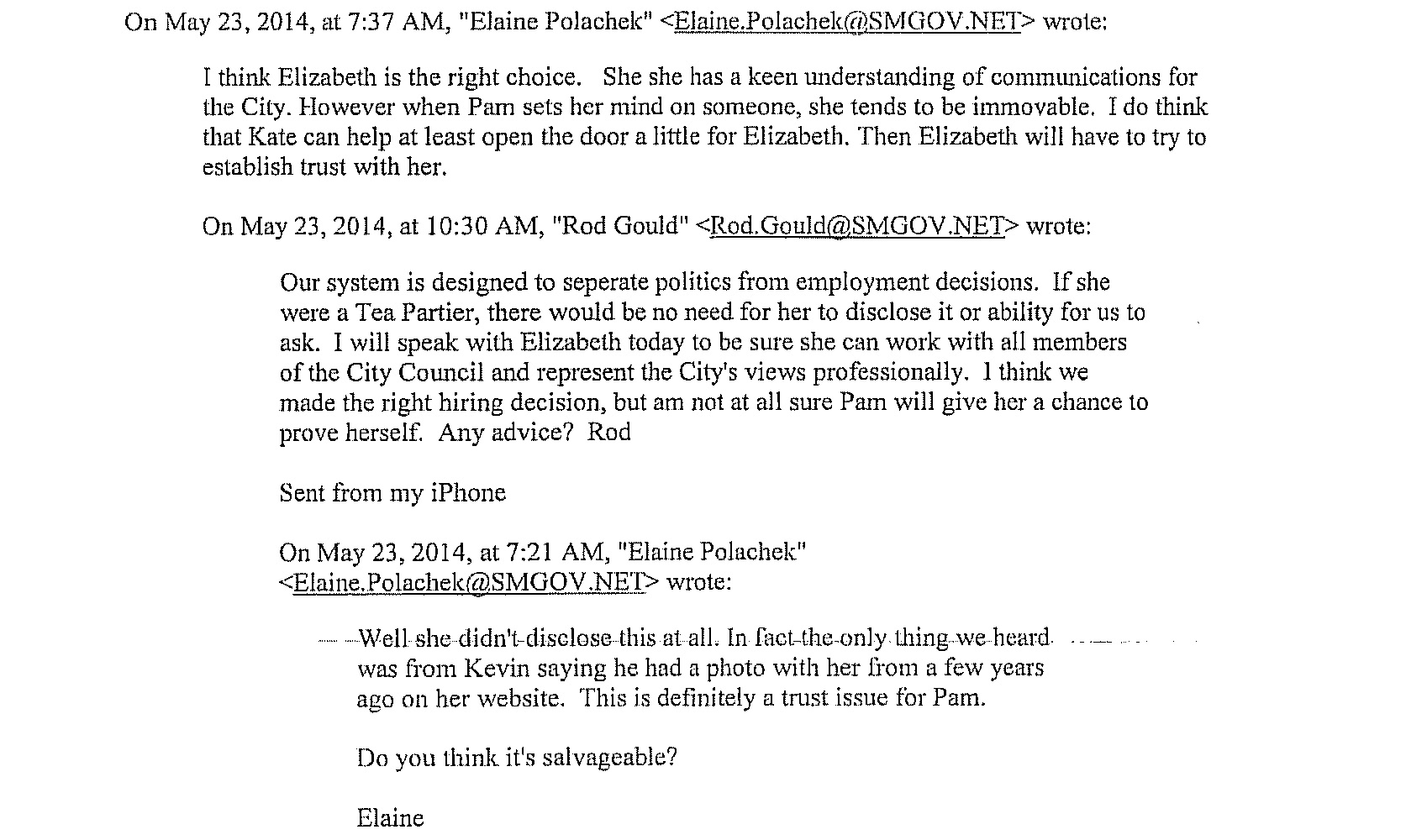
We get more insight into Gould’s state of mind as the day began through an early exchange of emails between him and Elaine Polachek, his deputy. At 7:21 that morning, Polachek, responding to Gould’s forwarding of O’Connor’s email from the night before, states to Gould that Riel had not disclosed the matters brought up by O’Connor and says that it’s a “trust issue for Pam.” Polachek asks Gould if he thinks “it’s salvageable.”

Gould responds in an email by saying that he will speak with Riel “to be sure she can work with all members of the City Council.” Crucially he then says, “I think we made the right hiring decision, but am not at all sure Pam will give her a chance to prove herself.” This is important because it shows that Gould was not then expecting to fire Riel, but was worried that O’Connor would not work with Riel when she came aboard. Nothing that O’Connor had said to that point made Gould think that the solution was to fire Riel.

Polachek was of the same mind: she affirmed that she thought that Riel was the right choice, but said that O’Connor, when she sets her mind, “tends to be immovable.” Repeating a suggestion she had made in another email even earlier Friday morning, Polachek suggests that Kate Vernez (the staff member Riel would replace), might help “open the door a little” for Riel with O’Connor, but says that Riel will then “have to try to establish trust with her.”

Emails between Gould and Elaine Polachek Friday morning.

Emails between Gould and Elaine Polachek Friday morning.

These emails make it clear that at this point both Gould and Polachek expected Riel to come to work, and the issue would be getting O’Connor to work with her. As Friday began, Gould was expecting to speak to Riel to confirm that she could work with all members of the Council, but he was worried that O’Connor would not give Riel the benefit of the doubt.

Meanwhile, it becomes apparent not only from the emails, but also from O’Connor’s deposition testimony, that she was getting deeper into the issue because she felt that Gould was not taking her concerns seriously. You never know what might have had happened if Gould had said something like, “don’t worry, I won’t make you work with anyone you don’t want to work with.” But as Gould keeps asking O’Connor to give Riel a chance, O’Connor keeps finding more about Riel she doesn’t like, and Friday afternoon O’Connor responds with a blistering email to Gould, saying that she does not and will not trust Riel. She says she will not work with Riel “not because she is a supporter of others but she attacked me directly by putting money onto (sic) a hit piece. There are very very few direct hit pieces done in Santa Monica and she was a leader in this effort.”

In the email O’Connor chides Gould for hiring “people who are political enemies of people elected to your Council,” but O’Connor still considers the hiring of Riel to be a done deal. There’s nothing indicating that O’Connor believes the decision can be reversed; she wants Gould to find someone else for her to work with.

As the afternoon goes on, O’Connor continues to ratchet up the pressure. In another email she tells Gould that she’ll be running for reelection—with the implication that that gave her even more reason not to trust Riel, who had worked for the reelection of Kevin McKeown in 2006 (McKeown would also be running again in November 2014). In another email O’Connor states that she’s sure Riel’s hiring will become a news story because of her political activity, implying that it’s going to be a public embarrassment, and possibly implying that she’ll make sure it’s a news story. When Gould asks her to have continued confidence that no one on his staff, including Riel, will prejudice O’Connor’s reelection campaign, O’Connor responds with, “I’m sure Kevin [McKeown] hasn’t lost faith!”

But again, there’s nothing where O’Connor indicates that Riel could or should be got rid of.

Returning to Gould’s actions, Friday morning he sent Riel an email asking her to call him. She tried to, but was told that he was in a lunch meeting. In an email she told Gould that she was going into a meeting herself, but that she would be available around 5:45. Gould replied by thanking Riel for trying to reach him; then he said it would be good if they “could talk briefly over the weekend if not today.” He told her that it was about “a small but gnarly political issue.” Gould did not reveal that the gnarly political issue involved her; and Riel responded, without any foreboding, “Ha – those are the best kind!”

Emails between Gould and Elizabeth Riel trying to schedule a phone call.

Emails between Gould and Elizabeth Riel trying to schedule a phone call.

The delay in connecting did not help the atmosphere for the eventual telephone conversation. As the day progressed, Gould became increasingly annoyed by what Riel had not disclosed during the hiring process. His annoyance became focused on four prior political activities that seemed particularly partisan: Riel’s financial contribution to the 2006 attack mailer on O’Connor; her being an active volunteer on McKeown’s 2006 reelection campaign (and donating to it); her being one of the founding members of SMCLC; and her being one of the leaders in the 2008 RIFT campaign.

Gould’s increasing frustration was reflected in two emails that he sent to O’Connor Friday afternoon before speaking to Riel. In them he first raises the possibility, if Riel can’t give him assurances that she’ll be able to work with all the councilmembers, of rescinding the job offer. (Gould always wrote as if Riel had only been offered the job, not that she’d accepted the offer and been employed). In the first email he writes, “if she insists that she can discharge the full duties of the position, then I must allow her to begin work.” He says that he will discuss the matter with City Attorney Marsha Moutrie to see what his options are; from the email it’s clear that he believed that Riel’s job was under civil service and that she might have job protections that could prevent him from terminating her employment.

The second email to O’Connor Friday afternoon came after he spoke with Moutrie. The City Attorney had apparently informed Gould that Riel’s job was not covered by civil service, but was rather an “at will” position meaning that her employment could be terminated at any time. Gould was still agonizing about what to do. He tells O’Connor that he is “depressed over this,” and “increasingly bothered that [Riel] shared none of this in the process. As a public relations expert, she of all people would have strong sense of how her previous activism would affect how she is perceived in this role.” He asks rhetorically, “does her previous political work disqualify her for this key position?,” and continues by telling O’Connor, “I will speak with her and think hard about this. I may have to reverse course and rescind the offer. Marsha and I have been discussing this option and she can help.”

O’Connor apparently didn’t see this last email from Gould until the next day when she was in Barcelona. Yes, while O’Connor was writing those emails that Friday afternoon, she was preparing to fly to Spain. She doesn’t respond to this email until Saturday, the 24th, after she got off her flight in the late morning Barcelona time, which was in the wee hours Saturday morning in Santa Monica.

In the meantime, it was all over but the litigating.

Gould and Riel finally connected late Friday afternoon; Riel was on her cellphone doing errands in her neighborhood. The conversation did not go well. While in their depositions and in court papers Gould and Riel differ on the tone of the conversation, the content is not materially in dispute. Gould began the call by asking Riel about the four incidents of partisan political activity that most bothered him. Riel, for her part, acknowledged that the facts as Gould had them were true. You might think, so far so good, but alas, instead of this acknowledgement leading to dialogue and an understanding that restored Gould’s faith that Riel could do the job, the conversation went downhill.

According to Gould, he lost faith in Riel because instead of going on from acknowledging that she’d engaged in partisan activities to a further acknowledgement that these revelations created problems, Riel gave Gould four of what he called “rationalizations.” The first was Riel’s saying, according to Gould, after she acknowledged the four partisan activities, “But I never hid it from you.” As Gould recounts in his deposition (page 239), that statement perplexed him, since she had not disclosed anything about political activities in the recruitment process.

More than anything else, this statement from Riel, that she had not hidden her prior political activities from Gould, seems to have been what cost her Gould’s confidence and her job.

In case you are wondering, as I am, what Riel meant by this statement, you won’t find an answer in her deposition, as the attorney for the City did not ask Riel why she told Gould that she had not hid the information. The attorney did ask her if she had disclosed the information in the recruitment process, and Riel admitted that she had not (page 278 of her deposition), and consequently it’s hard to understand what Riel was thinking when she told Gould she’d been open about her past. (Based upon something her husband said after the firing, it’s possible that Riel considered that she had disclosed enough about her political past by disclosing on her resume that she had been president of the North of Montana Association and that she had written a column for the Daily Press.) What’s unfortunate is that if, in the phone call with Gould, Riel had simply said what came out later, that after six years she’d put all of those politics out of her mind and didn’t think they were important (Riel deposition, page 74), the phone call might have had a better outcome.

Gould ended the conversation by telling Riel that they should both think about the issue over the weekend and speak again, but it’s clear from emails Gould sent to O’Connor and his staff that he had made up his mind based upon the phone call Friday afternoon to rescind the job offer.

Email from Gould to O'Connor and staff on Saturday regarding his decision to fire Riel.

Email from Gould to O’Connor, cc’ing Polachek and Moutrie, on Saturday regarding his decision to fire Riel.

For her part, Riel also believed that she’d lost the job. By the next day a sympathetic friend with whom Riel had confided was trying to find her a lawyer, and by Monday (Memorial Day), when Gould gave Riel the formal decision over the phone, she, anticipating legal action, took notes on what he said.

Suffice it to say that the phone call on Monday did not go well either. Gould was sad and apologetic, but his attempts to persuade Riel to agree to a joint statement, to spare her, he thought, embarrassment, only made things worse.

So that’s what happened. One can argue whether Gould fired Riel because of her political beliefs or because he no longer trusted her, or no longer believed that she could act impartially in her job, and O’Connor sure didn’t want to work with Riel, but there is no evidence from the record that Gould made his decision on orders from O’Connor or even on her suggestion.

Next installment—what can a councilmember say to a city manager, and what should a councilmember be able to to say to a city manager?

Thanks for reading.