Me at the Activists Support Circle tonight

I’m the speaker tonight at a meeting in Santa Monica of the Activists Support Circle; I’m going to talk about the up-and-down role that activism has played in my life. I’ll try to be objective. Here are the details if you can make it.

Activist Support Circle Public Forum in Santa Monica

Wednesday, October 30  6:30 PM

Santa Monica Friends Meeting Hall
1440 Harvard Street, Santa Monica 90404

The program will start at 7:00PM. Doors open and refreshments will be served at 6:30PM.

Guest Speaker: Frank Gruber

Author of Urban Worrier: Making Politics Personal & Co-Founder of Airport2Park.org

Mr. Gruber is an entertainment attorney, an author, a former member of the Santa Monica Planning Commission, a former local columnist, a popular blogger, and a longtime neighborhood activist and “self-proclaimed urbanist.” He is also a co-founder of Airport2Park.org, a community coalition of residents who want to create a park for everyone in place of the Santa Monica Airport.

Visit:  Airport2Park.org and facebook.com/Airport2Park

The event is free to the public. On-site free parking is available.

The Activist Support Circle is an open and ongoing support group for progressive activists that started in 2005 to help guard against activist burnout.

For more information visit: ActivistSupportCircle.org or call:  310-399-1000.

Arguing about the good stuff

I’ll admit it — I love it that Santa Monicans are arguing about what should go on in Palisades (and our other) parks. When it comes to city life and politics, what’s better than arguing about how to use public space? (So long as you’re not in Istanbul rioting over it.)

I mean, what a relief from the development wars — it’s so refreshing to hear our city council members being accused of selling out to exercise trainers instead of developers.

Seriously, we are blessed that we are having this argument. We are blessed that the founders of Santa Monica created public space in Palisades Park (although they might have blessed us with some big wide open spaces inland, too), and we are blessed that we use parks and care about how they are used.

I say so because we shouldn’t take public space for granted. Not today in America. Consider so much of America built since World War II, where the most public of all spaces are malls. We live in a city where there are vibrant public spaces – not only parks like Palisades Park, but also the Promenade and the Pier.

And streets where people actually walk! What if the closest thing you had to a main street was a highway lined with fast food drive-thru’s and strip malls?

We live in a city. Cities (and real towns) have public spaces.

Public space is not the same thing as open space, or natural space. Yosemite is the greatest of parks, but it’s not a public place — it’s not where people go to be with the public. Instead, it’s a place where people go to have an enhanced private experience (even if, or particularly if, the roads are clogged with others looking for the same).

It’s the genius of park designers who are geniuses that they can create in city parks, in public places, the sense that you can be alone with nature in a place where you do not expect to be alone.

This is why, as I wrote last week, I have high hopes for Tongva Park and, naturally, I have the highest of hopes that we can create a great park on the site of the Santa Monica Airport. (Speaking of which, I’ll be out of town this weekend, but I hope you join Airport2Park.org for a potluck picnic Sunday at Clover Park (noon to 2:00 pm) where noted urban planner James Rojas will run a fun workshop to envision an airport park.)

What about the current controversy over trainers in our parks?

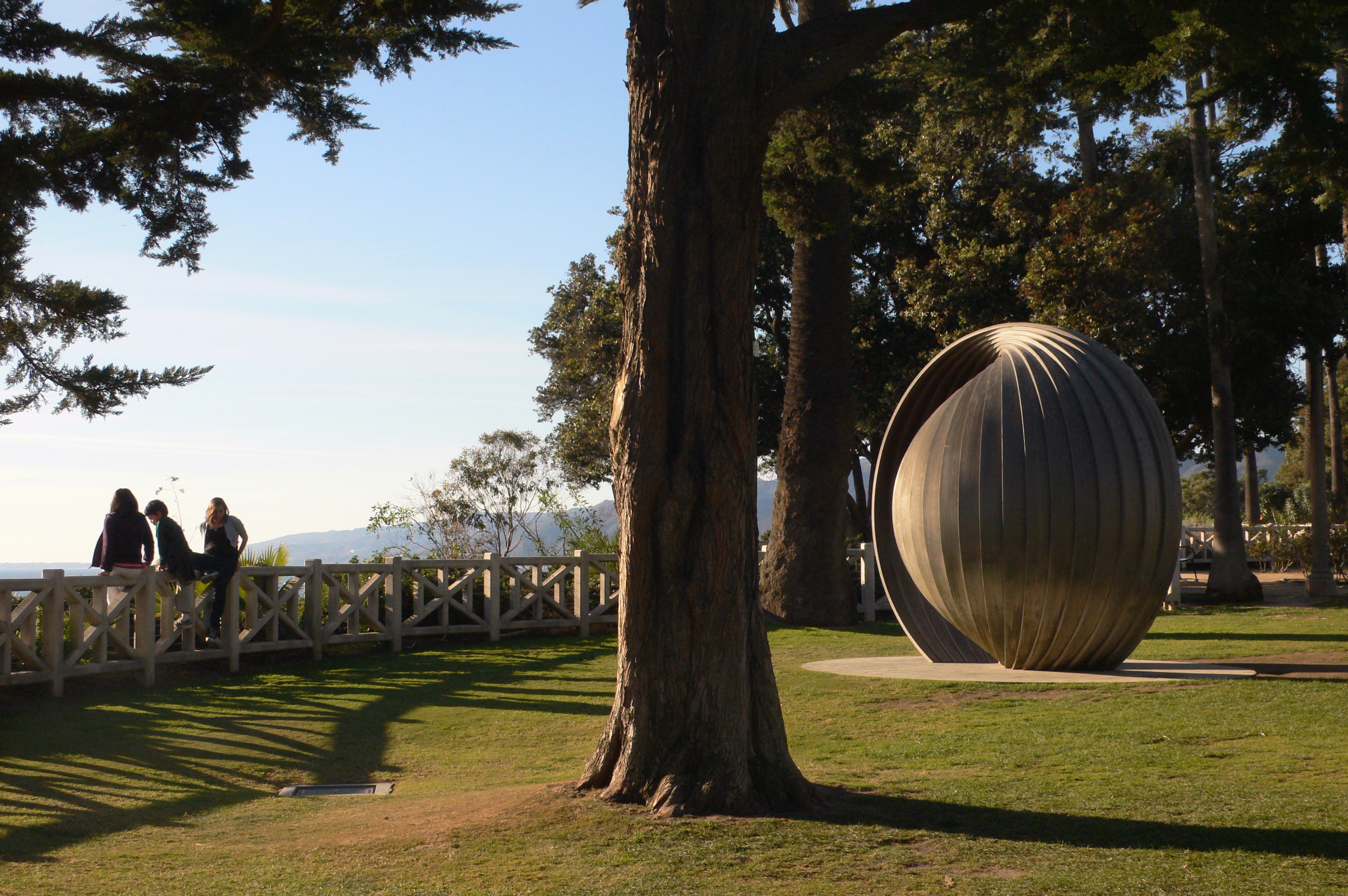
Palisades Park

Palisades Park

With everyone all riled up I hate to be boring, but I have to give the City Council credit for adopting a good program to regulate exercise trainers in the parks, at least on a “pilot” basis that will be evaluated in a year.

To begin with, I reject both extreme positions: On one hand, it was becoming intolerable (or had already become intolerable) to allow private trainers and exercise classes to dominate park use, particularly in narrow Palisades Park, for all the reasons you’ve heard (crowding out others, improper use of equipment, impacts on turf, etc.). On the other hand, a blanket prohibition of trainers and trainees wouldn’t be right either – i.e., it’s not surprising that after the vote to limit trainers, Santa Monica got ridiculed for “banning healthy people from parks.” Parks and exercise are a what you might call a good fit.

City parks are for people to use. It’s ironic, but in the past neighbors’ complaints about Palisades Park have focused on the homeless “taking over.” Homeless people are attracted to parks when other people don’t use them. Trainers bringing classes to a park is a sign of a park’s success.

But too much of a good thing is not a good thing. In this situation, you need to balance uses through regulation, and the council did a good job. (This is one of those cases where you think they must have done right since everyone – neighbors and trainers — seem to be mad at them.) They regulated how many trainers can use the park and where they can hold their workouts; the pricing seems fair and favors the use of other parks; the council banned trainers from Palisades Park on Sundays; and they regulated the use of equipment.

Let’s give this plan a try and see how it works out.

Thanks for reading.

Turning corners at Corner’s park

As I watched the festivities Saturday for the opening of Tongva Park and Ken Genser Square I couldn’t help but reflect on the history of the past 25 years of planning for the Civic Center and the various characters (and I mean that in at least two senses of the word) who had been involved, but there was one name that particularly came to mind: that of John Jalili, the former City Manager of Santa Monica.

I don’t recall hearing Jalili mentioned in anyone’s remarks Saturday, but he was a key player. After the 1994 earthquake Jalili established the City’s earthquake recovery redevelopment district, a district that covered most of the city and included downtown and the office/industrial corridor along Olympic. This took some chutzpah, since even with all of its earthquake damage Santa Monica did not fall obviously into the “blighted” category that was the justification for redevelopment.

The City used tax-increment money generated in the redevelopment zone from new development and re-sales of appreciated old development to fund the $53 million the City used to buy 11 acres from RAND, of which the new park covers about half.

Children's play area in Tongva Park

Children’s play area in Tongva Park

Ironically, or tragically, depending on how you look at these things, with the end of redevelopment the State of California now wants this money back, along with redevelopment money the City used to build parking structures and other infrastructure projects. If the City doesn’t pay up (or prevail in litigation) at least in theory the State could “repossess” the park.

One can make moral arguments against how redevelopment money that would have otherwise gone to fund schools and other public purposes was at times used in California to subsidize private developers in certain areas at the expense of other areas not getting the subsidies, but at least after Saturday’s glorious grand opening of the park, Santa Monica can hold its head high — we spent this redevelopment money to build a beautiful park in a location where it can and will serve the entire region.

Santa Monica City Hall from Tongva Park

Santa Monica City Hall from Tongva Park

The park design is a triumph, and to comprehend how triumphant it is, one must consider how difficult the site is for a park. On the northern edge, between the park and downtown, that’s not a river flowing languidly, under “Morty” the big fig tree, to the sea, that’s a freeway. And think about it, how much cause do people usually have to walk between City Hall and the Pier? For about 20 years I’ve ridden my bike nearly everyday over the Main Street Bridge, I can assure you few pedestrians find reason to walk on that stretch of Main Street.

To create a park that would stitch connections between downtown, Ocean Avenue, City Hall, and the rest of the Civic Center, as well as attract people to a location hard by a freeway, designer James Corner and his team had many challenges. While the site will be helped when the Olympic Drive extension opens along the southern edge, with the new apartments and ground-floor retail facing the park, and it will be great when Chez Jay opens its patio, the designers had to create a park that would be an attraction in and of itself, without becoming something other than a park.

James Corner speaking Saturday at the Grand Opening of Tongva Park

James Corner speaking Saturday at the Grand Opening of Tongva Park

While it’s too early to know for sure — we’ll know in a few years, after the novelty wears off if the park attracts enough users to keep it active — I suspect Corner succeeded. One reason — no pun intended — is that the park has a lot of … corners. There always seems to be another angle to turn at and see something new. The park is not a maze, but it is a bit amazing how in a tight space, about six acres, the park presents so many different “habitats” for the human species to enjoy itself and get lost in.

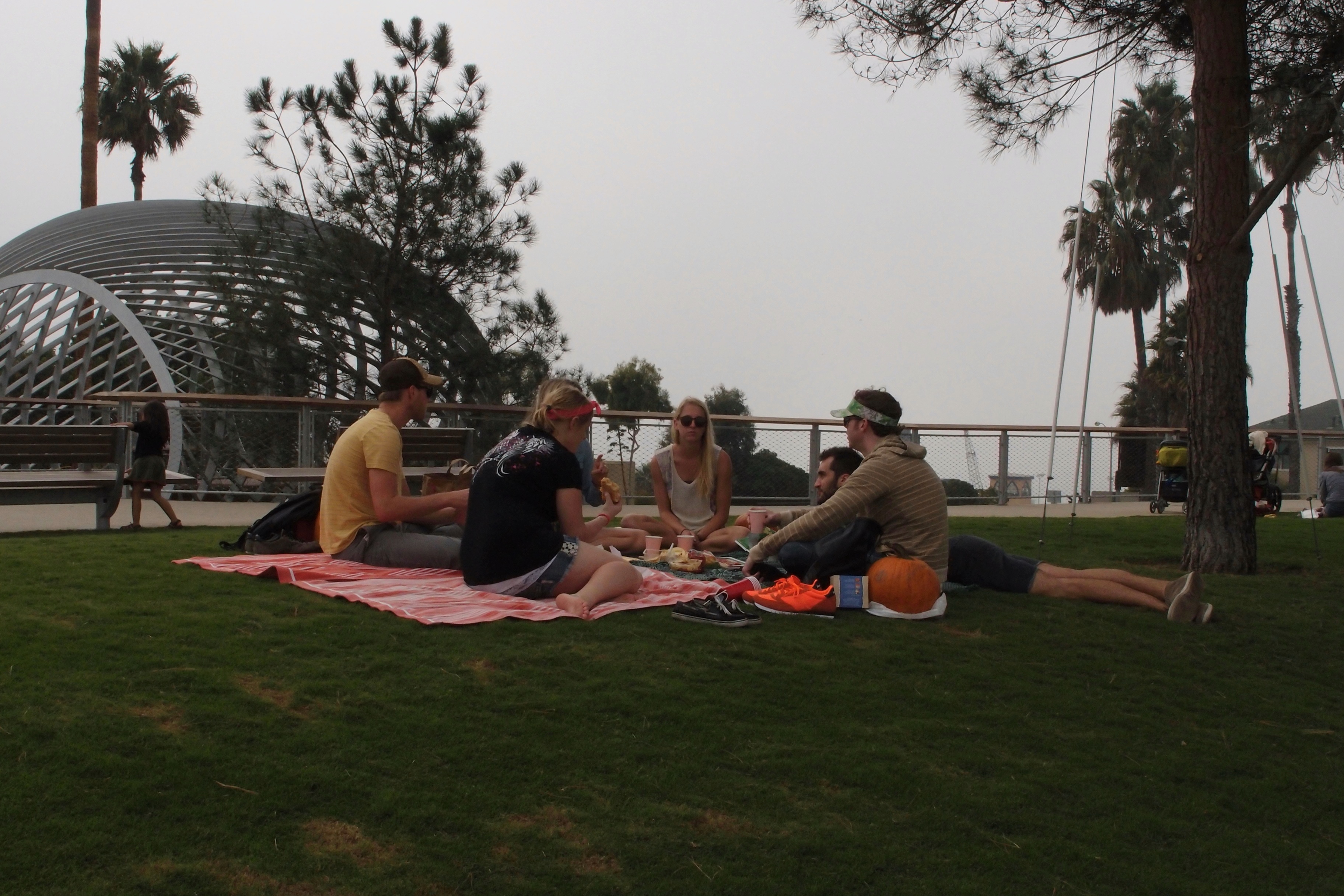
Picnickers in Tongva Park

Picnickers in Tongva Park

I suspect in a metropolis where most parks are either wilderness or dedicated to recreational uses, people will be attracted to and want to use a park that is a living, interactive sculpture.

Thanks for reading.

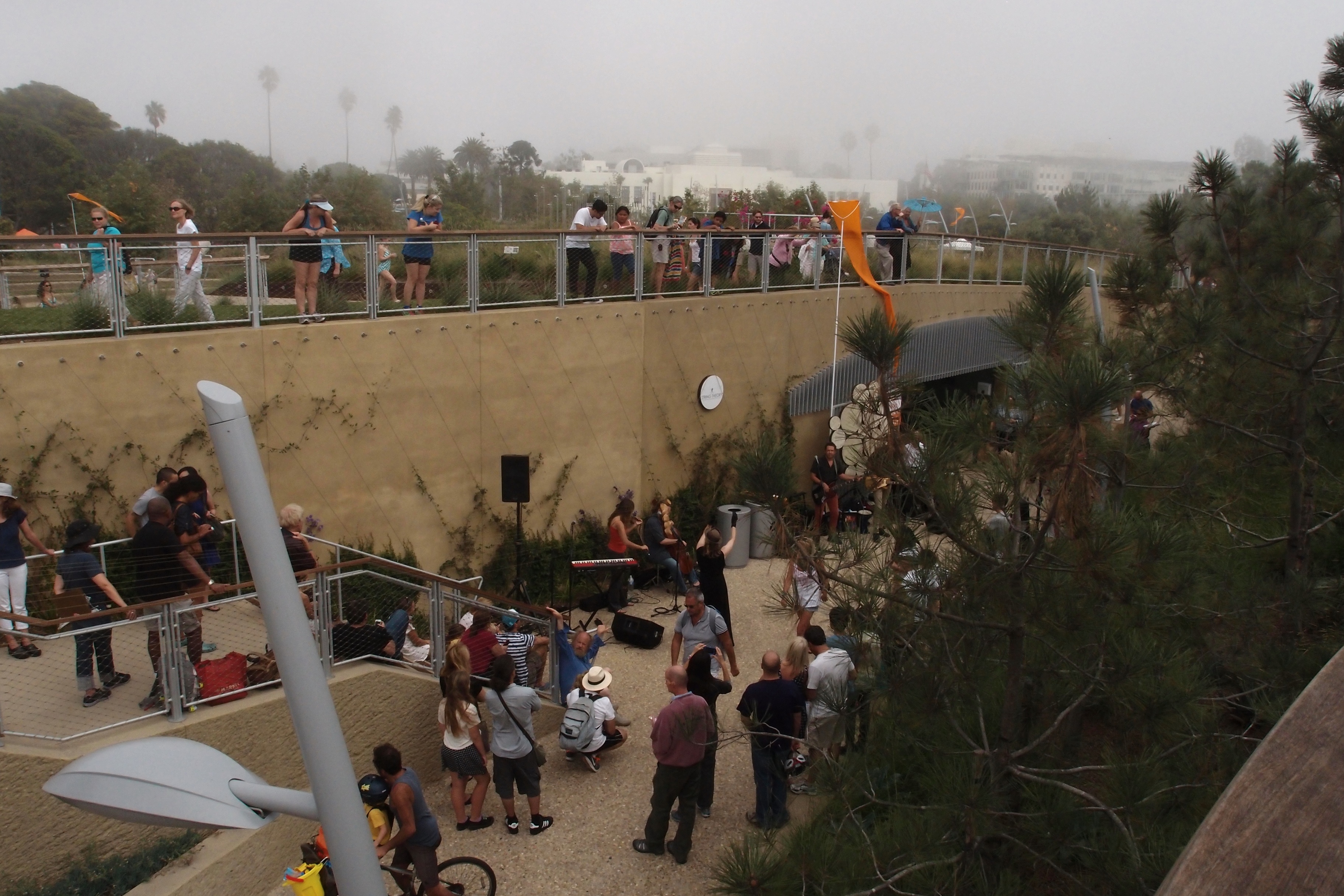
The group "String Theory" performing Saturday.

The group “String Theory” performing Saturday.

In this case, no need to compromise

I’m still consumed with (and writing about) the idea of turning the Santa Monica Airport into a big park, and this post contains more follow up to the Oct. 3 Airport2Park workshop — first to let readers know that videos of the workshop (in two parts) are available to watch on the Airport2Park website.

Honestly, the raw footage hasn’t been edited yet (and in certain places sound needs to be added from other cameras that were recording the meeting) and you may not want to spend two hours watching the whole event (although I guarantee you will be entertained!), but in the you-owe-it-to-yourself department, be sure to watch Mark Rios’ presentation on how airports and industrial sites all around the world are being turned into parks (which begins at the 20:42 mark of Part 1), and the presentation of the ideas from the breakout sessions (which begins around 11:30 in Part 2).

You will be edified.

In the meantime, we at A2P are tabulating the responses we received not only in the breakout sessions, but also from the many individual surveys that we have received from the public. (It’s also easy to add your ideas for a park to the mix by sending a message to Airport2Park from the website.)

Over the past decade or so, a number of landscape architects have made the case for a movement they call “landscape urbanism” which seeks to understand how cities develop by looking more at terrain and ecosystems than at a city’s buildings. It’s not coincidence that this way of looking at the city has arisen in an era when many cities are dealing with the remains of the industrial revolution in a postindustrial economy. (Perhaps the most famous example of landscape urbanism is the redevelopment of the High Line In New York City.)

Intrinsic to the landscape urbanism movement is the notion that in the urban context landscape is not simply landscape, it is what shapes the city. More specifically, a park is not simply a park. Parks and other open spaces not only serve important functions on their own, but also affect the performance of other urban functions.

There are many debates floating around about the role of landscape and the impact of landscape urbanism on the design of cities, but one thing that was clear from the A2P workshop is that ordinary residents instinctively understand the principles involved. While there were many calls for the restoration of terrain, unprogrammed spaces, and “quiet places,” there were as many calls, typically if not always from the same people, for connections to be made with the surrounding city, for active recreation, arts, and cultural uses, and for restaurants and cafés. People get it.

When asked at the end of the workshop to list five “takeaways” from the meeting, Mark Rios mentioned these — quiet spaces, connections to the city, environmental fixes (swales and the like), the arts, and cafés. But he also raised and responded to an important question that people might have: would trying to accommodate all these different uses lead to a compromise design, a “weird camel,” as Rios put it?

No, he said, a great park can accommodate many uses, programmed and unprogrammed alike, without being a compromise. Think about the great parks you have experienced in your life; a great park design is not compromised because the park accommodates conflicting purposes – doing that is what makes it a great design.

This is an important concept for any kind of urbanism, not only of the landscape variety. We spend a lot of energy trying to prevent things from getting worse. But it is possible to make things better.

Thanks for reading.

A2P Oct 3 Rios

Mark Rios speaking at the Oct. 3 workshop. (Photo courtesy Mike Salazar)


Airport2Park — the time is now

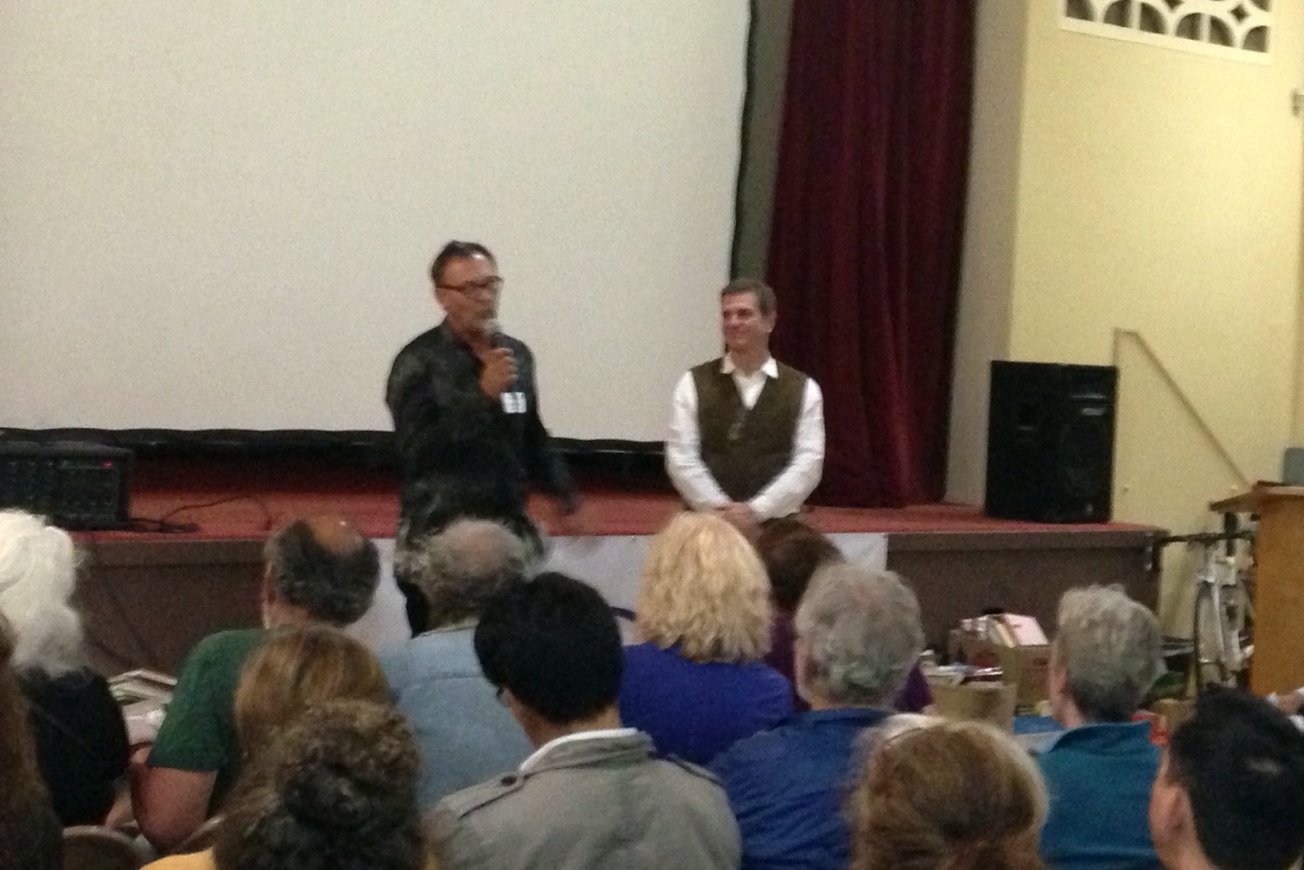
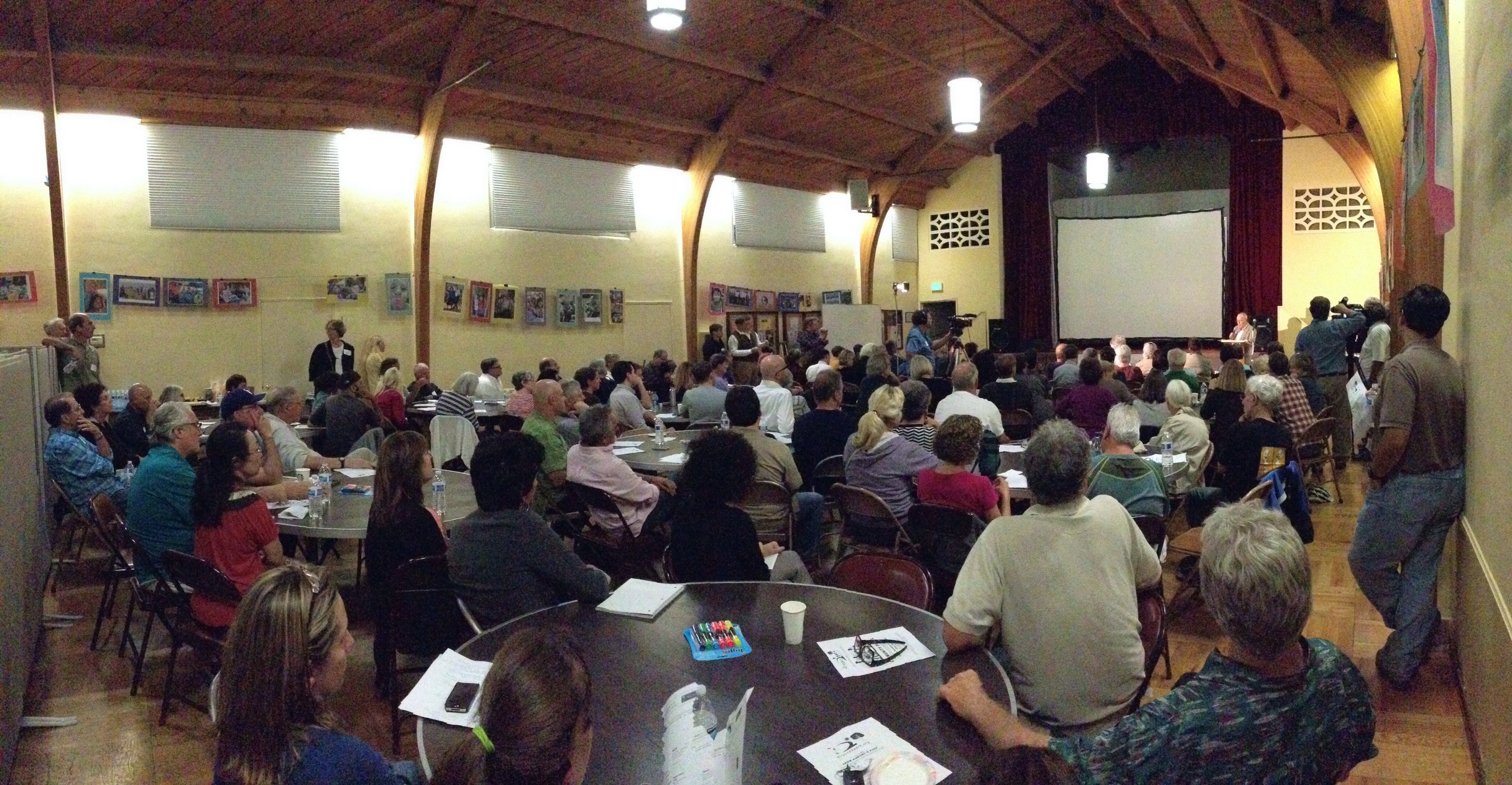
If you weren’t among the 150 or so who attended Airport2Park.org’s workshop Thursday evening about turning Santa Monica Airport into a great park, you missed an inspiring event. What was so exciting was how optimistic the gathering was. So much of local politics — I suppose all politics these days — is about fear of the future. This event was all about how good the future could be.

The key player in all that optimism was noted landscape architect Mark Rios, who gave what I can only call a moving talk, illustrated with slides, about how people around the world have turned godforsaken and human-forsaken landscapes leftover from the industrial revolution and turned them into beautiful, functional and beloved parks. His fundamental precepts: “Thing big; think green.”

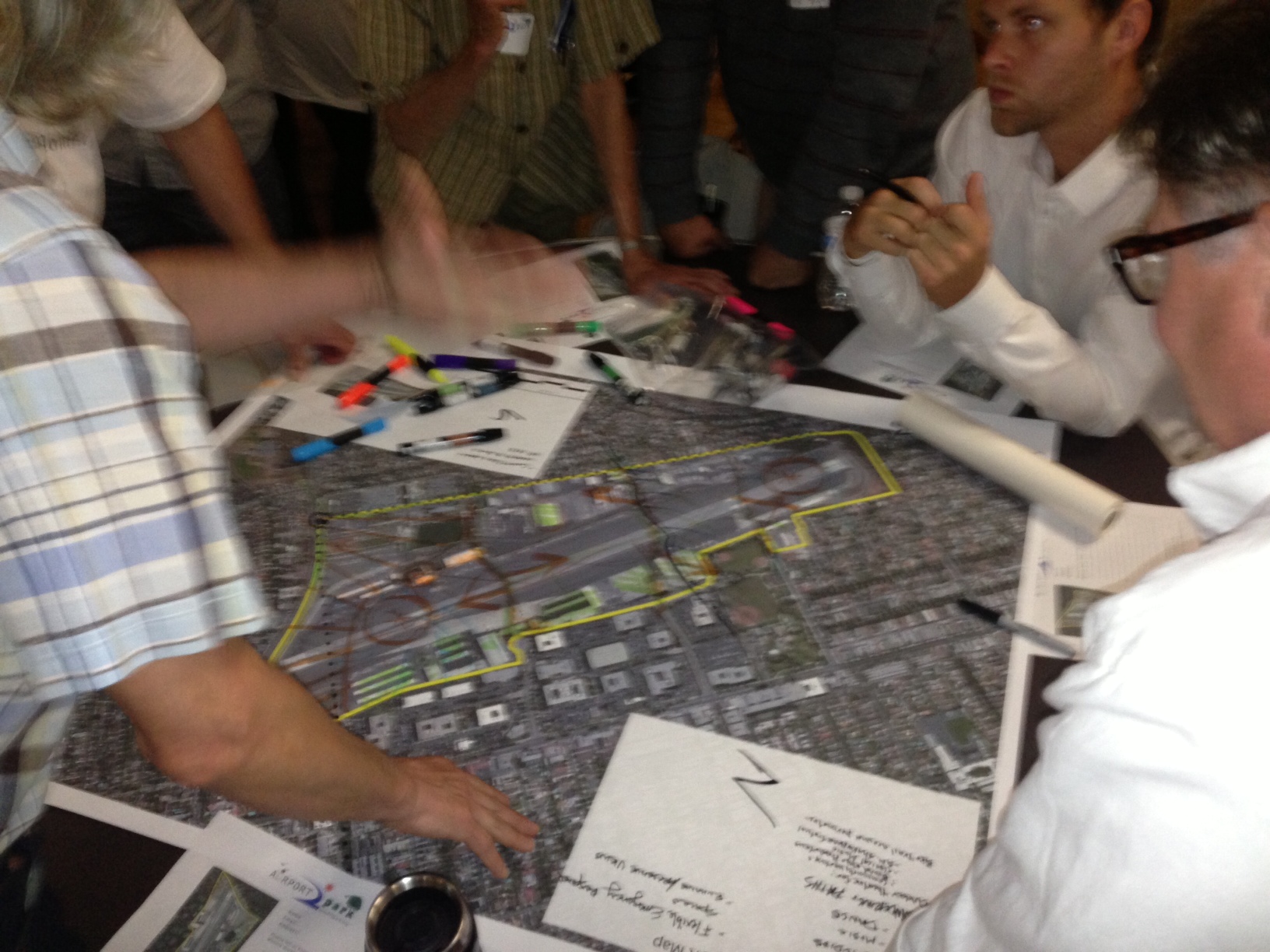
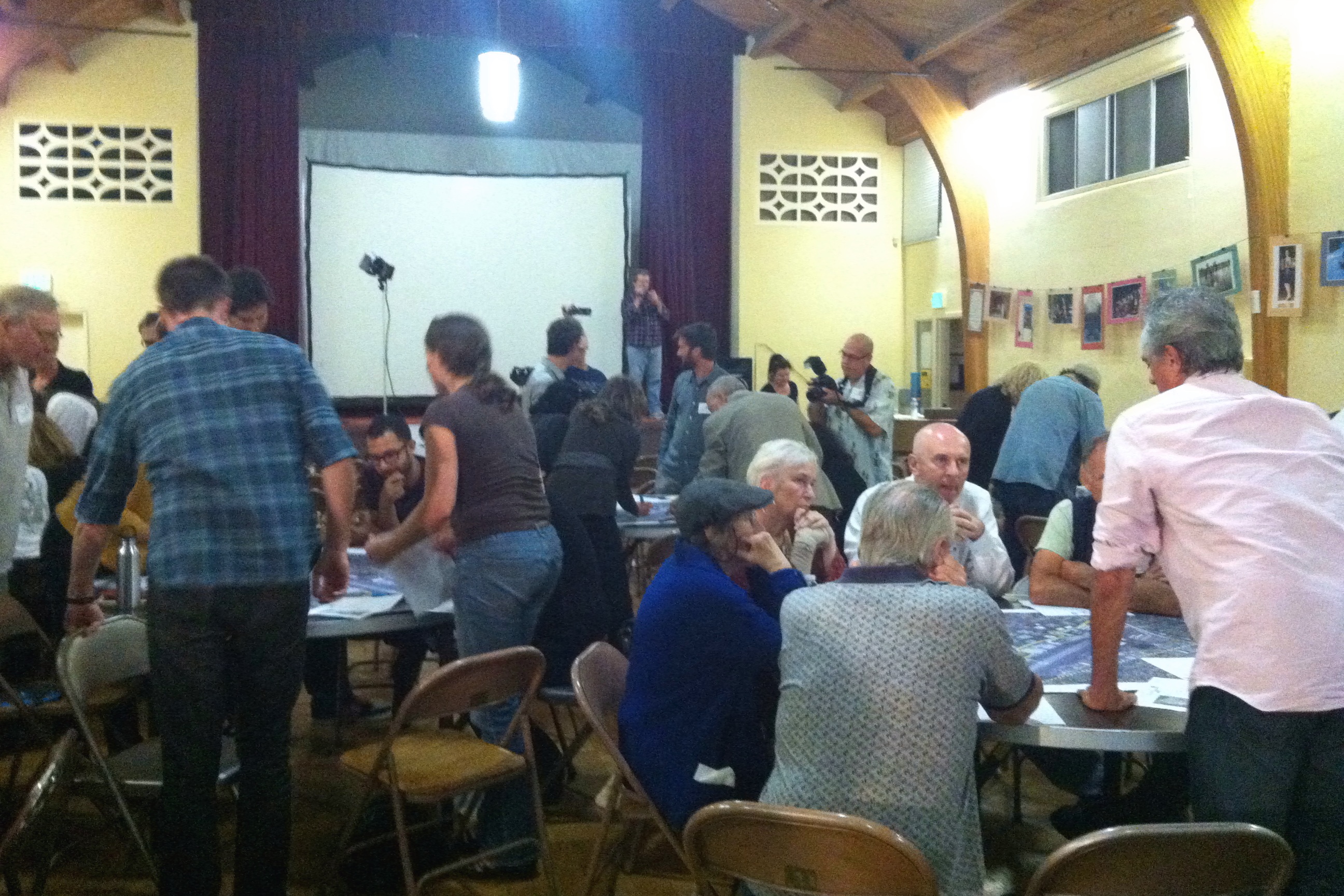
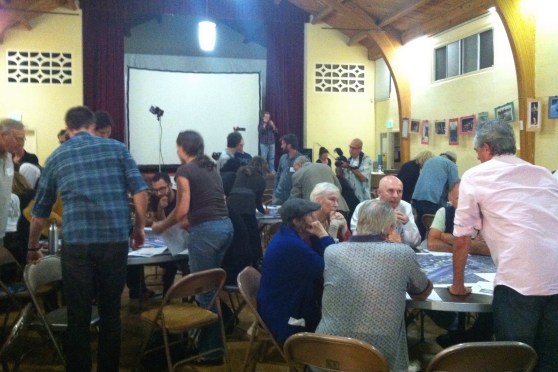
Rios’ presentation ignited the imaginations of the public, who then went to work in ten small groups and came up with ideas that showed the power and logic of collective action.

It was a lot of fun.

I was proud to have a part to play at the workshop, which was to give a curtain-raiser for Rios — a talk that explained why Airport2Park has been formed now and why now is the time to plan for the green future of the airport site. Rather than rewrite it for the blog, here is my talk:

Let’s Build a Park – Why Now is the Time

I’m going to make a few remarks to put what we are doing tonight in historical context, because we are at an historical moment. We at Airport2Park have called this a once-in-a-generation opportunity, but it’s really more like a once-in-a-century opportunity, because it was nearly a century ago that the City of Santa Monica began acquiring the land at the airport with money raised with a parks bond.

At that time, an airport — basically a dirt strip then — was considered park-like, but that hasn’t been the case for a long time. Donald Douglas may well have been the most important person in the history of Santa Monica, but if so, he became that by turning the airport into one of the world’s biggest industrial plants, part of the arsenal of democracy that won World War II.
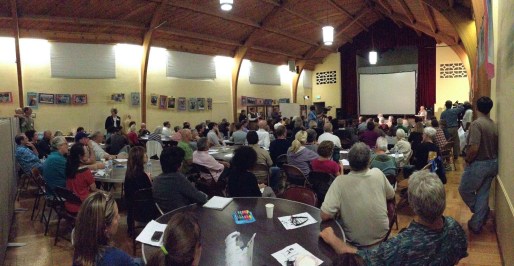
photo 2

Photo courtesy Mike Salazar

By the ’60s, however, when the City denied Douglas’ request to condemn residences to expand the runway so that he could build jets there, the residents of Santa Monica and city officials had recognized that the airport was no longer a good fit.

Things got worse when the FAA required the airport to serve jets. In response to that, in 1981 the City Council voted to close the airport. The FAA fought back in court, and the City, the FAA, and the pilots entered into the famous, or infamous, 1984 Settlement Agreement.

The 1984 agreement is clear: the City covenanted not to close the airport prior to July 1, 2015. Given this provision, it’s plain that all parties to the agreement believed at the time that the City had the right to close the airport. Speaking for myself, I got involved in local politics about 20 years ago, and all I can say is that everyone I met said that the airport was going to close in 2015.

It was also during this time that organizations like Concerned Residents Against Airport Pollution got started – they brought to everyone’s attention the negative impacts of the airport.
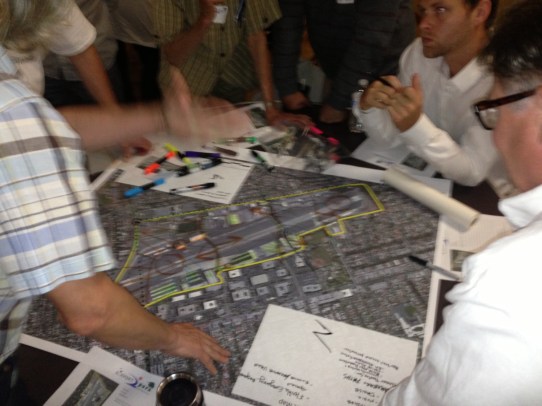
photo 5

Photo credit: Mike Salazar

The 1984 Agreement gave all aviation users 30 years to earn back a return on their investments and make arrangements to leave the airport. The aviation users often defend the airport by saying that nearby residents knowingly bought homes near an airport, but it’s they who have been on notice, for more than 30 years, that the airport would close.

Notwithstanding the clear language of the 1984 Agreement, a few years ago the FAA began claiming that under a provision of a 1948 agreement, the “Instrument of Transfer,” under which the federal government returned the airport to the City after leasing it from the City during the War, the City was obligated to operate the airport in perpetuity. I want to be clear that we at Airport2Park – and also the folks in City Hall – don’t accept the enforceability of this clause, and we don’t believe that anyone in 1984 believed that the clause was enforceable. But I won’t go into that legal analysis now; it would take a long time and we have work to do.

But it is important to note that based on research and documents uncovered by the groups working to close the airport, it is apparent that even assuming that the Instrument of Transfer is enforceable, it would not apply to that part of the airport, called the “Quitclaim Parcel,” that includes the westernmost two thousand feet of the five thousand feet of the current runway. Meaning that this part of the runway could be closed, but a functioning smaller runway would be left to satisfy the Instrument of Transfer if it is enforceable.

Last April Marsha Moutrie, the Santa Monica City Attorney, told the City Council that she thought this approach – using the Quitclaim Parcel – to sidestep any FAA claims based on the Instrument of Transfer was promising, and the council directed her to investigate further and report back in March 2014. At the same meeting, the council members expressed views in favor of converting this city-owned asset into a park if all or part of the airport can be closed.
Marcia Hanscom-1

Photo credit: Marcia Hanscom

We are now presented with exciting opportunities, but they may run in stages. The first stage is that the City can reclaim the Quitclaim Parcel July 1, 2015, the same date that all the leases for aviation uses at the airport expire and can be terminated. Without challenging the FAA on the Instrument of Transfer, the Quitclaim Parcel could then be turned into a park, and the runway could be reduced to less than three thousand feet.

We believe that ultimately, with a less than 3000-foot runway, which could not service jets, and without aviation services, the airport would have to close, and the whole of the runway and adjacent areas could be turned into a mile-long park.

After the City Council’s meeting in April, we formed Airport2Park.org to gather support for building a great park at the airport site, and we started planning this workshop over the summer. Surveys by Community Against Santa Monica Airport Traffic have already shown overwhelming local support for a park, but we need to create a movement to make this happen. We’re gratified by the support we’ve already received from the Sierra Club and the Friends of Sunset Park neighborhood group, and we expect more endorsements to follow.

The interests behind the airport, including the aviation industry and the FAA, a captive agency if there ever was one, will fight closure of the airport with every tool they have. But keep in mind — the FAA always says that it will not allow airports to close, but hundreds have closed in past decades.

Unfortunately, we know that the supporters of the airport will use fear as a fundamental tactic. What is scarier than anything else? . . . Well, it’s always the unknown. What the airport supporters say is, “don’t close the airport, because you don’t know what will take its place.” The politicians, they say, will allow big developments there that will be worse than the airport.

Our movement to build a park at the airport is designed to present a credible and a beautiful alternative to the airport, a positive message that everyone can support whether they live under the flight path or simply want a park to hike or cycle in, or one where they and their kids can play sports, or one where nature can be restored. A park would be a healthful, sustainable, environmentally safe and economically sound investment in Santa Monica’s future.

Tonight we’re taking a major step in that direction. Later on this evening we’re going to ask you to brainstorm about what a park could be, what it could mean. After that, we’re going to ask you to create a movement – at the city level, the county level, the state level, and yes, the federal level – to make this happen.

Tonight, let’s inspire ourselves, and hopefully others, as to what we can build for generations – for centuries – to come. And let’s have fun doing it.

Thanks.

And thanks for reading.