For Poorer and for Richer

Two of my favorite Santa Monicans to argue or agree with are former mayors Denny Zane and Michael Feinstein. (But it’s better when they agree with you.) The two of them will always let you know exactly what they are thinking and back up their arguments with facts and/or honest perspectives, as well as deep historical and practical knowledge.

But I disagree with their opposition to including luxury condominiums in any towers that the City might allow to be built along Ocean Avenue, opposition they expressed in articles Jason Islas wrote recently for The Lookout.

There are good reasons to question the desirability of allowing new towers along Ocean Avenue (there are also good reasons to favor them), but I don’t include opposing high-end residences as one of them.

Both Zane and Feinstein argue that allowing tall buildings for the purpose of housing rich people would compromise Santa Monica’s character — in Feinstein’s words, “change our entire community standards,” or, in Zane’s, to do so would “transgress some pretty fundamental values.” But what values and standards? Rich people are part of Santa Monica and always have been. From the earliest days there were mansions along Ocean Avenue, and let’s not forget Marion Davies’ little place on the beach. Luxury homes and the people who live in them are part of the mix that makes up our special character.

Would Zane and Feinstein say that Santa Monica’s community standards are challenged because 31% of all the land in Santa Monica, comprising nearly 47% percent of all residentially zoned land, is zoned for single-family homes? While it’s true that back in the days when Santa Monica was a factory town workers and shopkeepers lived in and owned many of those houses, it’s been a long time since a truly middle-income family could buy a house here.

I suspect that many of the people who oppose building towers on Ocean enjoy the fact that so much of our city is lightly populated (as do I – cities shouldn’t be uniformly dense), but the fact is that a lot of Santa Monica, including some of the most beautiful parts leading up to Santa Monica Canyon and the Santa Monica Mountains, is already privatized (to use Feinstein’s word). Has this ruined the character of Santa Monica? I don’t think so.

Opposing high-end condos also begs the question of what might go in a tower that would be less objectionable. Land downtown is zoned commercial; personally, I would find it worse to allow more office towers (like the former GTE and “Café Casino” buildings), and offices would also generate more traffic than condos. Does anyone want to build high-rises with only affordable housing? That’s a strategy that progressives rejected a long time ago. And what’s wrong with mixing residences with hotels? That’s a tradition in cities all around the world.

All in all, it seems that if towers are going to be built, the best mix that could be proposed would be a combination of hotels, market rate condos and apartments (meaning luxury, yes, but there’s nothing stopping the City from trying to negotiate housing for a broader mix of incomes), affordable housing (which in a development agreement can be required to be built on-site or nearby), and public access to the views from the tops of the buildings.

Thanks for reading.
Popularity Contest; and the Winner is . . .

For more than 30 years Santa Monicans for Renters Rights (SMRR) has been the dominant political organization in Santa Monica. I’d argue that now it’s more popular than ever.

Why do I say this at a time when residents are supposed to be so angry? Start with the last election, when SMRR candidates ran the table and for the first time won every race for City Council, the School Board, the College Board and the Rent Board. SMRR has by far the most powerful brand in Santa Monica politics. The power of that brand is based on performance: residents know that Santa Monica, notwithstanding the issues we have, is among the best-governed cities in the region, one that provides excellent services.

When it comes to the development issue, which these days generates the most headlines, Santa Monica, among the cities in the region that have historically been employment centers, is the one that has best managed development. Notably, when nearly every other Southern California city subsidizes development, Santa Monica requires that developers subsidize city services and capital investments. This has been the case ever since SMRR took charge in 1981 — when, in the words of William Fulton, Santa Monica was the first Southern California city to “confront the growth machine.” Since the ’60s population has boomed in Southern California, but for 50 years Santa Monica’s population has hardly budged.

As population has turned over in Santa Monica, and as the battles of 30 years ago over rent control faded into history, many have predicted that SMRR’s popularity would wane, but that hasn’t happened. Newcomers have high opinions of SMRR precisely because they have come from elsewhere and know in comparison just how well Santa Monica is governed (and they know that traffic is just as bad outside of Santa Monica as in it).

What I’m saying is contrary to the narrative that we read about in the local papers and online, but I don’t know any place where politics is about happy people expressing gratitude for their happiness — nor should it be. Everyone and every government makes mistakes, and that goes for Santa Monica, too. But according to a decade of consistent scientific polling, the real people who live here — not necessarily the people who purport to speak for them — are happy with their city and with local government. Even the critics appearing before the City Council or the Planning Commission typically preference their criticisms with “I love it here, but . . .”

In this context it was a shocker to read a column last week in the Daily Press written by longtime local activist Tricia Crane for a column-writing collective called “Our Town” that consists of Crane and fellow anti-development activists Ellen Brennan, Zina Josephs and Armen Melkonians. In the column, entitled “Taking from the poor, giving to the rich,” the Our Towners lit into “the people who run Santa Monica” who did “not care what residents want.”

According to Our Town, Santa Monica’s vaunted public development review process, one of SMRR’s achievements, was “a method used to keep people distracted from the hidden agenda of a group of politicos and developers who are working together to overbuild Santa Monica in a way that profits them while destroying the quality of life for residents.”

The immediate instigation for the column was the Rent Board’s decision to grant developer Marc Luzzatto a removal permit to allow him to proceed with his development on the site of the Village Trailer Park (VTP). According to the Our Town column, the failure of SMRR leadership to get the board members to ignore the advice of their attorneys (who advised that it was unlikely the board would prevail against Luzzatto in a lawsuit) and deny the permit was evidence for “just how far from its original values SMRR has wandered as it uses its political clout to forward the interests of the wealthy while leaving the neediest of Santa Monica further and further behind.”

Ouch.

And it’s not just the Our Town writers; the mantra of the Santa Monica Coalition for a Livable City (SMCLC) is, “Take back our city!” Take it back from whom?

A couple of things. For one, do you believe that the anti-development opposition to the VTP project (which will consist nearly entirely of workforce and affordable housing) is based on the plight of the trailer park tenants? (Who, by the way, could have been evicted seven years ago under state law if the City and Luzzatto had not reached a deal to keep them there.) I’m not doubting that Santa Monica’s anti-development activists feel bad, as we all do, for people losing their homes, but I suspect that if there had been a tannery there instead, and Luzzatto wanted to replace that with 400 apartments, the Our Town writers and SMCLC would have protested and argued that Santa Monica needs to preserve its tanneries.

While declaring that they are not against “all development,” the anti-development side conveniently finds “special” arguments to use against any specific development (for example, while condos are too big and luxurious and serve the rich, workforce apartments are too small and austere and the tenants can’t afford them), but the real problem is that they never tell us what development they would support. Development needs to be regulated, but anyone who argues that there shouldn’t be, or won’t be, any development can’t be taken seriously.

For two, what about the bite-the-hand-that-feeds-you angle? The anti-development faction in Santa Monica has never elected anyone to City Council without an endorsement from SMRR, and even those they have elected have at least been in favor of building housing. The anti-development forces who use SMRR every two years to pursue their agenda reject the members of SMRR, and the SMRR council members, who support regulated economic development and investment in Santa Monica. SMRR’s strength, however, and the ability to achieve its goals, depends on respecting a range of views within.

SMRR prides itself on being a “big tent” organization, and that strategy has worked well. You have to wonder what are the limits to that strategy. “Big tent” can easily become “battered political organization syndrome,” where disproportionate efforts are spent trying to accommodate a faction that plainly doesn’t like SMRR and won’t be happy until it has the whole tent.

Thanks for reading.

Memo to Planning Commission: You can handle more knowledge

Tonight the Planning Commission will discuss the parameters for the environmental analysis for the Downtown Specific Plan (DSP). I previously wrote, when the issue came to the City Council last week, that the council should set parameters to cover a wide range of heights and densities, so that, consistent with the purpose of the California Environmental Quality Act (CEQA), the council, as the decision-maker, will have all the information it needs. (The council tabled any action on the question until August 13 because it only had four members present.)

Since the Planning Commission will consider and vote on the DSP before the City Council does, the same reasoning holds for the commission. The commissioners should have more information, not less.

One of the common criticisms of the development review process in Santa Monica that the anti-development community makes, at times with justification, is that individual projects are evaluated before the City has completed overall plans for a given area. In the downtown area, developers have proposed projects in advance of adoption of the DSP, but neither the Planning Commission nor the City Council can make decisions on those developments until after the DSP is adopted. This is a good thing; but if the staff’s recommendations are followed, and the Environmental Impact Report (EIR) for the DSP only studies heights up to 130 feet, then any proposals to build higher than that will be evaluated later, on a one-off basis. That would be a bad thing.

While any major development will have its own EIR, many of the issues, particularly aesthetic issues (environmental analysis includes aesthetics), implicated by higher heights need to be evaluated with respect to the whole district. That’s where the EIR for the DSP has a whole comes in.

Only if the DSP’s EIR evaluates what a series of new towers would look like will the commission and the council, let alone the public, have a chance to evaluate the implications of changing 30 years of policy to allow taller buildings. This is not an issue that should be considered on a site-by-site basis, as it is the skyline of the district as a whole that needs to be considered. Once taller heights are evaluated (in the EIR and otherwise), the commission and ultimately the council can make decisions how to “sculpt” that skyline.

Another issue that has come up is whether to delay the DSP’s environmental review until after the commission and the council approve a draft DSP. Again, what I have heard over the years, often from the anti-development community but not only from them (and it’s certainly a point I agree with), is that it defeats the purpose of CEQA to have environmental review only after a plan a project has been tentatively approved. The complaint is often, with justification, that environmental review is then used to justify decisions previously made.

Making decisions, even tentative decisions, prior to environmental review puts the cart before the horse: the purpose of environmental analysis is to give decision-makers the information they need before they make decisions.

Knowledge is power. The staff’s proposal, unless modified, would reduce the commission’s and the council’s knowledge and their power. If the commission and the council don’t believe they have enough wisdom to make choices based on more knowledge, then I wonder why they want to sit on the dais in the first place.

I hope the Planning Commission and the City Council have enough self-respect to accept the staff’s invitation, contained in alternative proposals 2 and 3 in the staff report, to expand the scope of the EIR.

Thanks for reading.

The Specific Plan Back Then

The Los Angeles Times ran an article in today’s paper about how developments at Santa Monica’s Civic Center, both public and private, are now coming to fruition. This has been evident to anyone who has recently traveled on Main Street or Ocean Avenue south of the freeway, but it’s worth noting that both the City’s two new parks, Ken Genser Square and Tongva Park, are going to open soon, as well as the Related Companies’ mixed condo and affordable housing developments south of Tongva Park and along Ocean Avenue.

It’s also worth noting that these projects result from 25 years of planning, planning that began in the late ’80s when the City formed a task force to determine how much of what kind of development to permit in the Civic Center. The task force’s conclusions led, in 1993, to a public design process and the creation of a “specific plan” for the Civic Center.

Reading the article in the Times, I couldn’t help but reflect on the current process to develop a specific plan for downtown Santa Monica.

One thing that was the same in 1993 as it is 20 years later was that the plans to develop the Civic Center engendered considerable controversy. People ask me if I have ever seen people in Santa Monica as “angry” as they are now about development, and my reaction is, “Hell yes.” The opposition to the Civic Center Specific Plan (CCSP) was fierce. People got so riled up that even when the City Council, which then included anti-development stalwarts Ken Genser (for whom the plaza in front of City Hall has now been aptly named) and Kelly Olsen, voted 7-0 to approve the plan, opponents, who were worried the development of the Civic Center would cause gridlock, gathered signatures and put the CCSP on the ballot.

In the June 1994 primary election, the voters of Santa Monica approved the plan in a 60-40 landslide. Opponents of the CCSP will tell you that they lost because they were outspent, but they had a lot of factors in their favor, including the fact that one of the chief opponents of the plan, Tom Hayden, who was then a popular local politician, was on the June ballot running for the Democratic nomination for governor, and the election was a primary with lower turnout than a general election. Going into the election the opponents expected to win, because in an election just a few years before they had successfully defeated a City Council-approved plan to allow restaurateur Michael McCarty to build a hotel on the beach.

But the development and passage of the CCSP is only half the story. What happened since, what happened in reality, tells us a lot about why planning is . . . well, planning.

Of the 45 acres covered by the CCSP about one-third were owned by the RAND Corporation. One motivation for developing the plan was to determine what RAND, one of the most important companies in Santa Monica, could do with its land. RAND wanted to rebuild its headquarters, but also wanted to make some money developing its property. For this purpose it joined forces with a developer, the Janss Corporation. (Janss had a long history – it was the original developer of Westwood.)

Santa Monica voters approved the CCSP in 1994, but the approval came late for RAND, which had begun the planning process with high hopes in the boom years of the ’80s. The ’90s were bleak years for Southern California, a time of riots and crime, a drastic drop in real estate values, and, yes, an earthquake. RAND and Janss tried to develop the property, but Janss fell into bankruptcy over losses from a development in downtown Santa Monica (in the real world, developers do go bankrupt), and RAND ultimately threw in the development towel and sold most of its land to the City.

This resulted in the City revising the voter-approved CCSP and a drastic reduction in the amount of development anticipated in the plan.

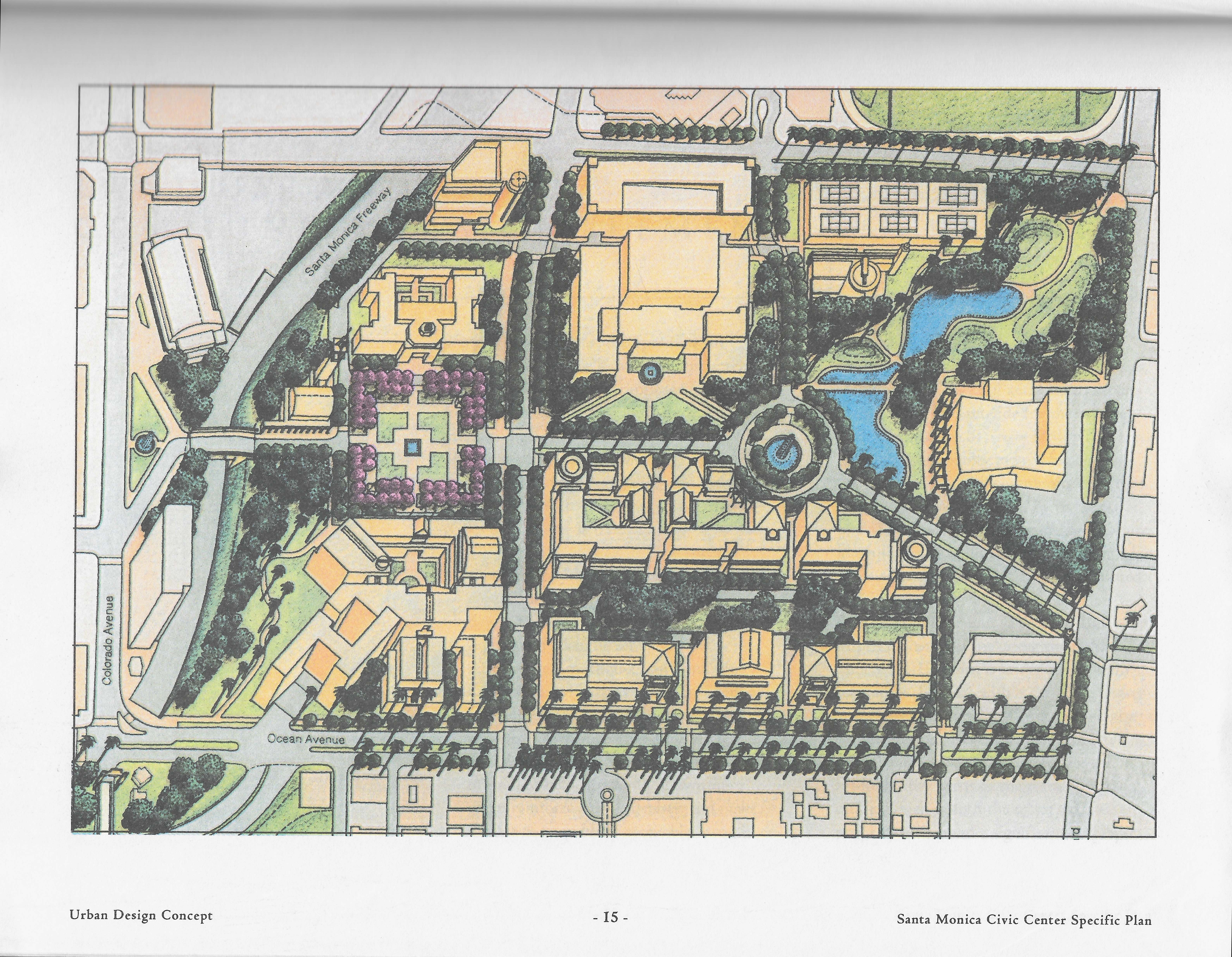
Below is a copy of the “Urban Design Concept” that was included in the CCSP (which was, in its entirety, sent to voters with their sample ballots) As you can see, the proposed development was much denser than what is being built today. The reason is that under the CCSP RAND had the right, under a development review process, to expand its facilities from its existing 300,000 square feet to 500,000, and to build another 250,000 square feet that could either be offices for rent or housing.

After the sale to the City of most of its land, RAND decided, for its own purposes, to build, on the land it retained, a new headquarters that was only a few thousand square feet bigger than the 300,000 square feet of its old buildings. The right to build the 250,000 additional square feet devolved to the City.

While at first during the process to revise the CCSP it looked like the 250,000 square feet would become housing, at the very end of the process, to please residents who wanted more open space, this housing was dropped from the plan. That’s why Tongva Park is so much bigger than the park that was originally intended to be a buffer between a new RAND headquarters and the freeway. (One reason the park was smaller in the 1993 CCSP with more development around it was that planners were worried that the park, given its location, would need help being “activated” – this may yet turn out to be a problem.)

Contrary to the popular narrative that against the will of the people politicians and planners have allowed Santa Monica to be overdeveloped, in the case of the Civic Center the opposite is true. Nearly 450,000 square feet of development, including around 250 units of housing, was dropped from a plan the voters approved overwhelmingly.

Thanks for reading.

1993 CCSP Design Concept

To Study or Not to Study

Tuesday night’s City Council meeting is going to be the latest big meeting on development standards in Santa Monica. The topic will be the scope of the environmental review for the Downtown Specific Plan (DSP).

Planning staff, in the staff report, takes a conservative approach, recommending that the Environmental Impact Report (EIR) cover only small changes to existing standards for both building heights and the amount of permitted development. Nonetheless, by including in the report two alternative actions that the council could take, staff has invited the council to expand the scope of the EIR to study the impacts of taller heights proposed in current pending projects and possible density bonuses for uses that generate fewer car trips.

Because the purpose of environmental review under the California Environmental Quality Act (CEQA) is to give decision-makers more information, not less, to inform their decision-making, the council should accept this invitation and expand the scope of the EIR.

Having said that, my instinct is that much of the staff’s conservatism is warranted, at least for most of downtown.

Regarding density, staff analyzed the current levels of development downtown and found that because of the density bonus for housing adopted in the ’90s to encourage residential development in commercial zones downtown, development in downtown Santa Monica often exceeds an floor-area-ratio (FAR) of 3.0 (meaning that on the average a given parcel of land could be 100% covered with a three-story building) and can approach an FAR of 4.0. (Because of requirements for light and air, and sometimes for setbacks, buildings in real life always require more stories than the theoretical average number of stories allowed under a given FAR.)

In general, consistent with what the reality has been over the past nearly 20 years, staff recommends FARs of between 2.5 and 4.0, but recommends dropping most of the density bonus for housing, intending that housing can be incentivized by other means (some of which are required by state law).

While an FAR as high as 4.0 should be rare in downtown (an FAR over 3.0 is difficult to work with on the small parcels that characterize most of downtown Santa Monica), where higher densities (within the range) might make sense would be on the western (Ocean Avenue) and southern (freeway) edges, because the density that you would be putting in those locations would not be “reflected” by density “across the street.” I don’t mean that you could double the density, but there could be more — but that would require more height to get appropriate light and air for the building and avoid boxy massing.

Which brings up the height issue. Given how controversial the three hotel/condo towers proposed for west of Second Street have been, I can understand the staff’s reticence about studying heights that high in the EIR, but not to study them would be ignoring the elephant in the room. It’s not, however, only (or even primarily) the environmental impacts that need analysis; aesthetic impacts are even more important. For height, we need an “AIR” – “Aesthetics Impact Report.”

And a “Meaning Impact Report” — we also need to analyze how higher heights affect the “meaning” Santa Monica has or the meaning — or values — that we want Santa Monica to have. Santa Monica has never been only a resort — we were once equally famous for the aircraft built here — but the beach and its attractions (both natural and human-made) have been an important part of our identity as a world famous place. Unusual for resorts, for a long time we’ve also been the edge of a metropolis. But how urban do we want that edge to be?

That’s a debate worth having, and one we need to have before the City Council makes its final decision about heights. To have that debate, and to make that decision, the community and the council need to see appropriate visualizations and models.

It’s hard to resist dipping a toe into the substance of that debate. Planning staff claims that there is less support for taller buildings west of Second Street than east of it, but that’s not what I’ve heard. Admittedly, I don’t have a scientific sample (nor does staff), but what I’ve heard frequently is that given that there are already many tall buildings along Ocean Avenue, that’s where new towers (if any are to be allowed) should go. Also, skinny tall buildings overlooking Palisades Park (densities being equal) will block breezes and views less than squat short ones.

We should be more conservative with the 20 or so blocks east of Second Street and north of Colorado. There are few buildings above six stories there and tall buildings would stand out more. In this I am being influenced by what Stefanos Polyzoides said at the forum Mike Feinstein and I hosted June 22, namely that towers are best when they are clustered, rather than scattered about. The five- and six-story height limits have worked well on what have become primarily residential blocks on Fifth, Sixth, and Seventh.

See you Tuesday night — and thanks for reading.