My feelings were sure wrong when I wrote on Election Day that they were telling me the election would go like 2012, not 2016. Just when polls were saying that the late breaking vote was going Kamala Harris’ way, a tsunami of Trump Election Day voters swamped her and other Democrats. Still, I’m glad I posted what posted, so that I can remind myself how out of touch my feelings can be.
On that note of self-doubt, I should refrain from saying anything about the debacle. So much is being written about it, even as those who are doing the writing often do so while advising everyone else to take a breath and wait to figure out what happened and what to do. There is, however, a fact I saw in a column by the astute L.A. Times political reporter Mark Z. Baraback that stands out: between 1960 and 1998, 38 years and 19 national elections, there were only seven votes that changed party control of the White House, the Senate or the House. In the 13 elections since 2000, however, there have been ten changes of control.
People are unhappy and have been so a while. When people are unhappy they do counter-productive things. Things, like, well, voting for Donald Trump. That’s why John Maynard Keynes developed a new economic theory in the 1930s—because he saw how chaos and economic distress caused people to turn to fascism and give up on established norms. Mind, I am not calling anyone, least of all any Trump voter, a fascist. But unhappy people want change, and no one promises more change than Donald Trump. Note that the two most successful politicians of the past 20 years, Trump and Barack Obama, both ran on hope and change.
Why are people unhappy? Why do they feel so insecure, so threatened and vulnerable? It’s paradoxical, because the world has never been more productive when it comes to material goods. We should all be swimming in prosperity—not coincidentally, precisely what Trump promises.
Again, why? Politicians and political analysts will look for reasons for the unhappiness, and, more specifically, for why so many Americans turned to Trump; reasons that will, no surprise, fit their varying perspectives. However, from the broadest view possible I suggest that the problem can be summed up with the title of a 2018 book I heartily recommend by Robert Kuttner: Can Democracy Survive Global Capitalism?
• • •
The local election here in Santa Monica was quite different. Here liberals won, defeating a local fear-based campaign that reflected the Trumpian zeitgeist. (I wrote about this a few weeks ago.)
So, congratulations to the United Slate of Dan Hall, Ellis Raskin, Barry Snell, and Natalya Zernitskaya. They will join Caroline Torosis and Jesse Zwick to form an unprecedented, six-out-seven liberal and pro-housing and social services majority on the City Council. At the same time, a parking tax and a big school bond also passed easily.
I am not surprised. In the election two years ago Santa Monica voters returned to their liberal traditions, but in that election four liberal candidates for three seats split the vote and only two of them, Torosis and Zwick, were victorious. That split delayed a new liberal majority on the council. Until now. This time Raskin and Zernitskaya ran together in a slate of four candidates for four seats. They all won.
Personally, these last two local elections have been gratifying. Not only do we have a new generation of leaders in Santa Monica, young leaders who will make us proud, but also the liberalism shared by nearly all Santa Monicans will no longer be distorted on the council by otherwise liberal council members spouting illiberal and specious excuses for why we should not provide housing for the current generation of young people and generations to come.
For me it’s been 30 years since I was appointed to the Housing Commission and started agitating for more housing, often to be vilified as “in the pocket of developers.” When I saw the vote totals Tuesday night, showing the United Slate well ahead, it felt good, a little bit of starlight in a dark night.
And with that Trumpian note of personal grievance combined with self-satisfaction, all I have left to say is:
It is hard to break bad habits. One habit that is hard to break in Santa Monica is fearmongering about development.
The latest instance comes from supporters of the “Safer Santa Monica” slate. As reported in the Lookout, a “small army of volunteers from the Northeast and Sunset Park neighborhoods has been busy blanketing their single family areas with an urgent message,” namely that if the candidates backed by Santa Monicans for Renters Rights (SMRR) are elected, they “would implement SB10, a State law that allows as many as 14 units to be built on a single family lot.”
SB10 was passed by the legislature and signed by the governor in 2021. I’ll wager that few laws have been more misunderstood than SB10. SB10 is a rather limited housing law that people opposed to housing development use to frighten people like a storyteller uses a ghost story to frighten children at Halloween.
SB10 does not mandate anything. It gives local governments the authority to override voter approved limits on development, and permit up to 10 units (yes, theoretically this number could be increased if ADU’s are included) on a parcel, but only if certain restrictions are satisfied. Here is the operative language, but you can read the whole statute here:
“Notwithstanding any local restrictions on adopting zoning ordinances enacted by the jurisdiction that limit the legislative body’s ability to adopt zoning ordinances, including … restrictions enacted by local initiative, a local government may adopt an ordinance to zone a parcel for up to 10 units of residential density per parcel, at a height specified by the local government in the ordinance, if the parcel is located in [a transit-rich area or an urban infill site].”
Note that SB10 doesn’t require local governments to do anything. It does expand the power of local governments to upzone, but only in cities or counties subject to “restrictions on adopting zoning ordinances.” SB10 did not expand the power of the Santa Monica City Council because Santa Monica does not have any such restrictions. The only zoning restriction relevant to housing enacted in Santa Monica is Measure LC. LC limits development of airport land (when the airport closes) to park and recreational purposes, but SB10 explicitly excludes from its scope “[a]ny local restriction enacted or approved by a local initiative that designates publicly owned land as open-space land … or for park or recreational purposes.”
Note that if the RIFT measure in 2008 or Measure LV in2016 had passed, SB10 would expand the power of City Council to override those measures, but voters defeated both RIFT and LV handily. SB10 therefore did not give the council more power than it already had. (There is a provision in SB10 that an upzoning enacted pursuant to SB10 would not be not subject to CEQA review, but CEQA review would not ultimately prevent an upzoning for housing in Santa Monica.)
But even if SB10 had expanded the Santa Monica City Council’s power, SB10 only gives authority to upzone if the local legislative body can make a finding that doing so “is consistent with [its] obligation to affirmatively further fair housing.” Readers may remember how the issue of “affirmatively furthering fair housing” (AFFH) was a factor when the City was adopting the Housing Element in 2021. (I wrote a number of posts back then about the Housing Element and AFFH; here is a link to one of them.)
Back then, the state rejected the City’s submission of a draft Housing Element because the council’s “Change Slate” majority had ignored warnings from Councilmember Gleam Davis and voted to approve a plan that didn’t take the AFFH requirement seriously. This led to Santa Monica becoming Ground Zero for Builder’s Remedy projects. Now that Santa Monica has an approved Housing Element, no matter who is elected to council it is unlikely that any zoning changes will be made other than those required by it.
I suppose the people distributing the SB10 flyers could have ignored SB10 and without reference to specific legislation simply generically mongered fear about what the United Santa Monica slate candidates might do to single-family neighborhoods. But they wouldn’t have been able to cite an immediate threat. Ever since Sen. Scott Wiener proposed SB10, the law has been a lightning rod for anti-housing panic. People should read the law and realize how limited it is.
There is the adage attributed to Georges Clemenceau that generals are always fighting the last war. In this case, we have some people in Santa Monica who keep fighting a war that’s over, the development war that so consumed Santa Monica politics for 30 years. The war is over because the state, reacting to California’s housing crisis, has taken over land use planning when it comes to housing.
The expanded legality of ADUs under state law, as well as SB9, have already upzoned urban R1 districts to some extent. While SB10 does not apply to Santa Monica, SB1123, which the governor recently signed into law, does. The new law, among other things, allows development of up to 10 units (plus ADUs) on vacant lots in single-family zones. Because it’s a state law, there is nothing the Santa Monica City Council has to say about it.
Yet, changes under all these laws are slow and incremental. No R1 neighborhoods, nor anyone’s “quality of life”, nor, for that matter, property values, have been destroyed. (Speaking as someone who lives in the delightful, very much housing heterogenous neighborhood of Ocean Park, my prediction is that in 20 or 30 years when traditional R1 neighborhoods have more of a mixture of housing types, residents then will be quite happy with where they live. Let’s plan for them.)
You may wonder: why did the state taken over land use planning (when it comes to housing)? Because cities like Santa Monica up and down the coast, and inland too, for so long blocked reasonable growth in the housing supply.
I was traveling in Italy earlier this month so thankfully I wasn’t around when the Santa Monica City Council had the mother of all nightmarish meetings. The meeting began the evening of Oct. 10, but the council was in closed session for hours and the public meeting didn’t start until late. Then the council stayed up until 4:00 a.m. to vote on what kind of public process to have for developing plans for when Santa Monica Airport closes at the end of 2028.
It was ugly. The “Make Santa Monica Great Again” crowd went way over-the-top crazy over a plan to expand public process by empowering a “grand jury” type group of randomly selected, but demographically representative residents to advise the City Council on what to do.
Staff had proposed the new plan after the council had directed it to do so, a fact ignored by some forgetful council members. The plan got caught up in anti-development paranoia, as MSMGA residents saw it as a plot to develop airport land. (This from the same residents who usually direct their paranoia at staff and City Council; one might think they would have more trust in 40 randomly-selected residents than the decision-makers they usually despise.) While the local outrage machine manufactured most of the hysteria, some was unfortunately stimulated by a staff report that seemed to forget that the default for the airport land is to turn it into a park in accordance with Measure LC. If you want to know more of the gory details, here are links to two articles in Santa Monica Next that unpack the false statements made against the plan: one from before the meeting and one from after.
There are lessons for everyone to learn.
For those worried about development at the airport, please – relax a little. However staff writes its reports, needing to sound evenhanded when it comes to alternatives, Measure LC still governs. No, a 40-person committee of randomly selected residents would not have had final decision-making authority over the airport land. Not even the City Council would have final authority if it wanted to propose something inconsistent with LC. Anything inconsistent with LC needs a vote of the people.
For those who want housing at the airport, take this over-reaction seriously even if it was not based on reality. This goes for staff, too, which may need to be agnostic about what happens at the airport, but which needs to be careful about the language it uses. The biggest danger to the future of the airport land is for the aviation industry to mount another initiative, like their Measure D in 2014, to stop the City from closing the airport. The biggest danger of such an initiative passing is if the aviation industry can whip up fear to persuade the anti-development element of Santa Monica politics that if the airport closes it will be replaced with development. Most anti-development residents live far enough from the airport that they don’t care if it closes.
Speaking for myself, as someone who for 30 years has pushed for Santa Monica to build more housing, the airport is simply not a good place for housing. Housers should look elsewhere. The airport land is never going to be convenient for transit or walking to shopping. Meanwhile, residents need parks, and every square foot of open land at the airport is a special and precious resource, purchased a century ago with a parks bond. While it would be possible, under LC, to convert existing structures into housing, those structures are better suited for what they are being used for now: offices that the City leases to businesses. The City will be able to use the revenues from the leases to build and operate the park. (See my prior blog on how to do this.) Affordable housing is needed in Santa Monica but it will not generate revenues to build a park – affordable housing needs its own subsidies.
My advice to housers who insist on locating housing at the airport: talk to the Santa Monica College (SMC) Board. SMC not only owns the Bundy Campus, but also owns land along Airport Avenue that is not subject to LC. Over the years, heedless of the impact on the local housing market, SMC has expanded by enrolling many international and other out-of-district students who need housing because they can’t or don’t live at home. SMC can build dormitories without parking for students, who can be connected to the SMC campus and to transit by SMC shuttles. They would thus neither add to traffic nor need a direct connection to transit.
My advice for the City Council, aside from not making decisions in the wee hours – please, help dial down the rhetoric, don’t amplify it. You are supposed to know better. The City is embarking on the biggest infrastructure project in its history. It is a great opportunity. It will not succeed if elected officials play into the fear game.
• • •
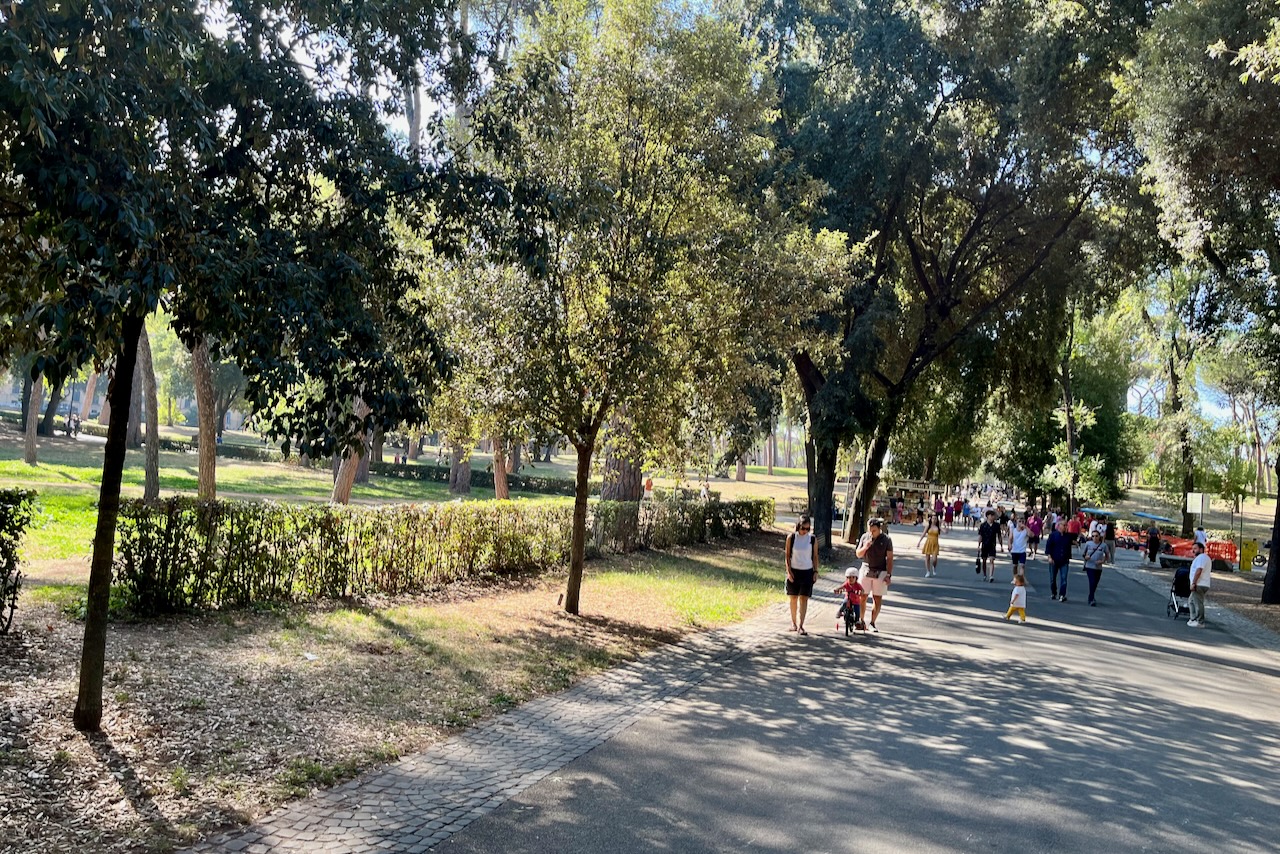
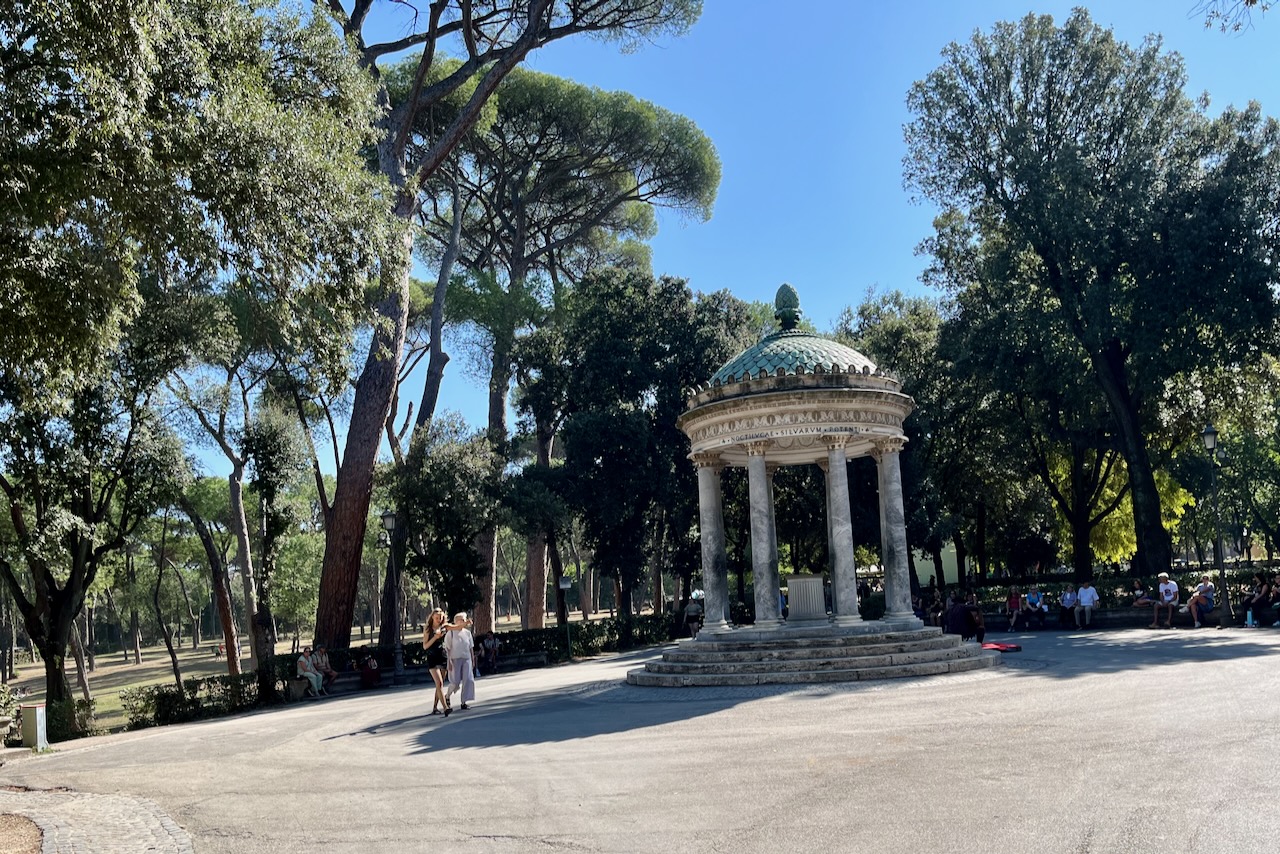
Meanwhile I want to report on something inspiring. When in Rome a couple of weeks ago I did what the Romans do – I took a long stroll in the Villa Borghese Gardens. The Villa Borghese is one of the great parks of Rome – of the world, in fact. Originally an aristocratic estate, built out over centuries, the government purchased the property in 1902 and turned it into a park.
A map of the Villa Borghese
How big is the Villa Borghese? About 198 acres, not too much bigger than the 160 or so acres of open land at Santa Monica Airport.
The Villa Borghese, in the middle of Rome
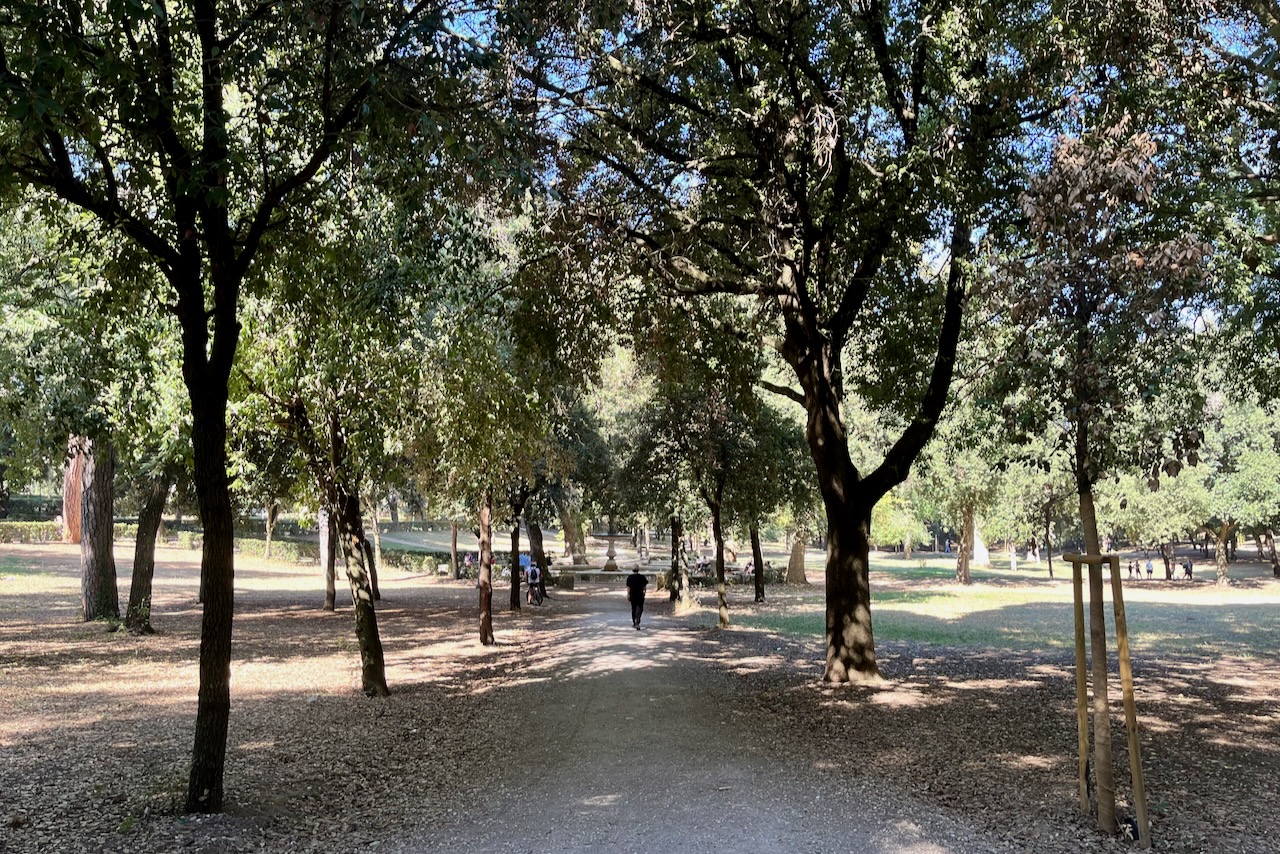
The Villa Borghese demonstrates that a great park need not be over-designed. Most of the park consists of winding paths through a landscape that is beautiful but, so far as I could tell, not irrigated. (The Roman climate is similar to ours.)
Playing fields at the Villa Borghese
Within the park are several museums, including the world famous Borghese Gallery and the Villa Giulia, Italy’s great Etruscan Museum. There is also a reconstruction of the Shakespeare’s Globe Theater, and a cinema, and Rome’s zoo. There are playing fields and playgrounds. But in no way does the park feel cramped or over-programmed – 198 acres is a lot of land (as is 160).
Families in pedal-powered carts roam the park.
There are a number of lessons to learn from the Villa Borghese. As I already said, but I’ll repeat it, a great park need not be over-designed. When it comes to the Airport Great Park, let’s keep it simple, and get it built. As I wrote in my previously-mentioned earlier blog, establish a budget first and stick to it.
And, yes it’s Rome, and you can get a snack.
Another lesson is that great parks can evolve over time. The Villa Borghese has evolved over centuries. Let’s get a basic version of the Airport Great Park built, and let future generations make decisions about whether they want to add features.
Last year I wrote several posts about Santa Monica’s efforts to write a new Housing Element that would comply with new state laws that put teeth in longstanding requirements that local governments plan for sufficient growth in housing. Overall, I was doubtful that the City was drafting and would submit a document that would be compliant. Based on those views, I might have been pleased when earlier this month the state’s Department of Housing and Community Development (HCD) rejected the Housing Element that Santa Monica submitted in October.
But I am not.
Let’s put things in context. Santa Monica was not alone. HCD is rejecting most housing elements that cities have submitted. As reported Thursday, HCD even rejected the housing element of the City of Los Angeles, one that had been much admired by the pro-housing community. The problem is that the housing elements can only go so far before they run up against reality.
While HCD must hold cities to a high standard in how they plan to allow more housing development, the process can reach a point of diminishing returns. The housing element process demands an idealization of what should be possible in a just world, but we don’t live in that world. The risk now is that continued efforts to create a perfect document will forestall reform of laws so that real housing, not paper plans for housing, can be constructed. Housing elements are only means to an end; the end is more housing.
I worry that we have reached that point.
When HCD’s rejection letter arrived, the City’s Planning Department immediately suspended a process that was underway to revise Santa Monica’s zoning to satisfy the goals of the housing element that the City had submitted. The process would necessarily lead to better, more inclusive zoning, even if ultimately new zoning, under a more perfect housing element, might be better. Now the process is stopped. Under state law, this creates a paradoxical result.
Because HCD determined that the housing element is not compliant, Santa Monica must now complete zoning changes to accommodate its regional housing needs allocation (RHNA) on an accelerated schedule — by October 15 of this year instead of in two years. However, since Planning has stopped the rezoning process while the department tries to figure out how to revise the housing element to comply, it is hard to imagine how the department can go jump throught all the hoops to get a new revision of the housing element approved by City Council, and then draft and get approval for a zoning update, all by October. (Not to mention that we have a City Council that recently violated the very first program, Program 1A, of the housing element it submitted to HCD by reinstating development review for projects on more than one acre.)
The very first program of Santa Monica’s submitted housing element calling for administrative review of nearly all housing projects.
It’s going to be a mess; as everyone in the housing world knows, messes lead to delays, and delays mean housing doesn’t get built.
In fact, particularly in the context of HCD’s rejection of L.A.’s housing element, I wonder if it is possible to create a real-world housing element that would satisfy HCD’s requirements. Consider two requirements: (i) that housing elements show how cities will “affirmatively further fair housing,” and (ii) that RHNA numbers, including Santa Monica’s, emphasize the need for affordable housing. (In Santa Monica 6,168 of the 8,895 RHNA units are supposed to be affordable.) It is not possible, however, (i) to remedy, using only land use laws, more than a century of laws and policies that have excluded non-white people from the housing market, suppressed their wages, and otherwise limited their accumulation of wealth, nor (ii) does housing element law provide funding to build the affordable units a housing element would require. For these reasons, housing elements are always going to be aspirational. The power of housing elements comes if the state uses them to force local governments to make zoning changes. If, however, HCD keeps rejecting housing elements, the zoning changes get pushed back.
A better tactic would have been for HCD to accept the housing elements from cities, regardless how aspirational they were, but then come back and review the zoning to make sure that new zoning would allow for achievement of the RHNA numbers if financing were available. If the zoning was inadequate, then a better remedy would be for state law to allow HCD to override zoning and allow by-right development of housing. As it is, if cities continue to be non-compliant in their housing elements, the law’s counter-intuitive remedy is that they can’t receive funding for affordable housing. Does that make sense? Anti-housers are not going to complain if their cities can’t get money to build affordable housing. Better to give the money to affordable housing providers and let them build wherever they can find land. (Cities can also lose other funding, but would anti-housers care?)
The current law ultimately has provisions that give housing developers rights to build anywhere within non-compliant cites (subject to certain conditions), but those aspects of the law are untested and would probably require litigation to enforce, something developers try to avoid. One option that could work now would be for HCD (or the legislature if necessary) to extend deadlines for the rewriting of rejected housing elements while requiring cities to continue updating their zoning to allow more housing.
The amendments that strengthened the housing element law are new this year and it is not surprising that there has been a steep learning curve. Cities say that they want local control and that the state can trust them not to block housing. An extension of the deadlines for a year would give them time to prove that, and we could get better zoning sooner.
The next episode in the continuing series of meetings regarding the new housing element of Santa Monica’s general plan will take place Tuesday evening. Then the City Council will review and vote on amendments and additions to the version of the document that the council approved in June. The state’s Department of Housing and Community Development (HCD) rejected the City’s draft in a letter dated August 30 detailing where HCD saw failures to satisfy the state’s requirements for the housing element. The changes the council will consider are those that planning staff recommends to satisfy HCD’s requirements. (Note that various drafts of the housing element, HCD’s letter, staff reports, public comment, Planning Commission actions, etc., many of which are referred to in this post, are downloadable at this link.)
On the surface of things, at this point the process seems underwhelming. This is because HCD’s comments, contained in a 12-page appendix to its letter, certainly “sweat the small stuff.” I read the document hoping for an eloquent critique of how Santa Monica, playing a small but important role in an larger story involving all of affluent California, had so botched housing policy over 40 years: (i) that our city and region are overwhelmed by and shamed by tens of thousands of people living on the streets, (ii) that low-income and even middle-class households of working people cannot find housing without paying 50% or more of their combined incomes in rents, (iii) that historically affordable neighborhoods are seeing unprecedented increases in housing costs because historically affluent areas have not allowed for growth, and (iv) that even young people with high incomes cannot find housing suitable for raising families.
Instead, and I suppose they were doing their job, HCD’s staff wrote a dry 12-page report showing where the City’s draft failed to satisfy its statutorily mandated requirements to assess the reality of the housing situation, the reality of the constraints to building housing, and the reality of what the City planned to do to fix the problem. Fine; every comment HCD made was justified, but then I don’t know how answering those comments will lead to more housing being built.
For example, in section 5 of the letter, HCD identifies numerous places where the City’s draft failed to identify constraints on the building of housing, or the costs of those constraints. But even if all those constraints, and there are many, were identified and their costs enumerated, how will that lead to more housing if there is not political will to do so? The housing element, even the draft council approved in June, has a list of actions the City is promising to take to make it easier to build housing, but with the current anti-housing council majority in power, do we believe they will follow through? Do we believe that even if they liberalize the zoning, they will not find some way to subvert the liberalization?
To get something done, you can’t ignore the politics, but of course any staff-written document must ignore the politics, even to the point of dissembling. I’ll give one example. Back in 2010, after six years of very public process, the City Council approved new land use and circulation elements of the general plan (the LUCE). To encourage housing in commercial and industrial zones (i.e., to build housing without densifying existing residential areas), the LUCE contemplated, among other things, larger projects that would be subject to a higher level of review and negotiation of community benefits (namely, development agreements). These were “Tier 3” projects and “activity centers,” the latter to be located near transit centers with the possibility of more development than even Tier 3 projects.
Santa Monica’s zoning map. Very few of these zones allow for significant new housing.
But when it came time to enact a zoning ordinance to implement the LUCE, the council had changed. It had become more conservative, more anti-change; more beholden to those who were comfortable with things the way they are. As a result, in the zoning law, the council very nearly obliterated the possibility of building Tier 3 projects and deleted four out of the five possible activity centers.
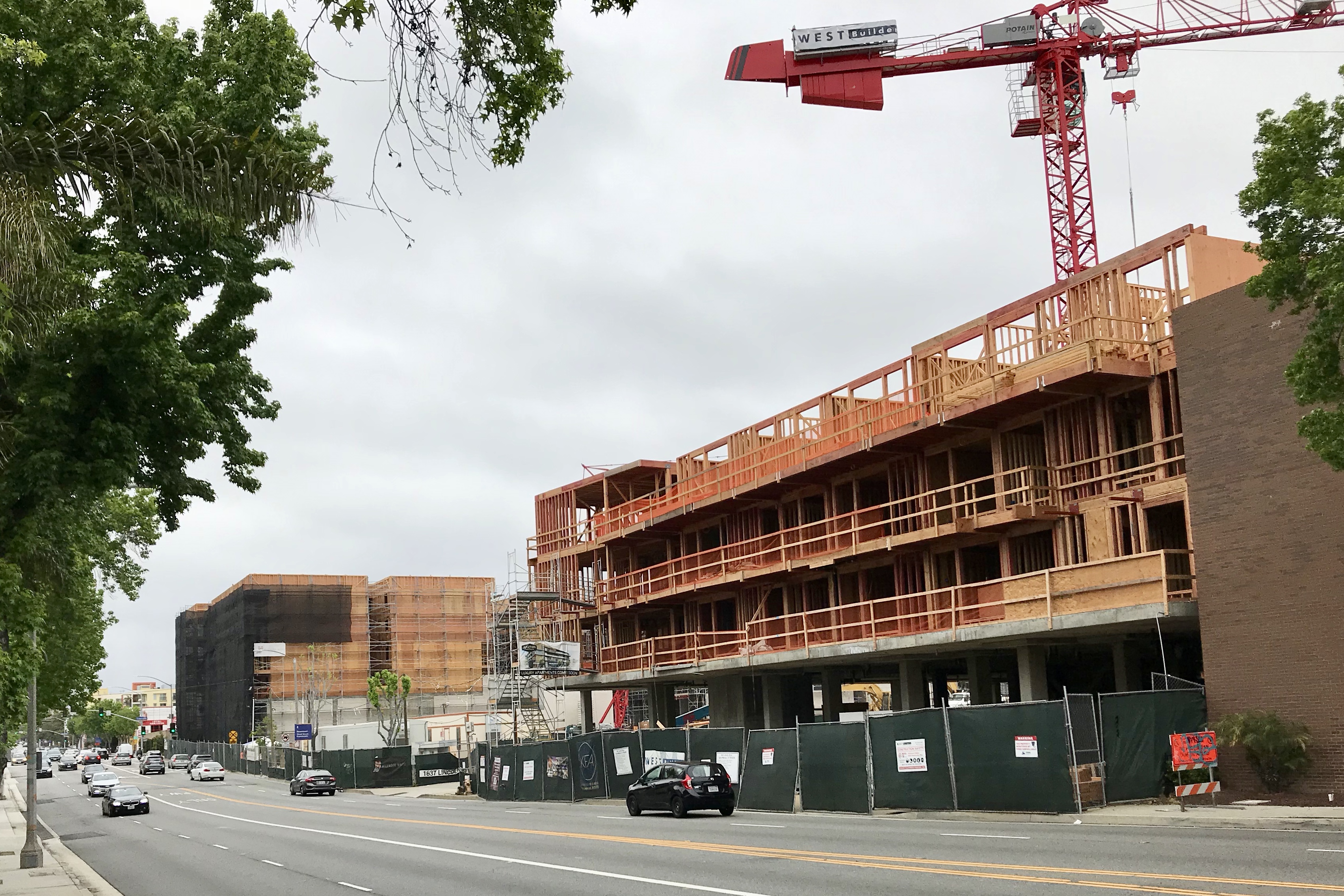
This history is recounted on page 9 of Appendix E to the housing element, the appendix that describes, as the law requires, constraints on housing. If you look at the redlined version staff is asking the council to approve, you will see language staff has added in response to HCD’s demands for more analysis of constraints, but the staff’s anodyne language ignores the real history. Instead, staff makes it sounds like the down-zoning occurred because the City wanted to avoid the discretionary processes developers would have had to go through to build the bigger projects, but that’s not what happened. The down-zoning occurred because of the politics. The council did not want the bigger projects and killed the possibility they would be built. Council did not kill Tier 3 and activity centers to make it easier to build housing; just the opposite. Later, the council passed new zoning for downtown that stopped new housing from being built; the apartments that are nearing completion now on Lincoln and elsewhere were built under the previous downtown zoning.
The whole housing element is a feel-good, “let’s pat ourselves on the back” document that belies the current reality.
If the council now passes the revised housing element it will be committing itself to, in the words of staff’s proposed revised Appendix E, a reevaluation of “development standards and regulations, both independently and cumulatively, to not only ensure housing projects are feasible, but that they also incentivize housing production citywide,” but I’ll believe it when I see it. What it all means is that the housing element is just the first step. The proof of the pudding will come when we find out if the council will enact new zoning and remove other constraints on housing to encourage housing to be built.
Otherwise, what will happen? If history provides precedent, there will be litigation. The Santa Monica Housing Council, the organization that successfully sued the City 30 years ago over the housing element the council passed then, has had its lawyers send long letters to the City detailing where they see deficiencies. Most of their comments are not reflected in the revised housing element and I doubt City Council would approve them if they were. Out of the litigation in the 1990s came the zoning that allowed the creation of a new residential neighborhood downtown east of Fourth Street; maybe more litigation is what will be needed again.
Whatever happens Tuesday evening, there will be more episodes in this continuing series.
Before I can quit with writing about the housing element that the City of Santa Monica has sent to the California Department of Housing and Community Development (HCD), I have to visit an extraordinary conversation that took place during the June 15 City Council meeting. That was when council gave planning staff final directions for the housing element before sending it to HCD.
The discussion I’m referring to was extraordinary because in it two councilmembers praised landlords for their role in providing affordable housing. Certainly, I have not observed every City Council hearing during the nearly 30 years I have been following and participating in Santa Monica politics, but I cannot remember anyone praising landlords, as a group or class, from the dais during that time. It seems that after the rent control battles of the ’80s subsided, all political discourse in Santa Monica, even from the pro-business side, devolved into a default mode in which anyone who owned or developed residential property (other than a homeowner) was at best the equivalent of a “kulak” (wealthy peasant) or at worst a predatory capitalist.
The discussion occurred when the councilmembers were discussing Program 3.A in the draft housing element. In the draft presented to the council June 15 Program 3.A said that the City would amend its ordinances to make permanent anti-displacement provisions in the California Housing Crisis Act of 2019 (known as SB 330). SB 330 requires that if a housing developer would in building a new housing development destroy existing rent-controlled or affordable deed-restricted units, the developer would need to replace those units in the new development and rent them to low-income tenants. Under SB 330, these provisions sunset in 2025; Program 3.A would make those requirements permanent in Santa Monica.
The discussion began with Mayor Sue Himmelrich expressing her opinion that not only did she want to make SB 330 permanent, but she wanted to provide that the rents in the newly built, but rent-controlled, apartments would be the old rents, not reset to current market-rate levels. Even better, she wanted the new units to be deed-restricted and made available to low-income tenants. She said this would add “predictability.”
Councilmember Oscar de la Torre, however, had a problem with Program 3.A. He was concerned with its impact on “mom and pop” landlords. He said these apartment owners had been providing affordable housing for many years in the form of rent-controlled apartments. De la Torre said that he would “have a hard time punishing them,” because they had been “doing the right thing for so many years.” He asked if this law wouldn’t “lock them into the same situation where they can’t make any progress for their family.” He said that “government should compensate these people;” he asked, “shouldn’t we have a way where we share that burden?”
De la Torre made it plain that he was only talking about “mom and pop” apartment owners, not corporations that might own “25 buildings,” but still my jaw dropped. As I said before, I cannot remember a member of the Santa Monica City Council expressing sympathy for landlords, big or small, let alone their heirs. Nor one of them making arguments that would make it more economically advantageous to tear down existing apartments—and this from a local figure known for his opposition to the use of the Ellis Act to do precisely that.
Councilmember Phil Brock agreed with de la Torre. He said that the law requiring replacement of rent-controlled units would disincentivize replacement of old housing, and that we would end up with “more rundown apartments.” He used a hypothetical of a 75-year-old building that might ultimately need to be replaced. He said that given the cost of doing so, the replacement could not happen if the new units were rent-controlled or deed-restricted affordable. (Both Brock and de la Torre come from families that own apartments. They did not make announcements at the meeting about this (although Brock referred to his mother as an apartment owner), but I expect that everyone on the (virtual) dais was aware of it.)
At this point Mayor Himmelrich jumped in. She responded to de la Torre and Brock by saying that property owners could make enough money to justify rebuilding from additional, market-rate units they could build. She took a hypothetical four-unit building de la Torre had used and said that such a building could be rebuilt with eight units, and the owners could make plenty of money from the four new units.
I doubt Himmelrich is correct. Since the ’80s Santa Monica has downzoned its multi-unit residential districts, so that it is not generally possible to build as much on a residential lot as could be built previously, when these old apartments were built, let alone double the size of existing apartment buildings. Here is a detail from the zoning map:
Detail of Santa Monica zoning map.
As shown, most multi-unit residential districts are zoned “Low Density Residential” (R2 or the analog in Ocean Park, OP2), including nearly all of the Pico Neighborhood, mid-Wilshire/WilMont, and Ocean Park. The theoretical maximum number of units per lot in R2 is four, but for most lots the real maximum is three because the minimum size of a unit in R2 is 2,000 square feet. (This large unit size is evidence, incidentally, that the downzoning discouraged affordable housing.) Even if retaining the units would qualify the development for a 50% state density bonus (the best available), at most the development would have five, or maybe six, units. Possibly the owner/developer could add a unit by asking for “concessions” under density bonus law, but even if Himmelrich’s hypothetical eight units could be built, privately-financed housing cannot be financed with a 50% inclusionary requirement. Finally, is it realistic that on single lots in residential districts, the size of apartment buildings will be doubled?
In fact, planning staffer Jing Yeo had already explained the real impact of SB 330 on Santa Monica: she told the council early in the discussion that the effect of SB 330 here was to prevent a property owner from tearing down four units and replacing them with three.
Brock replied to Himmelrich by saying that the replacement provisions made reinvestment infeasible. Himmelrich responded by asking him, “are we doing this housing element for landlords or for tenants?” Brock seemed taken back by the question. “I think we’re doing it for everyone,” he replied, “[i]t should be ideally a symbiotic relationship.”
I am a New Deal-type Democrat with socialist leanings, and as such I believe in regulation of economic activity. That includes rent control, which is, or can be, a reasonable exercise of governmental authority with multiple social benefits. Rent control, however, like any economic regulation, needs to be reasonable. Regulations are not reasonable if they are so strict that they defeat their own purposes. The purpose of rent control is to deliver safe and well-maintained housing that people can afford. All regulations require recalculation and review from time to time, just as all housing needs maintenance, whether the building is a wood-framed apartment structure in termite-country or a steel and concrete condo tower in Florida. Sometimes old buildings need to be replaced.
Councilmember Brock was right when he described the relationship between property owners and tenants as symbiotic. Our economy is largely capitalist, and we rely on private capital to build and maintain housing. This is even the case, to a great extent, when it comes to affordable housing. (Personally, I would like to see government get back into the business of building public housing, but that is not likely to happen any time soon.) Whether the capital comes from “moms and pops” investing their life savings into an apartment building, from private placement financing for specific developments, or from publicly-traded REITs, etc., investors have to believe that they have a good chance of having a better risk/return ratio than they would have if, for instance, they invest their money in a stock market index fund.
If you would like to watch these City Council deliberations about making SB 330 permanent, click here to go to the video, and then go to the 5:02 mark and start watching. Lasts about 20 minutes, and you’ll also see what they decided to do. Hint: nothing.
Tonight, the Santa Monica City Council will hold its first hearing to discuss specific and substantive proposals from planning staff for what to include in the next iteration of the state-mandated Housing Element of the City’s General Plan. This is the document you may have heard of in which the City must tell the state how during the period from 2021 to 2029 it will be possible, really and truly, to build 8,895 housing units, of which 6,168 must be affordable. (The numbers are Santa Monica’s “RHNA numbers,” from “Regional Housing Needs Allocation.”)
Cities need to file housing elements every eight years, and the deadline for filing this one is October. Between now and final approval of the Housing Element I will likely write more than a few posts about it. The purpose of this initial post is to give some context for the numbers involved.
The number to begin with is 52,983. That is the total number of housing units in the city as of June 30, 2019, as set forth in the City’s 2020 Affordable Housing Progress Report, the latest calculation I could find. As of that date, the City also had about 1,000 units, give or take, either under construction or approved, and these units presumably won’t be countable against the new RHNA number. That means that going into the 2021-29 period Santa Monica has about 54,000 units either extant or in the works.
The RHNA number, 8,895, is 16.5% of 54,000. Over eight years, that means that Santa Monica must plan for increasing its housing stock by two percent per year. While a two percent annual increase should not be anything to panic over, it would be a marked increase over the rate of housing production in Santa Monica for the past 40 years.
In 1994 I was appointed to the Housing Commission. A year later I was appointed to the Planning Commission. On both commissions I worked on a housing element. With regard to housing policy, I recall many similarities to the situation today.
The context then was that the City had just lost a lawsuit brought by housing developers who contended that the City had adopted a housing element that did not take into account measures the City had enacted that discouraged the building of housing. The developers won the case, and the City had to change its policies to allow more housing to be built. As now, there was a lot of gnashing of teeth.
You may ask, what did the City do in the 80s that was so anti-housing that it lost this case?
It’s complicated. For most of the 80s Santa Monicans for Renters Rights (SMRR) controlled City Council. SMRR leadership was committed to what it called a “human scaled community,” in opposition, say, to the towers previous city leadership had enabled to be built on the beachfront in Ocean Park or along Ocean Avenue. This led SMRR to oppose higher densities, even for affordable housing. While today people don’t see a disconnect between density and “human scale,” in fairness to Santa Monica’s leadership 40 years ago, the renter neighborhoods in Santa Monica, such as those along Wilshire, Ocean Park, and the Pico Neighborhood, were already among the denser neighborhoods in California and they probably didn’t think they needed to make them denser.
From what I understand, the primary motivations for SMRR’s anti-housing policies in the 80s were not meant to be anti-housing, but rather to preserve rental housing in residential districts from being destroyed to build condominiums. This was a big problem; conversions were a reaction to rent control, which had been enacted in 1979. While some warned that limitations on new development in residential areas would ultimately mean fewer low-income households in the city, City Council enacted limitations to make conversions less profitable.
Another at least putatively well-meant motivation was to get more affordable housing built. In 1990 City voters approved Measure R, which required that 30% of housing built in Santa Monica be deed-restricted affordable. That goal was not by itself unattainable, and Measure R by itself need not have stopped development of housing. (Since 1990 about 38% of the housing built in Santa Monica has been deed-restricted affordable.) The City Council followed up Measure R, however, with an enforcement ordinance that included draconian on-site requirements for projects with as few as five units.
The results of these policies were that virtually no housing was built, as shown in the following charts, which I scanned from City documents.
Based on the data in this chart, in 1990 the City had 47,753 housing units. Of them, you’ll see that roughly 9,000 were built before 1940, 7,500 in the 40s, 9,000 in the 50s, more than 10,000 in the 60s and nearly 8,000 in the 70s. (Note that these numbers represent only the units that survived to 1990; considering how many units were destroyed by the freeway and other public works, and normal attrition and replacement, many more units were built in those decades.)
Then note that only 3,617 units were built in the 80s, and there is reason to believe that nearly all of them were constructed early in the decade.
The second chart picks up the story in 1990. You’ll see that the 90s were a catastrophe for housing development. The net number of units in the city increased only 110, from 47,753 to 47,863 in 2000, the lowest rate of increase of the cities listed (none of which did very well, by the way). During the 90s the region was bursting with new immigrants as the population of Los Angeles County increased from 8.86 to 9.5 million (more than seven percent). Working-class poverty and homelessness were becoming crises, but Santa Monica only added, on a net basis, 110 units of housing. Santa Monica’s population, by the way, decreased during the 90s from 86,911 to 84,073, a decline of 3.3%. (This chart shows clearly how the housing crisis we have today in Southern California has its roots in the 90s when housing production failed miserably to keep up with population growth.)
After losing the court case in the early 90s, what did City Council do?
Actually, some good stuff. Before I joined the Housing and Planning Commissions, so I get no credit for this, the City passed landmark new zoning for downtown. The council, which for the most part was still controlled by SMRR, still wanted to discourage building in existing neighborhoods, to preserve rental units. In the meantime, however, the City had opened the Third Street Promenade, and the focus was on downtown. There was little housing there, and so new housing would not cause much displacement. The City decided to focus housing development downtown.
Downtown was zoned for commercial development, but the council did something simple to encourage residential development: it not only allowed residential development in commercial zones but also allowed twice as much development on downtown properties if the development were residential instead of commercial. The City also passed a new, much more flexible, ordinance implementing Measure R.
Not much happened immediately as we know from the housing production numbers for the 90s. It took a while for developers to figure out what they could do.
By 2000 the reforms began to take effect. In the first decade of the new century, as shown in the second chart, Santa Monica had a net increase of 3,049 units, to a total of 50,912, an increase of 6.4% over the decade. This was in fact a better rate of increase than the County as a whole. While I don’t have data for the next decade all the way through 2020, as of June 30, 2019, as I wrote above, the total number of units was 52,983, an increase of a little over 2,000 in the nine years after 2010.
While slower than the previous decade, growth was steady. An average of about 200 units per year was close to the rate of 250 units per year forecast in the 2010 Land Use and Circulation Element, a growth rate of half of one percent. I’ve previously written that a good, sustainable rate of increase for Santa Monica would be one percent per year, or about 500 units. As discussed above, the RHNA requirement over eight years is about double this number, a return to the housing production number of the decades before the 80s.
In future posts I’ll discuss why this number should not frighten anyone. The lesson of the 90s is that the City can respond creatively to the need to build more housing. And the lesson of the 2000s is that dense housing can create a vibrant neighborhood, as has happened downtown.
One last point: I hope someone tonight asks staff why the land the City owns at the Civic Auditorium isn’t included in the inventory of City-owned properties available for housing.
After years of creating procedural and other obstacles to the building of much-needed new housing, the City of Santa Monica is poised to do something significant to encourage housing development. Tuesday evening, if the City Council follows the recommendations of staff and a vote by the Planning Commission, the council will vote to streamline the approval process for all 100% affordable housing and most market-rate multi-unit housing developments.
If passed, the new rules will require only administrative approval for (i) 100% affordable projects of all sizes (under current rules, 100% affordable projects of more than 50 units outside of the downtown require Planning Commission review), and (ii) market-rate projects for which for all practical purposes the City’s review was already limited by state law (the “Housing Accountability Act”), but for which the City nevertheless required a Planning Commission hearing. Administrative review will not only shorten the duration of review by the City, but also add to the certainty of approval. This will facilitate financing, particularly for affordable projects that rely on tax-credits.
The hope is that by eliminating discretionary review, the City will rekindle interest from developers in what are called, under the City’s general plan, “Tier 2” projects. These are the mid-density, often mixed-use, projects that have been the mainstay of housing development in the city, to the extent there has been housing development, for about 30 years, for both affordable and market-rate developments. The City said it expected Tier 2 projects would be built under the supposedly “pro-housing” planning documents the City developed, after painfully slow processes, over the past 16 years, but few have been built under the new rules.
Perversely, the City’s housing laws make it more difficult to build Tier 2 projects, with more housing, than Tier 1 projects, which generate little housing and few benefits. Tier 1 projects already get administrative review. (As for Tier 3 projects, with even more housing and benefits, these are impossible. They are in the general plan only as window-dressing.) The City loaded Tier 2 projects with additional costs, including the state’s highest requirements for including affordable units, and required discretionary approvals. As a result, the few developers willing to work under the City’s new rules have primarily built smaller, Tier 1, projects that deliver much less housing, including drastically fewer affordable units.
If the council does the right thing Tuesday night, the discretionary review will be gone for most Tier 2 projects, but the restrictive development standards and added-on costs will remain. Nonetheless, the recommendation from staff to remove discretionary review comes in the context that the City expects its annual allocation under the “Regional Housing Needs Assessment” (RHNA) to be greatly increased to about 1,100 units for 2021 to 2029 period. Satisfying RHNA will require the City to demonstrate land availability and zoning capacity to achieve the RHNA numbers. Eliminating discretionary review does nothing for RHNA.
Satisfying RHNA will require a rethinking of the City’s zoning. The City will need to extend to commercial districts throughout the city the kind of zoning first adopted downtown in the 1990s that encouraged the building of housing instead of commercial development. The most important factor was allowing twice the amount of residential development as commercial. Of course, as those who followed the fiasco of the Downtown Community Plan (DCP), know, the DCP ruined the zoning that had over 20 years turned much of downtown into a vibrant neighborhood. One hopes that in the context of responding to RHNA, the City will fix the DCP, too. By concentrating housing development in commercial zones, the City can limit displacement of current tenants.
Tuesday night expect to hear pseudo-housers argue that the City should do nothing to encourage market-rate development, and only provide incentives for 100% affordable projects. In their view, it’s evil to make money from building housing, and only “greedy developers” do so (notwithstanding that everyone in Santa Monica lives in a development that was built by, or land that was subdivided by, a developer). To pseudo-housers, market-rate (or what they like to call “luxury”) development only raises rents for everyone else. As if they want to bring back redlining, they don’t like investment in cities. (I discussed pseudo-housers in more detail back in November.)
I won’t again discuss the silliness of these arguments, but it is worth taking a moment to examine the economics of housing development to try to understand why it is so hard in California to build housing for working-class and even middle-class households.
We talk about a “housing affordability” crisis but when we look at the numbers, we realize that it’s not that rents are too high, but that incomes are too low to pay for the real cost of building housing. It now costs, in southern California, on the order of $500 per square foot to build apartments. (For this analysis I’ll ignore whether this includes the cost of land.) That means that assuming a developer can find land and get zoning approval, an 800-square foot, two-bedroom apartment, our era’s equivalent to a 1950s or ’60s tract house, costs $400,000 to build. To cover amortization of costs, financing, operating costs, and to make some profit, the developer has to recoup at least 10% annually — $40,000 per year, meaning a monthly rent of about $3300, or about $4 per square foot. To afford $40,000 a year in rent, a household needs an income of at least $100,000, far beyond the average household income in L.A. of about $60,000.
These costs show why it is useless to criticize developers for building apartments that only “rich people” can afford. If there weren’t at least some households making $100,000 per year, there wouldn’t be a market for even 800-square foot new apartments, let alone the larger units (including condos) that young families aspire to. To the extent new housing isn’t built for people with above-average incomes, those people will move into the housing of lower-income workers—displacement. Keep on doing that, and what do you know, but 50,000 people in L.A. County don’t have homes at all.
Fifty years ago, workers made “middle-class” wages working union manufacturing jobs. Fifty years of Republican attacks on unions and the resulting shift of wealth from workers to capital, have created the fiction that it’s housing that has become too expensive, while it’s wages that have fallen too low to justify the development of market-rate housing for workers. Government is called upon to provide or subsidize affordable housing for workers who should be able to afford market-rate housing, and would be able to do so, if they received a reasonable share of the benefits of an expanded economy. And then liberals are criticized for giving away “free stuff.”
Rather than make it more difficult to invest money in housing, the way to solve the housing affordability crisis is to raise incomes starting at the lowest levels of wages.
I ended my blog last week about Santa Monica’s housing policies with some good news, namely that a lot of housing was either under construction in the city or had approvals to proceed to construction. As of the end of March, 759 units were under construction and another 1,384 had received planning approvals. Most of this housing received approval under laws that are no longer in force, but it was at least good to see that the one good thing about the high rents that result from the region’s housing crisis is that they do attract investment to build apartments that will house people for 50 or 60 years.
But then depressing news came to light when the City released its annual report on housing production. The numbers showed why the state is trying to take control of land use policy. The City reported that in fiscal year 2017-18 only 46 multi-family housing units (apartments or condos) were built in Santa Monica, of which only two were affordable.
This
low level of construction continued and exacerbated a trend from fiscal year 2014-15,
when housing production fell drastically. While in the 2013 and 2014 fiscal
years total multi-family production was 941 units in Santa Monica (of which 503
were affordable!), in the four years since then, only 478 housing units, an
average of 119 per year, have been built. This number is fewer than half of the
250 units expected to be built annually under the LUCE, and less even than the
average of 217 units built in Santa Monica annually over the past 24 years. (In
fact, housing production wasn’t even that good: the report’s construction
numbers don’t take into account demolitions. According to the City’s housing
reports, from June 2014 to June 2018, the net increase in housing units, after
deducting demolitions (and including data for single-family houses), was 422,
an average annual increase of only 105.)
Again, the good news is that a fair amount of housing is now in the works, either under construction or approved, in Santa Monica. However, the anemic production of the past four years, and, as I discussed in last week’s blog, the apparent debacle of the Downtown Community Plan, illustrate why Sacramento is not likely to leave housing policy to local governments. Not when Governor Newson wants his legacy to include 3.5 million new homes.
I write this even as the most ambitious proposal to limit local control, Scott Wiener’s SB50, is dead for the year. Sen. Anthony Portantino, of La Cañada/Flintridge, responding to pleas from residents of single-family, suburban areas (such as La Cañada/Flintridge), used his power as Chair of the Appropriations Committee to prevent Wiener’s bill from reaching the Senate floor. The bill drew the ire of single-family zone residents because somewhere along the way a bill that encouraged in-fill urban development had become a bill that would have drastically up-zoned nearly all single-family zones in the state.
This up-zoning of suburbia not only added a poison pill to SB50, but also it was bad urban policy. Why densify sprawl? It doesn’t make sense: if you build more housing off the urban grid, isolated from decent transit, jobs, shopping and entertainment, you magnify the disaster that sprawl is. Wiener needs to bring back a bill that privileges investment in urban housing, and there is plenty of urban land that is zoned for commercial and industrial purposes where this can be done without driving residents crazy. Santa Monica showed how to do this in the ’90s by allowing double the amount of residential development over commercial development in formerly commercial zones in its downtown. A boom in housing resulted.
Downtown Santa Monica development
But cities don’t like to turn commercial and industrial real estate into housing. While no-growth politics coming from affluent homeowners has had a lot to do with California’s failure to build enough housing, a factor that has drawn national attention, another factor has been that cities prefer commercial development that generates taxes over residential development that requires the delivery of services. Cities are loath to convert commercial real estate to housing.
In
the interest of promoting economic development cities don’t take into account
how many more jobs per square foot of development are now created in office and
retail buildings over what existed on old industrial properties, and how many
more square feet can now be built in multi-story office buildings than existed
in the old one-story factories. Every 1,000 square feet of office development
now generates at least three or four jobs, and for those jobs, at least two
housing units need to be built. But cities rarely consider that math when
rezoning commercial or industrial properties.
Unfortunately,
Santa Monica has been a leader in this regard as well, given how it has converted
originally industrial areas to offices without sufficient housing for the many
more people who work there. In a future version of his bill, Wiener would do
well to require more housing to be built whenever cities entitle more
commercial development.
As for the suburbs, instead of attacking single-family zoning where we don’t want denser development anyway, what the legislature needs to do is to require local governments to allow (and encourage) the repurposing of malls with added housing and offices (local jobs for suburbanites), and as nodes for transit. Leave the housing subdivisions alone.
Wiener will bring the bill back next year, and I suspect that next time a version of it will get further along in the process. Wiener learned from his mistakes with the first version of his housing bill last year, and I suspect he’ll learn from his mistakes this year. And presumably by then the governor will want to see more progress. This story isn’t over.
When in the summer of 2017 the Santa Monica City Council, after six years of work, adopted the Downtown Community Plan (DCP), the then architecture critic for the L.A. Times, Christopher Hawthorne, wrote an article about it. Hawthorne, after a conversation with City Manager Rick Cole, expressed guarded optimism that the plan, which Cole and the council had touted as a “housing” plan, would indeed lead to the building of more housing, for all income levels, in downtown Santa Monica.
According to Hawthorne, Cole characterized the DCP as being the result of a “grand bargain” between anti-growth and pro-housing factions in Santa Monica. Because the DCP included streamlined approvals for housing and height and density bonuses for housing development, and eliminated parking minimums, Cole was confident, based on the City’s financial analysis, that developers would build housing despite increased requirements for including affordable housing.
Hawthorne was respectful of Cole’s optimism, but the critic injected a note of skepticism in his article by including a comment from Santa Monica housing activist Jason Islas to the effect that the DCP’s high percentage requirements for affordable housing (maxing out at 30% for the largest projects “on-site,” or 35% “off-site”) would mean that no housing would be built. Islas’ comment on the affordability question was that “30% of zero is zero.”
Now
nearly two years on, and according to a “Downtown Community Plan Monitoring
Report” the City issued March 22, Islas’ predictions have proven more accurate
that City Manager Cole’s. Since adoption of the DCP, six projects have been
proposed under the DCP standards, totaling 335 units, but only 19—only 6%!—are
affordable. How can that be, you say? Isn’t 20% the minimum under the DCP?
No. Twenty percent is the minimum for projects over 39 feet tall (“Tier 2 projects.”) Five of the six DCP projects are Tier 1. Under the City’s rosy financial analysis, this wasn’t supposed to happen. The City’s financial consultants, and a majority of City Council members, predicted developers would build market rate units in Santa Monica even if they had to provide higher percentages of affordable housing than were required anywhere else in the state.
Developers are proposing to build market-rate housing (but not much) under DCP standards, but not with nearly the affordable housing City Council wanted to come with it.
As I said, five of the six DCP projects are Tier 1, which means they only have a five percent affordable requirement. One project is Tier 2, but as the March 22 report points out, the developer of that project opted to build to 50 feet even though the zoning would have allowed a height of 60 feet (meaning an additional floor of apartments). By adding that floor, the developer would have increased the affordable obligation from 20% to 25%, presumably wiping out any profit for the additional density.
It’s not only that developers are not building the denser and more affordable housing that the DCP was supposed to encourage, but the housing being proposed contravenes other goals of the DCP. The five Tier 1 DCP projects are entirely comprised of small (less than 375 square feet) studio units. (These units are referred to in developer applications and staff reports as “single room occupancy” (SRO) units, but don’t confuse them with what “SRO” usually refers to, namely “congregant” housing, with shared bathrooms, kitchens and other facilities often built for residents who need supportive services. The proposed units are small versions of what are variously referred to in real estate listings as “studios,” “singles” or “bachelor” units, with their own bathrooms and cooking facilities.)
The DCP is bizarre, but I suppose typical for the product of political “grand bargains,” in that the its standards penalize the building of what the City professes to want—a mix of unit types and affordability to create a diverse neighborhood downtown—while making it easier to build what the City says it doesn’t want, namely smaller projects with 95% market rate units and only one type of unit.
These Tier 1 projects, some of which have replaced previously-proposed Tier 2 projects, have caused the typical hysteria that is the City’s response to events that are simultaneously unexpected and predictable. Tomorrow night City Council will consider an ordinance to ban the building of projects with only small studio units after having adopted an emergency ordinance to do this in March. (Which, no surprise, caused the developer of the Tier 1 all-studio projects to sue the City, since the developer understandably felt that he had played by the rules.)
The ordinance won’t solve the problem, however, since it won’t stop the building of studios that are larger than 375 square feet. Meaning that developers could still build Tier 1, all studio projects, but with fewer, somewhat larger units. These would still be profitable: according to statistics I read in a recent Lookout article, 435-square-foot studios currently rent for about $2,500 (or more) in Santa Monica. That’s more than $5 per square foot. (Meaning that whatever residents who live comfortably in big houses or securely in rent-controlled apartments say, there’s a market for small apartments. Not only young tech workers, but think of the many international students at SMC.)
What developer needs to build above 39 feet if there is that kind of money to be made, especially if approvals are not discretionary and the affordable housing requirement is minimal? Figure it this way: if you remove all the unprofitable affordable housing from a Tier 2 project, you’re probably left with the same amount of profitable square footage in a Tier 1 project. As Islas said, 30% of zero is zero.
The
ordinance being proposed is a typical example of a whack-a-mole planning. You
don’t like all-studio projects? Ban them: whack! But the problem is not that
developers have found a work-around to the City’s Byzantine and onerous
requirements under the DCP, but the DCP itself, which the City based on wishful
thinking and a financial analysis that developers warned the City was flawed.
The fact that the DCP turns out not to be the housing plan the City touted is borne out by a lot of good news about housing in Santa Monica. Anyone who gets around town these days can see that a lot of apartments are under construction.
New apartments under construction on Lincoln Boulevard
According to a March 26 staff report on the City’s Affordable Housing Production Program, in the four years ending 2018 1001 units were constructed, of which 40% (402) are affordable. The 1001 is consistent with the LUCE’s modest goal that 250 units would be built per year, a one-half percentage point annual increase over the city’s approximately 50,000 housing units. Even more encouraging, 759 units were under construction, and 1,384 units had received planning approval. (Keep in mind that these figures are for the entire city, while the DCP only affects downtown.)
These
are the kind of numbers that the City could try to use to justify an exemption
to the “dreaded” SB50 making its way through the legislature. However, none of
this housing is a product of the DCP.
It’s
time to revisit the DCP. But who wants to spend six years doing that?






 The Healthy City Local