When 15,704 signatures are not 15,704 signatures

If you read my blog yesterday, where I wrote about what a struggle the Aircraft Owners and Pilots Association (AOPA) and their consultants, Arno Political Consulting, had to obtain signatures for their preserve-the-airport initiative, and then read the news reports that they had turned in 15,704 signatures, when they need about 9,150, you’re probably thinking that I was blowing smoke.

I wasn’t. The 15,704 number is a gross figure, including all the signatures that are not from registered Santa Monica voters, that are duplicates, or that are otherwise defective. These will be rejected when the Registrar of Voters reviews the petitions. Typically when a company (like Arno) uses paid-by-the-signature signature gatherers the rejection rate is high.

How high? One of the CASMAT volunteers who was counter-leafleting against signature gatherers over the weekend had, in a lull in the action, a civil conversation with an Arno representative who told him that Arno’s average rejection rate is 36 percent, and that in addition to that, with this petition they were finding a high rate, 6 percent, of duplicate signatures.

Now this information is secondhand, and who knows if the volunteer was getting played, but the numbers check out when you’re trying to explain why the AOPA waited so long to submit their signatures. If the 15,704 meant something, clearly the AOPA would have had enough signatures to submit them last week, to be sure they would be validated in time for the City Council to put the measure on the ballot.

Look at the numbers. Let’s say the volunteer got good information and the total of rejections and duplicates is 42 percent. In that case, the 15,704 “gross” signatures would equal 9,108 good ones. The AOPA says it needs about 9,100 good signatures – a coincidence? (And this 9,100 figure may be low; according the Santa Monica Daily Press, in the final tally of the Hines referendum Residocracy needed 6,525 signatures, representing 10 percent of registered voters. The AOPA needs, for its charter amendment, more — 15 percent; if 6,525 does equal 10 percent, then the AOPA needs 9,788.

What makes this even more interesting is that according to the City Clerk’s office, 102 voters filed notices rescinding their signatures – clearly enough to make a difference if it’s as close as it easily could be.

Delivering 15,704 signatures was no triumph for the AOPA. They may not even make it to the ballot.

* * *

There were many ironies surrounding the delivery of the signatures – the whole thing was a masquerade where a big national lobbyist firm was trying to pass itself off as a grassroots movement – but one irony stood out.

According to The Lookout, one resident the AOPA put forward to represent their astro-turf movement, Flora Yin, stated that, “‘Voters like me are tired of the insider political game that has gone on too long.’” Yin didn’t mention that she is a partner in the law firm that the AOPA hired to draft the initiative and run the legal side of the campaign. The firm, Reed & Davidson, and Yin herself, specialize in political law, including ballot initiatives – in other words, in playing the insider political game that so fatigues Yin. (FYI, the firm’s URL is www.politicallaw.com.)

Dear Ms. Yin: I know you’re tired, but voters like me are tired of operatives like you foisting phony populist initiatives on the rest of us.

Thanks for reading.

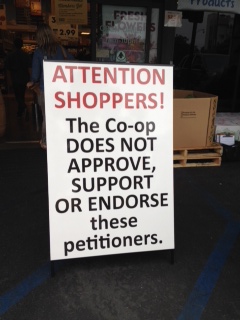
A sign of the recent times.

A sign of the recent times.

Negatives (and proving and disproving them) about Santa Monica Airport

The campaign to collect signatures for the aviation industry’s initiative to perpetuate Santa Monica Airport (SMO) is coming to a head. If the initiative’s sponsor, the Aircraft Owners and Pilots Association (AOPA), through its phony grass roots organization “Santa Monicans for Open and Honest Development Decisions,” doesn’t turn in enough signatures soon for county election officials to review, the initiative won’t make the November ballot. That would postpone a vote on the initiative until June 2016 because charter amendments, such as the AOPA initiative, need to be voted on at statewide primary or general elections.

The would be a disaster for the AOPA because by 2016 the Santa Monica City Council will have been able to create a real plan for voters to consider as an alternative to the airport. Until then the AOPA has the advantage because it can promote its initiative as an alternative to whatever parade of horribles it can conjure up for the future of the airport land.

Those Santa Monicans who want to close SMO, including those of us who want to turn the mile-long runway and adjacent areas into a great park, don’t fear a vote. We’ve always expected there would be a vote, because we expect that if the City Council votes to close the airport, the AOPA would mount a referendum campaign to put the council’s decision on the ballot.

That, however, would be a fair vote because the voters would have two concrete alternatives — keep the airport or do something specifically different. (I hope that something is a big park, in which case I’ll have to come up with a different adjective than “concrete” to describe the alternative.) Assuming the alternative makes sense, we believe we’d win that vote. (Putting massive development on the site, as AOPA signature gatherers say will happen, is not an alternative that makes sense.)

While the AOPA and its allies like to call us pro-park folks dreamers, the AOPA initiative is based on nightmares. The proponents of the initiative and other supporters of SMO don’t have to prove their claims while we opponents are left having to prove (or disprove!) negatives. Not only that, but besides requiring a vote on any airport plans the initiative also has provisions that would stymie any planning for a non-aviation future for the airport land or even managing the city-owned properties at SMO, without the city being overwhelmed with litigation.

I’ll tell you one thing — the truth doesn’t work for the signature gatherers. I’ve been part of the crew of residents trying to block the AOPA’s paid signature gatherers in grocery store parking lots all over town, and it’s been interesting to hear them make their pitch. The one truthful pitch, namely, to sign the initiative to “save Santa Monica Airport,” is a clunker. I’ve watched signature gatherers say that hundreds of times to passersby, and almost zero have responded.

There have been many unfounded arguments that the signature gatherers make, but none is more pernicious than one that if SMO doesn’t exist, flight patterns will change, and air traffic using LAX will fly low over Santa Monica. As is typical, I’ve never seen any evidence to back this up. Instead, the airport’s boosters leave it to airport opponents to prove the negative that air traffic patterns won’t change.

Neither I nor anyone else can tell you exactly what will happen to flying around here if the airport closes, but I can point out what looks like craziness when I see it. And it is crazy to think that LAX air traffic will change significantly.

Why? Flights landing at LAX descend gradually from the east. They take off over the ocean, then climb and turn if they are heading east, north or south. These are the most important patterns affecting flights in the area.

For instance, if you’ve flown from northern California, you know that flights from the north already fly over the Santa Monica Mountains and northern Santa Monica, but they fly fairly high. These commercial jets coming in from the north typically fly at altitudes between 6,000 and 9,000 feet. They need to be up high enough to fly east over downtown L.A. before making U-turns to descend into LAX. It’s absurd to think that if SMO isn’t there they are going to fly low over Santa Monica, Venice, Marina del Rey, and Playa del Rey to land at LAX from the northwest.

Similarly, if you fly out of LAX, you know that you sometimes turn and fly back over Santa Monica, but from the ground you know that those planes are already high enough not to be a nuisance.

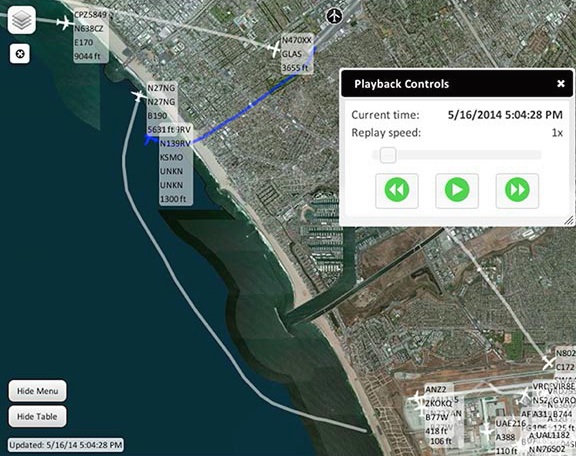
Another reason that commercial flights will continue to fly high over Santa Monica and the Westside is that regardless of the presence of SMO, the sky up to about 7,000 feet is full of private aircraft. The best way to see this is to spend some time looking a flights over Santa Monica through the lens of the airport’s PublicVue website.

PublicVue Screen Shot showing flights around Santa Monica

PublicVue Screen Shot showing flights around Santa Monica

If you monitor PublicVue, you’ll see that there are flight paths along the coast for general aviation (i.e., non-commercial) flights, with connections to inland airports such as Van Nuys, Burbank, and Long Beach, that at altitudes around 4,000 to 6,000 feet are below commercial flight and above the LAX landing paths. The takeoffs and landings to and from Santa Monica Airport are, obviously, below these altitudes — it’s not the planes taking off from SMO and climbing to 1,000 feet or so that keep the big jets up high, above 7,000 feet, it’s all the other private planes passing through.

If you signed the AOPA initiative because a signature gatherer persuaded you that you needed to sign to keep LAX air traffic from swooping down low over your neighborhood, you can rescind your signature by filling out and signing a simple form, and sending to the City Clerk. You can get a copy of the form through the CASMAT website.

Thanks for reading.

Don’t. Sign. The. Phony. Airport. Initiative.

If you’ve bought groceries recently in Santa Monica, or if you will anytime soon, chances are you’ve been asked or will be asked to sign a petition for an initiative to “give the people the right to vote on the airport,” or to “stop overdevelopment at the airport.” Maybe a canvasser has come to your door.

Please, don’t sign the petition, and if you have signed it, please contact the City Clerk to withdraw your signature (details on that below).

Here’s the truth about the petition. The aviation industry, through its lobbying organization, the Aircraft Owners and Pilots Association (AOPA), is funding a sham initiative to change Santa Monica’s City Charter to keep Santa Monica Airport, which the City of Santa Monica owns, operating for their own private benefit. They’ve funded an army of paid signature-gatherers in a desperate move to derail 50 years of Santa Monicans’ trying to take control of the airport’s more than 200 acres of land, most of which residents bought and paid for with a parks bond nearly 90 years ago.

Back then, in the 1920s, flying was a still romantic thing, different from today. In what was basically an empty wilderness one could even think of a grass airstrip as park-like. In only a few years, however, accelerated by the run-up to World War II, aviation became an industry and the park became the site of Douglas Aircraft and one of the world’s largest factories — an arsenal of democracy.

Today, Douglas is long gone — it moved out when Santa Monica refused to condemn houses to extend the runway so that Douglas could build DC-8’s here — but the aviation industry remains, mostly in the form of private jet operators. The airport is a cash cow for them, subsidized by the City and made possible by low rents on leases dating back 30 years.

To take one example, according to data unearthed by the Airport Commission, Atlantic Aviation, the largest jet operator at the airport, pays the City rent of $200,000 per year, and then rents to sub-tenants for over $4 million per year. Meanwhile, the City has been subsidizing operations at the airport to the tune of $1 million per year. The average monthly rent aviation tenants pay the City is 6¢ per square foot — when the market rate is nearly $4!

All the residents of Santa Monica own the Santa Monica Airport and all of us should benefit from the airport land, not just a few.

Predictably, the industry has jumped on two popular themes in Santa Monica politics to create a smokescreen to cover the motives behind the initiative: the theme that the people need to take control over decision-making and the theme that the city is being over-developed. These themes were, of course, exemplified by Residocracy’s recent, successful campaign to get enough signatures to put the Hines-Paper Mate development to a referendum vote.

But there is no similarity between the Residocracy campaign — which was a genuine movement of residents, who did most of the signature gathering on a volunteer basis — and the aviation industry’s campaign, which has no roots among any community groups in Santa Monica and is funded entirely by the industry. In fact, community groups are lining up against the initiative — as of today, Santa Monicans for Renters Rights, Friends of Sunset Park, Mid City Neighbors and Northeast Neighbors have all come out against the initiative, with more opposition from more groups on the way.

The aviation industry’s initiative purports to be about giving the people the right to vote on the future of the airport, but that’s not what it’s about. Through the referendum process, as shown by the Hines petition, Santa Monicans can already bring any action the City Council takes about the airport to a vote.

Nor is the initiative about preventing overdevelopment. The City Council in a “wall-to-wall” unanimous vote at a meeting in March initiated a process to ensure that there will not be intensive development on the airport land, a process that can lead to building a great public park there. The fact is, as expressed by Mayor Pam O’Connor at the council meeting in March, the airport is not a good place for development, since it’s poorly connected to transit corridors and the street grid.

The initiative is about stopping any planning for alternatives at the airport. According to the AOPA website, the initiative“requires the city to continue to operate the airport in a manner that supports its aviation purposes and stipulates that the city cannot impose new restrictions that would inhibit…the full use of aviation facilities.”

The purpose of the initiative is to prevent any change at Santa Monica Airport.

Airport businesses have known since 1984 that Santa Monica would take control of the Airport land in 2015, and that it was likely that the City would close the airport. The airport businesses say it’s the residents who moved near the airport and who therefore should forever bear the burden of increasing jet traffic, yet it’s the businesses that have known for 30 years that their time was running out. Now they are using this phony initiative so they can keep feeding from the public trough.

You can expect to see a lot of signature-gatherers in the next couple of weeks. Although the AOPA has six months from April 10 to get the 9,000 or so signatures it needs to get the initiative on a ballot, to place the initiative on this November’s ballot, the AOPA needs to get those signatures by mid-May at the latest to cover the time it takes for the County to certify the signatures and the City Council to review the measure before it goes on the ballot.

If the AOPA doesn’t get the initiative on this November’s ballot, because the initiative calls for a charter amendment it could not be voted on earlier than the June 2016 statewide primary election. By then the AOPA knows that the City Council will have had plenty of time to craft a plan for the future of the airport land that the residents of Santa Monica will support. This is the aviation industry’s last chance to stop the City and its residents from taking control of their property at the airport.

Thanks for reading — and thanks for not signing the petition.

(If you have already signed the petition, and want to rescind your signature, call the Santa Monica City Clerk’s office at (310) 458-8211.)

Desperate Times, Desperate Measures, Desperate Companies that Rent Corporate Jets

I’ve already been quoted by Jason Islas in The Lookout calling the initiative that the Aircraft Owners and Pilots Association (AOPA) has filed to prevent the Santa Monica City Council from closing Santa Monica Airport a desperation move, but there is more to it than that.

The filing of the initiative to amend the City Charter to preserve the airport also shows that notwithstanding all the bravado coming from AOPA and the aviation industry it represents, and the Federal Aviation Administration (FAA), about the City’s purported obligation to operate the airport in perpetuity, they are all scared. Why? They know that the deal they made with the City in 1984 to settle that generation’s litigation over the airport was that the City could close it in 2015, that the 31 more years of flying they got then were the last they’d get, and they know that once the City gets them in court, the City’s rights over the land will be confirmed.

Even more than that, they know that when the City Council takes the actions — by the end of this year — that the council directed staff to analyze and put into policy form, that the path to closing the airport, or at least reducing its operations substantially, will be irreversible.

They also know that once the City embarks on developing the “concept plan based on low intensity use” that Council Member Kevin McKeown added to the actions the council adopted Tuesday night, they will lose their argument that the City will replace the airport with commercial or otherwise intensive development.

So AOPA had to act now. Loaded with money from the aviation industry, AOPA will try to persuade voters that all it’s doing is making sure the voters have ultimate authority over the decisions the City Council makes, but voters already have that authority – through the referendum process. As the recent signature-gathering for the referendum on the Hines development shows, if 10% of Santa Monica voters don’t like what the City Council decides to do with the airport, the council’s actions will go to a vote.

From the language in the proposed initiative, it’s clear that AOPA wants not only to pass an initiative requiring votes on airport decisions, but also to pass one that is vague and broad enough that any action the City would take in managing its property at the airport – an adjustment to a lease, for instance – would be subject to a lawsuit from aviation interests on the basis that the action, however ministerial, would need to be voted on.

AOPA, if it spends enough money, can obtain enough signatures to put the initiative on the ballot. Sure. But I for one am confident that the voters of Santa Monica will see through their plan and vote no.

In the meantime, however, it’s worth looking at some of the arguments airport proponents made at the City Council hearing Tuesday night.

Perhaps the most obnoxious argument airport defenders make is the one that homeowners near the airport bought into the area with knowledge of the airport, and that that disqualifies them from being concerned about their health and safety. But of course those residents don’t really care about their health and safety – they’re only fighting the airport for the big bucks they are going to make when they can sell their homes once the airport is gone.

Do they know how insulting this is?

Aside from ignoring the many people who want to close the airport who don’t fall into this category, this argument ignores important facts. One is that many homeowners bought their properties when jets were banned at the airport. Jets magnify the airport’s impacts, and the number of jet operations and the size of the aircraft have increased greatly over the years, so that the situation has become much worse for all residents, regardless when they moved in.

But truly the argument should be reversed – since 1984 it is the pilots and the aviation businesses who have known that the City would likely close the airport in 2015 and would certainly have the right to do so. It is they who should have been making plans for the future. These businesses lease their facilities from the City – businesses in the real world lose their leases all the time. (I still miss Broadway Deli!) What are these proud business people complaining about? They way they go on about the government’s obligation to keep their businesses going, you’d think they were socialists!

Another argument the pro-airport people make is that in the event of an emergency Santa Monica Airport will be the area’s lifeline. Okay, I don’t want to jinx things, but we had an earthquake in 1994 that was big enough to knock down the Santa Monica Freeway, and I don’t recall anyone re-staging the Berlin Airlift. The same goes for emergency flights. There is no reason that a park at the airport can’t have open ground sufficient to land emergency helicopters.

There’s no question that the most appealing uses of the airport are the Angel’s Flight medical flights. But given that there are other airports nearby, and given the benefits of the great park that replace the airport, are they sufficient reason to keep the airport open?

As for building a great park on the airport land, the airport proponents keep saying that the City wouldn’t have the money to build it. Where they get this, I don’t know. In the past 20 years the voters of Santa Monica have approved more than a billion dollars in school and college bonds. They have an unbelievable public spirit and they love their city. I have no doubt that they would approve a parks bond to cover construction costs that cannot be financed otherwise.

Lastly, the Daily Press ran a story by David Mark Simpson about concern among non-aviation businesses at the airport over extending their leases, focusing on Typhoon Restaurant. A representative from Typhoon also spoke at the hearing Tuesday night, asking for flexibility in leasing guidelines to justify his client investing in improvements in the now 20-year-old restaurant. I hope that staff can incorporate that kind of flexibility into its leasing guidelines, but more than that, I am sure that Typhoon will sell even more of its delicious whole catfish to even more customers once the restaurant’s big windows look out over a great park full of happy people rather than a runway with screaming jets.

Thanks for reading.

Santa Monica Airport

Santa Monica Airport

A Quiver Full of Arrows to Close SMO

In the long term, Judge John Walter’s decision last week to dismiss the City’s case against the Federal Aviation Administration (FAA) doesn’t mean a whole lot. It’s not only that the judge emphasized that his decision had nothing to do with the merits of the case, but Santa Monica has several means to gain control of the airport land and ultimately close the airport.

The lawsuit that Judge Walter dismissed primarily on the basis of the technical requirements of the federal Quiet Title Act (QTA) was based on the City’s claim that the “perpetuity clause” in the 1948 Instrument of Transfer (IOT) is not enforceable and that control of the airport will return to the City when the 1984 Settlement Agreement with the FAA expires July 1, 2015.

By suing under the QTA, the City was trying to determine ahead of time what its rights were — to be able to plan accordingly for the future of the land. Judge Walter said he sympathized with that wish, but said the claim was not being made consistent with the time period allowed in the QTA for bringing suit against the federal government. His decision had nothing to do with the merits of the City’s case; since the City has not yet tried to close the airport, he said the issue was not yet “ripe.” The issue will be subject to litigation when the City moves to close the airport.

But litigation over the 1948 and 1984 agreements is not the only arrow in the City’s quiver. In its complaint, the City, in recounting the history of how it acquired the airport land, took pains to point out that the 1948 IOT only applies to one piece of the airport. A large piece, on which sits about 40% of the airport’s runway, is not subject to the perpetuity clause in the IOT.

Neighborhood groups opposed to the airport have made the argument, which City Attorney Marsha Moutrie has said appears to her to have merit, that the City could, on July 1, 2015, take back that portion of the airport, which would reduce the runway to less than 3000 feet. Obviously it would be simpler for the city to prevail in a suit over the 1948 and 1984 agreements, but reducing the length of the runway would mean that the big private jets that have the worst adverse impacts would not be able to use the airport. Even more significantly this would likely mean that the airport would not be able to subsist economically and would have to close.

In this connection, it’s not only the 1984 Settlement Agreement that expires July 1, 2015, but also all the leases of city-owned land and buildings at the airport to aviation interests. These are the hangars that the private jets and planes use, the support facilities for fuel and repairs, and the offices of the aviation companies. Under these old leases the rents are pennies on the dollar of what is now market-rate. Indeed, aviation companies are currently subleasing much of this space at a considerable profit to non-aviation tenants, such as Volkswagen’s design studio.

All of these leases end in 2015. Then the City can terminate the leases and lease to new, non-aviation tenants. As David Goddard, Chair of the Airport Commission, discussed at the Airport2Park panel a few weeks ago on financing a big park at the airport, this would represent a large swing, of millions of dollars, of revenue to the City — in the long term, these dollars could go to the operating costs of a park, in the short term there would be plenty of money to fund litigation with the FAA.

If the FAA could persuade a court that the perpetuity clause still applies, and if the airport could survive a starvation strategy, there would still be politics at a higher level. Congresswoman Karen Bass, who represents the district immediately to the east of the airport, has called for the airport to close. Henry Waxman was inching to that position when he announced his retirement, but there is every indication that his successor will support efforts to close the airport.

Candidates Ted Lieu and Marianne Williamson have both stated they support Santa Monica’s right to close the airport. Wendy Greuel, to my knowledge, has not yet declared a position on the airport, but there’s every reason that the next U.S. representative from our district will call for closing the airport. One has to wonder how much of its resources and political capital the FAA will want to expend defending a small airport that has lost the support of the local members of Congress.

Regardless whether the City chooses to appeal Judge Walter’s decision, it’s clear that the fight to close Santa Monica Airport is far from over.

Thanks for reading.

Santa Monica Airport

Santa Monica Airport

Santa Monica vs. FAA: By their words shall ye know them

As someone who wants to turn Santa Monica Airport into a big park, I have been following the lawsuit that the City of Santa Monica filed against the Federal Aviation Administration (FAA) to confirm that the City controls the airport land and will have the right to close the airport after July 1, 2015, when the current, 1984 settlement agreement with the FAA expires.

As discussed in my post a couple of weeks ago, in response to the lawsuit, the FAA filed a motion to dismiss it on jurisdictional and procedural grounds. This weekend I read the City’s response to the motion. (The motion will be heard February 10 in federal court in downtown Los Angeles.)

While the federal government moved to dismiss on various grounds, the most fundamental one was that the City’s claim was barred by the 12-year statute of limitations of the federal “Quiet Title Act.” According to the feds, the City’s claim is too late because the City should have known decades ago that the federal government was claiming an interest in the title to the property under the 1948 Instrument of Transfer (IOT) that returned control of the airport to the City after World War II.

As readers will recall, the FAA is relying on a clause in the IOT in which the City agreed to operate the airport in perpetuity. However, there was no consideration for this agreement, nor is there any way for the government to enforce it.

The City’s response to the motion doesn’t add much new information that was not contained in the its original complaint, but reading it brought home how preposterous it is that after all these decades the FAA is arguing that Santa Monica can’t close the airport because of the IOT.

This graphic shows the sizes of all existing Santa Monica parks at the same scale as what could be the park to replace the airport.

This graphic shows the sizes of all existing Santa Monica parks at the same scale as what could be the park to replace the airport.

In fact, it was only in 2008 that the FAA, which I suspect had begun to panic when it realized that 2015 was coming up in less than 10 years, dredged up the IOT’s perpetuity clause. Before then FAA administrators and lawyers must have looked at the history and the law and realized that this argument didn’t have a wing or a prayer.

Why do I say that? Because the city’s response highlights several documents from past decades where the FAA declared the obvious, that the City had the authority to close the airport. For instance, in 1971 (only 23 years after the 1948 IOT) the FAA wrote the Aircraft Owners and Pilots Association to tell them that once Santa Monica no longer had obligations arising from funding provided by the FAA, the airport would be “vulnerable to being discontinued and used for non-aviation purposes.”

As discussed previously, the 1984 settlement agreement clearly states that the City is only obligated to continue operations at the airport until the 2015, but to remove any doubt that this means precisely what it says, in 1998 the FAA issued a determination that the 1984 agreement “makes clear that the City is obligated to operate the Airport only for the duration of the [agreement]… To the extent that [pilots] seek to prevent the future closure of the Airport . . . that is a local land use matter.”

“A local land use matter.” Wow.

In 2003, at the conclusion of the same proceeding, the FAA ruled that the 1984 agreement only required the City to maintain the airport’s “role in the National Airport System as a general aviation reliever airport until July 1, 2015.”

The City’s point is that only in 2008 when the FAA changed its tune was the City put on notice that the FAA had designs on the land, and that the 12-year statute of limitations only started running then.

Not only does this argument seem obvious to me, but also, regardless how the judge rules on the motion, one has to wonder, when and where this dispute ultimately ends up in court, how will the U.S. Attorneys defending the FAA try to explain away the FAA’s own admissions that on July 1, 2015, the City of Santa Monica can close down Santa Monica Airport.

Thanks for reading.

Santa Monica Airport litigation: The FAA’s problem is no remedy, no right

In litigation as in life people waste time trying to avoid what matters, and a good example of that was the response that the federal government filed Friday to the City of Santa Monica’s lawsuit seeking to confirm the City’s control over the Santa Monica Airport.

On behalf of the Federal Aviation Administration, U.S. attorneys moved to dismiss the City’s lawsuit on various procedural and jurisdictional grounds, including that some claims should have been filed in a different court, some were outside of jurisdiction of federal courts, and that some were not “ripe” for adjudication — as if there is no controversy yet because the City has not already sent bulldozers to tear out the airport’s runway.

In court, procedural challenges are always the first line of defense – but you have to wonder: does the FAA want Santa Monica to send in the bulldozers? This dispute is going to end up in court somewhere, sometime, and we may as well get to the substance sooner rather than later.

The substance in the case of Santa Monica vs. United States is a clause in a 1948 agreement, called an “Instrument of Transfer” (IOT), between the federal government and Santa Monica. The IOT returned the airport to Santa Monica’s control after the federal government had leased it from the City during World War II (so that the army could protect Douglas Aircraft). The feds transferred many airports to cities after the War, and the IOT’s, including the one for Santa Monica Airport, contained a clause that the cities agreed to operate the airports in perpetuity. It is the enforceability of this perpetuity clause that will determine the future of the airport land.

Because I am involved in Airport2Park.org, the movement to turn the airport into a park, friends often ask me whether I believe Santa Monica will be able to close the airport. I’m not a litigator or expert on the laws at issue in the case, and you are welcome to take what I say with all the grains of salt you want, but I believe that the perpetuity clause is not enforceable, and the courts will confirm the City’s control over the airport land.

I believe this for two reasons. I’ll admit that the first is somewhat circumstantial — it is that if the FAA could stop the City from closing the airport it would not have entered into the settlement agreement with the City in 1984 that says that the City won’t close the airport before July 1, 2015, implying strongly that the City has that right to do so.

Somewhere deep in the FAA’s collective consciousness I suspect that there was in 1984 and is today a realization that there is no way that the courts – or if not the courts, politicians – are going to require, because of a pro forma clause in a 1948 contract, that a city continue to operate, at a financial deficit, a dangerous nuisance surrounded by homes, businesses, and schools. The 1984 agreement, at a minimum, should be seen as superseding any earlier agreement. The FAA is operating from a level of desperation, something the agency is familiar with because for all its bluff it hasn’t been able to stop hundreds of airports around the country from being closed.

Even if that is not the case, and the FAA believes in its cause, the second reason the City will win is not circumstantial — it is that even if the courts reject the City’s arguments that the 1948 perpetuity clause is unconstitutional or otherwise invalid (arguments that sound good to me!), and uphold the clause, the FAA doesn’t have a remedy to stop the City from closing the airport.

And as they teach you in law school, there is no right without a remedy.

The reason the FAA doesn’t have a remedy is stated right in the government’s response, on page 12, when the U.S. attorneys state that the “operative language” in the IOT if the City doesn’t comply with its obligations (i.e., operate the airport) is that the federal government has an interest in all rights “transferred by this instrument.” This means, and the IOT is specific about this, that if the City does not comply with its obligations, the rights or property transferred to the City under the IOT can revert, at the government’s option, to the government. That is the government’s remedy — it’s not as if the FAA could obtain an injunction to require the City to continue to operate the airport. It’s the reversion or nothing.

The problem for the FAA is that there’s nothing left of the rights transferred in 1948 to revert, because all the government had then was a lease that expired long ago and equipment and improvements that are long gone. This is what makes the Santa Monica Airport situation different from the typical postwar airport transfer — the feds never owned the land. There is nothing to revert.

As I said, I don’t know anything about the procedural or jurisdictional claims in the government’s motion to dismiss, but this is a case where Santa Monica could lose every motion and every argument, and then still win in the very last sentence of the final decision of the last court that considers the case.

Thanks for reading.

Northward view at Santa Monica Airport. Imagine this a park.

Northward view at Santa Monica Airport. Imagine this a park.

Growing a park at the airport: step by step

It’s been about a month since Santa Monica sued the Federal Aviation Administration (FAA) to confirm the City’s rights to control the future of Santa Monica Airport. The FAA still has a month or so to answer the City’s complaint, but in the meantime a lot has been going on that’s relevant to whether the airport will become a park.

For one thing, the FAA is losing political support, which could be critical as decisions are made in Washington. Although our representative in Congress, Henry Waxman, has said he won’t make any pronouncements about what he thinks the future of the airport should be until he feels he knows the wishes of his constituents, that has not stopped him from taking an increasingly aggressive attitude toward the FAA’s indifference to the rights and safety of those who live near the airport.

As reported in the Lookout News, the congressman, in response to concern from residents that a jet could overshoot the runway and devastate homes, recently wrote the National Transportation Safety Board (NTSB) requesting that the NTSB accelerate its review of the tragic crash in September that killed Mark Benjamin and three others.

Meanwhile, U.S. Rep. Karen Bass, whose district borders the airport and includes West L.A. and Mar Vista, sent a letter Nov. 7 to the FAA calling for the agency to consider allowing Santa Monica to close the airport after expressing her conviction that the “airport represents a danger to the health and safety of surrounding residents.”

While the FAA is committed to defending aviation, it has to pick and choose which battles to fight and how hard to fight them. Notwithstanding its efforts, hundreds of airports have closed in past decades, and it must have some institutional knowledge about when a cause is more likely lost than winnable. The FAA is used to congressmen and women who want something from it, like funding for a new radar tower. When the representatives no longer support a local airport, then the FAA has to start wondering whether it’s worth using its resources to defend it.

While all of this is going on at the rarefied Congressional level, Airport2Park.org, the local group formed to advocate for turning the airport into a park, is picking up support locally. The Westside Neighborhood Council of the City of L.A. passed a resolution two weeks ago supporting A2P’s efforts, if the airport closes, to build a park there.

At the same time there’s been other news in Southern California that is relevant to turning the airport into a park – news about two other park projects.

First, in the big picture department, last week the L.A. Times reported on a proposal in Long Beach to turn a piece of underused freeway into a park, to serve a neighborhood that is “boxed in by refineries, rail yards and truck routes.” According to the Times, “city officials are considering a radical makeover of west Long Beach that would involve ripping out a one-mile section of one of the Southland’s first freeways, now mostly used by truckers, and replacing it with a long ribbon of green space.”

I bring this up because I still hear from people who think that turning the airport into a park is a fantasy. Meanwhile, all over the world cities are doing great things with the gritty leftovers from the industrial era. I.e., if Long Beach can turn a mile-long piece of freeway into a park, then Santa Monica can do the same thing with the airport’s mile-long runway, which fewer people use than the freeway.

The other story is a cautionary tale that falls in the “avoid this” department. Perhaps you’ve been reading about the troubles that the City of Irvine has had with financing the “Great Park” that it planned to replace the 1,300-acre El Toro air base. Irvine expected developers to pay for the park, and built 200 acres with the initial cash it got, but after the 2008 market crash there was no money to finish the park. Now Irvine is debating an offer from a developer to pay for a scaled-down version of the park in return for the right to build about 4,600 homes.

The lesson: don’t rely on developers to build important public infrastructure. There is no free lunch. Design a park that’s worth spending taxes on. Get over the idea that the public realm isn’t worth paying for, and we’ll have a public realm that is worth paying for.

Thanks for reading.

The park created in Chicago on the former Meigs Field.

The park created in Chicago on the site of the former Meigs Field.

Storming FAA beach

For a while now the groups of residents seeking to close the Santa Monica Airport have been counseling caution in dealing with the Federal Aviation Administration (FAA). The City of Santa Monica was so bruised by losing its case against the FAA over big corporate jets that the groups, the chief of which are Community Against Santa Monica Airport Traffic (CASMAT) based largely in the Santa Monica neighborhoods of Sunset Park and Ocean Park, and Concerned Residents Against Airport Pollution (CRAAP) based largely in the L.A. neighborhoods of Mar Vista and Venice, proposed strategies and tactics that — t’ai chi ch’uan style — avoided a head-on clash with the FAA.

You know what t’ai chi masters say is the way to stop an oncoming train from running you over, don’t you? It’s “step off the track.”

The FAA’s train was a covenant in a 1948 “Instrument of Transfer” by which the federal government released its wartime interest in the airport; the covenant on its face required Santa Monica to operate the airport in perpetuity. In all the decades of litigation over the airport the feds had never tried to keep the airport operating by invoking this clause, but a few years ago — getting desperate? — FAA administrators grabbed hold of the covenant and threatened Santa Monica with dire consequences if the city tried to close the airport in 2015, after the city’s agreement to keep the airport open until then, contained in a 1984 Settlement Agreement with the FAA, expired.

In the t’ai chi philosophy of martial arts one defeats one’s foe by yielding and “sticking” to them rather than opposing force with force, and in true t’ai chi fashion the tactics of the anti-airport groups involved two gambits. One focused on a parcel of land, called the “Quitclaim Parcel” because the City obtained it by way of a quitclaim deed from the federal government in 1949, which was not covered by the Instrument of Transfer, and the other on the leases to aviation companies at the airport that expire in 2015.

The tactics were (1) that the city would take back the Quitclaim Parcel, which would reduce the airport’s runway from 5,000 to 3,000 feet and preclude big corporate jets from using the airport without directly challenging the “perpetuity” covenant, and (2) that the city would simply not renew the aviation leases, thus drastically reducing the functionality of the airport.

Although I had several times written in my Lookout column that the airport should close when the 1984 Settlement Agreement expired, I didn’t get to know the people in the anti-airport groups until I ran for City Council in 2012. I met them during the campaign, and what impressed me about them from the start was how practical they were.

It’s easy for residents to make demands on the city without always considering legal, economic and other realities, but the anti-airport groups never took anything for granted. They researched everything about the airport, from its history, including the legal history of each parcel that makes up the airport, to operations — such as analyzing flight data to reveal that about half of all takeoff and landings at the airport came from flight schools that operated out of leased city-owned buildings.

Then, knowing that fighting the FAA in court would be expensive and grueling, they came up with their strategies based on the Quitclaim Parcel and the leases. They demanded action from the City, but the actions they demanded were measured and cautious.

So what happened?

Well, blow us all away, but forget yielding and sticking. Last Thursday the City of Santa Monica went to battle against the FAA more like Marines landing on a beach. As I’m sure readers know, the City filed suit against the FAA seeking to quiet title on the airport land, asserting, among other arguments based on the language of the documents and, in some cases, the FAA’s own policies, that the perpetuity covenant in the Instrument of Transfer violated the City’s constitutional rights under the Fifth and Tenth Amendments of the Bill of Rights.

If you haven’t read the Complaint, I urge you to do so. It’s written in plain, non-legal language. The arguments based on the facts — and I can’t wait to read the legal briefs supporting them — are powerful.

SMO Complaint (10-31-13) page 1 cropped

A few things are clear. The City — and that includes the council members, City Manager Rod Gould and his staff, and City Attorney Marsha Moutrie and hers — not only listened to the community groups, but also studied the history of the airport they and others (notably environmental lawyers at UCLA) had unearthed.

As a member of Airport2Park.org and looking forward the great park the City will build at the airport, I’m thrilled by the bold action the city took.

But I also want to mention that the city’s complaint preserves the city’s rights to take back the Quitclaim Parcel (which it explicitly clarifies as not coming under the Instrument of Transfer) and terminate the airport leases.

In a future post I’ll go into the complaint in more detail, but for now — Bravo!

Thanks for reading.

In this case, no need to compromise

I’m still consumed with (and writing about) the idea of turning the Santa Monica Airport into a big park, and this post contains more follow up to the Oct. 3 Airport2Park workshop — first to let readers know that videos of the workshop (in two parts) are available to watch on the Airport2Park website.

Honestly, the raw footage hasn’t been edited yet (and in certain places sound needs to be added from other cameras that were recording the meeting) and you may not want to spend two hours watching the whole event (although I guarantee you will be entertained!), but in the you-owe-it-to-yourself department, be sure to watch Mark Rios’ presentation on how airports and industrial sites all around the world are being turned into parks (which begins at the 20:42 mark of Part 1), and the presentation of the ideas from the breakout sessions (which begins around 11:30 in Part 2).

You will be edified.

In the meantime, we at A2P are tabulating the responses we received not only in the breakout sessions, but also from the many individual surveys that we have received from the public. (It’s also easy to add your ideas for a park to the mix by sending a message to Airport2Park from the website.)

Over the past decade or so, a number of landscape architects have made the case for a movement they call “landscape urbanism” which seeks to understand how cities develop by looking more at terrain and ecosystems than at a city’s buildings. It’s not coincidence that this way of looking at the city has arisen in an era when many cities are dealing with the remains of the industrial revolution in a postindustrial economy. (Perhaps the most famous example of landscape urbanism is the redevelopment of the High Line In New York City.)

Intrinsic to the landscape urbanism movement is the notion that in the urban context landscape is not simply landscape, it is what shapes the city. More specifically, a park is not simply a park. Parks and other open spaces not only serve important functions on their own, but also affect the performance of other urban functions.

There are many debates floating around about the role of landscape and the impact of landscape urbanism on the design of cities, but one thing that was clear from the A2P workshop is that ordinary residents instinctively understand the principles involved. While there were many calls for the restoration of terrain, unprogrammed spaces, and “quiet places,” there were as many calls, typically if not always from the same people, for connections to be made with the surrounding city, for active recreation, arts, and cultural uses, and for restaurants and cafés. People get it.

When asked at the end of the workshop to list five “takeaways” from the meeting, Mark Rios mentioned these — quiet spaces, connections to the city, environmental fixes (swales and the like), the arts, and cafés. But he also raised and responded to an important question that people might have: would trying to accommodate all these different uses lead to a compromise design, a “weird camel,” as Rios put it?

No, he said, a great park can accommodate many uses, programmed and unprogrammed alike, without being a compromise. Think about the great parks you have experienced in your life; a great park design is not compromised because the park accommodates conflicting purposes – doing that is what makes it a great design.

This is an important concept for any kind of urbanism, not only of the landscape variety. We spend a lot of energy trying to prevent things from getting worse. But it is possible to make things better.

Thanks for reading.

A2P Oct 3 Rios

Mark Rios speaking at the Oct. 3 workshop. (Photo courtesy Mike Salazar)