Your legacy here

Recently I was in Bellingham, Washington, for a family event. In many ways, both historical and present-day, Bellingham is a lot like Santa Monica. Both cities were situated where railroads reached the sea – in Bellingham’s case, Puget Sound. Both grew primarily as industrial cities. Today both cities have populations of about 90,000.  

My wife and I stayed at a hotel in the Fairhaven district. Originally Fairhaven was a separate town, before merging with a town then called Whatcom to form Bellingham. Like Santa Monica’s Ocean Park neighborhood, it had its own business district separated by railroad tracks from the water. Like Ocean Park today it still has its own little downtown. (Unlike in Ocean Park where the railroad is long gone, the track that runs between Fairhaven and the water is still active. The hotel gives its guests earplugs and offers white noise machines.)

For the first two thirds of the 20th century, Fairhaven and the Bellingham area in general were industrial, much like Santa Monica was. Along with other industries, Puget Sound was the center of the largest salmon canning industry in the world.

The canned salmon industry closed in the 60s, leaving abandoned industrial sites along the Fairhaven waterfront. Again, there is a parallel to Santa Monica: Douglas Aircraft, which had been Santa Monica’s biggest industry, closed its Santa Monica plant around the same time.

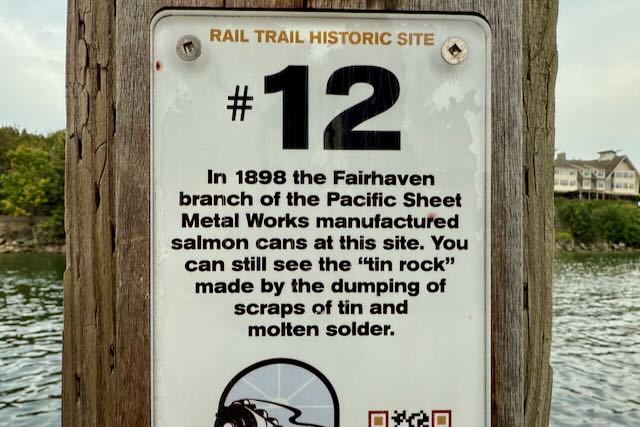
During the decades when the salmon canning industry was active, Fairhaven hosted a plant on the shoreline where the cans themselves were manufactured. Now a park, called Boulevard Park, has replaced the can factory.

The park has quite a few markers detailing this history; here are some, including about the can factory:

This “before” picture shows some of the park site before it was turned into a park

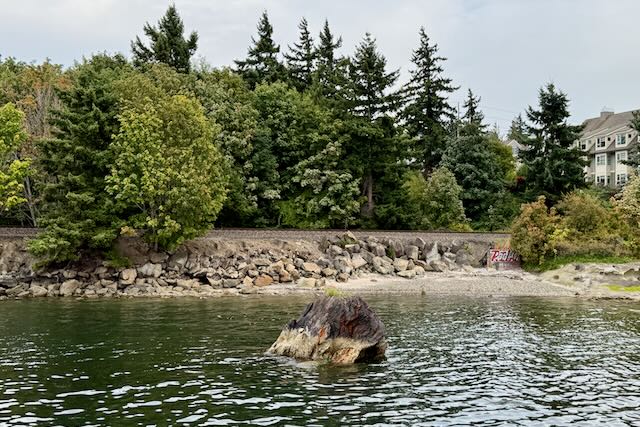
Here’s a picture of the “tin rock” mentioned in the marker:

Boulevard Park includes a pathway that runs out on trestles (this part is called Taylor Avenue Dock), which joins a trail on the land (and another park) to connect to downtown Bellingham, about two miles north. One day I walked the trail up to Bellingham. The parks and the trails are a great example of turning an industrial site into a park.

Naturally, I couldn’t help but think of our project here in Santa Monica to turn an industrial site, Santa Monica Airport, into (or back into) a park. What I learned, from signage in the park, was that it took decades of tenacious effort to do the job, and that the community of Bellingham is immensely proud of that effort.

Yes, as the marker said, it was a community effort. Also, note that it took about 50 years to complete the job — a waterside park was aspirational in the 60s, became a partial reality by 1980, and was completed only in 2004.

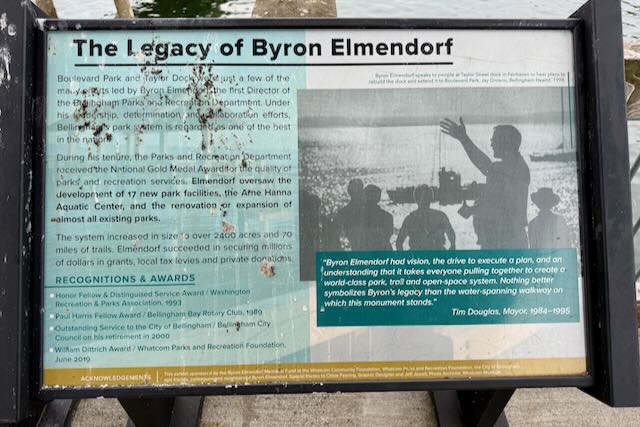
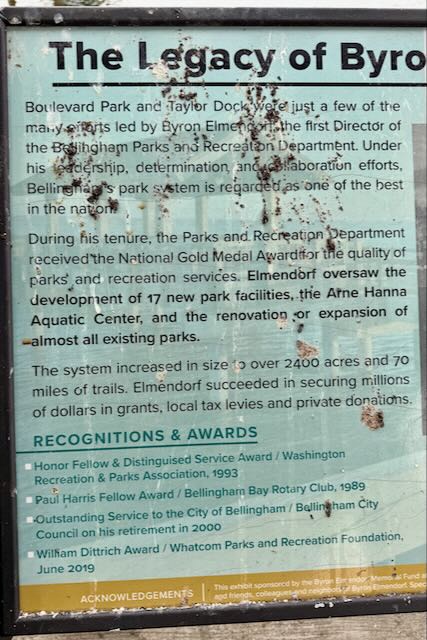
This timeframe is something to keep in mind as we grapple with reversing almost a century of industrial use at the airport. I’ll quote this language from the marker: “Facing numerous obstacles, including complex ownership, permitting, environmental impacts, industrial contamination, and skepticism, [Parks Director Byron] Elmendorf persisted.” (Italics added – what we most have to fear here in Santa Monica about building a great park at the airport is not any real problem in the long term, but rather skepticism all by itself. Yes, “we have nothing to fear but …”)

Specifically, Bellingham is proud of the longtime head of the city’s parks department, one Byron Elmendorf, who shepherded the project through to completion. Here’s a plaque that honors him. 

Here is a more readable photo of the legend on the marker:

I like this sentence, too: “Elmendorf succeeded in securing millions of dollars in grants, local tax levies, and private donations.” But doing so took time. As I wrote in a previous post, there will be many opportunities for funding the park over time. Santa Monica has one great advantage over Bellingham in that Santa Monica already owns the most expensive element of the airport great park, namely the land.

Bellingham has honored the legacy of Mr. Elmendorf with a special marker. Good for Bellingham to honor a civil servant! But I would say, and I suspect that Mr. Elmendorf would agree, that these beautiful and well-used parks are the legacy of the whole community, just as a great park to replace the airport can be the legacy of all of us.

Thanks for reading.

Ed. note: The original version of this article stated that Ocean Park had been a separate town from Santa Monica. From local historian Nina Fresco I’ve learned that what’s now the Ocean Park neighborhood was always within the borders of Santa Monica. The confusion arises because Abbott Kinney’s first name for what became the city of Venice was also Ocean Park. I’ve made a correction; thanks, Nina.

We already have a city. What we need is a park.

“The City is at an important point in the process of understanding how this project should serve Santa Monica and the wider region for several hundred years.” From Page 4, Agenda Item 7-A Staff Report for the July 8, 2025 meeting of the Santa Monica City Council.

That is my favorite sentence of the staff report for Tuesday’s night’s City Council meeting where the council will take the next steps to convert the Santa Monica Airport into a park. The sentence puts in context both the importance of the project and the time to get it done.

I have problems with the Staff Report (see below), but there are other good parts.

One of them is the PowerPoint that HR&A, the City’s financial advisors, prepared to give an overview of possible financing sources for the park. Although this report is preliminary, in part because HR&A did not have a program with specific costs to consider, I was pleased to learn of possible sources I knew nothing about. These include two forms of tax-increment financing, “Enhanced Infrastructure Financing Districts” and “Climate Resilience Districts,” that City Council could establish at the appropriate time.

Another good thing in the Staff Report is the summary of 69 “letters of interest” (LOIs) that staff received from entities and persons with ideas for how they could participate in development and/or operation of the park. Many of the ideas are unlikely to happen, but some have real potential.

One proposal, for instance, comes from California State Parks to join with Santa Monica in building and/or operating the park for “habitat restoration, cultural programming, and public recreation aligned with the state’s climate and equity goals.” We don’t have details, but one assumes that State Parks could bring in state money. Keep in mind that Santa Monica already cooperates with State Parks in the operation of the beach, which is formally a state park known as “Santa Monica State Beach”.

Other proposals come from sports groups that could help build and operate sports facilities.

Another LOI came from a major contractor firm, the Griffith Company, which proposes to create an on-site processing yard to recycle the concrete and asphalt that will result from removing runway and tie-down areas. Griffith says this will reduce environmental impacts as well as produce income for the City during the removal process. Removing the tarmac could be a major cost; if Griffith can cover it by recycling the materials, that’s in effect another financial source for the park.

Some of the LOI proposals are more long-term and would require more public process. For instance, New Roads School proposes to swap their current site on Olympic Boulevard, a site better located for housing than the airport, for land at the airport. New Roads would build a new campus there, and share cultural and recreational facilities with the City, much as the City now shares facilities with public schools. This proposal would probably need a vote to amend Measure LC and, as I said, more public process. It would need to wait, but it’s the kind of project that could utilize already built-on land at the airport, land that would be harder to turn into park.  

The summary of LOIs is a plus, but it ends with a throwaway paragraph: “At this time, there are no further steps associating with the LOIs. This list is provided to City Council for consideration on how the Preferred Scenario of Phase 3b should move forward and if any of these ideas are intriguing enough to instruct staff to continue exploring any of these ideas in the future.”

What a letdown. Maybe Sasaki and staff could have given City Council a heads up on which proposals might be helpful in building and operating the park? Do they expect the council members, who are not professional park designers, to go through these 69 proposals one by one? To find out which are “intriguing enough”?

Which brings me unhappily to the rest of the report. I could glean some other nice bits, but this is a blog, and sorry, I am going to exercise blogger’s privilege and focus on the negative.

I will try to explain what is disappointing in the report, and what reflects a disappointing process, by focusing on the third of the three scenarios that Sasaki developed to frame the future development of the site. Scenario 3 is the one that the Sasaki called, “Growing Park, Growing Community,” and it envisions “a complete neighborhood model with expanded housing and commercial development to support a regional park.”

Repeatedly the planners have told us that they developed the three scenarios only as schematics, to give ideas for what would go into a preferred alternative. Yet repeatedly in the Staff Report the scenarios, particularly Scenario 3, are lovingly described as complete projects; e.g., “Scenario 3 envisions a bold new urban district, a ‘complete neighborhood’ wrapped around a signature civic park.” (I’m confused: “regional” or “civic?” Later we learn the park would likely be “privatized.”)

Here is the plan for Scenario 3:

I can’t help but wonder: is this plan an homage to modernist superblocks from the 50s or to New Urbanist new towns of the 90s?

By the way, who asked Sasaki to design a neighborhood? I was at the January 28 City Council hearing and I heard the council ask for three park scenarios including one with “some housing.” Based on the survey data, certainly the public didn’t ask for a new neighborhood. Instead the planners gave us two scenarios with a lot of housing and other development and not much park: Scenario 2 has only 102 acres of park and Scenario 3 has only 114 acres.

We already have a city. What we need is a park.

Sasaki wasted a lot of time, energy and money on these two scenarios. Why do I say “wasted”? Because they are never going to happen. Why? Because of topography: the airport site is barely accessible. It is a huge, isolated superblock, next to another superblock (Penmar Golf Course), and cannot be connected to the grid or to significant public transit.

From the south, there is no access to the airport site.

From the east there is access only from one entrance on Bundy, and on Bundy a large grade separation makes further connections unlikely or expensive, as this photo of the intersection with National shows.

From the north it is possible to extend streets to connect the airport with Ocean Park Boulevard, but if there were to be significant development on the site, those roads would need to be little highways cutting up the park.

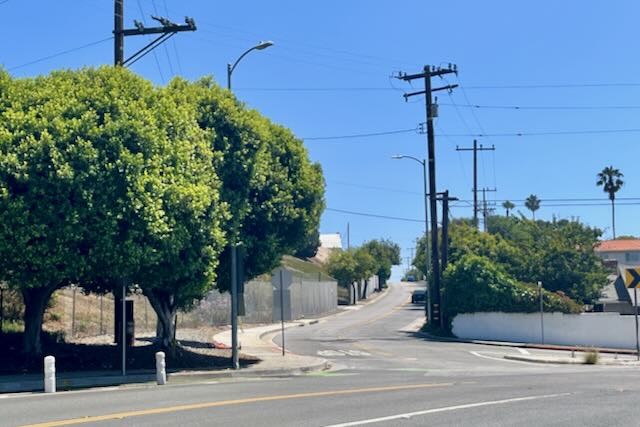
On the west, the airport site is only reachable up a steep incline on a two-lane road, Airport Avenue, that rises up from the scariest intersection in Santa Monica, the one where 23rd Street becomes Walgrove Avenue in L.A. The roads cannot be widened there without extraordinary measures.

Looking up Airport Avenue from where 23rd Street becomes Walgrove Avenue.

The Staff Report says that if the City moved forward with Scenario 3, “circulation systems for pedestrian, vehicular, and park connectivity [would be] fully restructured.”

What does this mean? In true modernist tradition, do the planners want to build an overpass to connect Airport Avenue to Dewey Street and then turn Dewey into a four lane road to connect the airport site to Lincoln Boulevard? (Something like this happened before in Santa Monica, when the Ocean Park neighborhood was ripped in half by a widened Ocean Park Boulevard, including an overpass at 4th Street, to connect Lincoln to the urban renewal project that was supposed to result in a Miami Beach West.) I know this sounds ridiculous, but the whole plan is ridiculous.

Okay, you are saying, but the park will have these access issues, too. But park traffic will not only be less, but also concentrated in off-peak hours. Housing isolated from transit is going to produce traffic just like all other commuting traffic.

Neither Scenario 2 or 3 could ever work for other reasons, too, some of which are even mentioned in the staff report. For instance, how is market-rate housing going to fund the park if it also has to subsidize affordable housing and build the infrastructure that the airport doesn’t have?

And then there is this bombshell admission in the Staff Report, buried at the end of analysis of Scenario 3: “The scenario raises questions about long-term park identity and whether it remains a civic anchor or becomes a central green within a privatized development pattern.” (Emphasis added.) Honestly, I read this sentence and my stomach turned. How could such a “scenario” make its way into a report on building a park in Santa Monica?

I hope that City Council takes charge of this project and tells the planners to stop wasting time and money on visionary, top-down “big plans” that make no sense. Yes, City Council asked for a plan that was financially feasible. But the easiest way to plan a financially feasible park is to start with a modest plan. (See my previous column for recent examples where cities did that.) The problem is that planners don’t go to planning school to learn how to make little plans that evolve over time.

I also object to conclusory language from the planners that a park cannot be financed, because “the City has not yet identified sufficient financing.” Of course it hasn’t yet identified sufficient financing: it hasn’t yet started to look for it. And it can’t start looking for financing until it has a plan that will not cost immense sums for infrastructure and be dependent on a political campaign to get voter approval. Meanwhile the planners act as if their very shaky ideas for financing new neighborhoods are real, notwithstanding that they identify legal problems from Measure LC to the Surplus Land Act and financial problems like infrastructure costs.

As stated in the staff report, “the key question before City Council is whether the Preferred Scenario should include any uses that could or would require future voter approval, pursuant to Measure LC.” The answer should be an emphatic no. If plans for the park depend in any way on a public vote, then there will be no real plan for the park coming out of this (expensive) process. Everything will be contingent and dependent on politics.

Having said that, I don’t believe it would be a mistake to study housing as an alternative in the EIR, or in a separate economic or transportation analysis, so long as it can be done conceptually. I’m sure that there are folks out there who disagree with my analysis above about why the airport site is not a good one for development; I’m open to seeing what experts say. But not if it would mean spending significant time or energy, including public involvement, this fall on developing a hypothetical housing plan.

However, if housing is to be studied, the Staff Report contemplates “additional outreach related to height, type, unit mix, etc.” that would be “illustrated through a comprehensive set of materials, including site diagrams, cross-sections, 3D model views, precedent imagery, and perspective renderings, to clearly convey design feature and technical considerations.”

Please, no! No!

The City Council must not let Sasaki spend time and money developing plans for a modernist/New Urbanist fantasy neighborhood. If that happens, planning for the housing alternative will dominate the public outreach process this fall, alienating the public from the park planning process. Never has Santa Monica ever developed “specific plans” like this on the fly, as adjuncts to another planning process. Specific plans always come after general plans.

If there is going to be a housing alternative in the EIR, base it conceptually on some number of units located at some place on the map. See what comes up.

Thanks for reading.  

Converting Santa Monica Airport into a park: time to talk about time

In case you have lost the thread of these posts, let me reiterate that there are three factors that will affect the planning and construction of the park that will replace Santa Monica Airport: land, money, and time. In the previous two posts I’ve discussed the first two, now it is time’s turn.

For building the park, there needs to be both a short-term calendar and a long-term calendar. That is another way of saying that there can be an ultimate goal, but there also needs to be a way to get to it. You know: a journey of a thousand miles starts with a small step.

The planning process so far has focused on a long-term calendar. (I say “so far,” because as I said in a prior post, I have heard from Sasaki and from city staff that they will be presenting a phasing schedule to City Council.) The planners have asked the public for wish lists of what they would want to see in a park. Specific limitations, such as cost figures or budgets, haven’t been placed on these wishes, although in general terms survey participants have been asked to “balance” costs and revenues.

From these wishes the planners, Sasaki and staff, have developed three scenarios. These scenarios present final, if hypothetical, visions of what the park would look like. Because City Council instructed the planners to make the park revenue neutral, the scenarios, particularly the more ambitious two of the three, include a lot of undefined “revenue generating” uses.

The second of the three scenarios. Note that it includes 35 enumerated uses, not including extensive but largely undefined revenue-generating “development zones” (in beige). Nearly all of these uses would require extensive planning processes of their own before they would need to be put to the voters for approval.

These revenue-generating uses distort the planning process, because, as I’ve discussed previously, they are hardly certain. Not only do we not know how much money they would generate, but also nearly all of them, and all of those that might produce the most revenue, would require a public vote to amend Measure LC. This would require extensive planning processes for these uses before they could go to a vote. We think we are planning a park, but in fact we are planning a hypothesis.

Nonetheless, it is from the wish lists embodied in the scenarios that City Council will, at its meeting July 8, choose the elements to include in the “project” for purposes of environmental review. The plan is that with further public outreach this fall, Sasaki and staff will develop a project that the council will approve in December for the EIR, along with alternatives as required by the California Environmental Quality Act (CEQA).

This is where the timeframe becomes a factor. The council will face the question whether the environmental review should focus on a long-term aspirational project, or a more pragmatic shorter term project.

There are several reasons to focus on the shorter term.

Primarily we need a shorter-term project because the public needs to have faith that when the airport closes there will be a genuine path towards the park. Specifically, in Santa Monica, many extensive public processes have resulted in nothing. More generally, people have lost considerable faith in the ability of government to get good things done.

A side but not insignificant benefit on making the project more short-term is that the less that needs to be considered in the EIR, the less it will cost. If we study highly aspirational features now, or undefined uses that require a public vote to be approved, we may be spending money to study features that will never be built, or might be built long in the future. There is no legal difficulty amending the EIR in the future, or doing a specific EIR, to add a feature once it is planned and/or as funding for it might become available.

What might the short-term calendar for park development look like? As I wrote in my posts on land and money, first we should look at the easiest land to convert into a park, namely the runway, and at the money that will be available from local sources, such as airport leasing revenues, park user fees, and, possibly, water and other environmental funds. Some revenue sources, such as a café, can be included because they are consistent with parks and can be consistent with Measure LC if zoning is amended.

Then we should be thrifty, and plan a “starter park” that we can build with available funds.

There is a lot that can be done “on the cheap.”

San Francisco this spring created and opened a 50-acre park, called Sunset Dunes, by closing a highway that ran up the western edge of the city, along the Pacific. Closing the highway was controversial, but was approved by almost 55% of voters.  Notably, San Francisco opened the park before starting its long-term planning process; the city’s parks department, working with a budget of about $1 million, and helped by volunteers, built basic amenities. According to the New York Times (this article might be behind a paywall), in the first month more than 150,000 people visited the park.

Directly relevant to converting our airport into a park, the National Park Service converted Crissy Field, a former military airport, in San Francisco into an approximately 100-acre urban park in the 1990s. The cost then was about $40 million, more than half of which came from philanthropic sources. The City of Chicago converted its local airport, Meigs Field, into Northerly Island Park, also for a reasonable price.

There is a role for big plans, but let’s not allow long-term perfection to stymie shorter-term good. A park with portable toilets before the plumbing goes in is better than no park.

Thanks for reading.

The second factor in building a great park at Santa Monica Airport: money

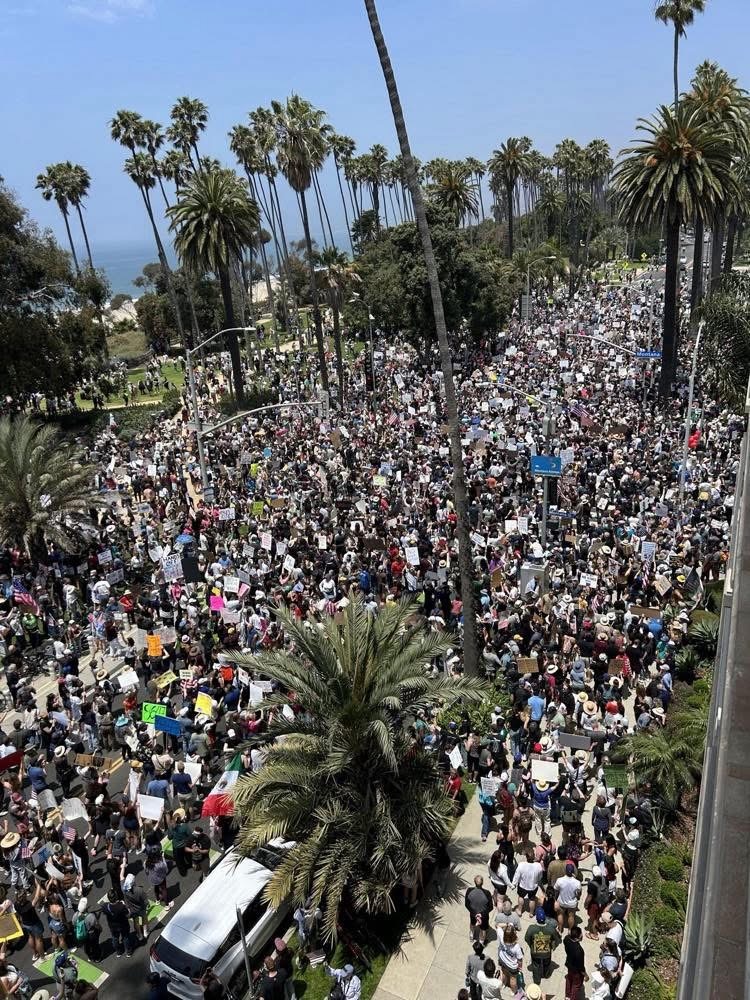
I suspect that many you reading this joined the 5,000 demonstrators who jammed Palisades Park on Saturday for the “No Kings” rally. Leaving aside the bigger issues like whether a nation conceived in liberty and dedicated to the proposition that all men are created equal can long endure, the rally sure showed the importance of parks and other public spaces.

The crowd Saturday in Palisades Park. Imagine great public events on a great lawn at the new park.

As I wrote last week, the de-privatization of Santa Monica Airport into that paradigm of a public space, a great park, will depend on three factors: land, money, and time. I wrote about land in my last post. Now, money.  

First, context. Courtesy of a parks bond 99 years ago, Santa Monica owns the land at the airport. In any developed urban environment, land is the most expensive element of a park. Done.

The City also owns the buildings on the airport, from which it has, since regaining control of the buildings in 2015, earned tens of millions of dollars from leases to non-aviation businesses. This income will continue once the airport closes.

Widening the context, this is a wealthy subregion of southern California. The Westside of L.A., including Santa Monica, is the second largest jobs center in the region. Property values, both commercial and residential, are among the highest in the state. The rate of millionaires per square mile is high.

Widening the context further, parks are good economic investments. Many studies show how parks increase property values and attract investments, and thus increase tax revenues. They improve public health, lessening healthcare costs, They provide services, such as for recreation and environmental mitigation, that have economic values. For tourism centers like Santa Monica, they attract visitors.

I bring up these contexts, local and general, to say that if you are worried about whether there will be enough money to build a park on land we already own in one of the richest areas on the planet, take a deep breath. The idea that there will not be enough money to build a park at the airport is simply fear talking. Have we lost the ability to have a positive vision for the future?

The positive context doesn’t mean, however, that money doesn’t need to be found. It is additional good news, though, that we have more than three years before the airport closes. Time to work on financing. Time, however, also adds uncertainty. The further we look into the future, the more speculative the financing picture becomes.

It is important to focus on realistic sources of funding in the relatively short-term, five to ten years after the airport closes on Jan. 1, 2029. What shouldn’t happen is that anxiety about money causes the City to make decisions (or deals) that compromise the vision of a great park. A vision that may be realized over decades.

I will try here to be as realistic as possible, but with one caveat: the City’s park planners have not yet released an economic analysis that is part of the planning program, or figures about the cost of building specific park features. The City has engaged HR&A Advisors, the City’s go-to firm for financial analysis, to prepare a study. Once the study is released, I may want to update what I am writing now with more detail.

Let’s start with what we know: the revenues that the City earns from leasing buildings to non-aviation businesses. At present, these gross revenues are about $15 million, of which about half goes to operating expenses, leaving about $7 million of surplus. These revenues only become available to the City if the airport closes; otherwise, under FAA rules, the money can only be spent at the airport.

These lease revenues will be available to maintain and operate the park, but the City can also issue bonds against them to pay capital costs. For instance, $80 million borrowed at 4 percent for 30 years would be amortized at about $5 million per year. (Caveat: we don’t know what interest rates will be four years from now.)

There are also means to generate operating funds for the park that are consistent with park purposes. These include user fees for facilities, such as sports fields and other recreational facilities, and income from concessions, such as cafés, that City Council can permit under Measure LC with a zoning overlay for the park. These revenue sources can be predicted and planned for now; staff to its credit has solicited “letters of interest” from organizations that can use the park. (And right now: please, let’s reopen a restaurant where Typhoon was!)

There are other governmental sources that can be considered at this early stage, depending on planned uses. For instance, water features have always scored high on public surveys about what to include in the park: there could be water bond or other infrastructure money available depending on whether water features at the park can serve water conservation purposes.

Philanthropy has traditionally played a major role in the funding of parks, and there are many wealthy people who live in Santa Monica and nearby. Philanthropy enabled Santa Monica to build the Annenberg Beach House, and philanthropy endowed the Broad Stage. In the long run I suspect philanthropy will pay for significant features at the park, but unless a major benefactor comes forward now (such as what happened with Banning Ranch in Orange County), we won’t be able to predict what philanthropy might pay for until we have specific projects to be funded.

Another source to be considered, but it’s too early for any action, would be a parks bond. Santa Monica voters have been generous with bond funding for infrastructure, and funding specific projects could be quite popular, but as long as municipal infrastructure bonds need a 2/3 vote to pass, bond funding is problematic.

Finances since Covid have been tight for Santa Monica. We don’t know if the important international tourism sector of our economy will rebound soon. High interest rates are stifling development. Santa Monica has been described as “broke,” and the budget makers are looking for savings everywhere.

However, we should remember that before the pandemic, Santa Monica had one of the strongest economies in the country, with high per capita tax revenues and a triple-A bond rating. The City may be running a deficit, but the City has paid out hundreds of millions of dollars to settle Eric Uller abuse cases. If Uller had been stopped decades ago, that money by itself could pay for a big park.

My next post will look at the third factor in building the park, time.

Thanks for reading.

Building a great park takes three things: land, money and time

The two posts I wrote last week about building a great park to replace Santa Monica Airport were gloomy, focusing as they did on problems with the planning process. Such issues, though, should not diminish the joy we should be experiencing now. (Joy about converting SMO into a park; there’s a lot of pain going around about everything else, and I urge my fellow Santa Monicans to attend the No Kings rally here (or one elsewhere) on Saturday.)

We Santa Monicans have within our power the possibility of building a large and wonderful park, one that’s big enough to both nurture nature and furnish wide opportunities for recreation and community, in the middle of the “Plains of Id” (to borrow Reyner Banham’s moniker for the urban L.A. flats from his classic book, Los Angeles: An Architecture of Four Ecologies).

The L.A. flats, including Santa Monica, have few parks because under the Spanish/Mexican land grant system little land was publicly owned. Then, after Yankees arrived and married into the landowning families, the ranchos were subdivided into towns and other settlements. As a result, public spaces are few and far between.

We owe a great debt to the residents of Santa Monica who, 99 years ago, voted to tax themselves to buy land for a park, land that is now conservatively valued at $2 billion and which at that price could never be obtained for public use again. When the airport closes at the end of 2028, this land will be returned to the public after being privatized for 80 years.

We can build a great park, but we need to be smart about it. Above all, we need to keep the public confident that we will succeed. To do that, we need to manage both resources and expectations.

There are three factors that will determine how we will build the park: land, money, and time. The three need to be coordinated, but for now I’ll treat them one-by-one.

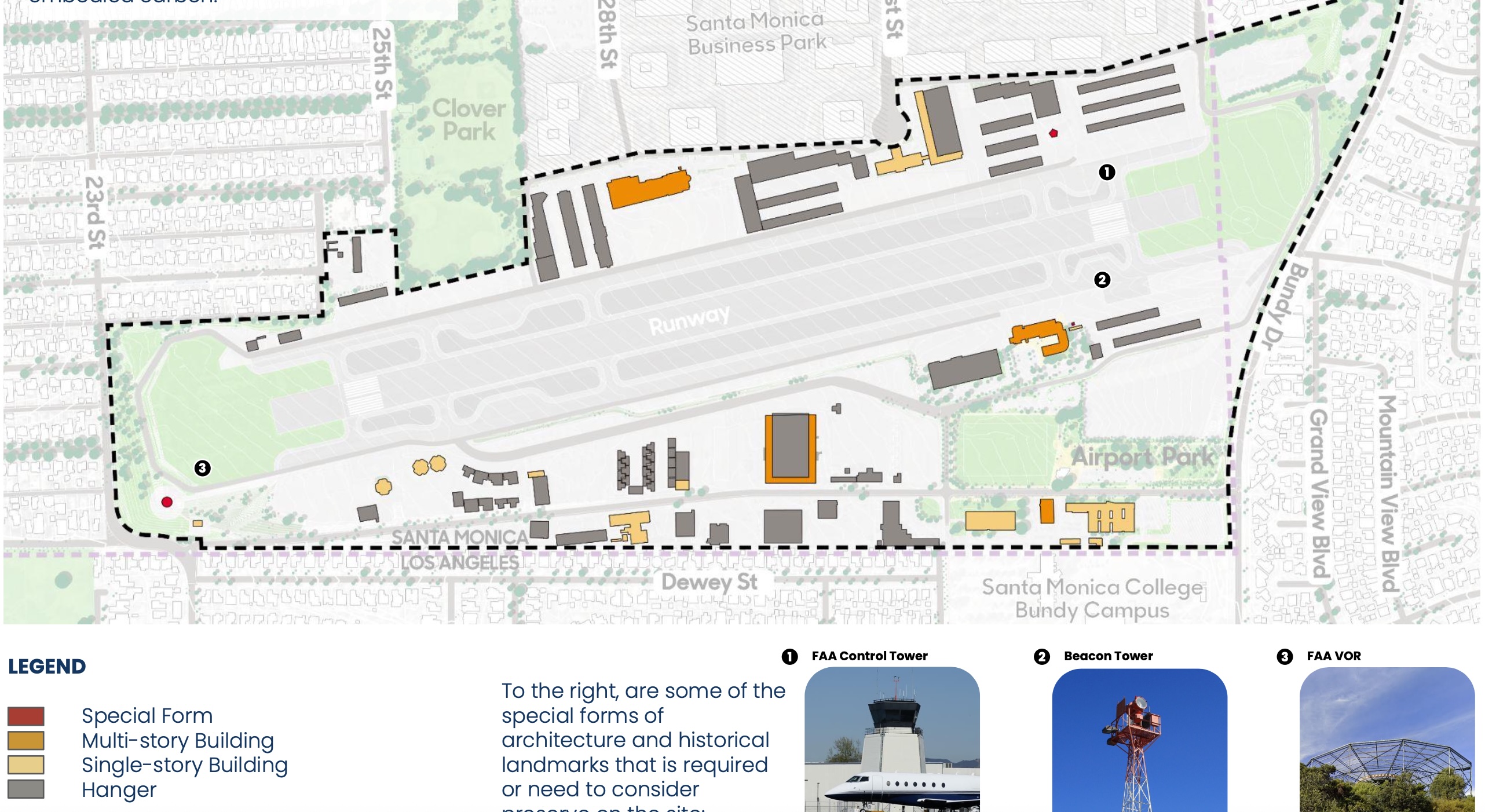
Land. Here’s a map of the site from the Site Inventory prepared for the current planning process.

The 192 acres of the airport site are within the dotted lines. The gray area of the runway, the white open areas near the runway, which are mostly tie-down areas, and the green areas at the end of the runway, are the areas on which this post focuses.

If you are going to build a park on this site, and you don’t have an unlimited budget, the logical place to start is the runway, along with the tie-down areas where planes are parked. Why? Because these areas are big and flat and empty, and easily connected to the existing Clover and Airport Parks.

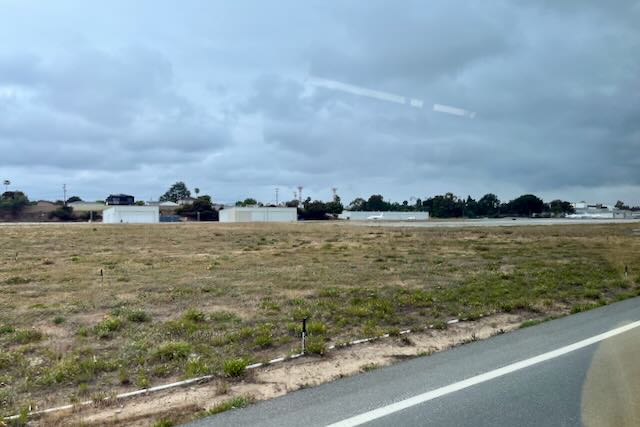
Tie-down area adjacent to runway.

Once any environmental issues have been evaluated and remediated, the runway and tie-down areas will be the easiest and least expensive parts of the site to develop. Already at each end of the runway 750 feet of tarmac have been removed.

Part of the 1500 feet of the runway where tarmac was removed after the 2017 settlement with the FAA.

It seems obvious (to me at least) that the starting place for planning the park should be the runway. However, the three scenarios produced by the planning process all show fully-developed parks on the whole site. No plan like those in the three scenarios will be built all at once, or even in the near future after airport closure in 2029. The problem with dreaming about the whole park is that trying to imagine how all of the park amenities would be paid for is driving the planning process, turning much of the site into “revenue-generating” uses.

The process should start the other way around, with what might be possible to build in stages. The planning should start with the easiest land to build on.

A lot of park amenities can be built on flat land, and for not a lot of money. Sports fields, for instance. They don’t need to be fancy, with artificial turf (which has its own environmental issues). If there are enough fields (in combination with those at the existing parks), the use of them can be staggered so that grass will have a chance to recover between seasons of use. Grass fields, as opposed to artificial turf, don’t need to be fenced off, and can be used casually, like for picnics and running around, when not being used for games. Temporary irrigation systems can be used until permanent irrigation can be installed.

Open meadows, and hiking and biking paths and trails can also be built inexpensively on flat land. Think about a bike path, which might even accommodate shuttle buses, that could use a strip of existing tarmac to connect the Santa Monica College Bundy campus and Airport Avenue with Ocean Park Boulevard.

And let’s not forget the (inexpensive) park amenity that might be what Santa Monica’s apartment-dwellers need most: picnic tables.

Trees can be planted to provide shade.

To save money upfront, we can use portable toilets before we install the plumbing for permanent facilities, and we can invite in food trucks and pop-ups before we build cafés. (Cafés can be permitted under Measure LC if City Council amends the City’s zoning on parks. Meanwhile, let’s return a restaurant to where Typhoon was.)

While we are building a park on the runway and tie-down areas with re-wilded open spaces and meadows, sports fields, hiking and bike paths, picnic tables, and the like, we can start planning more ambitious amenities for the rest of the land, or for the next iteration of the runway land.

And we can use that time to line up the money for doing so.

Oh, yes, time and money. I’ll get to them in upcoming posts.

Thanks for reading.

Planning a park at Santa Monica Airport: keep it real

As I discussed in my post on Monday, the process for planning the conversion of Santa Monica Airport into a park has produced three aspirational “scenarios.” While no one would expect or desire that Sasaki, the park designers hired by the City, would have by now a definitive plan, so far the process has not generated plans that would likely be built in the five, or 10, or even 15 or 20 years, after the airport closes Jan. 1, 2029.

The upshot of these “big plans” is the inclusion of extensive “revenue-generating” uses in two of the three “scenarios.” These uses would require a vote to amend Measure LC, although the City Council could use zoning amendments to make some revenue-generating uses, those that are are consistent with parks, LC-compliant.

Other suggested uses could not be made compliant by the council. They include (in one or both of the non-LC compliant scenarios) housing or commercial development, a hotel, and/or a Hollywood Bowl-sized amphitheater. These uses are themselves highly contingent because they also would need to be planned, through a public process, and then approved by voters, and then, of course, financed.

So at a time when City Council needs to focus on reality, we have speculation (aspirational designs) piled on speculation (hypothetical revenue generators).

Meanwhile, adding to the speculation is that the airport won’t close for more than three and half years. We don’t know what the City’s budget will look like then, we don’t know what interest rates will be, we don’t know what regional, state or federal grants might be available, and we don’t know – well, I could go on.

Perhaps I should have more faith (and patience). Based on a conversation I had with a Sasaki designer at the City’s May 17 event where the three scenarios were unveiled, and on remarks Amber Richane, from the City’s Public Works Department, recently made to the Santa Monica Democratic Club, it appears that Sasaki and staff will be generating a “phasing” plan for park development. This will, apparently, include a “Phase Zero” for the first five years or so. Phase Zero would include environmental remediation, if necessary, and park development that can be paid for from leasing revenues from the airport (which are considerable). (Ms. Richane also said there could be money for water projects from a different fund.)

Let’s hope this phasing plan will be released before the City Council meeting July 8. Then the council will pick and choose what elements will go into the plan that will be subject to environmental review. This council needs to focus on what can be done when the airport closes, not what might happen long after they have termed out. The preferred alternative for the EIR must be LC-compliant.

In the meantime, let’s consider revenue generation. Specifically the idea that housing development can help pay for the park. As supporter of housing development I have always been skeptical when I hear people assume that housing development can pay for anything other than its own development. Why? Maybe it’s because over the past 30 years the two most prolific for-profit housing developers in Santa Monica, Craig Jones and Neil Shekhter, both ended up in some form of insolvency. As for affordable housing, it requires its own subsidies.

Development is a tough business.

But then, historically nearly all housing development, especially since World War II, has required subsidies. Do you think that suburban developers would have made so much money without the highways, sewers, water systems, and other infrastructure government built, or the home loans government insured?

There is a lot of anxiety going around, much of it propagated by pro-airport people, but some of it coming from pro-housers, about how Santa Monica can’t afford to build a park, even though it already owns the land, the most expensive element of park-building. No one, however, seems to talk about how difficult and expensive it would be to build housing at the airport.

Consider the infrastructure costs. To give Sasaki and staff credit, in their scenarios they located all of the revenue generating uses on land at the airport that is already to some extent developed, but do we expect that those areas with their crumbling hangars and other sheds and shacks have the water and sewer and power infrastructure to support extensive housing?

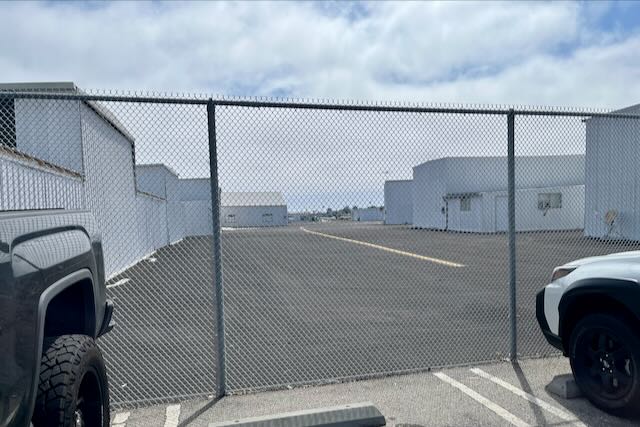
Sheds at the airport.

Consider that there’s no connection with transit corridors except on the northern and eastern edges (and not good connections there, either). On the southern parts of the airport, where the scenarios locate a lot of development, for vehicular access there is only Airport Avenue, with, on the western end, its woeful intersection with 23rd Street, Dewey Steet, and Walgrove Avenue. So who pays for the transportation infrastructure? (Yes, the park will also need more access, but not on the level of thousands of units of housing.)

To use a phrase I’ll borrow from an email sent to me by a pro-housing, urbanist friend, putting affordable housing at the airport would be to put low-income people “away from the public transit backbone of Santa Monica.”

One reason real estate development is a dicey business is that it’s hard to predict interest rates over the lengthy periods of time it takes to get permits and to construct housing. At the moment there is a pile of approved housing developments in Santa Monica that are stalled because of current high rates. We don’t know what interest rates will be when it comes time to “generate revenue” for the park.

The proponents of housing at the airport say that state housing element law will require the City to use airport land for housing under the next Housing Element cycle. This is false, as the City will be able to satisfy future state housing requirements elsewhere (as shown in the 2010 Land Use and Circulation Elements of the General Plan).

Meanwhile the housers fail to take into account the impact of the Surplus Land Act (SLA) on financing housing.

Under the SLA the City cannot dispose of the airport land, which includes selling it or leasing it for more than 15 years, without, and I admit I’m simplifying here (the law is complex), offering the land to affordable housing developers, who then would have the right to negotiate with the City for a reasonable price to acquire the land. The sounds good for affordable housing developers, but at what price? What’s reasonable? Realistically, affordable housing developers would need to get the land for free.

Consider for-profit developers. What developer can get financing if the developer only has control over the property for 15 years? If the financing needs more than 15 years of control, then the developer is thrown into the unknown of the City having to negotiate with affordable housing providers. In any case, it’s a long and complicated process. Housing development would not be a quick way of generating revenue.

I get it that pro-housers couldn’t care less if housing would subsidize the park. As I said, as a long-time houser, I’m always skeptical of putting more burdens on housing development. But what the City Council asked the planners for was development that would subsidize the park, and it’s on that basis that the planners’ scenarios should be evaluated. Independent of that, because of the infrastructure issues, housing development on the airport land would be significantly more costly than development elsewhere in the city.

Next week I’ll venture into some speculation of my own – on how the City could start building the park in 2029.

Thanks for reading.

Turning Santa Monica Airport into a park: let’s not bite off more than we can chew

Santa Monica Airport is set to close December 31, 2028, and the City’s process to reclaim the city-owned land at the airport and convert it to public use as a great park, the “Santa Monica Airport Conversion Project“, is underway. Sasaki, the consultants hired by the City at the end of 2023, and staff in the Public Works Department have stuck to the schedule originally agreed on. In January City Council adopted “Guiding Principles” and directed Sasaki and staff to come back to council this summer with three different scenarios for the future or the site. From these the council will pick and choose elements to be included in a plan that would by the end of the year be ready for environmental review. (The council’s meeting to do this is scheduled for July 8.)

Over the course of the process, as is de rigueur, Sasaki and staff have conducted considerable public outreach. As is typical the process has made few happy.

In case your memory needs refreshing, the City has been trying to close the airport since the early 80s, when the Federal Aviation Administration (FAA) required the airport to service jets. Under a 1984 agreement, the City gained the right to close the airport in 2015, but at some point after 2000 the FAA disputed the City’s right to do so. Litigation ensued. The aviation industry, fearing the City would win in court, collected signatures to put a measure on the 2014 ballot (“Measure D”) that would have perpetuated the airport by taking away the City Council’s power to close it. The City responded with a counter-measure, Measure LC (“LC,” for “local control”), which provided that once the airport closed, the land could only be developed for parks and recreational purposes, unless other development is approved by a vote of the people.

In the election, Meas. LC defeated Meas. D by a 60-40 margin. Three years later, the City entered into a new agreement with the FAA that definitively gave the City the power to close the airport at the end of 2028.

Disclosures: I am on the board of the Santa Monica Airport2Park Foundation (A2P), which was formed after the election by the committee that ran the campaign in support of LC and against D. We formed A2P to keep the vision of a park alive until the City could close the airport. I am also on the board of the Santa Monica Great Park Coalition (GPC), which was formed last fall. The GPC is a grouping mostly of organizations whose members want to use the park (such as sports organizations) or who believe the park is important for environmental or other social reasons. Our more than 60 organizations represent more than 20,000 members.

Getting back to planning the park, the extensive public process has made few happy. Which is unfortunate, but not unusual. To understand the reactions to the process, you need to know that the politics of the conversion process in Santa Monica have involved, at least so far, not much about the decision to close the airport, but instead whether any of the reclaimed public land should be used for housing.

At first pro-park people, like us in A2P and the GPC, were pleased because the process, in the form of surveys and a well-attended workshop in December, showed tremendous enthusiasm for the park. It was exciting and inspirational to see all the ideas for how these 192 acres, which have been privatized for so many years, could be returned to parkland. (In case you don’t know, the City originally purchased the land in 1926 with a parks bond, and the land was a park until the federal government took it over before World War II so that Douglas Aircraft could build planes there.)

Participants at the Dec. 8, 2024 workshop. And estimated 800 people attended, the largest turnout for a Santa Monica planning event in anyone’s memory.

The public process did not show widespread support for building housing on the land, and this result did not please housing proponents. They claimed that the surveys were biased against housing, in part because the surveys identified housing, along with other possible uses of the land, as requiring voter approval under LC. (As an aside, but an important one: many people oppose any effort to amend LC before airport closure, because of the well-grounded fear that in response the aviation industry would come back with a new Meas. D, and because a vote to amend LC now would effectively freeze the planning process for the park. For those reasons it made sense for the planners to identify in the surveys uses that would require a vote.)

Then recently at a Planning Commission meeting, the pro-housing complaints about the process were expanded when UNITE Here, the union representing hotel workers, most of whom are Latino and many of whom have limited English, had been excluded from the process because of inadequate outreach in Spanish and for other technical reasons. UNITE Here is a supporter of the most prominent proposal so far for building housing on the land, called “Cloverfield Commons,” which calls for using half the land to build 3,000 units of affordable housing.

No process is perfect, of course, but this reaction from the pro-housers was not unusual: people who don’t like the results of a process challenge the process. But recently we on the pro-park side have had our own complaints about the process, namely that Sasaki and staff were ignoring the results of their public outreach.

On May 17 Sasaki and staff, at a big event at the airport, released the three scenarios they had prepared in response to council’s direction back in January. Two of the three included considerable amounts of housing. This stunned the pro-park side, who felt blind-sided.  

Why? At the meeting in January City Council had directed that one of the three scenarios be compliant with Measure LC. They directed that another of the three would be non-compliant by using development – specifically,  to include “some housing” – to support the park financially. The third scenario was left somewhat vague: no one on council or staff said it should include housing, but it was understood that it would not be fully compliant with LC either. That’s because there is a gray area concerning compliance with LC. There are uses that are consistent with what a park is, such as a café or an amphitheater, but which are not currently included in the definition of “park” under the City’s zoning. City Council, however, can amend those ordinances to include other uses consistent with parks, which would then make those uses compliant with LC.

So when two of the three scenarios included lots of housing, not just “some housing” as City Council had asked for, that was a big win for the housers notwithstanding their feelings about the process. It’s natural, however, that we on the park side wonder if our input, and the overall enthusiasm for the park, had been listened to.

So how did this happen?

From the beginning of the process City Council has said that plans for the park should be financially feasible. This is a good thing, and one that we pro-parkers advocated for when the planning process was being started. We don’t want the public to be discouraged by a beautiful, but pie-in-the sky plan that can’t be built because it costs too much.

But that’s not how these processes work. Consultants ask the public what they want, and the public responds by asking for a lot. Designers like to design beautiful things (“make no little plans” as Daniel Burnham (in)famously said), and you can guess what happens.

The result of the direction from the council for financial feasibility was not a starter park that could be built when the airport closes and then expanded over the following years, but two highly aspirational scenarios. The “financial feasibility” solution, if they were going to be built quickly, without waiting for other sources of funds, was to include considerable amounts of on-site “revenue generation.” (While these revenue-generating areas on the maps showing the scenarios were not specifically designated as housing, no one would expect that they would be offices or something else.)

This controversy is unnecessary. The problem with this process, at least as described to the public so far, is that everything is focused on what a completed park would look like, so that the costs of building that park, and the financing that would be available, need to be computed and accounted for now. But the airport is not going to close until December 31, 2028 – more than three and a half years from now – and nothing on the scale shown in the scenarios is likely to be under construction soon after closing.

Not only that, but the idea that housing could pay for the park doesn’t make sense.

I’ll continue this discussion with upcoming posts.

Thanks for reading, and please stay tuned.

At the May 17 event, bus tours were given of the usually off-limits runway area. This photo shows some of the land “liberated” when the City was able to shorten the runway after the 2017 agreement with the FAA. It shows just a small part of the potential for the park.

Turns out my feelings were not determinative

My feelings were sure wrong when I wrote on Election Day that they were telling me the election would go like 2012, not 2016. Just when polls were saying that the late breaking vote was going Kamala Harris’ way, a tsunami of Trump Election Day voters swamped her and other Democrats. Still, I’m glad I posted what posted, so that I can remind myself how out of touch my feelings can be.

On that note of self-doubt, I should refrain from saying anything about the debacle. So much is being written about it, even as those who are doing the writing often do so while advising everyone else to take a breath and wait to figure out what happened and what to do. There is, however, a fact I saw in a column by the astute L.A. Times political reporter Mark Z. Baraback that stands out: between 1960 and 1998, 38 years and 19 national elections, there were only seven votes that changed party control of the White House, the Senate or the House. In the 13 elections since 2000, however, there have been ten changes of control.

People are unhappy and have been so a while. When people are unhappy they do counter-productive things. Things, like, well, voting for Donald Trump. That’s why John Maynard Keynes developed a new economic theory in the 1930s—because he saw how chaos and economic distress caused people to turn to fascism and give up on established norms. Mind, I am not calling anyone, least of all any Trump voter, a fascist. But unhappy people want change, and no one promises more change than Donald Trump. Note that the two most successful politicians of the past 20 years, Trump and Barack Obama, both ran on hope and change.

Why are people unhappy? Why do they feel so insecure, so threatened and vulnerable? It’s paradoxical, because the world has never been more productive when it comes to material goods. We should all be swimming in prosperity—not coincidentally, precisely what Trump promises.

Again, why? Politicians and political analysts will look for reasons for the unhappiness, and, more specifically, for why so many Americans turned to Trump; reasons that will, no surprise, fit their varying perspectives. However, from the broadest view possible I suggest that the problem can be summed up with the title of a 2018 book I heartily recommend by Robert Kuttner: Can Democracy Survive Global Capitalism?

• • •

The local election here in Santa Monica was quite different. Here liberals won, defeating a local fear-based campaign that reflected the Trumpian zeitgeist. (I wrote about this a few weeks ago.)

So, congratulations to the United Slate of Dan Hall, Ellis Raskin, Barry Snell, and Natalya Zernitskaya. They will join Caroline Torosis and Jesse Zwick to form an unprecedented, six-out-seven liberal and pro-housing and social services majority on the City Council. At the same time, a parking tax and a big school bond also passed easily.

I am not surprised. In the election two years ago Santa Monica voters returned to their liberal traditions, but in that election four liberal candidates for three seats split the vote and only two of them, Torosis and Zwick, were victorious. That split delayed a new liberal majority on the council. Until now. This time Raskin and Zernitskaya ran together in a slate of four candidates for four seats. They all won.

Personally, these last two local elections have been gratifying. Not only do we have a new generation of leaders in Santa Monica, young leaders who will make us proud, but also the liberalism shared by nearly all Santa Monicans will no longer be distorted on the council by otherwise liberal council members spouting illiberal and specious excuses for why we should not provide housing for the current generation of young people and generations to come.

For me it’s been 30 years since I was appointed to the Housing Commission and started agitating for more housing, often to be vilified as “in the pocket of developers.” When I saw the vote totals Tuesday night, showing the United Slate well ahead, it felt good, a little bit of starlight in a dark night.

And with that Trumpian note of personal grievance combined with self-satisfaction, all I have left to say is:

Thanks for reading.

Today feels to me more like 2012 than 2016

I’m not making predictions, but I am going to chronicle my feeling on this Election Day that could be either momentous or monstrous.

Today feels to me more like 2012 than 2016.

I had to be reminded by a friend that the 2012 election was considered close. In the end President Barack Obama won reelection decisively, winning the popular vote by a margin of 51-47 and winning 332 electoral votes. Until the results came in, however, the election was considered too close to call. So much so that Mitt Romney had not prepared a concession speech, and had to put something together when Colorado and Nevada were called for Obama late election night.

Perhaps not coincidentally, the last Marist/NPR poll that came out yesterday has Kamala Harris winning the popular vote 51-47. That’s also the same as the spread in the 2020 election.

As we all know, winning the popular vote by three or four points does not guarantee victory in the Electoral College. As I said, I am not making predictions and I am as nervous as any other Democrat (or Republican who cares about democracy), but it does seem that this time, as opposed to 2016, the Democratic campaign understands the importance of PA, MI and WI. That’s another reason I feel more like this is 2012, when Obama won eight of the then nine swing states, and not 2016.

The 2012 election followed the first term of a Democratic President, just as this year’s election does. Both of those Democratic presidents had won election in the wake of a national crisis (respectively, the Great Recession and Covid) and were dealing with electorates that had reasons leftover from those crises not to be happy. Obama and Joe Biden both lost control of the House of Representatives for the second half of their terms, which limited how much they could accomplish. Republican control of the House caused all sorts of chaos both then and now. Chaos does not help incumbents or their parties, but when all the votes were counted, in 2012 the voters preferred what they had to the alternative. (The alternatives, Mitt Romney in 2012 and Trump today, couldn’t have been more different.)

Looking at the enthusiasm of the Harris rallies versus the desperation of Trump’s final rallies, my feeling is that voters this year will make the same decision. In 2016 it was Trump who finished with wildly enthusiastic crowds. Now he can’t fill small arenas.

Anyway, this post doesn’t do anything other than memorialize how this one blogger feels at this moment.

Thanks for indulging me, and I assume you have voted already! If not, get to the polls.

SB10: not so scary

It is hard to break bad habits. One habit that is hard to break in Santa Monica is fearmongering about development.

The latest instance comes from supporters of the “Safer Santa Monica” slate. As reported in the Lookout, a “small army of volunteers from the Northeast and Sunset Park neighborhoods has been busy blanketing their single family areas with an urgent message,” namely that if the candidates backed by Santa Monicans for Renters Rights (SMRR) are elected, they “would implement SB10, a State law that allows as many as 14 units to be built on a single family lot.”

SB10 was passed by the legislature and signed by the governor in 2021. I’ll wager that few laws have been more misunderstood than SB10. SB10 is a rather limited housing law that people opposed to housing development use to frighten people like a storyteller uses a ghost story to frighten children at Halloween.

SB10 does not mandate anything. It gives local governments the authority to override voter approved limits on development, and permit up to 10 units (yes, theoretically this number could be increased if ADU’s are included) on a parcel, but only if certain restrictions are satisfied. Here is the operative language, but you can read the whole statute here:

“Notwithstanding any local restrictions on adopting zoning ordinances enacted by the jurisdiction that limit the legislative body’s ability to adopt zoning ordinances, including … restrictions enacted by local initiative, a local government may adopt an ordinance to zone a parcel for up to 10 units of residential density per parcel, at a height specified by the local government in the ordinance, if the parcel is located in [a transit-rich area or an urban infill site].”

Note that SB10 doesn’t require local governments to do anything. It does expand the power of local governments to upzone, but only in cities or counties subject to “restrictions on adopting zoning ordinances.” SB10 did not expand the power of the Santa Monica City Council because Santa Monica does not have any such restrictions. The only zoning restriction relevant to housing enacted in Santa Monica is Measure LC. LC limits development of airport land (when the airport closes) to park and recreational purposes, but SB10 explicitly excludes from its scope “[a]ny local restriction enacted or approved by a local initiative that designates publicly owned land as open-space land … or for park or recreational purposes.”

Note that if the RIFT measure in 2008 or Measure LV in2016 had passed, SB10 would expand the power of City Council to override those measures, but voters defeated both RIFT and LV handily. SB10 therefore did not give the council more power than it already had. (There is a provision in SB10 that an upzoning enacted pursuant to SB10 would not be not subject to CEQA review, but CEQA review would not ultimately prevent an upzoning for housing in Santa Monica.)

But even if SB10 had expanded the Santa Monica City Council’s power, SB10 only gives authority to upzone if the local legislative body can make a finding that doing so “is consistent with [its] obligation to affirmatively further fair housing.” Readers may remember how the issue of “affirmatively furthering fair housing” (AFFH) was a factor when the City was adopting the Housing Element in 2021. (I wrote a number of posts back then about the Housing Element and AFFH; here is a link to one of them.)

Back then, the state rejected the City’s submission of a draft Housing Element because the council’s “Change Slate” majority had ignored warnings from Councilmember Gleam Davis and voted to approve a plan that didn’t take the AFFH requirement seriously. This led to Santa Monica becoming Ground Zero for Builder’s Remedy projects. Now that Santa Monica has an approved Housing Element, no matter who is elected to council it is unlikely that any zoning changes will be made other than those required by it.

I suppose the people distributing the SB10 flyers could have ignored SB10 and without reference to specific legislation simply generically mongered fear about what the United Santa Monica slate candidates might do to single-family neighborhoods. But they wouldn’t have been able to cite an immediate threat. Ever since Sen. Scott Wiener proposed SB10, the law has been a lightning rod for anti-housing panic. People should read the law and realize how limited it is.

There is the adage attributed to Georges Clemenceau that generals are always fighting the last war. In this case, we have some people in Santa Monica who keep fighting a war that’s over, the development war that so consumed Santa Monica politics for 30 years. The war is over because the state, reacting to California’s housing crisis, has taken over land use planning when it comes to housing.

The expanded legality of ADUs under state law, as well as SB9, have already upzoned urban R1 districts to some extent. While SB10 does not apply to Santa Monica, SB1123, which the governor recently signed into law, does. The new law, among other things, allows development of up to 10 units (plus ADUs) on vacant lots in single-family zones. Because it’s a state law, there is nothing the Santa Monica City Council has to say about it.

Yet, changes under all these laws are slow and incremental. No R1 neighborhoods, nor anyone’s “quality of life”, nor, for that matter, property values, have been destroyed. (Speaking as someone who lives in the delightful, very much housing heterogenous neighborhood of Ocean Park, my prediction is that in 20 or 30 years when traditional R1 neighborhoods have more of a mixture of housing types, residents then will be quite happy with where they live. Let’s plan for them.)

You may wonder: why did the state taken over land use planning (when it comes to housing)? Because cities like Santa Monica up and down the coast, and inland too, for so long blocked reasonable growth in the housing supply.

You reap what you sow.

Thanks for reading.