Anticipating future slow grinding of wheels of justice

In my last blog I discussed the Ninth Circuit’s review of the City of Santa Monica’s appeal of the procedural dismissal of the City’s lawsuit asking for a judicial “declaration” of the legal status of the Santa Monica Airport (SMO). This week the City took actions that will ultimately lead to a judicial determination of the City’s rights even if the Ninth Circuit dismisses the City’s case.

Namely, the City Council adopted a policy for leasing its properties at SMO, which include all the land, buildings, and other facilities at the airport used for both aviation and non-aviation activities. The City needed a leasing policy because last July all of the leases at the airport terminated concurrently with the expiration of the 1984 Agreement that settled litigation with the Federal Aviation Administration.

While many current tenants at the airport are, naturally, aviation businesses, the leasing policy hardly mentions aviation beyond saying that alternative fuels will be used within an “Airport Operations Area.” Instead it establishes criteria for granting leases that are all based on impacts on the surrounding environment, criteria that are the same for all activities. It lists examples of authorized uses under these criteria that are all low impact; none are aviation uses.

But then, the authorized uses also include “uses required by law.”

“Uses required by law.” Hmmm. Maybe you’re asking, “what uses does the law require?” Well, that’s a good question, and it’s one that leads to a prediction that at some point the City is going to deny a lease to an aviation business that in turn leads to the business or the FAA going to court to claim that the City, by not leasing to aviation businesses, is violating legal obligations to operate an airport.

In fact, the City’s leasing policies, or non-leasing policies, are already being challenged. In February the usual suspects—the National Business Aviation Association (NBAA) and the Aircraft Owners and Pilots Association (AOPA)—brought an administration action (called a “Part 16 Complaint”) in the FAA claiming that the City was not fulfilling obligations to operate the airport arising under statute, under the “grant assurances” it gave in a 1994 contract with the FAA (the subject of anther Part 16 proceeding), and under the 1948 “Instrument of Transfer” by which the federal government relinquished control of the airport back to the City after World War II. While the new Part 16 action raises several objections to City policies, a significant basis for it is the City’s not giving new leases to aviation businesses.

The City is not due to respond to the February complaint until late April, at which point we might see something about what the City considers its legal obligations to be. We already know, however, from the City’s federal lawsuit, that the City doesn’t believe it has any obligation to keep the airport open under the 1948 agreement, and we know from the City’s response in the grant assurances Part 16 action that it believes that the grant assurances expired in 2014. I doubt there are other statutory obligations the City is willing to acknowledge. It seems likely, then, that the issue will soon be joined, at least in the interminable bowels of the FAA administrative process, as to whether the City has any obligation to continue aviation operations at SMO.

But it’s a different question when the Part 16 complainants or the FAA will determine that they need to go to court to seek an injunction to force the City to lease property to aviation businesses to keep operations going at the airport. What straw breaks that back we don’t know. Some community members seem to think that the FAA, NBAA and AOPA will stand aside while all the airport’s aviation businesses go away, so long as the runway is left open for takeoffs and landings, but I suspect this is unlikely. At the same time the FAA has resisted having the 1948 agreement tested in court, and the NBAA and the AOPA showed such little faith in the 1948 agreement that they spent nearly $1 million in 2014 trying to preserve the airport by passing Measure D. The agency and the aviation business will have to strategize about what their best options are.

But it will be a good thing if and when that suit finally comes. Why? Because it will ultimately lead to a federal court, not the FAA, determining whether the 1948 agreement prevents the City from closing the airport, without the City having to close the airport. In other words, it will be as if the City gets past the procedural hurdles in the declaratory relief case, and can get an answer without taking the risk (by closing the airport) of a catastrophic loss (however remote that risk may be) under the 1948 agreement.

But there are complications. For one, so long as the grant assurances case is pending in the FAA the FAA will be able to say that the City is obligated to keep the airport operational independent of the 1948 agreement. Until the grant assurance case is resolved, courts might take the position that they needn’t venture into interpreting the 1948 agreement if the City couldn’t close the airport anyway.

Even more complicating, the courts might grant an injunction and then throw the whole thing back into the FAA for an administrative determination first. This could be worse than a complication, because if the FAA rules against the City, which, let’s face it, is likely, then the City will have to appeal an administrative ruling, and the courts give these a considerable level of deference.

All in all, the best outcome is for the Ninth Circuit to reverse the District Court and remand the City’s action for declaratory relief. But failing that, never fear, the City will someday get the FAA into court for a fair determination of the City’s rights.

Thanks for reading.

More slow grinding of the wheels of justice

A week ago Friday (March 11) a three-judge panel of the federal Ninth Circuit Court of Appeals heard arguments in the City of Santa Monica’s lawsuit against the Federal Aviation Administration (FAA) about the future of Santa Monica Airport (SMO). You’re probably wondering, of all the litigation the City has with the FAA, just which case was this? Well, it’s the case the City brought in 2013 to get what’s called “declaratory relief,” which means the City is asking the courts to tell the City and the FAA what their respective rights are with respect the airport before the City makes decisions about SMO’s future.

American legal doctrine disfavors courts making decisions before there is what’s called an “actual controversy,” but in certain circumstances, federal courts will declare ahead of time, before fateful decisions are made, what are the rights of parties to a potential dispute. The City has since 1981 expressed its desire to close SMO, but if it tries to do so and it doesn’t have the right to do so, it could potentially be subject to serious penalties. Given that risk, it would make sense for the courts to analyze the situation ahead of time and declare what the City’s and the FAA’s rights are before the City takes action.

One avenue for requesting declaratory relief when a party has issues with the federal government over the ownership of property is an action under the federal Quiet Title Act, under which the federal government has promulgated rules by which it can be sued. (The government starts with something called “sovereign immunity,” which means it can’t be sued, but under laws like the Quiet Title Act (QTA) it allows suits against under specific rules.) One of the rules under the QTA is that there is a 12-year “statute of limitations,” meaning that if you have a dispute with the feds over a piece of property, you have 12 years from the time you know of the feds’ claim against the property to bring your lawsuit.

The key document for the question whether the City has the right to close the airport is a 1948 agreement, the “Instrument of Transfer” (IOT),” between the City and the federal government whereby the feds transferred back to the City certain improvements made to the airport during World War II when the feds leased the airport from the City. In return for the transfer, the feds had the City promise to operate the airport in perpetuity. The City argues that the government’s rights under the perpetuity clause are not enforceable, or, if even if they were enforceable, they were voided by a subsequent agreement the City and the FAA entered into in 1984.

But to get a court to consider these arguments (the “merits” of the case), the City first has to get past the procedural hurdle of the 12-year statute of limitations. The feds’ position, and one that the District Court judge who heard the case in 2014 agreed with, is that the City was on notice in 1948 that the federal government had a claim on the City’s land, a “cloud” on its title. The City’s argument is that it was only in 2008, when the FAA informed the City that if the City closed the airport the FAA could demand ownership of the land (as opposed to demanding return merely of the non-real property that had been transferred in 1948), that the City knew of a federal claim against the land, and that the 12 years only started to run then.

It took more than two years from the District Court’s 2014 decision against the City for the City’s appeal finally to be heard by the Ninth Circuit panel, which goes to show that in the interest of justice Congress must expand the federal courts of appeal. They are, or at least the Ninth Circuit is, overwhelmed. It’s unconscionable that any case, but particularly one that affects so many people, gets stuck in its tracks for this long over a procedural issue. “Justice delayed is justice denied.”

So what happened at the hearing? It was interesting. (You can watch the hearing yourself at this link; the case starts at around the 3:00 hour mark and the hearing last about 45 minutes.) The three judges were generationally diverse: the legendary 92-year-old Harry Pregerson, who was appointed by Jimmy Carter, and who is now on senior status; Judge Richard Paez, appointed by Bill Clinton; and an Obama appointee who joined the court in 2012, Jacqueline Nguyen. They asked good questions of the lawyers from both sides, and it’s impossible to predict what they will do.

If you want to be optimistic that the City will win, the best question came from Judge Nguyen. She asked the U.S. Attorney, Alisa Klein, how the statute of limitations issue could be separated from the merits of the case, since whether the 12 years started to run in 1948 depends on what was the subject matter of the 1948 IOT. Meaning, that if the court found that the IOT only applied to non-real property, that would dispose of both the statute of limitations issue but also, incidentally, the whole case.

Not surprisingly, U.S. Attorney Klein fervently tried to keep the case limited to the procedural question; she repeatedly argued that the City would have ample opportunity to raise the substantive issues if it closed the airport and if (“hypothetically” she said) the government brought an action to enforce its rights under the IOT. (The statute of limitations only limits the City’s rights under the Quiet Title Act; it does not limit the City’s arguments in a case the government should bring against it for closing the airport.)

In the strongest moments of the presentation from Deanne Maynard, the attorney from the firm of Morrison and Foerster representing Santa Monica, she argued that it was precisely this “Sword of Damocles” that the FAA held over the City’s head that compelled the court, for reasons of justice, to allow the City’s case to proceed. It’s wrong that a local government should be forced to make important decisions without knowing what its rights are vis-à-vis the powerful federal government.

Still, I left the hearing more than half expecting that the judges will do what judges in our tradition often do, which is to search for the narrowest grounds for making their decision. In this case that would be the statute of limitations. The Justice Department sent Klein, a highly regarded and experienced appellate lawyer, from Washington to argue the case, indicating the government thinks it’s important. Given, however, that Klein went out of her way to disassociate her arguments from the question whether the 1948 perpetuity clause could actually be enforced, I was left with the impression that the case was important to the Justice Department not necessarily because of the airport alone, but because the department didn’t want a hole opened in the Quiet Title Act’s statue of limitations.

Anyway, no use guessing what the court will do. We’ll know soon enough . . . well, check that, we’ll know whenever they get around to it.

Thanks for reading.

The Santa Monica Civic: the beat goes on, and on

At its meeting tomorrow evening the Santa Monica City Council will once again consider how to save the Santa Monica Civic Auditorium. Specifically, it will consider recommendations from the “Civic Working Group” (CWG), a nine-member task force the council convened in 2014 to analyze future possibilities for the Civic and its site. I was a member of the CWG. During the time I was a member I avoided opining publicly about the Civic outside of the CWG meetings. Now that the CWG has been disbanded after completing its work, I feel free to write again about the Civic.

Agonizing over the future of the Civic has been going on for decades. As the council and the community again debate the future of the auditorium (and its site), it’s worth considering the impact of the historical context. Our collective inability to do anything about the Civic is the consequence of how the Civic came to be. In the 1950s the City used eminent domain, under the then optimistic rhetoric of urban renewal, to clear out a neighborhood of largely African-American residences and small businesses. Following the mid-century fashion, the City used the land to create a superblock for an edifice that turned its back on Pico Boulevard. The four blocks of Pico stretching from the beach to Fourth Street should be four of the most delightful blocks in Santa Monica, and they still have the potential to be so if the Civic can be reworked.

As UCLA professor and Ocean Park resident, Dana Cuff, wrote in her book The Provisional City: Los Angeles Stories of Architecture and Urbanism, “convulsive urbanism” of the sort that allowed the Civic to be built is inherently disruptive and inevitably leads to contention. While ideally cities evolve organically, based on cumulative decision making over time, it’s difficult to make big decisions about what to do with large hunks of publicly owned land when it comes time for future urban evolution. (To give another example, consider the controversy over the site the City assembled at Fourth and Arizona.)

The Civic had its glorious moments, but within a decade of its construction the Civic was being called a white elephant. It ultimately became a drag on the City’s budget, and for decades the City has been trying to figure out what to do with it.

When Gov. Jerry Brown terminated redevelopment in California a few years ago, one local impact was to save the City of Santa Monica from spending about $50 million of redevelopment money (not “our money,” by the way, but money taken from social service and school budgets), in a desperate effort to save the Civic. The plan was to use the “free” redevelopment money to rehab the Civic and turn it over to a private operator, the Nederlander Organization. Unfortunately, the contract with the Nederlanders did not require them to invest in the facility or, in fact, to continue to operate it into the future, and the City still expected the Civic to run deficits. As I said, it was a desperate plan.

With no redevelopment money, City Council voted to close the Civic. This tough vote had the unfortunate consequence that auditorium employees lost their jobs, but it did improve the possibilities of saving the Civic as a going concern because any new operator would come in with a clean slate. In the aftermath, the council convened the CWG to develop strategies to save the Civic as the anchor of a “mixed-use cultural district.”

“Mixed-use cultural district.” It’s important to keep that phrase in mind. A cultural district using the whole site, possibly with income-generating properties to subsidize the Civic, was the CWG’s mandate.

One problem arose, however, because the council had not said anything explicit about how the cultural district vision related to a decision the council had made in 2005 to convert most of the Civic parking lot into a full-sized athletic field. As the CWG did its work, it became clear that it would be unlikely that a full-sized field could be consistent with a cultural district. That’s because such a field, particularly if it would be used by Santa Monica High School, would need to be fenced in (and with high fences to prevent balls from sailing onto Fourth Street). For that and other reasons it’s difficult to visualize how a full-sized field could double as publicly usable open space.

While it is possible that a “village green” on, say, two acres, could work as part of a cultural district and be suitable for soccer for young children, the CWG didn’t want to dodge the issue about the full-sized field because it was so important to the sports community. In the CWG’s report, the position we took was that the site had to include open space that included athletic uses consistent with a cultural campus, and that in that connection the possibility of a full-sized playing field had to be investigated. Anticipating, however, that a full-sized field would not be consistent with a cultural campus, we advised the council that in that case the council should not proceed with plans at the Civic Center without making sure that fields were built elsewhere.

This, as everyone knows, did not satisfy the sport field people, who want the council to make an absolute commitment a full-sized field regardless of the consequences for the site as a whole. Tomorrow night the playing field issue will dominate the politics. But beyond that issue, the most important recommendation the CWG developed was to advise the council to look outside for partners to take over (to what extent we don’t know) operation of the Civic. There is no reason for the City to be in the events management business, and the Civic is a valuable property. While there have been financial analyses made of what the economics would be for rehabbing and operating the Civic, we won’t truly know what the property is worth as a revitalized venue until we open it up for bids from businesses in the entertainment field as well as non-profit arts and cultural organizations.

Taking all this into account, staff’s recommendations to council make sense. Staff is suggesting that the City issue a “request for qualifications” to identify entities that might make proposals to renovate and operate the Civic, but only for the auditorium and not the parking lot. Staff recommends holding off on planning the parking lot until other planning processes have been completed, most notably the School District’s planning for improvements at Samohi. Back in 2009 the District developed plans that would have added a new field on the campus, and sought City redevelopment money to help pay for it. Now the District has its own bond money and is determining how to use it. The District and the City should work together to make a new field on the school campus happen.

Thanks for reading.

Transit ridership, the obvious and the complex

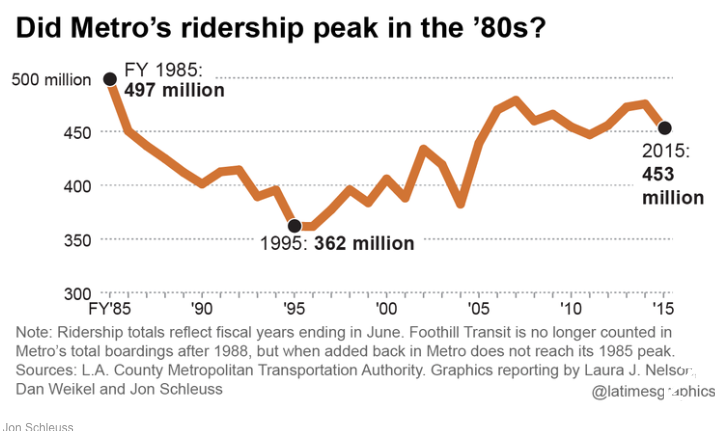
Last week the Los Angeles Times ran a story, by Laura Nelson and Dan Weikel, about how transit ridership has declined in Southern California at the same time that large investments have been made in public transit, mostly in the rail system. The article led with the fact that Metro’s boardings declined 10 percent between 2006 and 2015, notwithstanding billions of dollars of capital expenditures, and that Metro had also experienced long-term declines in ridership, going back to when L.A. transit ridership peaked in 1985.

Then the Times ran something of a counter piece, an op-ed by Ethan Elkind, a researcher and writer on environmental law and policy. Elkind explained some of the reasons for the recent decline in ridership, argued that the long-term decline is not as bad as the article made it seem because of the starting date the authors chose to compare to (more on that below), and why the future should not be so bleak for transit in the region, once the rail lines and extensions those billions are paying for have opened.

Then, today, there were four letters in the Times responding to Elkind.

Transportation issues are complex, involving at the micro level decisions that individuals make balancing myriad tiny factors and at the macro level decisions that governments make balancing massive public and private interests. To me, the Times story and the response to it illustrate how people can ignore this complexity at the same time that they fail to make obvious connections.

To begin with, the original article has contradictions. Its main point is that recent investments haven’t had a positive impact on ridership, but the article itself includes a chart that shows that since 1995 Metro ridership has increased from 362 million boardings per year to 453 million, an increase of 25 percent. When did the Blue Line, L.A.’s first new rail line, open? In 1990. When did the Red Line subway open? 1993. Green Line? 1995. Gold Line? 2003. What do you know, but there’s a correlation between when L.A. began investing in a modern rail system and when ridership began to increase.The Times' chart. (C) 2016 Los Angeles Times

The Times’ chart. © 2016 Los Angeles Times

What about the 10 percent decline since 2006? Well, the article answers that question, but you have to dig. Nelson and Weikel recount the history that after a settlement with the Bus Riders Union in the 1990s Metro added more than one million hours of bus service; as a result, ridership soared, reaching 492 million boardings in 2006 (very nearly the 1985 peak). Then what happened? Well, it’s right there in the article: the Great Recession hit, ridership which had been rapidly increasing leveled off, and then between 2009 and 2011 Metro reduced bus service by 900,000 hours. Hardly a shock, but there will be a correlation between reducing service and losing riders.

There are, of course, many factors that affect decisions that people make about how to travel. In the 30 years since the 1985 peak in ridership, many of the jobs that people once took transit to were moved outside of the region’s inner, transit-served core to places like Lancaster and the inland Empire (or, in the case of the garment industry, to Asia). Immigrants, who, as the article points out, use transit more frequently than non-immigrants, followed those jobs into sprawl-ville. We also have fewer immigrants now than in 1985. Given these trends, both demographic and geographic, it’s remarkable that Metro has about the same ridership today that it had 30 years ago (and don’t forget that 25% increase since 1995).

Reading the letters in today’s Times about the ridership issue illustrates that no matter how complex a problem is you can always try to reduce it to something you can express in a letter to the editor.

The first letter is from Santa Monica’s own Bruce Feldman, who presents himself as the classic Everyman, with “common sense,” in contrast to “scholars like Ethan N. Elkind.” To Feldman, it’s clear: Southern Californians “want real world steps that can be put into place quickly.” He says that we should dramatically lower the cost of public transportation, create more bus lanes and run buses every three to five minutes to make transportation “even more convenient than cars.” “That’s just common sense,” he says.

Hey, I agree. But does Feldman believe that anyone could accomplish those things quickly? I mean, does he know, for instance, how many years it took to wrestle the new bus lanes on Wilshire away from those Southern Californians of his who drive cars? Does he known anything about the politics (and federal financing) of fares? Does he know what buses cost?

Common sense is great, but does Feldman believe that he’s the first to think up this stuff?

Feldman concludes his letter with classic Amur’can anti-intellectualism, saying that he’s “sure academics will have plenty of theoretical reasons why I’m wrong.” I don’t think so! I mean, I read a fair amount of academic literature in this field and I’ve never read anything saying that lowering fares, increasing frequency, and speeding up buses would not attract more riders. The problems are not theoretical; they’re practical and political.

The second letter, wouldn’t you know it, comes from an academic, but one who agrees with Feldman. (This only goes to show that if you’re going to attack intellectuals be careful, because there’s going to be at least one whose pointy-head points the way you want it to point.) The letter, naturally, is from USC professor James E. Moore II, who has led a personal crusade for many years against building rail in L.A. As Times reporters often do, Nelson and Weikel quote Moore in their article, this time to the effect that Metro has been driving ridership down by spending on rail. (Maybe I mentioned this already, but since Metro began opening new rail lines, ridership is up 25 percent.)

Moore’s point in today’s letter is that if you lower fares, you increase ridership more effectively than by using the money to build rail. Although everyone likes low transit fares, particularly for poor people, around the world the cities that have the best and busiest transit systems, including the best service for working-class and poor people, are not cities where fares are cheap. And by the way, they usually have lots of rail.

Time is money for everyone, especially for people without much money since they need every minute they have to make money. If you treat your transportation system as an adjunct of the welfare system, you’re not going to have a good transportation system serving the people in the welfare system. (And nor will you have a system that reduces traffic congestion by attracting the non-poor.)

Every few weeks during the academic year I take the Metro 534 bus from downtown Santa Monica to Culver City, where I catch the Expo train to meet my wife at USC (where she teaches). We do this so that we can get some dinner and then hear a concert at Disney Hall or the Music Center. Mind you, my wife has her car at USC and we drive back, but we never regularly went to weeknight concerts before the Expo line opened, because for me to get or USC or downtown L.A. on the freeway would be a nightmare. I get on that 534 bus around 4:30 p.m. and it’s always packed, usually standing room only, full of workers coming home from jobs in Malibu and Pacific Palisades. We get on the freeway, and it usually takes 50, 55 or even 60 minutes to get to the train in Culver, where most of us passengers disembark.

When the train opens in Santa Monica in May, those passengers, our transit-riding heroes, will be able to exit the bus and get on the train here in Santa Monica, and a trip that now takes almost an hour to Culver City will take 15 minutes, saving them up to 45 minutes in each direction.

And the ride will be smooth.

Thanks for reading.

A cyclist and a motorist talk

For about 20 years I’ve commuted by bike from my home in Ocean Park to my office in downtown Santa Monica. My route takes me north on Fourth Street, which means crossing the freeway on Fourth, which in turn means cycling past the freeway on-ramp that was added about 25 years ago. It’s not an easy route for a cyclist because there’s a dedicated right turn lane at the intersection that during the morning rush is usually backed up with motorists anxious to get on the freeway.

Right turn lanes are one of many banes of a cyclist’s existence traffic engineers have designed. Right turn lanes put cyclists who are traveling through in conflict with two rules of the road: (i) that slower traffic should stick to the right, and (ii) that cyclists should follow traffic rules like any other vehicle. As I ride my bike north on Fourth, if I stay in the right lane, close to the curb, I interfere with drivers turning right, but if I move over to the thru-lane, I confuse motorists who think I should be over by the curb because I’m a slow-moving vehicle.

If you’re wondering which choice I make, the answer is that once I pass Pico I start looking for a chance to move safely into the thru-lane, which usually I can do. I make this choice because the overriding rule of bicycle safety is to make yourself visible to motorists. The worst thing for a cyclist is to be in a place where motorists don’t expect to or can’t see you—for example, coming off a sidewalk into an intersection. For a cyclist, the problem with a right-turn lane is that if you’re riding on the right, along the curb, it’s difficult for a motorist making the turn to see you, and since it’s a dedicated right-turn lane, motorists don’t expect to see you.

Let me say that in 20 years I’ve seldom had anything close to a close call. I’m living proof that most motorists are not homicidal jerks, and I hope I’m proof that most cyclists are not suicidal jerks. Once I signal and carefully move into the thru-lane, 99.44% of motorists give me a wide berth as they drive north. Of course I have to be careful about drivers who are in the right-turn lane changing their minds and shifting into the thru-lane, but that’s a matter of not going too fast and making “eye-contact” with side-mirrors. I have no complaints.

But the other day I had an interesting experience. After I’d safely shifted left into the thru-lane and was approaching the intersection at the on-ramp (which is at Olympic Drive, where there’s a light, which was at that moment green for northbound traffic), a car passed me on the right. The car was not going too fast because the driver was slowing for the turn, and as he passed the driver scolded me. He leaned out the window and said, “you’re a dangerous biker.” I caught his eye, and with his left hand he wagged his finger at me. Now when I say “scolded,” I hope you know what I mean. This was not some tattooed hot-rodder shouting an expletive at a slow-moving 63-year-old cyclist. This was someone of my own demographic, who wanted me to know that in the infinite wisdom of a middle-aged Westsider I was a dangerous biker and (perhaps even more important) that he knew better.

I immediately looked up to see if the light was going to change, because if it did turn red, I would have had the opportunity to pull up beside the driver’s window and politely explain my reasons for using the thru-line and not delaying motorists like him who were making right turns to get on the freeway. Alas, the light was green and he was pulling away from me toward the turn. He was already about ten feet ahead of me and I only had seconds to explain to him why right-turn lanes were inherently dangerous for cyclists.

Desperate to sum up the whole situation, I did what I could. I shouted out, “Fuck off!”

The motorist thrust this arm out the window, middle finger extended.

Thus concluded another dialogue between cyclist and motorist.

Thanks for reading.

Let’s see who shows up

Good jobs and good housing are the goals of progressive economic policies, and both are on the agenda of the Santa Monica City Council tomorrow night. Good jobs, because the council will be joining many jurisdictions around the country in significantly increasing minimum wages, and good housing because the council will considering a report from Housing Commission on how to fund affordable housing construction.

This blog is going to focus on the minimum wage, but jobs and housing are related. Given the real costs of construction and assembling land, one can argue that we don’t have a high cost of housing crisis in the region, but a crisis of low wages.

The decline in real wages over the past three or four decades is a national issue, but the crisis has been particularly acute in Southern California, where immigration of low-skill workers vastly expanded the work force at the same time that good, unionized manufacturing jobs vanished with foreign competition and the end of the Cold War. To a great extent the movement for higher wages got started in the L.A. region with Justice for Janitors and then the living wage movement, including in Santa Monica. About 15 years ago, Santa Monica passed a living wage that applied in the Coastal Zone, but hotels mounted a referendum campaign against it, and in a bitter election that took place in the conservative election year of 2002, they defeated it.

Now, with a notably different national attitude toward wages (minimum wages have been increased, with voter support, all over the country, including in conservative jurisdictions) the movement has come back full circle geographically. The Los Angeles City Council approved a $15.37 minimum wage for hotels in 2014 (currently being phased in) and then, in 2015, a gradual increase to a citywide $15 minimum wage. The County Board of Supervisors followed with a $15 minimum for unincorporated areas that are under its jurisdiction.

Now it’s Santa Monica’s turn. In September the City Council agreed unanimously to pass a minimum wage increase in line with the City and County increases. The council, however, asked City staff to canvass both employers and employees, and their representatives, and the community, on a series of questions concerning various details, some of which the L.A. City Council had left for future resolution. I heartily recommend reading the staff report, in which staff describes the input it received and how it based its recommendations on that input and on the council’s direction. While I’m sure there will be details the council will need to address, staff has suggested good faith compromises that try to resolve practical issues raised by both employers and employees.

That doesn’t mean there isn’t controversy, most of which surrounds the provision council is poised to pass allowing union collective bargaining agreements to supersede the minimum wage. I have previously explained why I support “supersession,” but it’s worth noting that supersession is hardly new. It’s in all of the development agreements the City has entered into for hotels that have a minimum wage provision. Supersession by another name, “preemption,” is part of federal labor law, and it’s been held, for instance, that a collective bargaining agreement’s overtime provisions preempt local law. Supersession is also in the 2014 L.A. minimum wage for hotels, and that provision has been approved in court (ironically in a case that said that said that labor law did not preempt the minimum wage).

Supersession wouldn’t be much of an issue tomorrow night in City Hall but for the efforts of a mysterious group that calls itself variously, the “Employment Policies Institute,” “Fair Wage Santa Monica,” or the “One Fair Wage Coalition.” Since September this group has been campaigning against supersession. If you live in Santa Monica and you watch YouTube, you probably have seen anti-supersession commercials from these guys, whoever they are.

I say “mysterious” and “whoever they are” because the public representatives for the campaign won’t say who is putting up the money for it. It’s not hard to find out though, at least in general terms. Back in September the campaign started with newspaper ads, and they were identified as coming from the Employment Policies Institute (EPI), an established anti-minimum wage, anti-union organization. EPI is associated with the right-wing provocateur Richard Berman. Berman is a controversial figure known, among other things, for establishing non-profit groups to raise money for right-wing causes, which groups then use the money to hire him to run campaigns.

It’s a living.

Sure enough, the Santa Monica anti-supersession campaign looks like a manufactured, artificial campaign. Why? Primarily because it’s been so out-of-touch with how Santa Monica politics work. I mean, YouTube commercials? (Maybe they should have learned something from the aviation’s failed bid in 2014 to make Santa Monica Airport permanent.)

Local employers, such as the hotels that opposed the living wage in 2002, or local restaurants, have addressed their comments to staff and (presumably) lobbied council members. As I said before, the staff recommendations strike reasonable compromises on various practical matters that concern both employers and employees, and the council members will also no doubt be looking to tweak the ordinance to make sure that it will work.

Why would national players like Berman get involved in Santa Monica? I suspect that the reason, aside from simple ideology, is that Los Angeles has yet to make its decision about supersession, and Santa Monica will to some extent establish a precedent. Berman is likely using Santa Monica as a test case, to show his backers what he can do.

It’ll be interesting to see who shows up tomorrow night from the One Fair Wage Coalition.

Thanks for reading.

Santa Monica Airport: the saga continues (and the struggle)

The Santa Monica Airport (SMO) has been in the news a lot recently. As readers probably know, the Federal Aviation Administration (FAA), after a self-serving delay of six months, finally issued a “Director’s Determination” in the “grant assurances” case. This case is the FAA administrative proceeding that airport users brought in 2014 claiming that Santa Monica was obligated to operate the airport until 2023 because the City received federal money in 2003 for airport improvements. Not surprisingly, the FAA Director determined that the City was so obligated—more about that decision below.

But there has been news about SMO beyond the FAA decision.

In the litigation front, another group of airport users filed a class-action suit against the City protesting takeoff and landing fees that the City began collecting in 1985, alleging that the City failed to follow notice requirements and used the money for non-airport purposes. (Who knows about whether proper notice was given way back then, but the claim about the money is hard to figure, given that when the City raised fees in 2013, the airport fund was $13 million in the red.)

But as aviation interests get more desperate, expect even more litigation (at the same time, of course, that the FAA is doing everything it can to prevent the City’s case in federal court from proceeding). In an appeal for funds, the Santa Monica Airport Association recently promised its members that it would soon file a new administrative law proceeding with the FAA against the City, this time to protest the City’s recent actions to restructure aviation leases, assume control over fuel sales, and otherwise try to bring airport operations under the City’s control.

On the other side of the coin, a few weeks ago the City announced the hiring of Nelson Hernandez to advise City Manager Rick Cole specifically on airport policies. Hernandez has extensive administrative experience in both local and federal government, and the idea is that he will, with the goal of establishing City control over SMO, coordinate City actions and policies respecting the airport that are now scattered among several departments.

Getting back to the FAA Director’s Determination in the grant assurances case, the most important fact is that this “decision” did not even come from a purportedly independent administrative law judge, but from the FAA administrator in charge of compliance with FAA rules (in fact, an acting administrator). The ruling reads more like a brief than a judge’s decision. The good news is that the decision was a necessary step to get the FAA into federal court, where the facts and law can ultimately be heard in a neutral forum.

Besides the layers of delay, what’s unfortunate about the case is that if the contract drafting in 2003 had been better, there would be no need for the litigation. As an entertainment lawyer by trade, whose job it is to write contracts, I find this particularly galling. The facts are that in 1994 the City signed a contract with the FAA to get funding for improvements at the airport; in return the City promised to keep operating the airport for at least 20 years, i.e., the City’s obligations would expire in 2014. In 2003 the City and the FAA signed an amendment to the 1994 agreement that increased the amount of funding the City received (by about $240,000).

Unfortunately, the amendment was vague on a crucial point, namely whether the new money extended the term (to 2023) or whether the 2014 expiration date still applied. The amendment did have a “savings clause” stating that all provisions in the original agreement that weren’t amended would remain in force, and the City is relying on this to argue that the expiration date was not changed. The City is also arguing that since the FAA prepared the agreement, any ambiguities should be interpreted against the FAA. While it’s true that the form agreement should be clearer, the City’s argument is legalistic and would have been unnecessary if the savings clause had included language specifically including the expiration date in what provisions remained in force.

The FAA is countering with a legalistic argument of its own, namely that if there was no extension of the term, there was no consideration for the new money. The agency is also arguing that under federal statutory law the City could not take the money if the term were not extended. I suspect that when the case ultimately reaches federal court, the judge there will be looking to determine what the intent of the parties was. I doubt that the City could have had the intent of extending of the term when it accepted the money, but again, the contract is not clear. If the contract as drafted had been clear about the term, and if the FAA and the City didn’t agree on the term, then presumably there wouldn’t have been the increase in the grant that they are fighting about now.

When negotiating a contract, a lawyer’s purpose is to get the best deal for the client. When drafting a contract, the purpose should be to make the contract clear enough that no one has to litigate to find out what it means. I often recite an old Italian proverb to clients: Conti chiari, amicizia lunga—“clear accounts, long friendship.” I’m not saying that with a clear contract the FAA and the City of Santa Monica would be friends, but at least they wouldn’t be heading to court over the expiration date for the grant assurances.

In the litigation so far the City and its lawyers spent unnecessary time and energy arguing that the airport users who brought the case didn’t have standing to do so, in part because the City had not done anything to close the airport and so the issue was not ripe. I have to attribute these arguments to the customary zeal of litigators since (just as in the City’s federal case) it’s in the City’s interest to get these issues decided. I hope that when the City appeals the Director’s Determination, the City drops the standing arguments and focuses on the meaning of the 2003 amendment.

However, in the “fair is fair” department, the City should make a hypothetical argument of its own. Even if the City is obligated to keep Santa Monica Airport open until 2023 because of the money received in 2003, the ultimate issue will be what the FAA’s remedy would be if the City tries to close the airport before then. Would the FAA be able to get an injunction requiring the City to continue to operate the airport, or could the City satisfy its obligations by paying back the 2003 money? At the moment, that’s a theoretical question because the City hasn’t tried to shut down (all or part of) the airport. Perhaps the City should push the issue by declaring it will close the airport, but in any case, as the case wends its way through the FAA’s appeal process and into federal court, the City should try to get an answer to its hypothetical.

Thanks for reading – and Merry Christmas (if you celebrate that) and Happy New Year (if this turns out to be my last post for 2015)!

The past isn’t quite dead here, either: how racism shaped Santa Monica

When Fay Wells went national to write, in the Washington Post, about what happened when a neighbor called 9-1-1 on her, she brought the issue of race to the attention of the white majority in Santa Monica, a city where race is not typically a major part of the public conversation. To me the case is a lens through which to examine how racism has shaped Santa Monica.

Santa Monica has been shaped by segregation. Segregation? In Santa Monica? Well, yes. Like much if not most of America that was developed in the 20th century, Santa Monica was developed as a segregated city. The mechanisms of segregation were not blatant Jim Crow laws. Instead, segregation was implemented formally through restrictive covenants included in deeds for properties in single-family zones and by federally mandated redlining for F.H.A. financing that also kept minorities out of neighborhoods, and informally by realtors seeking to “protect property values.” While the Supreme Court declared restrictive covenants to be unconstitutional in 1948, redlining and other forms of housing discrimination weren’t illegal until the Civil Rights Act of 1968.

Restrictive covenants were part of the DNA of suburban development in the first half of the 20th century, when most of Santa Monica was subdivided, much of it only for single family homes. Single-family zoning, by prohibiting apartments (which had been common in American cities), was another strategy to keep lower-income families (i.e., renters), and in particular black families, out of new neighborhoods. (This history is discussed in detail in Benjamin Ross’ 2014 book, Dead End: Suburban Sprawl and the Rebirth of American Urbanism.)

The impact of restrictive covenants and single-family zoning on Santa Monica today cannot be underestimated: about 32% of all the land in the city is zoned for single-family homes (nearly half of all land zoned residential), and to this day few black or brown people live in R1 zones. Santa Monica is about 70% non-Hispanic white, but it is more segregated than one would expect for a city that is 30% non-Anglo.

Nearly all minorities in Santa Monica, with the exception of some of Asian descent who have moved into the city in recent decades, live south of Wilshire and north of Pico (mostly in the Pico Neighborhood), with a few other clusters in Ocean Park and in non-single-family areas of Sunset Park. Not coincidentally, these were, historically, the only integrated neighborhoods in Santa Monica. And also not coincidentally, these neighborhoods mostly straddled the industrial belt that ran along the railroad tracks that ran through the city—in Santa Monica, as in much of America, most black and brown people lived “across the tracks.”

African-Americans and Latinos have lived in Santa Monica for over a century, but they didn’t have the opportunity to buy houses in Santa Monica when working-class whites were able to, part of a shameful national story of how minorities were denied the opportunity to participate in the (heavily subsidized) post-World War II real estate boom.

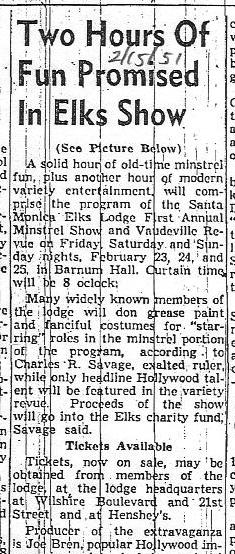
And racism in Santa Monica wasn’t all about what could be built, and for whom, but what could be destroyed. Who were displaced to build the high school, the Civic Auditorium, and the freeway? Black and brown property owners and renters. Santa Monica has African-American churches to which black families still return to worship from their scattered homes miles away.

From the Santa Monica Evening Outlook, Feb. 15, 1951

From the Santa Monica Evening Outlook, Feb. 15, 1951

So you’re saying, what’s the point? History is history, right, and only in places like Faulkner’s Mississippi is the past not even past, right? Well, yes, to a point. We’re not doomed to be racist because our physical environment was shaped by racism. In my lifetime I’ve seen whites go from asking rhetorically what they would do if their sister married a black man, to today, when I doubt if there are too many white Santa Monica parents who would bat an eyelash if their child brought a black or Latino boyfriend or girlfriend home (preferably without too many piercings, but that goes for a white boyfriend or girlfriend, too).

Progress does get made. I’m not calling anyone a racist. May I repeat that: I’m not calling anyone a racist.

However, the past isn’t dead. One can argue whether racial incidents involving the Santa Monica police, and there are more than the two involving Fay Wells and Justin Palmer, are evidence of institutional racism or isolated incidents that don’t reflect the police department’s earnest efforts to be fair. In fact I’ve made the latter argument. One cannot honestly argue, however, that blacks and Latinos do not have historical grounds to feel marginalized in our city, which is going to affect their interpretation of interactions with the police and other public institutions. And because of Santa Monica’s history of segregation, you’re also going to have white people who don’t see black or brown people in their neighborhoods often, and because residents want the police to protect their neighborhoods, that is bound to lead to trouble.

Would the Fay Wells 9-1-1 caller have called the police if the locksmith had been white? I doubt the caller himself can answer that question.

The legacy goes further. Politicians appeal to voters in R1 zones by talking about the importance of preserving neighborhood “character” (when, for instance, the issue is whether to allow the building of apartments on adjacent boulevards); should it matter that that character is based on a racist history? What about when politicians decry gentrification in the historically integrated neighborhoods of Santa Monica, but then side with residents who oppose building apartments near R1 neighborhoods that might (mildly) de-gentrify them by bringing in renters?

Thanks for reading.

Race: it’s everywhere (more on Fay Wells)

As I said when I concluded my first column about Fay Wells, the heart of the matter was the police response to the 9-1-1 call. The question is why Wells and the police have such a different views about what happened (recognizing that Police Chief Jacqueline Seabrooks acknowledged the validity of Wells’ response). Before I approach the question, however, I want to make some disclosures: if I’m going to take this Rorschach test you should know where I’m coming from.

The first disclosure is that when I ran for City Council in 2014 I had the endorsement of the Santa Monica Police Officers Association (SMPOA). I was proud to have that endorsement. You have to be proud to be associated with (and I wrote the first draft of this sentence prior to the attack in San Bernardino) any group of people who will put their lives on the line to protect ours, as SMPD officers did in the attack on Santa Monica College in 2013.

But beyond that primary level of respect, I believe that the Santa Monica police strive to be professional, disciplined and objective. This is not Ferguson and not Chicago. This doesn’t mean that our police never make mistakes, and currently there are several incidents of potentially discriminatory treatment by police that are properly under review. Yet I understand why Darrell Goode, of the local NAACP, told the Lookout that the organization did not “want to throw the Santa Monica Police Department under the bus” in the aftermath of the incident involving Justin Palmer, the African-American man arrested while trying to charge his electric car.

I was also proud to receive the SMPOA endorsement because the union endorsed me despite the fact that I had criticized the police officer who had investigated Oscar de la Torre after de la Torre broke up a fight between two Samohi students. Naturally I believe that I richly deserved every endorsement I received, but it meant something (more about the police than me) that the police were willing to look beyond my criticism.

My second disclosure is that underlying my analysis of what happened to Fay Wells is that I’ve researched some of the racist aspects of Santa Monica’s past. Most of my research focused on how the City of Santa Monica destroyed a black neighborhood to obtain the land for the Civic Auditorium. Through this work I became acquainted with and appreciative of the work of the Quinn Research Center, which focuses on the history of the African-American community in Santa Monica, and the Committee for Racial Justice (CRJ), which was formed in 2011 after a racial incident at Samohi. (The CRJ has monthly meetings to discuss issues related to race in Santa Monica. The next meeting is tomorrow night (Dec. 6) and the subject will be racial profiling in Santa Monica. All are welcome. The meetings take place from 6 pm to 8:30 (first half hour is a potluck supper) in the Thelma Terry Building in Virginia Avenue Park.)

My third disclosure is obvious, but important. I’m white. I’m not bringing that up to join the ongoing national discussion about privilege, but to remind myself as well as readers that when I use the word we, or words like one or you, as in “one must . . . ,” I can’t help but be referring to the majoritarian us. While I shouldn’t presume to speak for the white majority culture either, the only way I can speak about what could be a minority perspective is through a white filter.

Back to Fay Wells. Based on what she’s written and said, what’s outraged Wells most was that the police had their guns drawn when they approached her apartment, and that they continued to treat her as a suspect even after she told them that she lived in the apartment and offered to prove it with ID, the locksmith’s receipt, etc. She attributes her treatment to her race—she doesn’t believe a white person would have been treated the same way.

In my opinion, there is no way one (there goes that majoritarian one) can honestly second guess Wells on this, in particular because of the recent incidents of police killing blacks. Trying to put myself in Wells’ shoes, I suspect that her treatment must have been particularly painful because, as she said, she’d never had so much as a speeding ticket. With her education and budding career, and her calm (and somewhat ironic) demeanor (clear from listening to her on the 47-minute tape), she’d done everything not to be one of those “angry” blacks whom white folks just can’t understand, and she certainly had not been enmeshed in the criminal justice system, and yet there she was, black, with police pointing guns at her.

So I don’t believe that “we” can question Wells’ perspective on what happened. Memo to Ms. Wells: I hope that time will heal these wounds, but in the meantime this member of the majority culture says, go ahead, be angry.

But that doesn’t necessarily mean that the police officers on the scene did wrong. If the standard protocol when investigating a three-person burglary is to approach the apartment with guns drawn, and that’s how the officers are trained, then I can’t fault them for following their procedures. Similarly, if it’s standard protocol not to believe what anyone who answers the door says until the area has been secured, then again, I can’t fault them for not taking Wells’ word that she lived there. And, although the officers might have known that the 9-1-1 caller had ID’d the “burglars” as Latino, and perhaps, if they weren’t following the proper protocol, the officers had their guns drawn because of that, one thing we do know is that the officers did not expect that an African-American might be involved until Wells opened the door.

But that doesn’t mean that race wasn’t involved.

Let’s assume that it was proper protocol for the officers to have drawn their guns. Why would that be the case? After all, Santa Monica, other than in connection with gang shootings, does not have much violent crime, and the 9-1-1 caller had not said anything about burglars being armed. I can’t recall any burglaries here ending up in shootouts. What would make drawing guns when investigating a possible burglary standard procedure?

The answer is guns. Our country is full of them, and they’re getting more powerful all the time. The only reason I can think of for police being instructed to draw their guns when approaching potential burglars is that they consider it necessary to be prepared to confront someone with a gun. These days that’s hardly irrational. Look—when 35 or so years ago I first sent money to a gun control organization, the issue was handguns. (Remember Handgun Control, Inc.?) In these days of assault weapons, to be worried about handguns seems quaint.

But that only raises another question. Why do Americans—and let’s face it, when we’re talking about who blocks gun control we’re talking about white Americans—love guns so much? Why can’t Congress pass sensible limits on guns designed to kill people? Okay, there are a lot of reasons, it’s probably over-determined, but historically a fundamental factor is race.

America’s gun fetish starts on the frontier, with fear of Indians (and a desire to conquer them), and with slavery, when slave owners and the rest of white society feared slave revolts. After Emancipation, whites in the South used violence and terror to keep freed slaves down. That continued through Jim Crow and the lynching era. When blacks got pushed off their land and moved north, fear and guns became suburbanized. It was all about “my home is my castle” and Willie Horton.

Race is everywhere. We’re not going to solve the gun problem until we solve the race problem.

Next—how historical racism shapes Santa Monica.

Thanks for reading.

Rorschach moments

By now I assume that readers of this blog are aware of the incident involving Fay Wells, the young African-American woman who in September was mistaken by a neighbor for a burglar after she locked herself out of her apartment and had to call a locksmith. The neighbor called 9-1-1, telling the dispatcher that he “needed some cops.” He said that his “next door neighbor,” whom he described as a Hispanic man, along with two female companions (also, he said, likely Hispanic), had just broken into into someone else’s apartment.

Within minutes Santa Monica police arrived on the scene. In response to a command to come out with her hands up, Wells emerged from the apartment to face two officers with guns drawn, as well as a barking police dog. Only after officers took Wells to the street with her hands held behind her back, was Wells able to convince them that she lived in the apartment. The case received nationwide, in fact international, attention after Wells wrote an op-ed about it for the Washington Post. (Wells can also be heard on last Monday’s Warren Olney’s KCRW show, Which Way, L.A.?”)

If you haven’t already, I suggest following up on a few links beyond the news coverage. For one, there is the 9-1-1 call that started the whole thing. Then there is the statement that Police Chief Jacqueline Seabrooks released. Along with her statement, Seabrooks also released a 47-minute audio recording of a conversation between Wells and police officers on the scene. The recording begins, unfortunately, only after Wells has established her bona fides. (A transcript of the recording has also been published.) Seabrooks’ response has been the only official response from the City.

The facts of what happened that night don’t appear to be in dispute, but different people interpret them differently. In her statement, Seabrooks invokes the metaphor of a Rorschach test, and she’s certainly right about that.

The facts start with the 9-1-1 call, which is a textbook example about the unreliability of eyewitness observation. The caller is confused both in his facts and his interpretation of what he’s seeing. He identifies the man “tapping” on the lock to get in—the locksmith—as a neighbor breaking into the apartment of someone else. The caller doesn’t identify Wells, his actual neighbor, as a neighbor, but instead includes her as one of two Hispanic “girls.” The caller twice says he “needs” cops, but then a couple of times tries to tell the dispatcher that it’s not an emergency, that he doesn’t “think this is some kind of crazy robbery.” (The dispatcher, trying to get the facts, cuts him off both times.)

Regardless of the caller’s confusion, the 9-1-1 call set the ball rolling for the whole incident. Depending on your perspective, the caller was either a conscientious “eye on the street” protecting the neighborhood (the view of Seabrooks and the caller himself), or otherwise a careless neighbor, possibly tipsy (a possibility that comes up later when Wells and the caller meet—you can listen, and judge for yourself), who can’t fathom that three Hispanics—including a neighbor!—trying to get into a locked apartment in an all-white apartment building at 11:15 on a Sunday evening could be up to any good.

My view? Admittedly with the benefit of 20-20 hindsight, I lean toward the latter interpretation: this doesn’t sound like a high-crime location and I wish the caller had done “due diligence” before calling. But I also recognize that the caller had probably internalized a lot of the irrational fear that permeates our “Film at 11!” society. To me what the caller relayed to the dispatcher precisely describes a locksmith doing his job, and in my wishful world the caller might have checked first to see if there was a locksmith’s truck parked outside before calling 9-1-1. Even better, and even more idealistic, what if he had called out over the ten feet he says that separated him from the locksmith and said something like, “Hey, everything okay, need any help?” That would have been neighborly, but it’s also nearly impossible to contemplate that he would have done that given our culture of fear. (Open question: would the caller have been more likely to do the neighborly thing if the locksmith had been white?)

The heart of the controversy, however, occurs when the police arrive. As Wells articulates in her op-ed as well as in other statements, she was terrified to emerge from her home to face drawn guns. Because of the barking dog, she couldn’t hear the police identify themselves. Anyone would have been afraid, but as an African-American Wells couldn’t avoid visualizing herself about to become another post-Ferguson victim. When she finds out that 19 officers have answered the call, she believes that they are all there as an overreaction to fear of blacks in an overwhelmingly white city.

From the police perspective, it’s different. As the officers explain to Wells in the 47-minute tape, they believed they had followed prudent standard procedures and would have done the same if she had been white. For all they knew, three burglars were in the apartment and they can’t take Wells’ word for it that she’s the only person there. Three burglars warrant a big response. Guns are drawn because officers get shot at in these circumstances. For all Wells’ fears, they did not shoot or tear up her apartment.

I urge readers to listen to the whole 47 minutes of the tape, if only to hear how easy it is for articulate, intelligent and well-meaning people to talk past each other. You’ll hear both sides, and I suspect your sentiments will go back and forth. Which raises this question: why is this a Rorschach situation? Why is it that (i) a young black woman, well-educated and professional, who says she’s never had so much as a speeding ticket, and (ii) the police (some of whom, including at least one officer on the scene and Chief Seabrooks, are themselves black), interpret the same facts so differently?

I’ll try to address this question in a future column. In the meantime, thanks for reading.