Sprawl Repair

Santa Monica is a post-sprawl city, but vestigial remains of its origins are still around. The most obvious are its major commercial boulevards, which offer miles of low-slung, mostly nondescript but often ramshackle commercial buildings, strip and mini-malls, and surface parking lots. This land use pattern is a characteristic of sprawl, in great part because of onsite parking requirements.

The ugliness of sprawl is so commonplace that people take it for granted. It’s another aspect of what John Kenneth Galbraith described as “private affluence and public squalor.”

However, there is one boulevard in Santa Monica that is so degraded that even people who rarely accept the idea that Santa Monica might stand to change for the better in any respect acknowledge its ugliness. I’m speaking, of course, of Lincoln Boulevard from the freeway to the Venice border. (Lincoln is even uglier in Venice, because of the utility poles and because there are even fewer trees than in Santa Monica, but that’s for someone else to write about.)

The urbanist writer James Howard Kunstler, in his great screed, The Geography of Nowhere, coined the word “crudscape” to describe what the roads and highways that lead into cities and towns all across America look like, and crudscape is what Lincoln Boulevard is.

Lincoln Boulevard is so ugly (this is sounding like a Rodney Dangerfield routine) that a few years ago neighbors decided to do something about it. Some of them made a video about what they called “Stinkin’ Lincoln,” the Ocean Park Association set up a committee to look into how Lincoln could be improved, and most eye-opening of all, a young neighbor, Evan Meyer, started persuading businesses to allow artists to paint murals on their walls, in a project first called Beautify Lincoln, but now expanded to Beautify Earth.

The City’s Planning Department got involved, not only in response to all the agitation from the community, but also because of the zoning ordinance update, and now there’s a process, called “The LiNC” (from “Lincoln Neighborhood Corridor”), to remake the boulevard into something you might actually want to take a stroll on. Last Thursday evening the department hosted a workshop to get feedback on the work the department and consultants have done so far. (Materials presented at the workshop can be accessed through the LiNC website, by scrolling down to the section on “Workshops & Milestones.)

There are many reasons that Lincoln is particularly difficult to improve. To begin with, since there are so few north-south routes west of Centinela, it carries a heavy transportation load. At the workshop planners said that vehicle traffic is 50,000 a day and 8,000 riders take the bus. This is not realistically a situation for a “road diet” like Santa Monica has used on other streets, including Ocean Park Boulevard.

Perhaps the most exciting part of the developing plans for Lincoln is the return of the idea to run bus-only lanes during peak hours. The bus lanes would not require the removal of any traffic lanes because they would replace curbside parking; studies show that very few of those spaces are used during peak travel hours. At the workshop last week, and previously in surveys, residents showed strong support for the bus lanes, which would, according to planning staff, drastically improve travel times for buses and thus attract more riders.

While a road diet wouldn’t work at the present time, the City is planning on using landscaped medians to at least make the roadway greener (and in some cases provide “way stations” for pedestrians trying to cross the street). One of the questions staff had for the public last week was whether residents favored more or fewer medians. Nearly everyone at the workshop, including myself, voted for more medians, yet the planners need to be careful not to turn the boulevard into a divided highway. In certain cases, it might be better, where the center turn lane can be eliminated, to use the regained space to widen sidewalks rather than build a median.

Another problem with Lincoln is the narrowness of many of the lots that line it; the effect of narrow lots is that even if the economics of a site would justify the cost of underground parking, it’s often impossible physically to build it. Given the parking requirements, and the lack of any shared parking other than street parking, this means that in many locations it’s practically impossible to build anything new that might improve the boulevard.

Rather than wait for new development that might never happen, the LiNC planners are focusing on developing programs to encourage property owners and businesses to upgrade their current buildings. For the City’s part, planners have identified 48 locations where the City could plant more trees.

Another issue is that because the Ocean Park and Sunset Park neighborhoods, which are on opposite sides of Lincoln, were subdivided separately, few side streets on one side of the boulevard match up with streets on the other side, which means that there are few places where pedestrians can cross. At the workshop last week planners said that the average distance now between crosswalks is 1500 feet—five football fields! They have plans to add crosswalks so that the average distance is half that.

All in all, the ideas the Planning Department presented at the workshop were well received. We in Santa Monica like to celebrate our history. The Lincoln Boulevard crudscape should become it.

Thanks for reading.

U.S. Reps to FAA: make up your administrative mind

A few weeks ago U.S. Representatives Ted Lieu and Karen Bass organized a meeting in Washington where Santa Monica officials and local residents could express their grievances about Santa Monica Airport to Federal Aviation Administration (FAA) officials. The meeting had no concrete effect because the FAA had declared ahead of time that its representatives would not respond to anything that was said there, but the meeting did result in Reps. Lieu and Bass promising to press the FAA to issue an overdue decision in an administrative proceeding brought against the City by the National Business Aviation Association (NBAA) and other aviation interests.

By way of background, the case Lieu and Bass referred to involves a grant of money Santa Monica received from the FAA for airport upgrades under a contract entered into in 1994. The contract obligated the City to assure continued operation of the airport, but for no longer than 20 years, i.e., the City’s obligations under the contract would terminate no later than 2014. This is important because the City was not going to accept any money from the FAA that would tie the City’s hands beyond the expiration of another agreement with the FAA, from 1984, that required the City to operate the airport only to July 1, 2015. (The City’s obligations under the 1994 contract are often referred to as “grant assurances,” and the case is often referred to as the “grant assurances case.”)

In 2003 the 1994 contract was amended to increase the amount of the FAA’s grant by about $240,000 because work contemplated in the 1994 agreement proved to be more expensive than anticipated. The amendment, however, left the remaining terms of the contract, including its 2014 expiration date, unchanged. Nonetheless, last year the NBAA was the lead plaintiff in an FAA administrative law proceeding demanding that the FAA tell the City that it was bound, because of the 2003 amendment, to keep the airport operating until 2023, i.e., 20 years after the increase in the grant.

For months now the grant assurances case has been fully briefed. The delay maintains the status quo at the airport, which must please the aviation parties who brought the action. Santa Monica wants a decision. Any decision (for reasons I’ll discuss below).

Last week Lieu and Bass acted on their promise and sent a letter to the FAA that not only asked the agency to make up its administrative mind, but also forcefully expressed the City’s case why the 2003 amendment did not extend the contract term. (You can read the letter here.)

The decision in the grant assurances case is of tremendous importance—but not, I would argue, for what the decision might be. Whatever the decision is, it will free the City to take drastic action regarding the airport.

More background. Santa Monica has brought its own lawsuit against the FAA to determine whether a 1948 agreement requires the City to operate the airport “in perpetuity.” The case now languishes, on appeal from a procedural decision against the City, in the Ninth Circuit. But the 1948 agreement should not apply to a large parcel of land (known as the “Western Parcel”) that includes 2,000 feet of SMO’s 5,000-foot runway. If the City is not otherwise obligated (such as because of the grant assurances) to keep the airport operating, then regardless of the enforceability of the 1948 agreement the City should be able to close down the Western Parcel and reduce the runway to not more than 3,000 feet. In that event the largest private jets would not be able to use SMO.

(Important parenthetical: the FAA disputes this, and says that the 1948 agreement would be violated if the City terminated aviation on the Western Parcel. But if the FAA does bring an action against the City on this issue, it will be better to litigate first over the Western Parcel than over the airport as a whole.)

But why do I say that the actual decision in the grant assurances case is not important?

What is hamstringing the City from pulling the trigger on the Western Parcel is not whether the FAA might rule that the 2003 amendment extended the grant assurances to 2023, but rather the fact that the case is still pending. The City Council decided over a year ago that if the 2003 increase in the grant did extend the term of the grant assurances, then to resolve the matter the City would repay the FAA the $240,000. While the City has made strong arguments on both procedural and substantive grounds for why the FAA should dismiss the case, in practical terms the only issue is whether the City gets to keep the $240,000.

In a post two weeks ago, I wrote that the City need not make any strategic decisions regarding the airport until it receives the FAA’s decision in the grant assurances case. True enough, but the Lieu/Bass letter focuses the mind. Why? It’s one thing for the City to be patiently waiting for the FAA to announce a decision in the case, but it’s quite another when two members of Congress call the FAA out on their delay.

The FAA’s decision should come soon, but no matter what the decision is, the City’s strategy should be the same: announce a closing date, as soon as practicable, for all aviation operations on the Western Parcel.

Thanks for reading.

An emerging consensus on what to build in Santa Monica?

After six years of communal agonizing over the LUCE and then another five spent on a new zoning code to implement the LUCE, is there finally a working consensus on what projects can be built in Santa Monica?

Based on actions the Planning Commission took last week, the answer may be yes.

Could our long local nightmare be over?

As reported here and here and here, the Planning Commission last week approved two mixed use (retail on the ground floor, housing on the floors above) projects downtown that would together add 163 needed apartments to Santa Monica’s inventory of housing. These are the first significant projects to come before the commission under the LUCE and since approval of the zoning ordinance, and since two new commissioners took office who were recently appointed by the slow(er) growth City Council majority.

One project, on the block of Fifth Street between Santa Monica Boulevard and Broadway, is about 52,500 square feet of development on a double lot (i.e., on 15,000 square feet of land). The other, on the northwest corner of Lincoln and Colorado, is about twice the size, 102,500 square feet, but sits on five lots (37,500 square feet of land). The Fifth Street project has a height of 84 feet, the Lincoln Boulevard project would go up to 60 feet. Both projects require development agreements, and thus final approval will rest with City Council.

Fifth Street project; digital rendering by Michael Folonis, Architect

Fifth Street project; digital rendering by Michael Folonis, Architect

The Planning Commission voted 4-1 to forward the Fifth Street project to City Council (two of the seven commissioners were absent). The no vote came from new member Mario Fonda-Bonardi. His no, however, was a vote on principle against the 84-foot height (he wanted it reduced 10 feet), and otherwise he didn’t have big problems with the project. The vote for the Lincoln Boulevard project was a unanimous 5-0.

It’s significant that the majorities in favor of both projects included commissioners Richard McKinnon and new commissioner Nina Fresco, and the Lincoln Boulevard project received Fonda-Bonardi’s support as well. (Fresco and Fonda-Bonardi were both attending their first commission meetings.) McKinnon is generally identified with the slower-growth side in local politics. The development politics of Fresco are not well known, but the self-described slow-growth majority on the council appointed her to the commission. Fonda-Bonardi is strongly identified with anti-development views because of his being part of the S.M.a.r.t. group that writes for the Daily Press (even though, in a column he wrote, he advocated for the same rate of housing construction forecast in the LUCE, about 250 units a year).

Lincoln/Colorado Project; digital rendering by Killefer/Flammang Architects

Lincoln/Colorado Project; digital rendering by Killefer/Flammang Architects

The votes made it clear that at least certain kinds of projects are going to have support from a broad spectrum of Santa Monica politics. It’s worth looking at what the two projects had in common, beyond the fact that under their development agreements, the developer (NMS in both cases) had agreed to substantial community benefit packages and affordable housing.

Both projects:

  • Are located downtown, i.e., convenient to transit, and are otherwise designed to reduce environmental impacts, with LEED-platinum certifications, solar panels, and mechanisms for reducing water and energy use. Both projects would replace low-slung, suburban-style commercial buildings and surface parking primarily with housing. All the current council members, even those who identify themselves as “slow-growth,” recognize the need to build housing, given the region-wide shortage and market demand that’s pushing rents and housing prices to record highs.
  • Are characterized by good, contemporary design that maximizes public space and avoids “boxiness.” The Fifth Street project, designed by local architect Michael Folonis, creatively re-considered the use of setbacks, and instead of wasting them in a wedding cake design that would leave a monolithic street frontage, used the required cubic feet of the setbacks to widen the sidewalk in the front of the building into a mini-piazza and to create a “donut hole” in the middle of the building that will better open the façade to the street. The Lincoln Boulevard project, designed by local architects Killefer-Flammang, will create a similarly widened sidewalk/plaza area at the important corner of Lincoln and Colorado and a paseo coming off Lincoln.
  • Adhere to the City’s new standards for unit mix, to encourage more two and three bedroom units. Also, by breaking up the buildings with ground and upper floor open space, the architects have been able to give the apartments more light and air. The amount of development in both projects also reflects de facto downzoning downtown, since under the pre-LUCE development standards residential square footage was discounted 50% when determining the amount of development allowed. Perhaps ironically it’s the regional and local housing shortage and the resulting high rents that enable these projects, with their community benefits and reduced size.

Projects like these two mark and are consistent with 60 years of changes that have made Santa Monica a “post-sprawl” city. While there will be battles to come over big projects, while one wonders what’s going to be built on the boulevards, and while Residocracy may float an initiative that would ban nearly all development, nonetheless there are encouraging signs of an emerging consensus on what will work for Santa Monica’s future.

Thanks for reading.

SMO leases: City Council steps off the track to let the train pass by

Sometimes government—not unlike other aspects of life—can be simpler than expected, and anticlimax rules the day. Whimper rather than bang. This was the case with the City Council’s vote last week on leases at Santa Monica Airport (SMO). I wrote about the issue last week, trying to analyze as many angles about a complex question as I could in one column. In retrospect, overdid it. When the leases finally came before council Tuesday night, the council, after hearing a complicated staff report and about 75 speakers, quickly came to a unanimous and sensible decision that appears to have sidestepped controversy.

As has been reported, City Council approved three-year leases for restaurants and a theater, but deferred action on four leases to aviation businesses. What the council notably didn’t do was step into the controversial issue of whether the City is required to maintain aviation businesses while the City’s litigation with the FAA is pending. Instead, council asked staff to hold off on the proposed aviation leases because they all allowed for subleasing, which the council had told staff in March that it didn’t want. The council also directed staff to investigate further what are the appropriate market rates rents.

The decision reminded me of the old t’ai chi strategy about how to avoid being killed if you’re standing on railroad tracks and a train is roaring towards you—namely, step off the tracks.

Stepping off the tracks was not the advice City Council was getting from some anti-airport activists. For months, going back to before the council authorized staff in March to negotiate three-year leases for both aviation and non-aviation uses on some airport land, there’s been a steady drumbeat demanding that the City confront the FAA and the aviation industry head on, by banning aviation businesses, no matter what the consequences—which are manifestly unpredictable—might be.

The demands have mostly taken the form of emails to councilmembers that are cc’d to activists, but Monday, the day before the hearing, the City received a formal “lawyer’s letter” from Jonathan Stein, of Sunset Park Anti-Airport, Inc., warning the councilmembers that if they approved leases with aviation businesses at the rates staff was recommending Stein would do what he could to have them personally prosecuted by the District Attorney for making “gifts of public funds.”

Stein’s group has been sending out mailers for months to residents of Sunset Park and Ocean Park more or less accusing Mayor Kevin McKeown and other council members and staff of conspiring with aviation interests to create a jetport at the airport. Readers may recall that Stein is the attorney who filed the ill-fated suit against the City and aviation lobbying groups in 2014 trying to invalidate the industry’s initiative to preserve the airport before it could be voted on. (The initiative, as Measure D, was, thankfully, overwhelming defeated in the November 2014 election.)

At the council meeting, cooler heads prevailed. Although initially Councilmember Sue Himmelrich made a motion not to give leases to aviation businesses, by the time council had approved its directions to staff to defer approval of the leases use (aviation or non-aviation) was not part of the council’s reasons. The primary reason, as Himmelrich confirmed to City Attorney Marsha Moutrie, was to get subleasing out of the leases. Subleasing is also an issue with non-aviation property at the airport.

So what happens next? City Manager Rick Cole made it clear that it’s going to take time for staff to answer the council’s questions about subleasing and rental rates. During that time the status quo will stay the same at the airport, with the notable change that the City is making considerable money as the direct lessor to some large business tenants at the airport that formerly paid rent to aviation businesses that had master leases, in effect subsidizing aviation operations. That money now goes to the City.

Don’t hold your breath, but by all rights the City should soon get an overdue answer from the FAA on whether the FAA agrees with aviation businesses that the City is required to keep the airport open until 2023 because of federal money the City spent on the airport. There is no reason to make any strategic decisions about the airport until the City receives that decision.

Anecdote department: A week ago Sunday I flew back from my vacation in Italy. At one point in the long flight, while I was hanging around in the back of the plane, I got to talking with a young man who it turned out had moved to Santa Monica a few years ago. One thing led to another, and our discussion turned to local politics. He said he hadn’t paid much attention to last year’s election (let’s put it this way, he didn’t recall that I’d been a candidate), except that he and his wife had made sure to vote to turn the airport into a park. (They have a new baby and they were looking ahead.)

Listening to us talk was another passenger, and at a certain point he asked us if we thought Santa Monica Airport would close. I said yes, ultimately. He nodded, and said that he owned property near Van Nuys Airport, and that recently there had been a lot more interest in properties around that airport . . . from aviation businesses at Santa Monica Airport that were expecting it to close, and were looking for places to move to.

Thanks for reading.

Rights and Remedies at Santa Monica Airport

Time, tide and vacation wait for no man, and as it happened I was traveling the past two weeks when there was big news about Santa Monica Airport. Regrettably I missed “Start the Park,” the celebratory barbecue that the Santa Monica Airport2Park Foundation threw July 1 to note the termination of the 1984 Settlement Agreement and the immediate prospects of turning twelve acres of asphalt used for airplane tie-downs into parkland.

Mayor Kevin McKeown at the "Start the Park" barbecue

Mayor Kevin McKeown at the “Start the Park” barbecue

Then there was a potentially significant meeting in Washington. Under the auspices of U.S. Reps Ted Lieu and Karen Bass, representatives from the Federal Aviation Administration (FAA) heard from Santa Monica officials and from members of the public about why Santa Monica needs to control the airport land it has owned for almost a century. Because the FAA had made it clear that their representatives would not comment on anything said at the meeting there could never be concessions from the FAA that some airport-impacted residents originally hoped for or even expected, but the meeting might still lead to changes from the agency.

When Bobby Shriver was a member of the City Council he expressed the view that the path to solving the airport problem would run through the political process in Washington if and when local congressional representatives got involved. For decades our congressman, Henry Waxman, took a hands-off approach to the airport; the activism of Lieu and Bass is a notable change. It might not be the only factor that ultimately allows the City to close the airport, but at least in the short-term it appears that Lieu and Bass might at least be able to push the FAA to give the City a quicker FAA ruling on whether the City must operate the airport until 2023 to satisfy so-called “grant assurances.”

But whatever politicians outside Santa Monica do or don’t do about the airport, the biggest issues always end up before the City Council. Tonight the council will have more tough decisions to make, in particular whether to grant three-year leases to aviation businesses. This issue was controversial in March, when the council voted to allow three-year leases on part of the airport provided that the leases included clauses that allowed the City to terminate if the City gained control of the land.

The issue is even more charged now. In March opponents of the three-year leases wanted leases to be given on a month-to-month basis; now many opponents want to go further, and evict all aviation businesses from the airport. They argue that now that the 1984 Agreement has expired, the City has the right to close the airport, and further that even if the City can’t do that during the pendency of current litigation, the City can get rid of any businesses that support aviation and still not be in violation of any obligations to the FAA.

It’s hard to argue with this reasoning, because the substance of the argument is correct. The City, if you look at the documents and the history, acquired, as of July 1, the right to close the airport. In fact, the City based its 2013 lawsuit against the FAA on that right. The FAA must know that it has a terrible case—in 2000 it issued a ruling that after July 1, 2015, the future of the airport would be a “local land use matter.” The agency has in recent years repudiated that decision, declaring that under a 1948 agreement the City must operate the airport in perpetuity, but there’s a reason the FAA has been trying to keep the issue out of federal court.

There’s an adage in law that there’s no right without a remedy, meaning that if you can’t enforce a right, you may as well not have it, and at the moment the City has no remedy to enforce its rights. With litigation and administrative proceedings pending, the City is vulnerable. Based on recent history, it’s reasonable to fear (as the City Attorney does) that if the City made it practically impossible or even difficult to use the airport the FAA would come down on the City like a ton of bricks, those bricks taking the form of an injunction that could freeze the status quo at the airport for years and years.

There may come a day (for instance, if the Ninth Circuit rules that Santa Monica doesn’t have legal standing to get a declaration of its rights in federal court) when the City’s only means of getting a judicial validation of its rights will be to close the airport, but until then the City’s best strategy is a patient one—continue the litigation in federal court to get a declaration of its rights, meanwhile do what it can to reduce the impact of airport operations.

We’ve been through this before. In 2008, after years of trying to deal with the FAA about safety issues associated with large jets, the City banned them from the airport. The FAA immediately struck back and got an injunction. The City’s cause was noble, but the City lost, as the courts affirmed an FAA administrative ruling that the big jet ban violated the City’s grant assurances. In retrospect the ban was a mistake. The case cost the City a lot in money and credibility, and made the City Council and City staff gun-shy. Not only that, but it was during the course of these proceedings that the FAA repudiated its 2000 ruling that after July 1, 2015 the future of the airport would be a local land use matter.

As for the business terms of the leases, I’m no expert in leasing rates or appraisals. It’s troublesome, however, that staff did not find a way to open the bidding process to non-aviation businesses for properties being used now for aviation purposes. This likely would have increased rents—under the proposed leases aviation tenants will be paying less per square foot than office tenants would pay. It does seem, however, that the City is again handcuffed because of the need, out of fear of FAA action, to keep some airport businesses operating while the litigation proceeds.

It’s hard to be patient, but ultimately, I hope in just a few years, the City is going to get control over the airport land. At that point the City will convene a public process not only to design a great park there, but also to determine the future of the aviation buildings.

Thanks for reading.

Start the Park

I’m out of town on vacation and so I’m going to miss the happy event, but a momentous occasion will be celebrated tomorrow, July 1, in Santa Monica, namely the beginning of the creation of a great park on the site of Santa Monica Airport. Today, June 30, 2015, is the termination date of the 1984 Settlement Agreement between the City of Santa Monica and the Federal Aviation Administration. While by all rights the City should be able to close the airport tomorrow, July 1, administrative proceedings and the course of the City’s litigation to establish its right are holding up that inevitable eventuality. However, the 1984 Agreement contained provisions (namely requirements to provide aircraft tie-downs) that unquestionably expire today and the expiration of those requirements frees up for City use about 12 acres of land south of the runway and north of Airport Avenue (in two parcels more or less straddling the existing Airport Park).

Under Measure LC passed by Santa Monica voters last November all land released from aviation use must be used for park and recreation purposes unless voters approve something different. The City Council has duly designated these 12 acres to be turned into a park, and the budget the council recently passed includes funds for an expedited process to plan the conversion of the land (now covered in asphalt) into parkland. These 12 acres will be the first of 170 or so acres of park that the City will ultimately create from the airport land.

With antecedents in the campaign to pass LC (and defeat the aviation industry’s Measure D), a new 501(c)(3) non-profit has been formed, the Santa Monica Airport2Park Foundation, to organize public support for the park conversion. The foundation is hosting a barbecue tomorrow at Airport Park, on land adjacent to the one of the new park parcels, and the public is invited. To view the invitation, and to RSVP, click here. (If you plan to attend, be sure to RSVP so that the organizers know how much food to get.)

Wishing I could be there! (But nonetheless enjoying where I am.)

Thanks for reading.

Multiple Character Disorder

In my last post I wrote that it would take a lot of change in Santa Monica to change the city’s character. Since I wrote that I’ve been wondering what I meant.

I couldn’t have meant that Santa Monica wouldn’t change, because cities evolve and Santa Monica is no exception. Indeed, in the 140 years since its first developers, Messrs. Jones and Baker (enabled by Baker’s wife, the estimable Arcadia Bandini de Baker) subdivided the old rancho and sold their first lots, Santa Monica has changed over and over.

Santa Monica changed not only in actuality, but also in how people have imagined it. Often the reality and the image have had only a tenuous relationship, perhaps because the reality of the city emerged from an amalgam of two fundamentally different visions.

Jones and Baker wanted to make Santa Monica the region’s port, and they developed what became the north side of the city with business in mind. The original street grid between Colorado Avenue and Montana, with its large blocks, good-sized lots, and wide rights-of-way, was designed for development. Banks, office buildings, and stores were built continuously downtown until the crash in 1929. When Jones sold his Los Angeles and Independence Railroad to Collis Huntington, the line became the connection between the Southern Pacific’s Long Wharf and the nation. Along the railroad, industrialists built factories. Ultimately, Donald Douglas built one of the world’s largest industrial plants.

Meanwhile, a different kind of Santa Monica was developing south of downtown—a more sybaritic city. In the early years the magnificent Arcadia Hotel, located near today’s Tongva Park, was the big attraction. Then Abbott Kinney and his partners developed Ocean Park as a resort. The pleasure piers were built, arcades and baths, and little vacation homes.

Today when you hear competing narratives like “Silicon Beach” vs. “laidback beach town” you’re hearing a dialectic that has been fundamental to Santa Monica from the start. The descendants, actual or not, of old Santa Monica families who can’t understand why people are telling them they can’t develop their land, and those residents who can’t understand why anyone would consider desecrating Santa Monica by building anything over two stories, are all true, in their own fashions, to Santa Monica’s history.

When it comes to residential neighborhoods, Santa Monica also has two competing realities that engender different visions. It’s often mentioned that (unusual among well-off American towns) 70 percent of Santa Monica residents are renters. As a housing or neighborhood type, however, apartments don’t define Santa Monica because so much of the city is covered with single-family houses. Approximately 32 percent of all land in Santa Monica, and approximately 47 percent of land that is zoned residential, is zoned R1. Consequently many people conceptualize Santa Monica as a leafy suburb, an extension of Brentwood. You can see how they might believe that apartment buildings violate that suburban character, particularly if a developer proposes to build apartments on a boulevard near an R1 neighborhood.

People can visualize all they want, but the fact remains that 70 percent of Santa Monicans live in apartments, nearly all of which (along with quite a few condominiums) were built by developers. Given that reality, it’s at least incongruous to say that building more apartments and condos (within reason) would destroy the character of Santa Monica.

The flipside is also true—or, rather, untrue. Many residents celebrate the fact that because of its apartments Santa Monica is not a monolithic suburb and hosts a wide range of incomes. Some of these folks argue that allowing the building of luxury condominiums would alter the character of Santa Monica: make it too ritzy. But given the price of those houses in the 32 percent of Santa Monica zoned R1, it’s hard to say with a straight face that a few more rich people would turn Santa Monica into something it isn’t.

In fact, it’s hard to take any talk about the character of a city seriously. Character in this context is always a word that carries an agenda. There are so many characters to choose from, you can take your pick to support whatever point you want to make. Change is going to happen; to the extent we can control change, it’s better to make decisions based on what might be objectively determined to be good change, rather than base our decisions on something as subjective as a city’s character. It is possible to have progress, to improve things.

People don’t talk about a city’s character this way only in Santa Monica. Recently the New York Daily News ran an essay by Glynnis MacNicol about memory and a city—in that case the city being New York (“When I was young, so was New York”). MacNicol’s premise is that one’s view of what a city is depends on one’s first memories of it; as she puts it, “each of us mistakes the city we knew first with the city’s truest version of itself.”

We’d all be happier, I suspect, if whenever we started to talk about the city’s character, we would instead acknowledge that what we really wanted to talk about are our memories, especially the fond ones.

Thanks for reading.

Ideas, Values and Experience: Not a Bad Combination

It has been a few weeks since I’ve written on this blog. I was on vacation: back east for two family events spread out over two weekends. Both events were joyful, but in different ways. The first was joyful prospectively—Memorial Day weekend my niece graduated from Bard College. Everything there was about the future. The event the following weekend was joyful, but retrospectively. It was a celebration in Pittsburgh of the life of my wife’s mother, who died in March. We call these events memorials, because they are about memory and the past, but in this case the memories were of a former future that was very much fulfilled.

Between the weekend events I spent the week in New York City. So, in the span of 10 days my travels took me from small town America (Bard is located on the Hudson River 100 miles north of New York City), to New York, America’s greatest metropolis, and then to Pittsburgh, a midsized former industrial city that’s been remaking itself for a few decades as a center for higher education, research and healthcare.

Here’s a picture of downtown Red Hook, the village near Bard where my niece lived as a student.

Red Hook, New York

Red Hook, New York

And here’s Manhattan, as seen from the new state park on the East River shore in Long Island City, Queens.

Manhattan from Long Island City

Manhattan from Long Island City

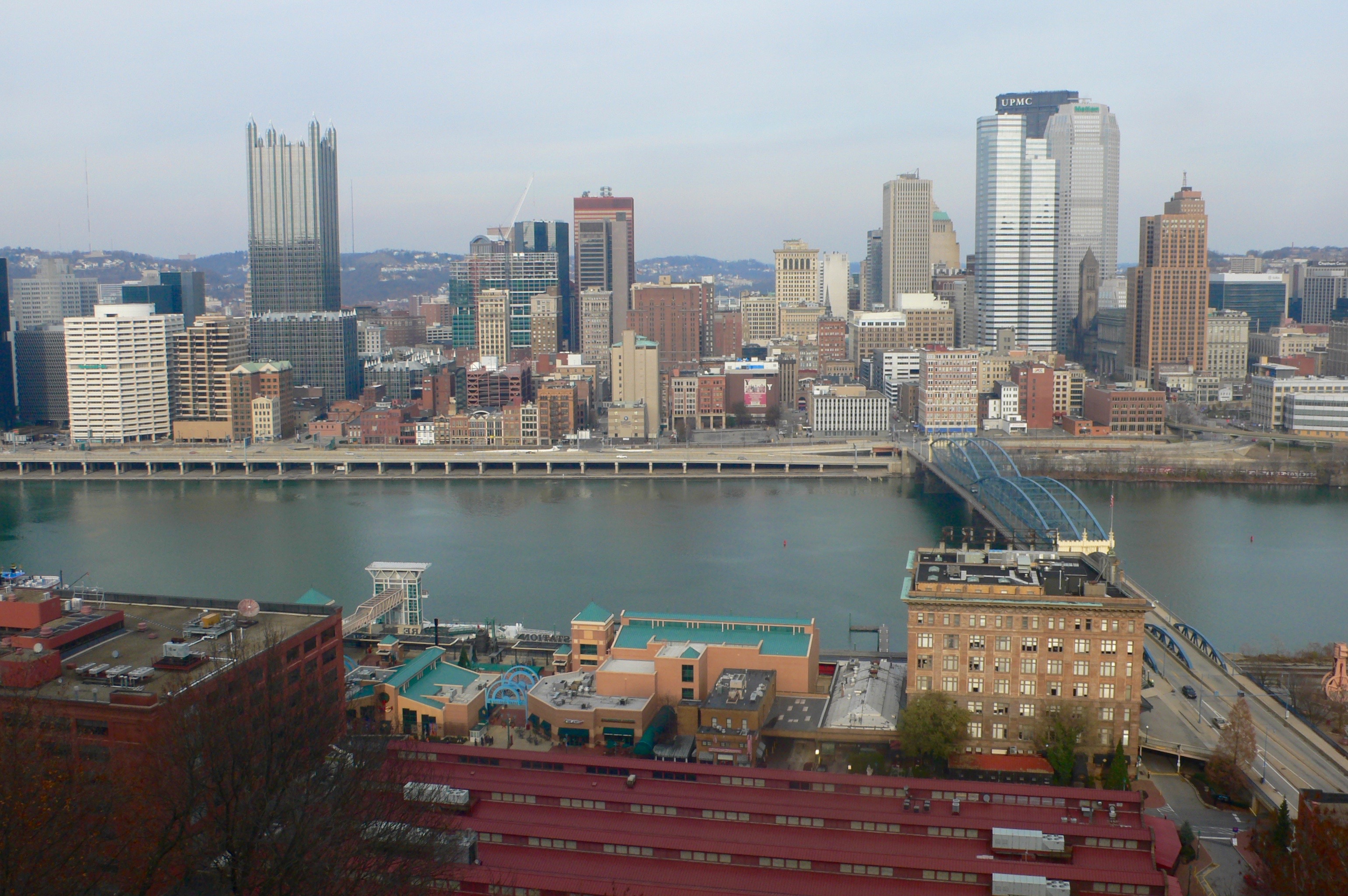
Here’s Pittsburgh.

Pittsburgh, PA

Pittsburgh, from across the Monongahela River

None of these places look like Santa Monica. Few places do. It’s funny how people here often either express fear or hope that Santa Monica is going to become something it isn’t or change from something it’s never been to something it will never be when it would take an awful lot of change to make Santa Monica something fundamentally different from what it is.

• • •

I may have taken a vacation, but Santa Monica news didn’t. The big news was the hiring of Rick Cole to be Santa Monica’s new city manager. I was surprised and thrilled. The surprise mostly had to do with the apparent unanimity among the City Council members over the choice of Cole, in particular the enthusiasm that emanated from both Mayor Kevin McKown and his immediate predecessor as mayor, Pam O’Connor. The conventional wisdom is that the two of them “couldn’t agree on lunch” (to borrow Abbie Hoffman’s explanation for why the Chicago Seven could never have conspired to disrupt the 1968 Democratic Convention), yet they both seem more than happy with the hiring of Cole.

But that just goes to show how conventional one’s wisdom, including my own, can be, which brings me to the “thrilled” part. Sure, we might, and McKeown and O’Connor themselves might, focus on dramatic disputes over what are in the big scheme of things small differences, but that doesn’t mean that both of them can’t appreciate the manifest talent and abilities of a Rick Cole.

What’s truly remarkable (but I don’t want to call it surprising) about the decision to hire Cole is that the council members must know that they are getting someone who has ideas, and ideas that go beyond balancing budgets and negotiating contracts. In Santa Monica, city councilmembers usually like to be the idea-generators. It’s a good thing that they are open to someone who has that vision thing.

What are those ideas? I can’t predict what Cole will come up with next, but going back to the ’80s, in Pasadena, Cole was one of those who started imagining what a post-sprawl city could and would look like. He was one of those people who didn’t believe that our civilization was inexorably doomed to take the form of freeways and shopping malls. As it happened, at the time there were people thinking the same way in Santa Monica, and the rejuvenations of the Pasadena and Santa Monica downtowns reset the thinking for the future of Southern California.

At the same time, the council’s decision to hire Cole must have been made easier because his values (and as anyone who was spent even a little time with Cole will tell you, values mean a lot to him) are in sync with those of the council members.

What are those values? Simply put, and I’m basing this upon the work he has done in his career, Rick Cole cares about the well being of people. While this includes what is usually included in phrases like “livability” or “quality of life,” Cole extends his caring to those who don’t necessarily have the luxury of merely worrying about the quality of their lives. Social justice and a helping hand to those who need it have been part of Cole’s agenda wherever he has worked in government.

Along with ideas and values, Cole has a level of experience, as a city councilmember and mayor in Pasadena, as a planner, as a city manager in Azusa and Ventura, and most recently as a deputy major in Los Angeles, that isn’t matched by anyone in municipal government in (at least) Southern California.

Cole believes in the potential of government to solve problems, and it’s not surprising that Governing magazine once named him a public official of the year. This doesn’t mean, however, that Cole believes that government solves problems alone, or from the top down. Wherever Cole has worked, he has been known for not only being a great listener, and for getting members of the public to listen to each other, but also for pushing for small-scale actions that residents and volunteer groups can take themselves.

It’s refreshing to know, or to have confirmed, that the members of the Santa Monica City Council, however they may disagree about one thing or another, can agree on Rick Cole.

“Are we there yet?”

With the Santa Monica City Council’s action last week approving the new zoning ordinance, leaving only a pro forma second reading to finalize the new law, it looked like eleven long years of planning would soon come to an end. The light at the end of the tunnel was finally more glare than glimmer.

Slow down. We’re not there yet. Just when you think it might be safe for Santa Monica government to spend more time and resources on something other than responding irrationally to bad traffic, the anti-development group Residocracy is contemplating, dare I say threatening, a referendum on the zoning ordinance.

That glare that looked sunny turns out to be oncoming headlights.

According to a Lookout article headlined “Santa Monica Slow-Growth Groups look to Public Vote on Development Issues,” Residocracy is polling its members on whether they want to take to the street to gather signatures to overturn the new zoning law, and the group’s founder Armen Melkonians expects they will say yes. (Who’s going to say no?)

Melkonians told the Lookout that the new zoning, though approved by the council’s anti-development majority, “‘still creates density.’” “‘Are we going to grow Santa Monica,’” he asked, “‘so it doubles its population?’”

Well, the answer to that question is no, or at least not until a few generations or even centuries have passed. I mean, even if Santa Monica adds all of the 4,955 housing units predicted under the LUCE by 2030, that’s only about a 10 percent increase in the city’s stock of housing units. That’s unlikely even to result in a 10 percent increase in population, however, because for decades the average number of people living in each housing unit in Santa Monica has been in decline.

Even if—as Melkonians fears—Santa Monica should add more than 4,955 units, say, twice that many, by 2030, a 20 percent increase, and even if each percentage point increase in units translated into a percentage point increase in population, well, can someone do the math? How long would it take to double the number of housing units if there was a 20 percent increase every 20 years?

In any case a while, but any significant population increase is unlikely. To give some perspective, Santa Monica’s population in 1970 was 88,289. In 2010, after decades of purported “massive overdevelopment,” it was 89,736. (I know that estimates since the 2010 census have added a few thousand more residents, but the history of those population estimates is that they get debunked when the decennial census comes around. The estimates focus on the number of housing units, but historically haven’t take into account how many young Santa Monicans leave town each year rarely to return.)

Okay, I get it—surely Melkonians was being rhetorical. But that’s what happens when you start asking people to sign petitions. If the first casualty of war is truth, then the first casualty of a local referendum campaign must be any sense of reality.

Residocracy isn’t the only group talking about going to the voters. The Santa Monica Coalition for a Livable City (SMCLC), Santa Monica’s more establishment, less populist, anti-development group, is considering a Version 2.0 of the “Residents’ Initiative to Fight Traffic (RIFT), their unsuccessful 2008 initiative. SMCLC wants to give voters a veto over “large projects.”

Based on an open letter to supporters that SMCLC leadership published last week, it does not appear, however, that SMCLC wants to join in an effort to overturn the zoning ordinance. For now at least, based on the letter it appears that SMCLC leadership is celebrating the new law, and especially the reductions in the scope of the LUCE, as the product of the anti-development majority SMCLC helped elect last November.

This makes sense, since the SMCLC leadership has long ties to councilmembers Kevin McKeown and Ted Winterer and they view the new zoning law as an achievement.

But indications are that SMCLC wants to bring back a new version of RIFT. SMCLC has never trusted the City Council or planning staff, and according to the letter to supporters, “large projects must be subject to a resident vote.” SMCLC’s co-chair of SMCLC, Diana Gordon, told the Lookout that the group would support a measure like RIFT. SMCLC touted the fact that RIFT garnered more than 18,000 votes in 2008. (The problem for SMCLC was that nearly 51,000 Santa Monicans voted that year.)

Of course, as Melkonians acknowledged to the Lookout, the point of having votes on developments is to scare developers away. While according to him, “only the best projects would go through,” the opposite is true. Developers and landowners will build to the lowest common denominator, slicing and dicing their projects to slip under whatever the voter-approval threshold is. It’s strange to hear a group like SMCLC, which I believe honestly wants better projects to be built, promote voter control as a way to get them.

SMCLC blames RIFT’s loss in 2008 on, as Gordon told the Lookout, its being “‘outspent in a deceptive opposition campaign.’” “Deceptive” is in the eye of the beholder, but the last several elections, notably the votes in 2014 on Measures D and LC, if anything show that money doesn’t mean much in Santa Monica elections. Beyond the merits of any thing or person on the ballot, endorsements are what count. In 2008 most of the well-respected elected officials in and around Santa Monica opposed RIFT, and SMRR was neutral.

Promoters of new anti-development referendums, whether to overturn the zoning law or to make developments subject to popular vote, would no doubt base their campaigns on their conviction that the views of voters have changed.

We’d find out.

Thanks for reading.

Can Santa Monica regulate emissions at SMO? Let’s find out.

Even if planes and jets made no noise, emitted nothing harmful, and never crashed, I’d still want to close Santa Monica Airport (SMO). Why? Because the airport and its mile-long runway, which the City owns, should be a public park and cultural facility that everyone can use instead of a privatized facility that benefits only a few users of private planes and jets. For this reason, I haven’t spent a lot of time analyzing technologies that might make the airport a better neighbor by making flying over neighborhoods less objectionable, such as by making aircraft quieter or cleaner. I’ve been more interested in figuring out how to close the airport to build the park.

As we know, however, closing SMO is complicated, because of the regulatory powers of the Federal Aviation Administration (FAA), not mentioned a tangled legal history. Briefly put, the City’s position is that as of July 1 it will have the right to close SMO, but proving that in court is difficult. If the City simply tries to close SMO, or does something the FAA considers equivalent to closing it, the FAA will likely get an injunction freezing the status quo, and begin its own administrative proceedings, where it has all the advantages, to determine the City’s rights.

The City wants the issue adjudicated in federal court, where the playing field will be more level. For that purpose the City brought a case in federal court in 2013 seeking a “declaration” of what its rights are. The FAA, not eager to have an independent federal judge decide the issue, got the case dismissed on procedural grounds. The question whether the City can get a decision from a federal district judge is now being decided in the Ninth Circuit Court of Appeals, with a decision not expected until 2016.

In the meantime, the City Council in March gave direction to staff to take various actions after July 1 designed to limit impacts of aviation uses at SMO and to enhance non-aviation uses—notably by converting twelve acres currently being used for aircraft tie-downs into parkland and by allowing non-aviation uses on the south side of the airport to negotiate longer term leases for the use of city-owned properties.

One thing the City Council did not do was follow a recommendation from the Airport Commission to add limits on aircraft emissions to leases to aviation businesses. The council followed the advice of City Attorney Marsha Moutrie, who gave her office’s opinion that federal legislation preempted any action the City would take regarding emissions. The commission and other supporters of emissions controls have, however, made the counter-argument that provisions in the City’s 1984 settlement agreement with the FAA allow the City to regulate emissions if the City acts before the 1984 agreement expires on July 1.

Now, however, City Councilmember Terry O’Day has put the issue back on the council’s agenda: he’s added an item for tomorrow night’s council meeting requesting consideration of an ordinance and leasing standards that would limit allowable emissions of air pollutants from aircraft and other sources at SMO.

I am a lawyer, but I’m not going to pretend to know enough about federal preemption law and the specific laws applicable to aviation to venture an opinion about who is right on the preemption issue. However, I’m not surprised O’Day is bringing this up.

O’Day is a veteran of the environmental movement. I remember him telling me, during the election campaign in 2012, before the City had decided on the bold move of suing the FAA in federal court, that he thought that pollution controls, which have greatly expanded in importance since the City battled the FAA in 1984, could be the City’s ultimate card to play against the FAA. Environmental science has shown how pollutants in the air are more dangerous than previously thought. As O’Day has reminded me, the need to reduce the negative health impacts of air pollution is what gave the environmental movement the ammunition it needed to begin to force the clean up the ports of Los Angeles and Long Beach.

Again, sorry, no opinions here on what can or should be done. Like a lot of people I’ll be listening to the discussion. If I can, I’ll try to sort things out in a future blog.

• • •

Speaking of the airport, and battles over the airport, readers will probably recall that after the aviation industry filed its initiative (ultimately called Measure D on the 2014 ballot) to take control of SMO away from the City Council (and for all practical purposes preserve the status quo there forever), a group of eleven Santa Monica residents went to court to try to prevent the initiative from reaching the ballot.

It was a well-motivated move, but one that ultimately foundered because it turns out that it’s near impossible to prevent a measure with enough signatures from getting on a ballot in California. Even worse, a judge ordered the plaintiffs to pay $31,525 to reimburse some of the aviation industry’s legal fees, on the grounds that the lawsuit prejudiced the industry’s rights to free speech. This is a hardship for many of the plaintiffs, and for a couple of months a campaign has been underway to raise money to help them pay the bill. (As it happened, of course, Measure D lost big at the polls (after the aviation industry spent almost $1 million exercising its free speech rights!), but that doesn’t help the plaintiffs out—they are still on the hook.)

It now turns out you can help out the plaintiffs and get some fine art for your walls.

On May 3 the Santa Monica Eleven launched an online art auction that runs two weeks—until May 17.

Renowned artists, painters, photographers, and sculptors from Santa Monica, Venice and London, have furnished artworks for the auction. These works include Laddie John Dill’s Ariel Perspective, Gregg Chadwick’s The Hum of Time and Steve Bernstein’s The Roofs of Rye, as well as cartoons from award-winning satirist Tony Peyser. And a lot of other good stuff at prices for any art collector’s budget.

To view the art and take part, click here.

Remember, though, the auction closes this Sunday, May 17.

To donate to the Santa Monica Eleven directly click here.

Thanks for reading.