Paper Mate: Small differences, big differences

Because of a family obligation Tuesday evening I didn’t watch the City Council’s deliberations on the Hines Paper Mate project until last night, and I tried to wait before forming any opinions until I watched the hearing, because I knew there would be subtleties. (I suggest watching the video from at least the 1:50 mark; the press coverage of the hearing has also been good, with the most detailed analysis coming from Lindsay Miller in Santa Monica Next. I also recommend Jason Islas’ article in The Lookout in which he collects the reactions of several former mayors – they disagree, but they all have important things to say.)

What I learned from watching the meeting was that the council was even more closely divided than the 4-3 vote indicates, and that the obstacle to a broader agreement that would have garnered five or even six votes turned out to be fear of violating the California Environmental Quality Act (CEQA). To see how close the councilmembers were to reaching a compromise, one needs to follow the motions the councilmembers made.

Councilmember Kevin McKeown made the first motion, which was to return the project to staff to study turning the entire project into residential, with only ground-floor retail as commercial development. This was the proposal that former mayor Denny Zane and Santa Monicans for Renters Rights have been suggesting.

While McKeown’s motion was dead on arrival for various reasons, it’s significant that he did not call categorically for a reduction in the size of the project. He did say that he wanted to see a project that would generate no net new car trips, but he pointed out that office development, on a square footage basis, produces three times the traffic of housing; it is conceivable that an all residential/ground-floor retail project at the 765,000 square feet proposed in the plan would not generate more traffic than what would be generated if the existing factory were turned into offices.

So, McKeown recognized that considerable development was appropriate for the site, and he wasn’t necessarily calling for a down-sizing. Nonetheless, the motion was never going to get four votes, and for at least a couple of reasons.

The first was that at least four council members believe that the project is better with some office development and, as Councilmember Gleam Davis pointed out, no one during the updates of the Land Use and Circulation Elements (LUCE), including, by implication, McKeown, had called for development in Bergamot to be 100% residential.

The second reason McKeown’s motion was DOA turned out to be the crucial factor in the whole debate, namely that changing the plan in any significant way would cause so much delay that a majority of councilmembers believed that the whole project would be in jeopardy. They feared that Hines would throw in the towel and reoccupy the factory site, thus stymieing the redevelopment of the area pursuant to the LUCE and the recently passed Bergamot Area Plan.

To a significant extent this problem was a result of the failure, as identified by former mayor Michael Feinstein in the aforementioned Lookout article, of the City to have had a more residential project evaluated under CEQA and negotiated with the developer. But beyond that, something was missing at Tuesday night’s meeting that would have been necessary to alter the project: any negotiation with the developer. If you have watched City Council deliberations on development agreements before, you know that there are typically several moments when the developer’s attorney asks for time to consult with his client, and then informs the council what changes in the agreement his client would agree to.

I wasn’t in the room, but from the video none of that seemed to happen Tuesday night, which makes me think that the councilmembers who were concerned about delay had grounds to believe that there was not going to be much more negotiating. But neither could they assure Hines that what they decided on Tuesday night would be approved later.

This problem about certainty became even more apparent with a motion from Councilmember Ted Winterer. Winterer proposed changes to the project that I and many others would have liked to see: he proposed restricting office development to one building, essentially replicating the square footage that now exists in the factory, and converting the second proposed office building into housing. This would have made all added square footage, and 70% of the whole project, residential.

It appeared that Winterer’s motion could have garnered four or even five or six votes, but it was staff’s view that it would take months for environmental review for this new configuration, and there was no way for the council to approve the plan before then, meaning that council couldn’t close a deal. The motion lost 5-2. (McKeown voted against it because he thought the project would still have too much office.)

Winterer’s motion was particularly significant because when he and Councilmember Tony Vasquez, who both ultimately voted no on the project, voted yes on the motion, they voted yes on a project with the full 765,000 square feet. The was reminiscent of what happened at the Planning Commission, where Richard McKinnon, Susan Himmelrich, and Jennifer Kennedy, commissioners who all ultimately voted no on the project, all voted in favor of a similar, “full-sized but more residential” proposal that McKinnon made.

With all the charges flying around about developer campaign contributions corrupting the four council members who voted yes, the fact is that because of the many virtues of this project as a whole, virtues that are well known to the council members and the planning commissioners, two councilmembers and three planning commissioners whom the anti-development side supports voted for a project that is only marginally different from the project that passed. (In fact, the project that passed has increased levels of affordable housing because of amendments Councilmember Gleam Davis proposed.)

When Winterer’s motion failed, it was Davis who made a last-ditch motion to try to garner more than a four-vote majority. Her proposal did what neither McKeown’s nor Winterer’s did: she moved explicitly for a reduction in size, by removing about 42,000 square feet of office development and not replacing it with housing. She did this in hopes of picking up one or two more votes, but neither Winterer nor Vazquez supported her.

Well, maybe they would have if that motion had come to a vote, but it all became moot because staff, even though the environmental review would take less time since the project was only being reduced in size, could not find a means for the council to approve the project with the reduction before all the documents and plans were changed to reflect it. A majority of councilmembers were concerned that without any certainty of approval Hines would reoccupy the factory and there would be no deal.

What we saw Tuesday night was a failure of CEQA and the triumph of form over substance. The purpose of CEQA is to give decision-makers data relating to the environmental impacts of their decisions, and, sure enough, the councilmembers were well aware from environmental review of the relative impacts of office and residential development. They had plenty of knowledge on which to base a decision to increase the amount of housing.

In the view, however, of the City Attorney and planning staff, CEQA would not have been satisfied, or, and this was important, at least not satisfied enough in the face of expected litigation. In effect, it’s not sufficient for the councilmembers to base their decision on what they know from environmental review if what they learned didn’t originate precisely within the scope of the environmental review. CEQA, instead of protecting the environment, became an impediment to the council’s adopting an alternative that would have had less impact than the plan the council approved.

In the end, a bare majority of four councilmembers approved the project, as modified in certain respects, including to increase affordability.

At the heart of this approval was the LUCE, and it was clear that the four councilmembers of the majority believe in what the council did when it unanimously adopted the LUCE in 2010, calling for development of considerable office space in Santa Monica’s former industrial areas. They believe that more offices near the light rail will help with traffic in the long run. I suspect they also believe that Hines played by the rules, developing a project in accordance with the LUCE ratios, and that it wouldn’t be fair to change those rules now.

Mayor Pam O’Connor also made the point that 82% of Santa Monica residents who work, work outside the city, and that we can also reduce traffic by locating jobs nearer to them. True, but we all know the traffic pattern that is the worst is the inbound in the morning and outbound in the afternoon. Perhaps the most reassuring comment for those of us who believe we need more housing in the area instead of offices came from Councilmember Terry O’Day, who pointed out that none of the 33 currently pending development agreements propose any offices.

While by Santa Monica standards the Paper Mate project is a big development it will add only about 150,000 square feet of office development on top of the square footage of the existing factory, while building almost 500 units of housing. There are millions of square feet of office in the area and more elsewhere on the Westside, and 150,000 square feet aren’t going to make a big difference. In square footage terms, 70% of the net new development is residential.

Still, the battle lines are being drawn, there is talk of a referendum and everyone expects a nasty election in November fought over development issues. Freud has that expression I like so much, “the narcissism of small differences.” When I consider how small the difference was between the proposal Winterer and Vazquez voted for and the plan that passed, and when I reflect on the fact that McKeown at least contemplated a 765,000 square foot project with his motion, I start to think of Freud.

Thanks for reading.

Money and politics: when it’s okay and when it’s not for the twain to meet

Tomorrow night City Council will deliberate Hines’ plan to redevelop the Paper Mate factory site and the development agreement that would allow it to happen. In December, after the Planning Commission’s 4-3 vote to approve the project (with significant conditions) I wrote a blog about what I thought should happen, namely a final negotiation at the council level to reduce the amount of offices and increase the amount of housing. Since then nothing I’ve heard or read has changed my views (although I acknowledge that there are many levels of detail I haven’t addressed, but then that’s what’s great about being a blogger).

In the meantime another issue has arisen: the demands of some, made several times during last week’s public hearing, that Mayor Pam O’Connor recuse herself from the Paper Mate vote because seven years ago she accepted campaign contributions from Hines executives to help retire the debt leftover from her 2006 reelection campaign.

Contributing to the passions aroused by the contributions is that everyone predicts that O’Connor will vote in favor of the project in some form or another; if she recused herself, that, in effect, would be a “no” vote. Opponents of the project would like this; they also want to embarrass O’Connor, as they consider her too friendly to development. Supporters of the project and the kind of transit-oriented development it reflects, feel the opposite and have come to O’Connor’s defense.

The prediction that O’Connor will support the project is based on evidence both general and specific.

The general evidence comes from O’Connor’s consistent record over 20 years, not only on the council but also in regional positions such as the boards of Metro and as service as President of the Southern California Association of Governments, of supporting urban in-fill development projects, particularly those, like the Paper Mate project, that are near transit and promote walkability.

More specific evidence that O’Connor is likely to support the project comes from votes and public comments directly relating to Paper Mate. These came not only when, in 2011, the project had its float-up hearings at the council (when Hines dropped from its proposal about 200,000 square feet of office development), but also in connection with the years of planning and votes that went into the updates to the land use and circulation elements of the general plan (the LUCE), which the council approved in 2010, and more recently into the Bergamot Area Plan (BAP), which the council passed last fall.

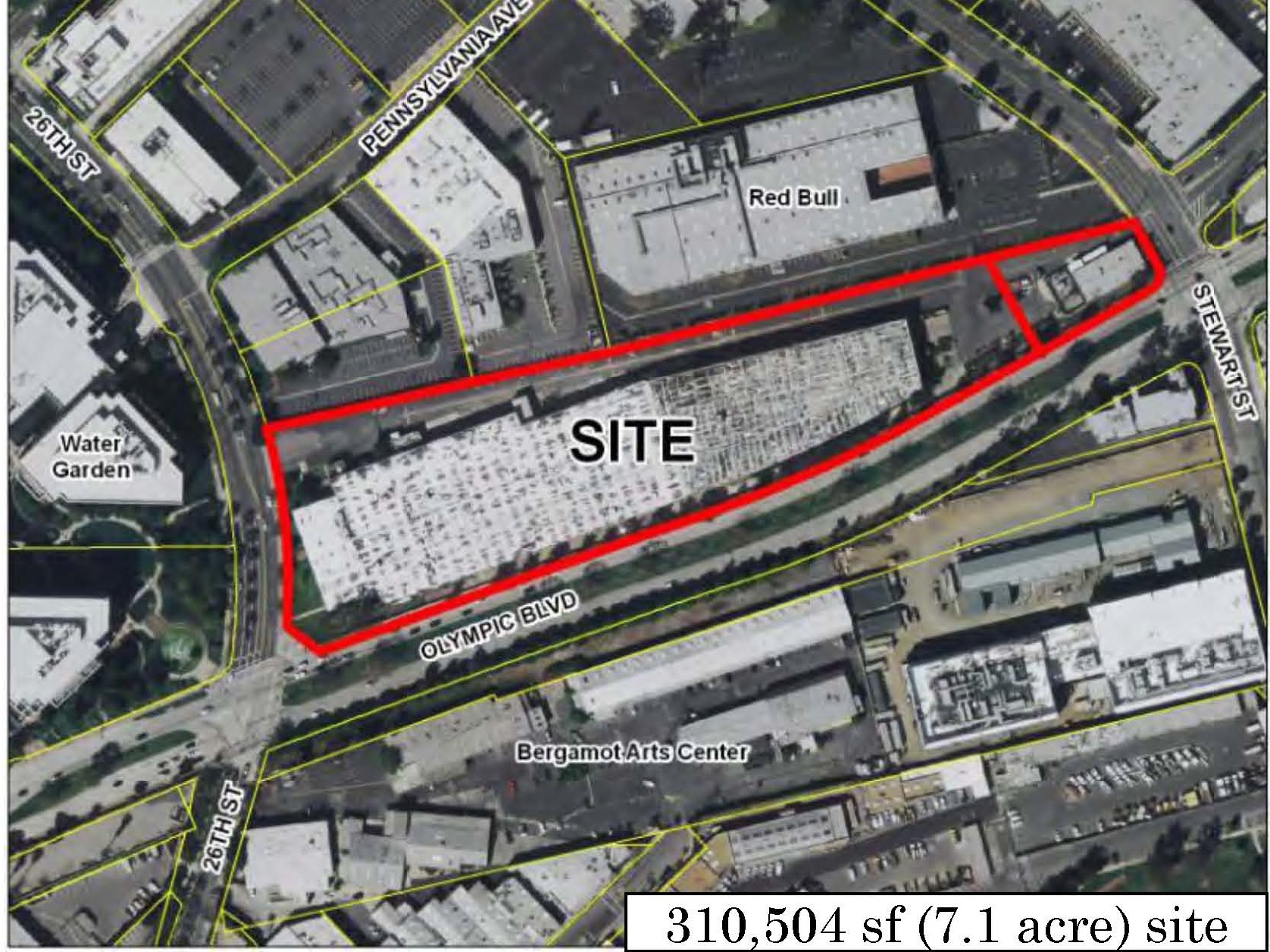
Both the LUCE and the BAP were developed with the Paper Mate site in mind: the 310,000 square-foot property, sitting directly across Olympic Boulevard from the future Bergamot Expo station, is the crucial site for connecting the old industrial properties north of Olympic to the station. More generally, the fundamental bargain in the LUCE was to channel future development away from existing neighborhoods and into Santa Monica’s former industrial zones. O’Connor voted in favor of both the LUCE and the BAP—not surprising, since they represent the urban principles she has supported.

Also not surprisingly, the Hines plans for Paper Mate more or less follow the LUCE and the BAP.

The Paper Mate plant back in the day. (Photo credit: Santa Monica Public Library Image Archive_

The Paper Mate plant back in the day. (Photo credit: Santa Monica Public Library Image Archive)

So what does this have to do with the contributions from Hines executives to pay off O’Connor’s 2006 campaign debts? There’s a fine line in American politics—the whole system depends on candidates being able to raise money to run campaigns (otherwise only rich people could run for office) and naturally candidates will collect more money from contributors who believe that the candidate, once in office, will make decisions that benefit the contributor (either indirectly or directly). Think about it—on a national basis, businesses give money to Republicans, and unions give money to Democrats, and both sides believe that the other side’s contributors consequently have undue influence.

So where’s the fine line? Well, it’s okay for a candidate to collect money from contributors who agree with the candidate in general and expect good things from the candidate’s election, but it’s not okay to collect contributions in return for the promise of a specific benefit.

The question is, then, what’s more likely: did the Hines executives make their contributions to O’Connor’s campaign in return for a promise to vote for their Paper Mate proposal (which, although talked about previously, wasn’t submitted to the planning department until May 2010), or because they believed that O’Connor already held principles about how to develop the industrial areas of Santa Monica that would allow for redevelopment of the site?

It’s worth keeping mind that Hines in 2006 was not a newcomer to Santa Monica—it had already developed its Lantana entertainment office complex on Olympic Boulevard, which had had its development agreement approved just a few years before.

I suspect you can tell where my own answer is heading—it’s unlikely to me that the Hines executives made their contributions for a quid pro quo on the specific Paper Mate project, but highly likely that they did so knowing that O’Connor believed in policies for redevelopment that meant she wouldn’t want to see the old factory stay there.

In any case, since the council voted 7-0 in favor of the LUCE, which itself emerged from a long public process (and was quite popular when it passed), and 6-1 in favor of the BAP, is it plausible to tie O’Connor’s support for the redevelopment of the Paper Mate site along the lines proposed in the LUCE the BAP to undue influence from the developer? She didn’t vote any different from the other council members who supported the plans.

Aye, and there’s the rub, because, to inject a bit of substance into this post about politics, the LUCE and the BAP are flawed in that they call for too much office development in the area. The City’s planners and consultants believed in good faith that adding more offices near the Bergamot Expo station would both increase transit ridership and aid the city’s economy, and the council members took their advice, but given the morning inbound and afternoon outbound traffic problems, it was predictable that adding any more commuter traffic would fail any traffic analysis.

I don’t know if it would require an amendment to the LUCE, but the final negotiations, from the dais tomorrow night if need be, should be to reduce the amount of office development in the project to no more than the existing square footage of the Paper Mate factory, and increase housing, which does not add to the morning and afternoon gridlock.

Thanks for reading.

Santa Monica vs. FAA: By their words shall ye know them

As someone who wants to turn Santa Monica Airport into a big park, I have been following the lawsuit that the City of Santa Monica filed against the Federal Aviation Administration (FAA) to confirm that the City controls the airport land and will have the right to close the airport after July 1, 2015, when the current, 1984 settlement agreement with the FAA expires.

As discussed in my post a couple of weeks ago, in response to the lawsuit, the FAA filed a motion to dismiss it on jurisdictional and procedural grounds. This weekend I read the City’s response to the motion. (The motion will be heard February 10 in federal court in downtown Los Angeles.)

While the federal government moved to dismiss on various grounds, the most fundamental one was that the City’s claim was barred by the 12-year statute of limitations of the federal “Quiet Title Act.” According to the feds, the City’s claim is too late because the City should have known decades ago that the federal government was claiming an interest in the title to the property under the 1948 Instrument of Transfer (IOT) that returned control of the airport to the City after World War II.

As readers will recall, the FAA is relying on a clause in the IOT in which the City agreed to operate the airport in perpetuity. However, there was no consideration for this agreement, nor is there any way for the government to enforce it.

The City’s response to the motion doesn’t add much new information that was not contained in the its original complaint, but reading it brought home how preposterous it is that after all these decades the FAA is arguing that Santa Monica can’t close the airport because of the IOT.

This graphic shows the sizes of all existing Santa Monica parks at the same scale as what could be the park to replace the airport.

This graphic shows the sizes of all existing Santa Monica parks at the same scale as what could be the park to replace the airport.

In fact, it was only in 2008 that the FAA, which I suspect had begun to panic when it realized that 2015 was coming up in less than 10 years, dredged up the IOT’s perpetuity clause. Before then FAA administrators and lawyers must have looked at the history and the law and realized that this argument didn’t have a wing or a prayer.

Why do I say that? Because the city’s response highlights several documents from past decades where the FAA declared the obvious, that the City had the authority to close the airport. For instance, in 1971 (only 23 years after the 1948 IOT) the FAA wrote the Aircraft Owners and Pilots Association to tell them that once Santa Monica no longer had obligations arising from funding provided by the FAA, the airport would be “vulnerable to being discontinued and used for non-aviation purposes.”

As discussed previously, the 1984 settlement agreement clearly states that the City is only obligated to continue operations at the airport until the 2015, but to remove any doubt that this means precisely what it says, in 1998 the FAA issued a determination that the 1984 agreement “makes clear that the City is obligated to operate the Airport only for the duration of the [agreement]… To the extent that [pilots] seek to prevent the future closure of the Airport . . . that is a local land use matter.”

“A local land use matter.” Wow.

In 2003, at the conclusion of the same proceeding, the FAA ruled that the 1984 agreement only required the City to maintain the airport’s “role in the National Airport System as a general aviation reliever airport until July 1, 2015.”

The City’s point is that only in 2008 when the FAA changed its tune was the City put on notice that the FAA had designs on the land, and that the 12-year statute of limitations only started running then.

Not only does this argument seem obvious to me, but also, regardless how the judge rules on the motion, one has to wonder, when and where this dispute ultimately ends up in court, how will the U.S. Attorneys defending the FAA try to explain away the FAA’s own admissions that on July 1, 2015, the City of Santa Monica can close down Santa Monica Airport.

Thanks for reading.

Gathering the tribes to celebrate labor victories in Santa Monica

Last week there was a party in Santa Monica to celebrate a remarkable success: that of the labor movement in our city. The event, called “Celebration with a Vision,” was low key but inspiring — a few speeches, some rousing songs, and sitting down together for dinner. It took place Wednesday evening at the Unitarian Universalist Church on 18th Street. The purpose was to take stock of and satisfaction in the victories the hotel workers union, UNITE HERE Local 11, has achieved in Santa Monica, most recently the agreement the union signed with OTO, the developers of the two hotels coming to Fifth and Colorado, to allow the future workers there to unionize without interference from management.

The victories are the result of a 19-year long process that had its ups and downs.

The event was, as City Council Member Kevin McKeown described it in an inspiring address, a “gathering of the tribes.” Nearly all those attending were, as either union members and staff or members of the union’s support groups in the community, veterans of a long and now seemingly successful struggle to make Santa Monica, at least with respect to hotels, a “union town.”

That struggle began inauspiciously in 1995 when the management of what was then Santa Monica’s only unionized hotel, the Miramar (then a Sheraton), sought to “decertify” their workers’ union by filing petitions with the National Labor Relations Board (NLRB) for a decertification election. The NLRB ultimately determined that the hotel used unfair labor practices to call the election (by paying three employees to file the petitions) and invalidated the vote, but in a hostile environment of forced meetings with hotel management and union-busting consultants, hotel employees, in 1997, narrowly voted for decertification.

It was from this momentary defeat that the current labor movement in Santa Monica arose. The hotel workers union reached out for support to the Los Angeles Alliance for a New Economy (LAANE), which helped organize a local community organization, Santa Monicans Allied for Responsible Tourism (SMART), to help gather support for hotel workers in the community. Together with another organization, Clergy and Laity United for Economic Justice (called CLUE), SMART publicized the difficulties hotel workers had earning enough to support themselves and their families, and how few rights they had vis-à-vis not only the union busting Miramar Sheraton, but also the other hotels in the city, none of which were unionized.

As mentioned above, the union ultimately had the decertification election thrown out because of hotel management’s unfair labor practices (in a replay of the vote the union won in a landslide), but in the meantime new owners bought the hotel and they had no problem recognizing the union and signing a new collective bargaining agreement, rendering the NLRB proceedings moot.

Ironically, it was the anti-union activities of the Miramar Sheraton that mobilized both the union and the community. The union and its allies at SMART, LAANE and CLUE focused on enacting a living wage that would cover workers at the big local hotels in the coastal zone where existing hotels had financial advantages because Prop. S, enacted by voters in 1990, prohibited the building of new, competing hotels. (Municipal governments have limited power over labor relations, since federal labor law controls, but they can enact minimum wages.)

The battle over the living wage spawned two ballot measures. The first was KK, a measure the hotels put on the ballot in 2000 that would have prevented the City Council from enacting a living wage that applied to hotels. KK lost badly — the pro-worker movement received crucial support from Santa Monicans for Renters Rights (SMRR), whose council candidates were also under attack from the hotels.

The second ballot measure was JJ, in 2002, which came after the council passed a ground-breaking living wage ordinance — the first in the nation that targeted workers in businesses that did not have a business relationship with a city or other governmental entity. The hotels gathered enough signatures to put ratification of the living wage on the ballot, and JJ was the result (a vote for JJ was a vote for the living wage).

The 2002 election, the first after 9/11 and during a recession, was a conservative election all over the country. Nevertheless, polls showed JJ passing until the hotel PAC, which had practically unlimited funding, unleashed a flurry of misleading mailers the weekend before the election to confuse voters, and JJ narrowly lost. The living wage was defeated.

But the union movement in Santa Monica was only getting started. Aided by the City Council, which insisted on including a “labor peace” clause in the ground lease for the Viceroy Hotel (which sits on city-owned land), the union signed an agreement in 2000 making the Viceroy Santa Monica’s second union hotel. Then in December 2002, just weeks after JJ’s defeat, the union had an even bigger victory, signing the Loew’s Hotel on Ocean Avenue to a union contract.

A union contract followed for what is now the Sheraton Delfina on Pico Boulevard, which had the same management as the Viceroy.

From one embattled union hotel in 1995, Santa Monica now had four unionized hotels representing 50% of the city’s existing luxury hotel rooms. Starting wages for hotel housekeepers in the area also had increased from $7.25/hour when the organizing campaign began to $11.25.

New hotel development proposals returned to Santa Monica in 2007 with a proposal to convert the landmarked office building at 710 Wilshire, and construct an addition, to build a 284-room hotel. The 710 Wilshire project reached the City Council in 2012. The union and its community allies pushed the City Council to require a living wage of $14.97 for the project.

While the council, on approving the project, made precedent by requiring a living wage, the wage was less than $14.97. The union in April filed papers to gather signatures for a referendum to challenge the development agreement for the project, but shortly afterwards, the owner of the 710 Wilshire project reversed course and contacted Local 11 to negotiate a settlement. The developer and the union then negotiated a neutrality agreement for the project, which means that once the hotel is operating management won’t try to block the workers from unionizing.

Since the end of the Great Recession and the rebound of the economy and tourism industry, five new hotels, in addition to 710 Wilshire, are being proposed for downtown Santa Monica. The first of these were the two “mid-priced” hotels proposed by OTO for the corner of Fifth and Colorado. While originally OTO took the position that a union contract was incompatible with a mid-priced hotel, in the face of organizing by Local 11 and its community allies, and after long negotiations, the union and OTO successfully negotiated a neutrality agreement just before the hotels came before City Council in November 2013. The City Council unanimously approved the hotels.

While each of the other three proposed hotels have unique issues that complicate their developers’ negotiations with the union, and as a result those negotiations will no doubt be long, and while each project has development issues to deal with, all three developers have announced their intention to enter into neutrality agreements with the union. Looking back to 1995, this is an earthquake in the relationship between management and labor in Santa Monica.

It’s that earthquake, and the long struggle that led to it, that “the tribes” were celebrating last week. Take note that if in five years or so there are five or six new union hotels in Santa Monica, operated by topflight hotel companies, this will have national implications, putting the lie to the constant right-wing refrains that union rights are incompatible with topflight economic development and that service workers won’t unionize.

Meantime, it’s impossible not to give some credit to the 19-year struggle in Santa Monica, and others like it around the country, for the current wave of support nationally for higher minimum wages, including a $15 per hour wage for fast food and other service workers.

Yes they can.

Thanks for reading.

Local 11 lead organizer and former hotel worker Soledad Garcia speaking at the Celebration with a Vision last week

Local 11 lead organizer and former hotel worker Soledad Garcia speaking at the Celebration with a Vision last week

Santa Monica Airport litigation: The FAA’s problem is no remedy, no right

In litigation as in life people waste time trying to avoid what matters, and a good example of that was the response that the federal government filed Friday to the City of Santa Monica’s lawsuit seeking to confirm the City’s control over the Santa Monica Airport.

On behalf of the Federal Aviation Administration, U.S. attorneys moved to dismiss the City’s lawsuit on various procedural and jurisdictional grounds, including that some claims should have been filed in a different court, some were outside of jurisdiction of federal courts, and that some were not “ripe” for adjudication — as if there is no controversy yet because the City has not already sent bulldozers to tear out the airport’s runway.

In court, procedural challenges are always the first line of defense – but you have to wonder: does the FAA want Santa Monica to send in the bulldozers? This dispute is going to end up in court somewhere, sometime, and we may as well get to the substance sooner rather than later.

The substance in the case of Santa Monica vs. United States is a clause in a 1948 agreement, called an “Instrument of Transfer” (IOT), between the federal government and Santa Monica. The IOT returned the airport to Santa Monica’s control after the federal government had leased it from the City during World War II (so that the army could protect Douglas Aircraft). The feds transferred many airports to cities after the War, and the IOT’s, including the one for Santa Monica Airport, contained a clause that the cities agreed to operate the airports in perpetuity. It is the enforceability of this perpetuity clause that will determine the future of the airport land.

Because I am involved in Airport2Park.org, the movement to turn the airport into a park, friends often ask me whether I believe Santa Monica will be able to close the airport. I’m not a litigator or expert on the laws at issue in the case, and you are welcome to take what I say with all the grains of salt you want, but I believe that the perpetuity clause is not enforceable, and the courts will confirm the City’s control over the airport land.

I believe this for two reasons. I’ll admit that the first is somewhat circumstantial — it is that if the FAA could stop the City from closing the airport it would not have entered into the settlement agreement with the City in 1984 that says that the City won’t close the airport before July 1, 2015, implying strongly that the City has that right to do so.

Somewhere deep in the FAA’s collective consciousness I suspect that there was in 1984 and is today a realization that there is no way that the courts – or if not the courts, politicians – are going to require, because of a pro forma clause in a 1948 contract, that a city continue to operate, at a financial deficit, a dangerous nuisance surrounded by homes, businesses, and schools. The 1984 agreement, at a minimum, should be seen as superseding any earlier agreement. The FAA is operating from a level of desperation, something the agency is familiar with because for all its bluff it hasn’t been able to stop hundreds of airports around the country from being closed.

Even if that is not the case, and the FAA believes in its cause, the second reason the City will win is not circumstantial — it is that even if the courts reject the City’s arguments that the 1948 perpetuity clause is unconstitutional or otherwise invalid (arguments that sound good to me!), and uphold the clause, the FAA doesn’t have a remedy to stop the City from closing the airport.

And as they teach you in law school, there is no right without a remedy.

The reason the FAA doesn’t have a remedy is stated right in the government’s response, on page 12, when the U.S. attorneys state that the “operative language” in the IOT if the City doesn’t comply with its obligations (i.e., operate the airport) is that the federal government has an interest in all rights “transferred by this instrument.” This means, and the IOT is specific about this, that if the City does not comply with its obligations, the rights or property transferred to the City under the IOT can revert, at the government’s option, to the government. That is the government’s remedy — it’s not as if the FAA could obtain an injunction to require the City to continue to operate the airport. It’s the reversion or nothing.

The problem for the FAA is that there’s nothing left of the rights transferred in 1948 to revert, because all the government had then was a lease that expired long ago and equipment and improvements that are long gone. This is what makes the Santa Monica Airport situation different from the typical postwar airport transfer — the feds never owned the land. There is nothing to revert.

As I said, I don’t know anything about the procedural or jurisdictional claims in the government’s motion to dismiss, but this is a case where Santa Monica could lose every motion and every argument, and then still win in the very last sentence of the final decision of the last court that considers the case.

Thanks for reading.

Northward view at Santa Monica Airport. Imagine this a park.

Northward view at Santa Monica Airport. Imagine this a park.

Slow News Weeks for the President and Me

The New York Times reported on Sunday that the number and intensity of national and international crises over the holidays was low enough that President Obama could, for the first time since becoming president, enjoy a relaxing family vacation in Hawaii.

I felt the same way about news in Santa Monica. Sure there was news, notably the reversal by city staff on the City’s obligation to preserve the Chain Reaction sculpture, but not too much. Like the president I took a vacation (in his case, from preserving national and world order, in my case, from blogging about Santa Monica). I’ve never been to Hawaii, but it can’t be better than Santa Monica in winter.

As for what news there was, I am more than curious about what response the Federal Aviation Administration (FAA) will make to the City’s airport lawsuit. The deadline is this Friday, Jan. 10; as reported in The Lookout, Federal District Judge John F. Walter denied the FAA’s request for a longer extension of time to respond to the complaint. Notably Judge Walter accepted the City’s contention that time was of the essence, given that the City wants to know what its rights are before July 1, 2015, the date its 1984 agreement with the FAA expires.

I’m not reading any tea leaves based on that, but if the FAA moves to dismiss the lawsuit (which is what, according to the Lookout article, City Attorney Marsha Moutrie expects), there may soon be a hearing on the merits, as the City will have to prove to the judge that it has a cause of action suitable for “declaratory relief” (which means asking the court to make a decision before there is an actual conflict between the parties). How the judge would rule on that would, needless to say, be an indication about the strength of the City’s case.

One analytical thing I did do over the holidays was to try to catch up with outside reading. While Santa Monica has many unique or at least unusual circumstances, sometimes we consider ourselves more in control of what happens here than we are, and forget the context in which the city exists. I like to read about the context.

To that end, there’s a newsletter that I subscribe to called Better! Cities & Towns (BCT), which covers urban planning and development. I like BCT because while it focuses on real-world projects it also publishes articles with relevant data about what’s going on in America. The December issue was a particularly good one.

Take, for instance, the issue of making developers build more family-friendly housing instead of the singles and one-bedroom apartments they want to build. There’s a sense that this problem arises from a self-willed decision by the developers not to build bigger units — based, according to some, on greed. But what if developers (motivated, it goes without saying, by profit) were merely responding to a market for smaller units that is the result of demographic change?

According to an article in the December BCT, “Demographic Wave Transforming the Market,” that is exactly what is happening. The article presents forecasts from a new book, Reshaping Metropolitan America, by Arthur C. Nelson, a planning professor at the University of Utah who has been studying cities for 30 years. According to the forecasts, which are consistent with other studies, between 2010 and 2030 the U.S. will add about 26.3 million households, but the net number of households with children will increase by only about 3.5 million, meaning that the number of households without children will increase, on a net basis, by almost 23 million. Of that increase, nearly 14 million will be single-person households. There is also data showing that the average number of children in households with children is declining.

While these households with no or few children will be located everywhere — in cities, in suburbs, and in rural areas — due to the boom in housing in far-flung suburbs before the 2008 crash, and due to empty nest Baby Boomers vacating their homes, there is and will be a large existing inventory of family-friendly homes, located mostly in the suburbs. While some new single-family homes will be built, they can’t be built in already-developed urban areas, like Santa Monica, where all lots in R-1 zones already have houses.

This doesn’t mean that Santa Monica should not seek to get larger, family-friendly apartments and condos built, with amenities that will attract families who don’t want to move to the exurbs and can’t afford to buy existing single-family homes here from downsizing Baby Boomers. We need to make sure that Santa Monica continues to have a full-range of housing types and a community that is diverse by every standard – that diversity is part of our history and part of what makes us a great place to live. But we won’t get that unless we understand the demographic changes that make America a different place from what it was 50 years ago, and why it is that developers today can rent or sell all the small units they can build.

On another subject, some of those opposed to development in Santa Monica are so skeptical of any benefits coming from development that they assume that any politician who votes for even the most regulated developments must be on the take or otherwise beholden to developers. Many also believe that development creates costs that taxpayers have to bear. But two articles in the December BCT show how in-fill developments economically benefit cities.

One article, “Smart Growth Costs Less, Yields more Revenue for Cities and Towns,” reported on a study summarizing 17 separate studies around the country showing that infill urban development results in lower capital costs for cities, lower costs of providing services, and higher tax revenues. One study found, for instance, using data from Raleigh, North Carolina, that a six-story downtown building produced 50 times the property tax as a Walmart, and that even a three-story residential building produced more property tax than a major shopping mall.

Another article, “Per-acre Tax Advantage is Persuasive Across the Political Spectrum” shows how compact, walkable places generate higher land values and taxes per acre, and lower per acre infrastructure costs; for instance, one study showed that “mixed-use downtown development takes three years to pay back infrastructure costs, while a suburban counterpart takes 42 years.” The title of the article refers to the fact that for the first time both liberal (from the organization Smart Growth America) and conservative (from the Cato Institute) analysts are coming to the same conclusion, that the costs of both capital infrastructure and the delivery of governmental services are lower, and tax revenues are higher, in infill urban developments as opposed to suburban developments.

This doesn’t mean that development, like all economic activity in the complex world we live in, doesn’t need to be regulated, but in an era when cities are going bankrupt and even those cities that are solvent are struggling to provide services (and, yes, fulfill their real obligations to fund pensions), do you think that those responsible for a city’s budget – both politicians and staff – need to be bribed to take a look at proposals to bring more investment into their towns? Or do you think that maybe they’re doing their jobs?

Thanks for reading.

Infill development in downtown Santa Monica

Infill development in downtown Santa Monica

Taking circumstances into account

Wednesday night the Planning Commission approved a draft development agreement (DA) to allow the developer Hines to tear down the old 203,000 square foot Papermate factory on Olympic and build a 767,000 square foot office and residential project. This vote represented good work by the four commissioners who voted for the project and by the three who voted against it.

Last week’s hearing was the commission’s fifth on the Papermate project. I have heard people say that this was excessive, but it wasn’t for a project of this magnitude. I don’t remember exactly how many hearings the Planning Commission, when I was on it in the ’90s, held on the St. John’s Hospital DA, but there were many and we even had the City hire an architect to give us a second opinion about some aspect of it. It’s reasonable for the commission (and staff) to spend this kind of time on a big project — I bet that on a per-square foot basis it’s not so many minutes.

Why do I say that both the commissioners who voted for the project and those who voted against it did good work? To begin with, the entire commission worked to improve the project and achieved improvements that even the developer acknowledged. When the project goes before the Architectural Review Board, it can benefit from input there, too.

As for the four commissioners who voted in favor, in a difficult political climate they did the responsible thing and voted for a project that the city must have. It would be disastrous for the Bergamot Expo line station to have to face the massive bulk of the Papermate factory, sitting as it is on a 310,000 square foot superblock. The Papermate site is the key site for the connection of the whole Bergamot plan area to the light rail. This has been acknowledged at previous hearings before the commission and before City Council.

An aerial showing the location of the Papermate factory on Olympic, across from Bergamot Station. (From the S.M. planning staff's PowerPoint presentation.)

An aerial showing the location of the Papermate factory on Olympic, across from Bergamot Station. (From the S.M. planning staff’s PowerPoint presentation.)

It was interesting that Wednesday it was Commissioner Richard McKinnon, one of the three commissioners who ultimately voted against the project, who made this point most forcefully. McKinnon pointed out that the worst result would be that Hines would simply turn the factory into offices. If you don’t think this would happen, consider that this is what Red Bull did with another big industrial building next to Papermate. If Hines did that, we would get all the traffic of office development, with none of the residential development and new streets the area needs, and without any of the traffic mitigations and other benefits included in the DA.

What the four-person majority did was to recognize that the commission had negotiated as much as the commission could negotiate, and it was time to send the project to City Council for final negotiations. As I said, in the current climate, this took courage. But when it comes to those final negotiations, I hope it will be the ideas of the minority who voted against the project that the council will be able to use.

Going back to the six years during which the LUCE was being developed and the Papermate development was taking shape, which was when I was writing my Lookout column, I always took the view that ideally all new development in the old industrial areas would be residential (with only incidental, neighborhood-oriented commercial development). More housing is needed to balance the overwhelming amount of office development that was built in the ’80s and ’90s. (Because I’ve discussed it so often, I won’t go into here why residential development not only would not exacerbate our traffic problems but also would have many benefits.)

But ideals have to take into account circumstances, and the circumstance here, as Commissioner McKinnon and others noted, is that Hines already owns a 203,000 square foot commercial building. Moreover, even under the pre-LUCE zoning, which allowed a floor-to-area-ratio of 1.0, and I suspect now under what’s called a “Tier One” development (not that I pretend to understand the rules), Hines could add a mezzanine with about 100,000 more square feet of development inside the existing building. This would give Hines 300,000-plus square feet of office — nearly equal to all of the office development in their current proposal.

Commissioner McKinnon’s proposal was to allow Hines to build 233,000 square feet of office, plus about 30,000 square feet of retail; this would mean that 142,000 square feet of office in the plan would be converted into more housing. His motion failed on a 4-3 vote, but I don’t know if this position was ever taken up in negotiations with Hines.

I hope that planning staff (and Hines) look into something like McKinnon’s proposal before taking the DA to City Council, and, if they don’t, I hope that the council members insist they do so. But I would rephrase and remake McKinnon’s proposal slightly, for the purpose of making a deal. What seems fair is to allow Hines the 310,000 square feet of commercial development they would have under the pre-LUCE zoning (about 45,000 square feet more than what McKinnon was proposing). The rest of the project would be residential: a net change of about 100,000 square feet from commercial to residential.

Not so long ago, when the office market was stronger than the residential market, I can imagine that this would have been a deal-breaker for Hines, but I would hope that it wouldn’t be one now, given that the residential market, both for rentals and condos, is now so strong.

A lot of people (including myself!), observing the morning and afternoon gridlock generated by commuters coming into the Bergamot area, wonder how it’s possible to consider any more office development there. But the fact is — 203,000 square feet already exist on the Papermate site. I know it’s cold consolation, but 300,000 square feet of offices is not a lot when compared to the many millions of square feet already in existence in Santa Monica and West L.A., and the location across the street from the Expo line is the best place for the development.

Thanks for reading.

When art becomes history, save the history

If all politics are local, as Tip O’Neill said, that only means that politics that appear to be local, at times are not.

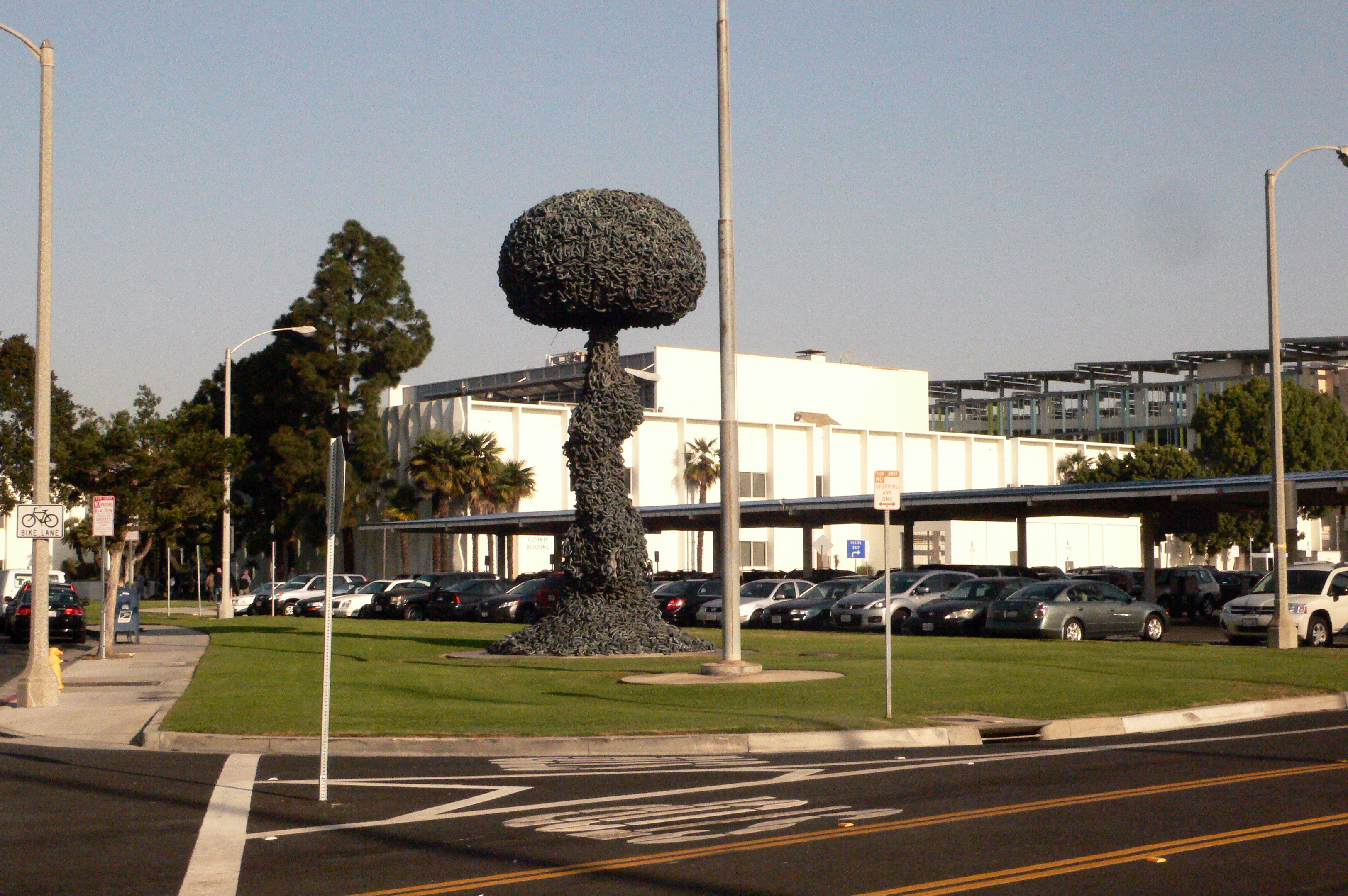
Take the controversy over what to do with Paul Conrad’s Chain Reaction, a sculpture that has stood in a triangle of grass in Santa Monica’s Civic Center, wedged between a parking lot and a drive-by stretch of Main Street, for more than 20 years.

Chain Reaction before the fence went up.

Chain Reaction before the fence went up.

About two years ago a City staffer saw children playing on the sculpture, became alarmed, and all of a sudden — even though an engineer’s report later determined that the sculpture was in no imminent danger of falling down — City staff was saying that Chain Reaction had to go unless hundreds of thousands of dollars could be raised — privately — to restore it.

In the aftermath, the Landmarks Commission declared the sculpture to be a historic landmark, while the Arts Commission voted not to spend public money saving it. The City Council told pro-sculpture partisans to raise the money. About $40,000 has been raised — a good showing for a campaign like this when no one knows just how much is truly needed, but not what the City has required.

City Council will take up the future of Chain Reaction in February.

The face-off between the Arts and Landmarks Commissions is the key to understanding why it’s important to preserve Chain Reaction, and why this dispute over a local monument implicates broader issues, and what the historic meaning of it includes.

From the start, namely 22 years ago when Conrad offered the sculpture to the City, Chain Reaction was controversial because it pitted political activists, who loved how the chains metaphor communicated visually the tyranny of nuclear weapons, against some members of the arts community who variously thought that the metaphor was too obvious to be good art, or that the sculpture was plain ugly.

While appreciation of a given work of art, or even how one defines art, has subjective, “eye-of-the-beholder,” aspects, the history of art is more objective, and the dispute between political people and arts people reflects certain aspects of the history of art in the 20th century.

Up until the emergence a century ago of modernism in general and abstraction in art in particular, it was taken for granted that art would, could or might reflect social, political, religious or other cultural contexts, ideas, and mores, as much as the artist’s inner, and art’s formal, dialogues. But even in the context of modernism, at least through the ’30s and ’40s, many artists (think Mexican muralists) worked in an explicitly political manner.

In the ’50s, however, abstraction triumphed — not only was political art out, but representational art of any sort. Critics declared that this was the necessary progress of art, but I always thought that abstraction, at least in the American context, regardless of the quality of work of any given artist, was a convenient response to the Blacklist. Left-wing artists could declare their radical politics by insisting that the formal radicalism of their work was a challenge to the society as a whole, while avoiding persecution as leftists. (Meanwhile big business could embrace abstract art and modernist architecture, as evidence of “forward thinking,” without undercutting their interests. Nelson Rockefeller famously said that modern art was “free enterprise painting,” and the CIA in promoted modern art abroad.)

Where did that leave political activists looking for support from the arts? Often, out-of-luck, and that’s why, post-abstraction, a political graphics movement arose outside of the mainstream art world. (And if you visit MOCA or the Broad collection at LACMA, you’ll see that the worlds of art and politics are still for the most part conveniently separate even as art has moved on from pure abstraction and become big business itself.)

Chain Reaction, and the disputes about its creation (and now preservation), arose from the sundering of mainstream art from social engagement, and the existence of Chain Reaction is important tangible evidence of this historic moment. Paul Conrad was a Pulitzer Prize winning political cartoonist, but he was an outsider artist. When critics of the sculpture criticize its message as being simplistic one might ask them what they think about the recent unearthing and conservation of Siqueiros’ América Tropical. Was depictinga Mexican Indian, crucified on a double cross beneath an American eagle, with two sharpshooters taking aim at the eagle from a nearby rooftop” (as the Getty describes the work) too obvious?

The Landmarks Commission has done an exceptional job in documenting its reasons for declaring Chain Reaction a Santa Monica landmark, and I support all the commission’s reasons and reasoning. I want only to add that to me the importance of the sculpture transcends local history and heritage. It’s a case of local politics being not all local.

(There’s been a lot written about Chain Reaction, most of which is accessible from the Save Chain Reaction website. I particularly recommend Christopher Knight’s article for the Los Angeles Times and Paul Von Blum’s article for Truthdig (the latter placing Chain Reaction in the context of political art). While pressure is building on the City not to let the sculpture go, and the City has ultimate responsibility for saving it, there are good reasons for the City to solicit private funding to help do so (think Annenberg Beach House). A fun way to support the preservation effort is to attend Jerry Rubin’s 70th birthday party/benefit at Rusty’s on the Pier December 11. Tickets, benefiting the Chain Reaction fund, are $70. For ticket information, go here.)

Thanks for reading.

Growing a park at the airport: step by step

It’s been about a month since Santa Monica sued the Federal Aviation Administration (FAA) to confirm the City’s rights to control the future of Santa Monica Airport. The FAA still has a month or so to answer the City’s complaint, but in the meantime a lot has been going on that’s relevant to whether the airport will become a park.

For one thing, the FAA is losing political support, which could be critical as decisions are made in Washington. Although our representative in Congress, Henry Waxman, has said he won’t make any pronouncements about what he thinks the future of the airport should be until he feels he knows the wishes of his constituents, that has not stopped him from taking an increasingly aggressive attitude toward the FAA’s indifference to the rights and safety of those who live near the airport.

As reported in the Lookout News, the congressman, in response to concern from residents that a jet could overshoot the runway and devastate homes, recently wrote the National Transportation Safety Board (NTSB) requesting that the NTSB accelerate its review of the tragic crash in September that killed Mark Benjamin and three others.

Meanwhile, U.S. Rep. Karen Bass, whose district borders the airport and includes West L.A. and Mar Vista, sent a letter Nov. 7 to the FAA calling for the agency to consider allowing Santa Monica to close the airport after expressing her conviction that the “airport represents a danger to the health and safety of surrounding residents.”

While the FAA is committed to defending aviation, it has to pick and choose which battles to fight and how hard to fight them. Notwithstanding its efforts, hundreds of airports have closed in past decades, and it must have some institutional knowledge about when a cause is more likely lost than winnable. The FAA is used to congressmen and women who want something from it, like funding for a new radar tower. When the representatives no longer support a local airport, then the FAA has to start wondering whether it’s worth using its resources to defend it.

While all of this is going on at the rarefied Congressional level, Airport2Park.org, the local group formed to advocate for turning the airport into a park, is picking up support locally. The Westside Neighborhood Council of the City of L.A. passed a resolution two weeks ago supporting A2P’s efforts, if the airport closes, to build a park there.

At the same time there’s been other news in Southern California that is relevant to turning the airport into a park – news about two other park projects.

First, in the big picture department, last week the L.A. Times reported on a proposal in Long Beach to turn a piece of underused freeway into a park, to serve a neighborhood that is “boxed in by refineries, rail yards and truck routes.” According to the Times, “city officials are considering a radical makeover of west Long Beach that would involve ripping out a one-mile section of one of the Southland’s first freeways, now mostly used by truckers, and replacing it with a long ribbon of green space.”

I bring this up because I still hear from people who think that turning the airport into a park is a fantasy. Meanwhile, all over the world cities are doing great things with the gritty leftovers from the industrial era. I.e., if Long Beach can turn a mile-long piece of freeway into a park, then Santa Monica can do the same thing with the airport’s mile-long runway, which fewer people use than the freeway.

The other story is a cautionary tale that falls in the “avoid this” department. Perhaps you’ve been reading about the troubles that the City of Irvine has had with financing the “Great Park” that it planned to replace the 1,300-acre El Toro air base. Irvine expected developers to pay for the park, and built 200 acres with the initial cash it got, but after the 2008 market crash there was no money to finish the park. Now Irvine is debating an offer from a developer to pay for a scaled-down version of the park in return for the right to build about 4,600 homes.

The lesson: don’t rely on developers to build important public infrastructure. There is no free lunch. Design a park that’s worth spending taxes on. Get over the idea that the public realm isn’t worth paying for, and we’ll have a public realm that is worth paying for.

Thanks for reading.

The park created in Chicago on the former Meigs Field.

The park created in Chicago on the site of the former Meigs Field.

Mixing partisanship with an open-mind: Ken Genser

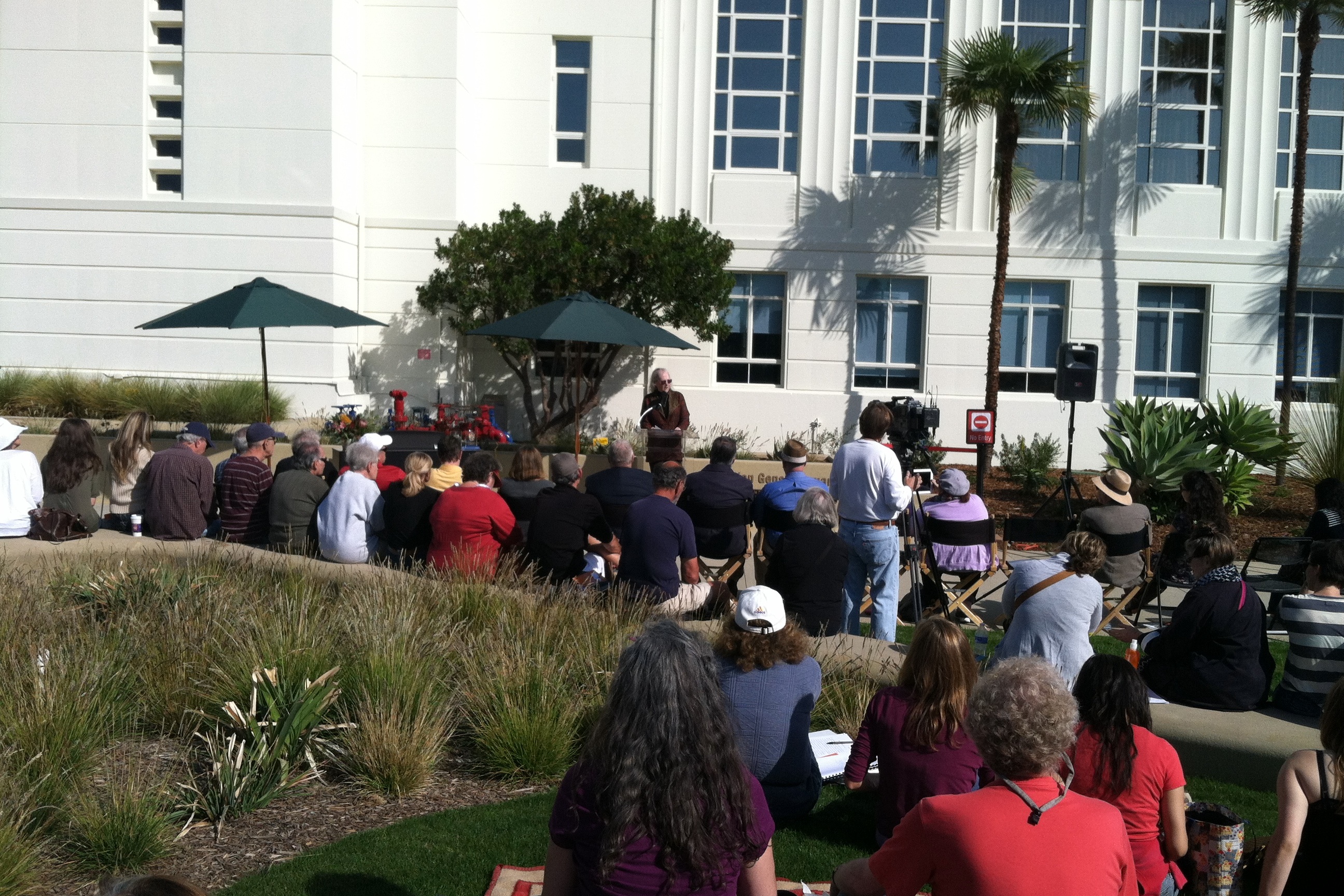
Yesterday’s dedication of Ken Genser Square in front of City Hall was a beautiful occasion — both because the new plaza is beautiful and because it was a fine gathering of the friends of the former mayor and 21-year council member, and of his co-laborers in the vineyards of Santa Monica activism and politics.

Naturally I thought of my relationship with Ken over the 17 years I knew him, and my recollections of a complicated human being. I never knew Ken on any kind of significant personal level, but we interacted a lot over the years, beginning in 1993 when he as a council member was on the working group for the Civic Center Specific Plan and I was an actively involved resident, and then in 1994 when we worked on the campaign to defeat the initiative Tom Hayden and anti-development groups had put on the ballot to overturn the plan.

What I always thought defined Ken as a politician, at least in the earlier years I knew him (and, yes, even one of Ken’s closest friends, Patricia Hoffman, noted at the dedication ceremony how Ken had mellowed over the years he was in office), was a fascinating combination of fierce partisanship coupled with, when it came to policy, a wonderfully open mind.

SMRR Co-Chair and longtime friend of Ken Genser speaks at the dedication of Ken Genser Square.

Patricia Hoffman, SMRR Co-Chair and longtime friend of Ken Genser, speaks at the dedication of Ken Genser Square.

Ken’s partisanship most significantly took place in the context of the internal politics of Santa Monicans for Renters Rights (SMRR). Ken was the primary standard-bearer for the more anti-development faction within SMRR that arose in the ’80s, and was the first council member who explicitly represented that wing when he was elected in 1988. (I say more anti-development because all factions within SMRR advocate regulating development stringently.)

From then and on through the ’90s Ken worked — as I said, “fiercely” — to have SMRR endorse more anti-development candidates. As with politics in any organization of like-minded people, there is a lot of the “narcissism of small differences” and elbows are known to be thrown. Arguably Ken’s greatest political triumph came in 1999 when Richard Bloom, in a special election, won election to the council, creating what was then called a “no growth” majority on the council.

That was Ken the partisan politician. When it came to policy, Ken couldn’t be pigeon-holed, and often broke with his supporters. I mentioned the Civic Center Plan in 1994; there was also the downtown Target in 2001 (Ken and Pam O’Connor were the only council members who voted to approve it), and Ken did not support Measure T, the RIFT initiative, in 2008. These were the three most contentious development issues over past 20 years, and in none of them was Ken on the anti-development side.

It simply was that Ken would examine the reasons he was skeptical in general about development, and when those reasons didn’t apply to the facts at hand, he wouldn’t oppose the project. His analysis of the Target project was telling — he didn’t see that opposing development downtown made much sense, and he saw Target’s benefits (such as providing discount shopping within Santa Monica) outweighing any downside it might have.

While Ken lost the Target vote, his vote in favor of the project foreshadowed the demise of the anti-development majority, since it seemed to free up, ultimately, two other members of the bloc, Bloom and Michael Feinstein, to take more nuanced views about development also.

All of this needs to be seen in the context that development has been tightly controlled in Santa Monica in the decades after the big office parks were approved in the ’80s, a policy success that belonged to Ken as much as to anyone else.

Politically, I had a mixed relationship with Ken. He had two opportunities to vote for me for the Planning Commission, in 1995 and in 1999, and neither time did I get his vote. But we were in agreement when it came to the Civic Center, Target, and Measure T. (There were a lot of other issues we agreed about that didn’t concern development — which was good, because it was always better to have Ken on your side than against you.)

While it’s useless to play the game of “what would Ken do” when it comes to evaluating the issues of today, it is worth recalling some of his last pronouncements on development issues. Ken died about six months before the completed LUCE came before the council, but during its development Ken warned that the document was relying on discretionary review at nearly every level of project size.

Ken’s view was that to the greatest extent possible the City should legislate what the City wanted or would accept from developers, and then let the developers figure out how to make their projects work within those parameters. If they couldn’t work, that was their problem. But trying to balance development with negotiated benefits was always going to create problems, and should be restricted to the biggest projects.

As Santa Monica turns to its new proposed zoning ordinance that seems like good advice.

Thanks for reading.

(To read more what I wrote about Ken, back when I wrote for the Lookout News, click here.)

Ken Genser at the opening of the Annenberg Beach House in 2009.

Ken Genser at the opening of the Annenberg Beach House in 2009.