The Santa Monica Civic: the beat goes on, and on

At its meeting tomorrow evening the Santa Monica City Council will once again consider how to save the Santa Monica Civic Auditorium. Specifically, it will consider recommendations from the “Civic Working Group” (CWG), a nine-member task force the council convened in 2014 to analyze future possibilities for the Civic and its site. I was a member of the CWG. During the time I was a member I avoided opining publicly about the Civic outside of the CWG meetings. Now that the CWG has been disbanded after completing its work, I feel free to write again about the Civic.

Agonizing over the future of the Civic has been going on for decades. As the council and the community again debate the future of the auditorium (and its site), it’s worth considering the impact of the historical context. Our collective inability to do anything about the Civic is the consequence of how the Civic came to be. In the 1950s the City used eminent domain, under the then optimistic rhetoric of urban renewal, to clear out a neighborhood of largely African-American residences and small businesses. Following the mid-century fashion, the City used the land to create a superblock for an edifice that turned its back on Pico Boulevard. The four blocks of Pico stretching from the beach to Fourth Street should be four of the most delightful blocks in Santa Monica, and they still have the potential to be so if the Civic can be reworked.

As UCLA professor and Ocean Park resident, Dana Cuff, wrote in her book The Provisional City: Los Angeles Stories of Architecture and Urbanism, “convulsive urbanism” of the sort that allowed the Civic to be built is inherently disruptive and inevitably leads to contention. While ideally cities evolve organically, based on cumulative decision making over time, it’s difficult to make big decisions about what to do with large hunks of publicly owned land when it comes time for future urban evolution. (To give another example, consider the controversy over the site the City assembled at Fourth and Arizona.)

The Civic had its glorious moments, but within a decade of its construction the Civic was being called a white elephant. It ultimately became a drag on the City’s budget, and for decades the City has been trying to figure out what to do with it.

When Gov. Jerry Brown terminated redevelopment in California a few years ago, one local impact was to save the City of Santa Monica from spending about $50 million of redevelopment money (not “our money,” by the way, but money taken from social service and school budgets), in a desperate effort to save the Civic. The plan was to use the “free” redevelopment money to rehab the Civic and turn it over to a private operator, the Nederlander Organization. Unfortunately, the contract with the Nederlanders did not require them to invest in the facility or, in fact, to continue to operate it into the future, and the City still expected the Civic to run deficits. As I said, it was a desperate plan.

With no redevelopment money, City Council voted to close the Civic. This tough vote had the unfortunate consequence that auditorium employees lost their jobs, but it did improve the possibilities of saving the Civic as a going concern because any new operator would come in with a clean slate. In the aftermath, the council convened the CWG to develop strategies to save the Civic as the anchor of a “mixed-use cultural district.”

“Mixed-use cultural district.” It’s important to keep that phrase in mind. A cultural district using the whole site, possibly with income-generating properties to subsidize the Civic, was the CWG’s mandate.

One problem arose, however, because the council had not said anything explicit about how the cultural district vision related to a decision the council had made in 2005 to convert most of the Civic parking lot into a full-sized athletic field. As the CWG did its work, it became clear that it would be unlikely that a full-sized field could be consistent with a cultural district. That’s because such a field, particularly if it would be used by Santa Monica High School, would need to be fenced in (and with high fences to prevent balls from sailing onto Fourth Street). For that and other reasons it’s difficult to visualize how a full-sized field could double as publicly usable open space.

While it is possible that a “village green” on, say, two acres, could work as part of a cultural district and be suitable for soccer for young children, the CWG didn’t want to dodge the issue about the full-sized field because it was so important to the sports community. In the CWG’s report, the position we took was that the site had to include open space that included athletic uses consistent with a cultural campus, and that in that connection the possibility of a full-sized playing field had to be investigated. Anticipating, however, that a full-sized field would not be consistent with a cultural campus, we advised the council that in that case the council should not proceed with plans at the Civic Center without making sure that fields were built elsewhere.

This, as everyone knows, did not satisfy the sport field people, who want the council to make an absolute commitment a full-sized field regardless of the consequences for the site as a whole. Tomorrow night the playing field issue will dominate the politics. But beyond that issue, the most important recommendation the CWG developed was to advise the council to look outside for partners to take over (to what extent we don’t know) operation of the Civic. There is no reason for the City to be in the events management business, and the Civic is a valuable property. While there have been financial analyses made of what the economics would be for rehabbing and operating the Civic, we won’t truly know what the property is worth as a revitalized venue until we open it up for bids from businesses in the entertainment field as well as non-profit arts and cultural organizations.

Taking all this into account, staff’s recommendations to council make sense. Staff is suggesting that the City issue a “request for qualifications” to identify entities that might make proposals to renovate and operate the Civic, but only for the auditorium and not the parking lot. Staff recommends holding off on planning the parking lot until other planning processes have been completed, most notably the School District’s planning for improvements at Samohi. Back in 2009 the District developed plans that would have added a new field on the campus, and sought City redevelopment money to help pay for it. Now the District has its own bond money and is determining how to use it. The District and the City should work together to make a new field on the school campus happen.

Thanks for reading.
Transit ridership, the obvious and the complex

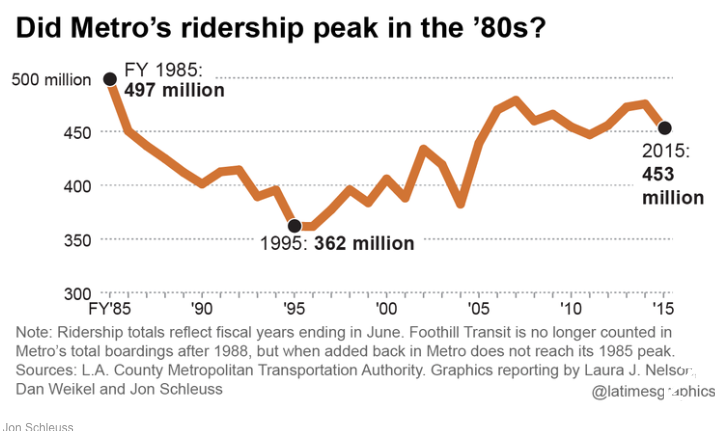
Last week the Los Angeles Times ran a story, by Laura Nelson and Dan Weikel, about how transit ridership has declined in Southern California at the same time that large investments have been made in public transit, mostly in the rail system. The article led with the fact that Metro’s boardings declined 10 percent between 2006 and 2015, notwithstanding billions of dollars of capital expenditures, and that Metro had also experienced long-term declines in ridership, going back to when L.A. transit ridership peaked in 1985.

Then the Times ran something of a counter piece, an op-ed by Ethan Elkind, a researcher and writer on environmental law and policy. Elkind explained some of the reasons for the recent decline in ridership, argued that the long-term decline is not as bad as the article made it seem because of the starting date the authors chose to compare to (more on that below), and why the future should not be so bleak for transit in the region, once the rail lines and extensions those billions are paying for have opened.

Then, today, there were four letters in the Times responding to Elkind.

Transportation issues are complex, involving at the micro level decisions that individuals make balancing myriad tiny factors and at the macro level decisions that governments make balancing massive public and private interests. To me, the Times story and the response to it illustrate how people can ignore this complexity at the same time that they fail to make obvious connections.

To begin with, the original article has contradictions. Its main point is that recent investments haven’t had a positive impact on ridership, but the article itself includes a chart that shows that since 1995 Metro ridership has increased from 362 million boardings per year to 453 million, an increase of 25 percent. When did the Blue Line, L.A.’s first new rail line, open? In 1990. When did the Red Line subway open? 1993. Green Line? 1995. Gold Line? 2003. What do you know, but there’s a correlation between when L.A. began investing in a modern rail system and when ridership began to increase.The Times' chart. (C) 2016 Los Angeles Times

The Times’ chart. © 2016 Los Angeles Times

What about the 10 percent decline since 2006? Well, the article answers that question, but you have to dig. Nelson and Weikel recount the history that after a settlement with the Bus Riders Union in the 1990s Metro added more than one million hours of bus service; as a result, ridership soared, reaching 492 million boardings in 2006 (very nearly the 1985 peak). Then what happened? Well, it’s right there in the article: the Great Recession hit, ridership which had been rapidly increasing leveled off, and then between 2009 and 2011 Metro reduced bus service by 900,000 hours. Hardly a shock, but there will be a correlation between reducing service and losing riders.

There are, of course, many factors that affect decisions that people make about how to travel. In the 30 years since the 1985 peak in ridership, many of the jobs that people once took transit to were moved outside of the region’s inner, transit-served core to places like Lancaster and the inland Empire (or, in the case of the garment industry, to Asia). Immigrants, who, as the article points out, use transit more frequently than non-immigrants, followed those jobs into sprawl-ville. We also have fewer immigrants now than in 1985. Given these trends, both demographic and geographic, it’s remarkable that Metro has about the same ridership today that it had 30 years ago (and don’t forget that 25% increase since 1995).

Reading the letters in today’s Times about the ridership issue illustrates that no matter how complex a problem is you can always try to reduce it to something you can express in a letter to the editor.

The first letter is from Santa Monica’s own Bruce Feldman, who presents himself as the classic Everyman, with “common sense,” in contrast to “scholars like Ethan N. Elkind.” To Feldman, it’s clear: Southern Californians “want real world steps that can be put into place quickly.” He says that we should dramatically lower the cost of public transportation, create more bus lanes and run buses every three to five minutes to make transportation “even more convenient than cars.” “That’s just common sense,” he says.

Hey, I agree. But does Feldman believe that anyone could accomplish those things quickly? I mean, does he know, for instance, how many years it took to wrestle the new bus lanes on Wilshire away from those Southern Californians of his who drive cars? Does he known anything about the politics (and federal financing) of fares? Does he know what buses cost?

Common sense is great, but does Feldman believe that he’s the first to think up this stuff?

Feldman concludes his letter with classic Amur’can anti-intellectualism, saying that he’s “sure academics will have plenty of theoretical reasons why I’m wrong.” I don’t think so! I mean, I read a fair amount of academic literature in this field and I’ve never read anything saying that lowering fares, increasing frequency, and speeding up buses would not attract more riders. The problems are not theoretical; they’re practical and political.

The second letter, wouldn’t you know it, comes from an academic, but one who agrees with Feldman. (This only goes to show that if you’re going to attack intellectuals be careful, because there’s going to be at least one whose pointy-head points the way you want it to point.) The letter, naturally, is from USC professor James E. Moore II, who has led a personal crusade for many years against building rail in L.A. As Times reporters often do, Nelson and Weikel quote Moore in their article, this time to the effect that Metro has been driving ridership down by spending on rail. (Maybe I mentioned this already, but since Metro began opening new rail lines, ridership is up 25 percent.)

Moore’s point in today’s letter is that if you lower fares, you increase ridership more effectively than by using the money to build rail. Although everyone likes low transit fares, particularly for poor people, around the world the cities that have the best and busiest transit systems, including the best service for working-class and poor people, are not cities where fares are cheap. And by the way, they usually have lots of rail.

Time is money for everyone, especially for people without much money since they need every minute they have to make money. If you treat your transportation system as an adjunct of the welfare system, you’re not going to have a good transportation system serving the people in the welfare system. (And nor will you have a system that reduces traffic congestion by attracting the non-poor.)

Every few weeks during the academic year I take the Metro 534 bus from downtown Santa Monica to Culver City, where I catch the Expo train to meet my wife at USC (where she teaches). We do this so that we can get some dinner and then hear a concert at Disney Hall or the Music Center. Mind you, my wife has her car at USC and we drive back, but we never regularly went to weeknight concerts before the Expo line opened, because for me to get or USC or downtown L.A. on the freeway would be a nightmare. I get on that 534 bus around 4:30 p.m. and it’s always packed, usually standing room only, full of workers coming home from jobs in Malibu and Pacific Palisades. We get on the freeway, and it usually takes 50, 55 or even 60 minutes to get to the train in Culver, where most of us passengers disembark.

When the train opens in Santa Monica in May, those passengers, our transit-riding heroes, will be able to exit the bus and get on the train here in Santa Monica, and a trip that now takes almost an hour to Culver City will take 15 minutes, saving them up to 45 minutes in each direction.

And the ride will be smooth.

Thanks for reading.