Negatives (and proving and disproving them) about Santa Monica Airport

The campaign to collect signatures for the aviation industry’s initiative to perpetuate Santa Monica Airport (SMO) is coming to a head. If the initiative’s sponsor, the Aircraft Owners and Pilots Association (AOPA), through its phony grass roots organization “Santa Monicans for Open and Honest Development Decisions,” doesn’t turn in enough signatures soon for county election officials to review, the initiative won’t make the November ballot. That would postpone a vote on the initiative until June 2016 because charter amendments, such as the AOPA initiative, need to be voted on at statewide primary or general elections.

The would be a disaster for the AOPA because by 2016 the Santa Monica City Council will have been able to create a real plan for voters to consider as an alternative to the airport. Until then the AOPA has the advantage because it can promote its initiative as an alternative to whatever parade of horribles it can conjure up for the future of the airport land.

Those Santa Monicans who want to close SMO, including those of us who want to turn the mile-long runway and adjacent areas into a great park, don’t fear a vote. We’ve always expected there would be a vote, because we expect that if the City Council votes to close the airport, the AOPA would mount a referendum campaign to put the council’s decision on the ballot.

That, however, would be a fair vote because the voters would have two concrete alternatives — keep the airport or do something specifically different. (I hope that something is a big park, in which case I’ll have to come up with a different adjective than “concrete” to describe the alternative.) Assuming the alternative makes sense, we believe we’d win that vote. (Putting massive development on the site, as AOPA signature gatherers say will happen, is not an alternative that makes sense.)

While the AOPA and its allies like to call us pro-park folks dreamers, the AOPA initiative is based on nightmares. The proponents of the initiative and other supporters of SMO don’t have to prove their claims while we opponents are left having to prove (or disprove!) negatives. Not only that, but besides requiring a vote on any airport plans the initiative also has provisions that would stymie any planning for a non-aviation future for the airport land or even managing the city-owned properties at SMO, without the city being overwhelmed with litigation.

I’ll tell you one thing — the truth doesn’t work for the signature gatherers. I’ve been part of the crew of residents trying to block the AOPA’s paid signature gatherers in grocery store parking lots all over town, and it’s been interesting to hear them make their pitch. The one truthful pitch, namely, to sign the initiative to “save Santa Monica Airport,” is a clunker. I’ve watched signature gatherers say that hundreds of times to passersby, and almost zero have responded.

There have been many unfounded arguments that the signature gatherers make, but none is more pernicious than one that if SMO doesn’t exist, flight patterns will change, and air traffic using LAX will fly low over Santa Monica. As is typical, I’ve never seen any evidence to back this up. Instead, the airport’s boosters leave it to airport opponents to prove the negative that air traffic patterns won’t change.

Neither I nor anyone else can tell you exactly what will happen to flying around here if the airport closes, but I can point out what looks like craziness when I see it. And it is crazy to think that LAX air traffic will change significantly.

Why? Flights landing at LAX descend gradually from the east. They take off over the ocean, then climb and turn if they are heading east, north or south. These are the most important patterns affecting flights in the area.

For instance, if you’ve flown from northern California, you know that flights from the north already fly over the Santa Monica Mountains and northern Santa Monica, but they fly fairly high. These commercial jets coming in from the north typically fly at altitudes between 6,000 and 9,000 feet. They need to be up high enough to fly east over downtown L.A. before making U-turns to descend into LAX. It’s absurd to think that if SMO isn’t there they are going to fly low over Santa Monica, Venice, Marina del Rey, and Playa del Rey to land at LAX from the northwest.

Similarly, if you fly out of LAX, you know that you sometimes turn and fly back over Santa Monica, but from the ground you know that those planes are already high enough not to be a nuisance.

Another reason that commercial flights will continue to fly high over Santa Monica and the Westside is that regardless of the presence of SMO, the sky up to about 7,000 feet is full of private aircraft. The best way to see this is to spend some time looking a flights over Santa Monica through the lens of the airport’s PublicVue website.
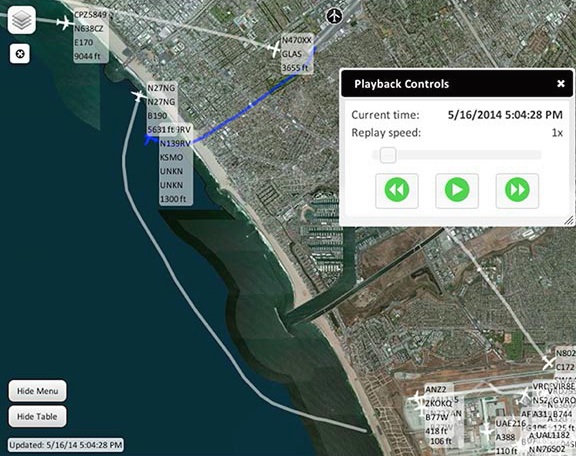
PublicVue Screen Shot showing flights around Santa Monica

PublicVue Screen Shot showing flights around Santa Monica

If you monitor PublicVue, you’ll see that there are flight paths along the coast for general aviation (i.e., non-commercial) flights, with connections to inland airports such as Van Nuys, Burbank, and Long Beach, that at altitudes around 4,000 to 6,000 feet are below commercial flight and above the LAX landing paths. The takeoffs and landings to and from Santa Monica Airport are, obviously, below these altitudes — it’s not the planes taking off from SMO and climbing to 1,000 feet or so that keep the big jets up high, above 7,000 feet, it’s all the other private planes passing through.

If you signed the AOPA initiative because a signature gatherer persuaded you that you needed to sign to keep LAX air traffic from swooping down low over your neighborhood, you can rescind your signature by filling out and signing a simple form, and sending to the City Clerk. You can get a copy of the form through the CASMAT website.

Thanks for reading.

Dear Hines: Please sell. Sincerely, Santa Monica

As I watched the City Council rescind its approval of the Hines Paper Mate site project what became overwhelmingly apparent was that by the end of the road, after seven years, Hines and its project were alone. Friendless. From the public, only the indefatigable Jerry Rubin spoke in favor of the project. All those supporters from before, vanished.

From the dais, there wasn’t much more support. Terry O’Day voted for the project again, but he acknowledged it was not the best it could be. Risk-averse, he voted for it because he feared the worst. Gleam Davis defended the project, but, conflict-averse, she voted to rescind. Bob Holbrook spoke little about the project, instead lamenting how nasty politics had become, and noting that change was inevitable. Pam O’Connor didn’t have to say anything.

The most profound silence came, however, from the developer. Ever since Hines got the four votes its execs thought were all they needed, the company has done nothing, at least in public, to defend its project. There was no campaign contra the signature gathering, and there were no offers to revise the project in the face of the opposition against it. Was this ambivalence or fatalism? Or arrogance?

Through my column (and occasionally over breakfast) I have been telling Hines for five years that to be approved Paper Mate had to be a residential project because adding even one car trip to the intersection of 26th and Olympic would drive people crazy. I’ve talked to brick walls that listen better.

In fairness to Hines, they thought they had a deal, because the City, in the aftermath of the Great Recession in 2008, wanted more commercial office space in the Bergamot area, and that’s what the LUCE called for. The council approved the LUCE on a 7-0 vote, and Hines had grounds to believe that that was the deal. Times change, however, and ultimately it is the developer’s responsibility to call an audible when they do. Hines should have asked to amend the LUCE so that it could develop a residential project.

The crucial moment took place in February when Hines got its four votes. Hines could have had six, which would have changed the political dynamic entirely, if someone from the company had jumped up that night to accept the offer that Ted Winterer made to approve the deal if 150,000 square feet of commercial development was shifted to residential. (Winterer had other concerns as well, notably about architecture, but one assumes they could have been resolved.)

Winterer’s proposal would have entailed more environmental review, because the scope of the environmental review had remarkably not included more residential development, and that would have created some uncertainty. But it would have created a better plan. If Hines had said that night that it could make the revised plan work, it could easily have had at least six votes to approve, since Tony Vazquez voted for Winterer’s motion, too.

Memo to developers: if you have a big project in Santa Monica, you need to count higher than four.

What now? I know that Terry O’Day hopes more than anything that his fears are proven wrong and Hines does not start the process to reoccupy the existing building, but it’s hard to dismiss his fears. If I ran Hines, that’s what I would do, because they no longer have friends to support them here during a new process.

But I have hope. There’s an alternative. My hope is that Hines sells the property to a new developer, one that specializes in urban residential development. There are good residential developers working in Santa Monica already, and there are others working in the region. Perhaps the fundamental problem with the project was that Hines is a commercial developer, and never seemed comfortable with building a place for people to live.

By the way, it’s a good time to sell, or at least to bring in a residential developer partner to take over. According to an article in today’s L.A. Times, the multi-family residential market is booming. Dear Hines: You’ll get your money back.

A new developer would not have to start from scratch. A lot of good planning has been done, such the new streets and pathways. Bring in new architects and planners, however. Let them reconfigure the open space to make it better suit a residential development. That wouldn’t mean there couldn’t be good public spaces connecting the station with the area to the north. There are many urban plazas around the world that are framed with residences.

According to the EIR, nearly all the new car trips the project would have generated would have come from the commercial development. Eliminate the offices, and the impacts of the project will be entirely different.

These seven acres across the street from the Bergamot stop on the Expo line need to be redeveloped to replace the hulking mass of the old factory. It’s time to get someone new to do it.

Thanks for reading.

The Paper Mate factory

The Paper Mate factory

New music, Expo and me (and maybe you)

The Expo line will not reach Santa Monica for a year and a half or so, but I have already become a regular user — that is, if taking the train about once a month equals regular use. It all has to do with avant-garde music and the fact that my wife teaches at USC. You see, starting about eight or nine years ago we began attending the wonderful Jacaranda chamber music concerts at the First Presbyterian Church on Second Street. Jacaranda presents concert music going back centuries (check out tomorrow night’s concert with music from Mozart, Debussy and Arvo Pärt), but for Jacaranda the history of music didn’t end in 1900. Before Jacaranda, my wife and I didn’t pay much attention to new music, but now we’ve become addicted.

The L.A. Phil presents a prominent concert series, called Green Umbrella, for new music on Tuesday nights about once a month in Disney Hall, but we never attended those concerts because weeknight traffic is so miserable from Santa Monica is to downtown L.A. That changed, however, when Expo reached Culver City.

My office is in downtown Santa Monica. I board the Metro 534 bus on Fourth Street at Santa Monica Place around 4:30; from there the 534 travels non-stop on the freeway to the temporary Expo terminus in Culver City. The train takes me to USC in 14 minutes, where I meet my wife; she has her car there because she drives in in the morning. We drive to a restaurant downtown, and then go to the concert.

Obviously our circumstances are unusual and won’t apply to many others, but in taking Expo at least I’ve learned something about it.

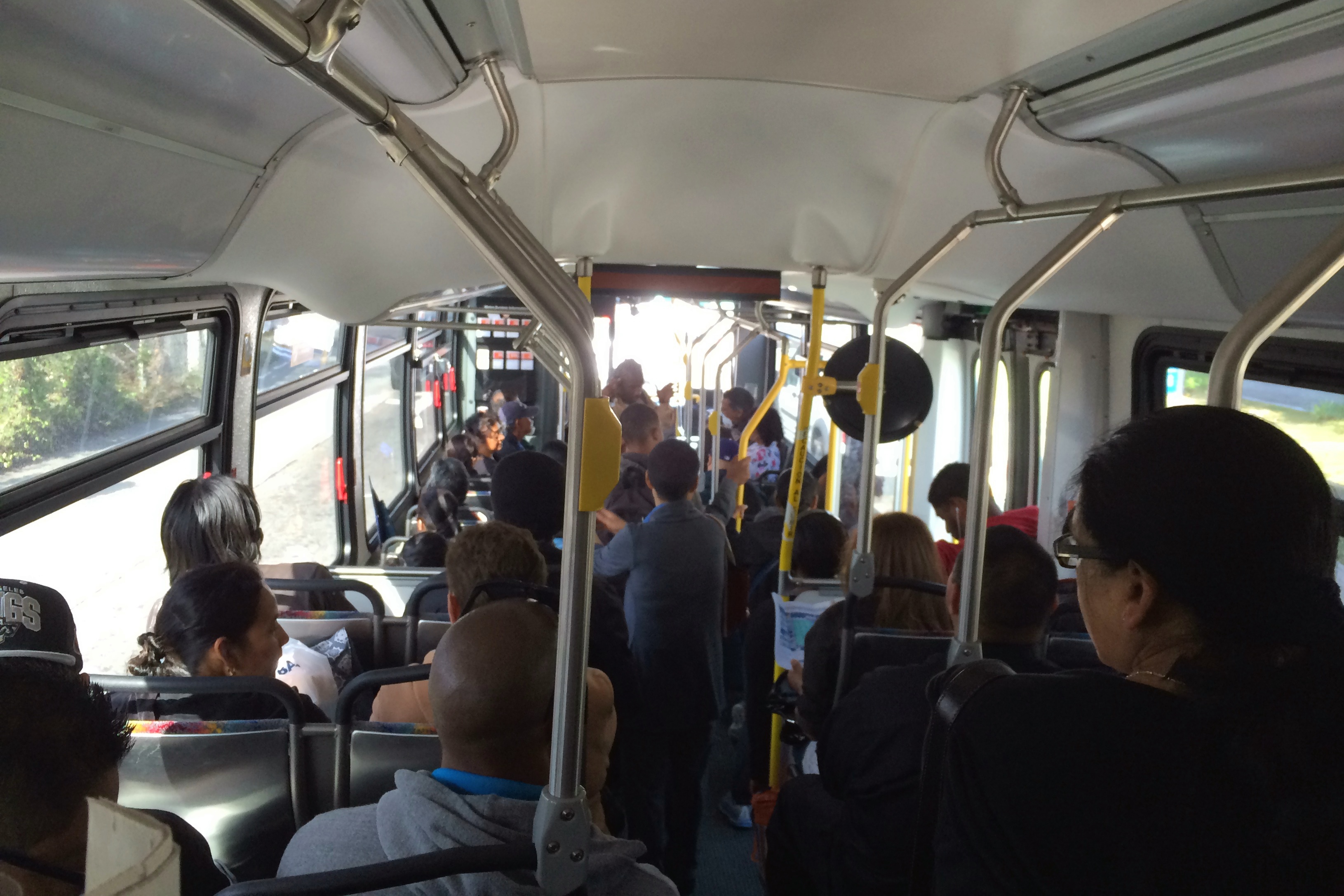
To begin with I’ve learned whom Expo will serve when it reaches Santa Monica. The 534 originates in Malibu and when I board it at 4:30 it is full of workers returning to L.A. from jobs along the coast. I’ve been told the 534 is called the “nanny bus,” but nanny hardly encompasses all the people on it. Class defines transportation in L.A., yet it still surprises me when friends tell me they have never taken a bus here. (They have no problem with using transit in New York.) Some even confess that they are “scared” to do so, but when I’m on the 534 I feel like I am among 40 of the most dignified people in all of L.A.

Passengers on the 534 bus returning home from work

Passengers on the 534 bus returning home from work

The bus I catch at 4:30 originates in Malibu at 3:28, and no doubt some of the people on it have been riding for an hour already when I board. When we get on the freeway, we are stuck in the same traffic as everyone else. (I guess that’s what equality means today — motorists in private cars get to travel as fast as a bus carrying 40 people.)

At that time of day the 534 takes between 30 and 60 minutes to travel from Fourth and Colorado to Culver City (it takes 10 minutes when there is no traffic). Typically, more than half the passengers exit in Culver City to get the train. When Expo opens in Santa Monica, the train will take about 15 minutes from downtown Santa Monica to Culver City. That means that all those 534 riders who connect with the train will do so in Santa Monica and save between 15 and 45 minutes each trip home.

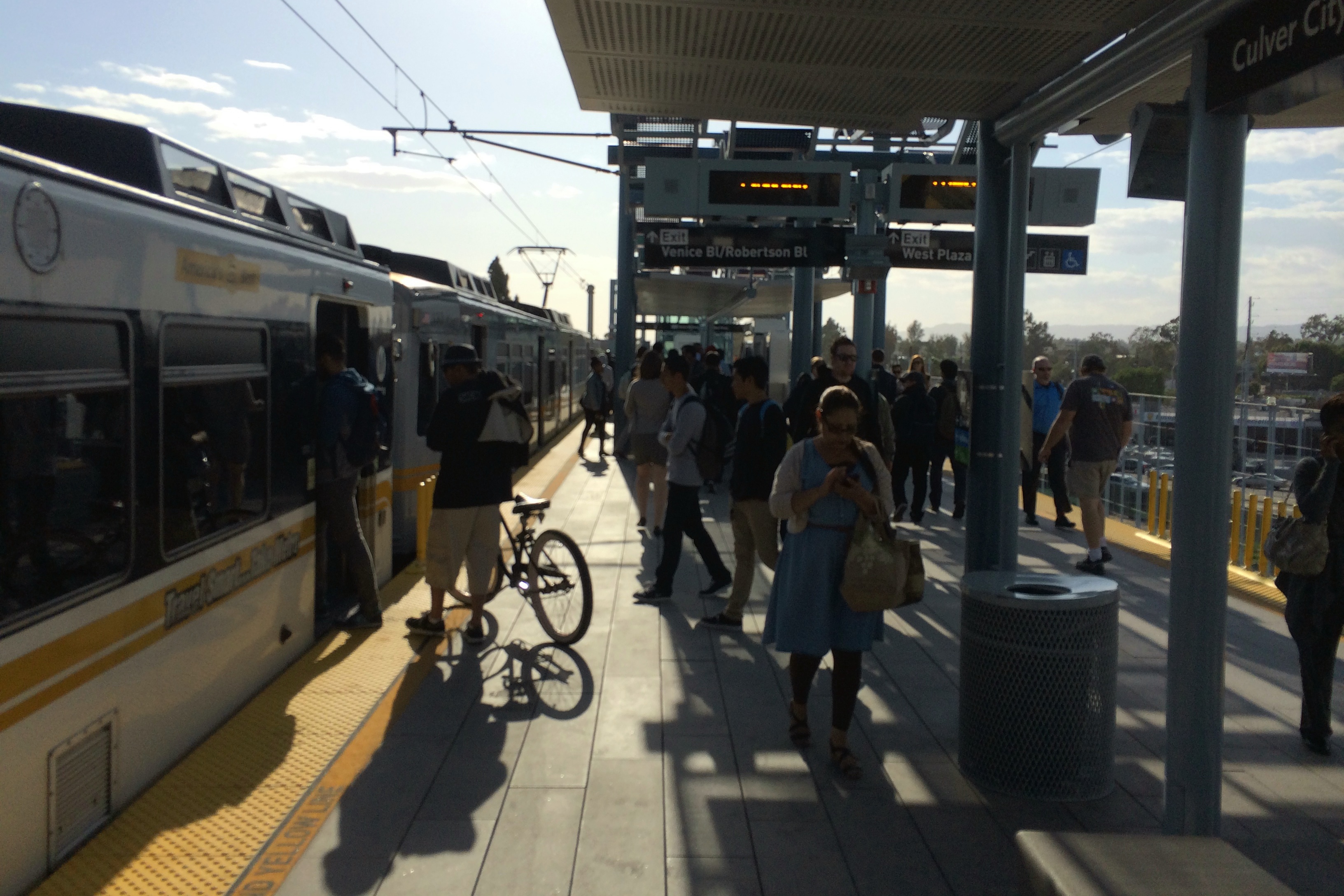
Boarding the Expo train in Culver City

Boarding the Expo train in Culver City

These workers and others like them are the people whom Expo will serve immediately. The primary purpose of Expo is to provide access to jobs on the Westside and in downtown L.A. to the vast middle of Los Angeles, home to much of L.A.’s working-class. By doing this, Expo (and the Crenshaw line scheduled to open in 2019) will help reverse half a century of dis-investment and decline in South Los Angeles. Already Expo is prompting investment in those areas, as the L.A. Times reported last week.

Indeed, another group of Expo users don’t even know who they are today – they are the people who will move to neighborhoods near Expo, or to apartment buildings and condos along the line that aren’t yet built. Economists and planners have long understood that transportation shapes land use and can create or destroy wealth. If you run a freeway through an existing city, it typically reduces property values along the way (while increasing them where the freeway reaches open land), while rail does the opposite – it increases property values along the route.

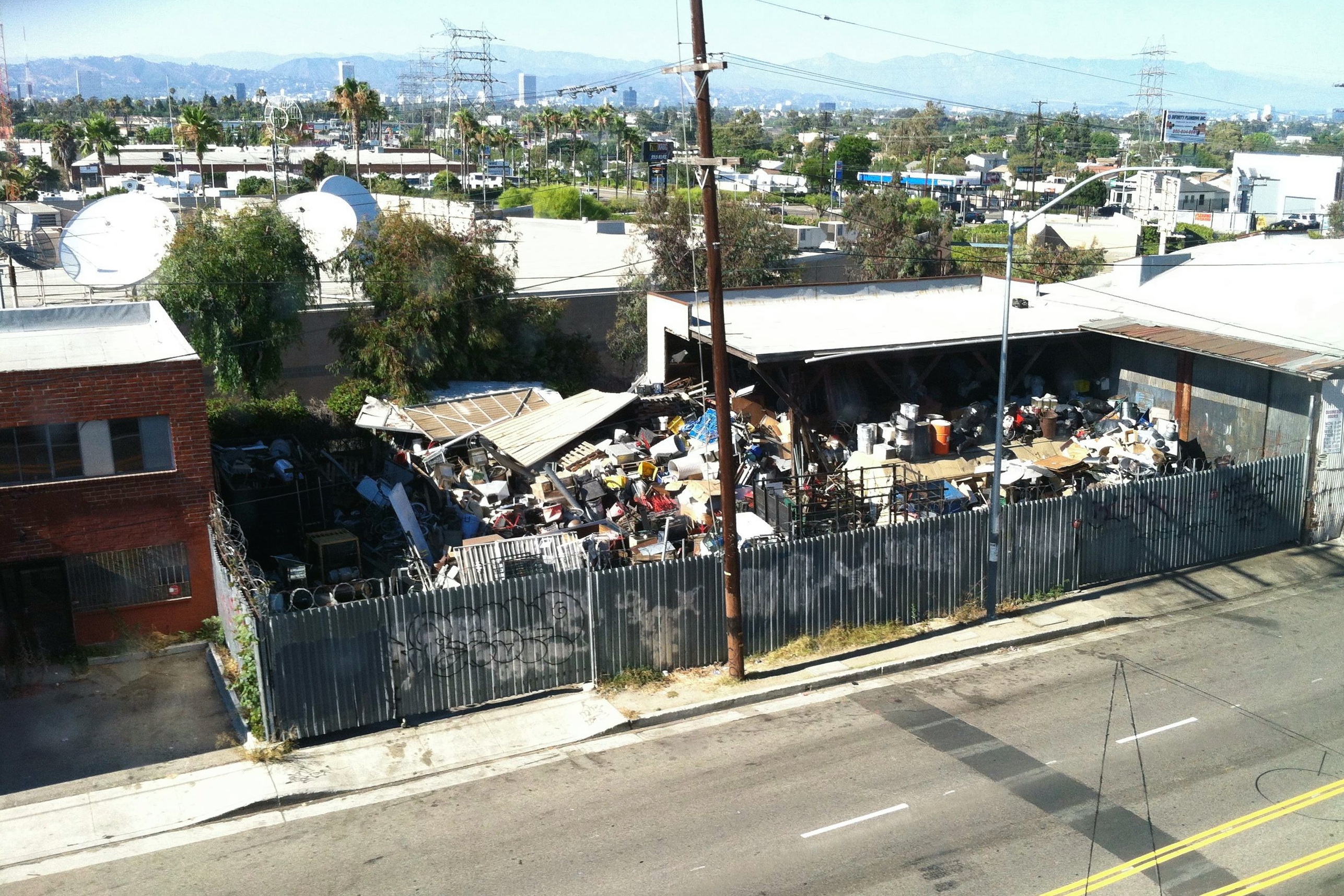
It’s through this increase in economic value that transit pays for itself at the macro-economic level. If you ride Expo, and look out the window, you’ll see many derelict properties that will be redeveloped over the years with new housing and businesses.

View from Expo of property that's become more valuable

View from Expo of property that’s become more valuable

These land use changes don’t happen overnight, but gradually new development gravitates toward transit. Thirty years from now, many riders on Expo will live in buildings that don’t exist today. It is changes in land use over time that result in a greater percentage of commuters and other travelers not driving.

Santa Monicans are asking themselves if they will use Expo. I hate to say it, but initially I doubt many will. This is for various reasons. Because the Exposition right-of-way originally passed through industrial areas of the city, few Santa Monicans now live with walking distance of Expo stations. In addition, because of the number of jobs in and near Santa Monica and how the traffic pattern now favors residents such as my wife who leave Santa Monica to work, Santa Monicans already have lower than average commute times and few Santa Monica commuters are likely to benefit from a switch to Expo.

Frankly, for people who already drive it’s going to be hard for Expo to compete with the convenience of driving for most of their trips. I have to ask myself the honest question – if we didn’t have my wife’s car to drive back to Santa Monica at 10:00 p.m. when the Green Umbrella concert ends would I take the train in? Even when the train reaches Santa Monica, that would involve getting from Disney Hall to the 7th/Metro train station and then a 45-minute ride back to Santa Monica, and then we’d have to get home from the station. Driving home at 10 o’clock never takes more than 25 minutes. (In the big scheme of things, probably taking the train in and a taxi home would make the most sense, and maybe I’ll evolve into that level of urban consciousness.)

Meanwhile the Big Blue Bus is exploring how to set up buses and shuttles to connect with Expo, and to do this Santa Monica has some advantages. Transit lines usually connect city centers with jobs to areas on the periphery with residents, and most riders go in one direction in the morning and the other later on, but Santa Monica has both residents and jobs. This means that connecting buses in the morning and afternoon rush hours can carry passengers in both directions, making them more efficient.

Which brings me to a simmering controversy in Santa Monica – should the City build parking at our Expo stations? The answer is no, or at least not much of it, and none of it subsidized.

There are many reasons for saying no to building parking at the train stations. One obvious one is traffic. Do we want to create more incentives for people to drive to downtown, the Memorial Park area, and Bergamot? “Park and ride” means “drive and ride.” But the most fundamental reason to oppose building parking is economic: parking costs too much, and let’s face it, when people say they want parking they mean free or heavily discounted parking.

The construction cost per parking space in the new Structure 6 on Second Street was about $50,000. Let’s say you wanted to build a five-story, 500-space structure near an Expo station. That would need a footprint of about 33,000 square feet. Land cost (at $400/square foot, typical for prime land in Santa Monica), plus construction cost would mean the structure would cost about $38 million, or about $75,000 per space. Assuming the City would pay for this with a 30-year, 5% bond, the monthly amortization for each space would be $403. Add a typical maintenance and operations budget of 15 percent, and the monthly nut that needs to be recouped is about $450 per space, or about $15 per day (including weekends).

Theoretically, I have no problem if Santa Monica built parking structures and charged enough to earn that back, but my guess is that if the City charged that much, there wouldn’t be much demand for the parking. (Conversely, there might be a demand for taxis and services like Uber and Lyft — but again, I haven’t evolved that far.) (To read how Metro has squandered public money to subsidize parking at train stations, read this.)

The cost of providing parking at stations is not only, however, a matter of dollars, but also a matter of opportunity. The land near the stations is prime land, and if it’s used for parking, it can’t be used for housing. There is much more social value in building housing near transit than there is in building automobile storage for people who already have housing and can afford to own and operate a car. Public dollars are better spent subsidizing housing, and much of the housing we need can be built without subsidy.

Thanks for reading.