Santa Monica vs. FAA: By their words shall ye know them

As someone who wants to turn Santa Monica Airport into a big park, I have been following the lawsuit that the City of Santa Monica filed against the Federal Aviation Administration (FAA) to confirm that the City controls the airport land and will have the right to close the airport after July 1, 2015, when the current, 1984 settlement agreement with the FAA expires.

As discussed in my post a couple of weeks ago, in response to the lawsuit, the FAA filed a motion to dismiss it on jurisdictional and procedural grounds. This weekend I read the City’s response to the motion. (The motion will be heard February 10 in federal court in downtown Los Angeles.)

While the federal government moved to dismiss on various grounds, the most fundamental one was that the City’s claim was barred by the 12-year statute of limitations of the federal “Quiet Title Act.” According to the feds, the City’s claim is too late because the City should have known decades ago that the federal government was claiming an interest in the title to the property under the 1948 Instrument of Transfer (IOT) that returned control of the airport to the City after World War II.

As readers will recall, the FAA is relying on a clause in the IOT in which the City agreed to operate the airport in perpetuity. However, there was no consideration for this agreement, nor is there any way for the government to enforce it.

The City’s response to the motion doesn’t add much new information that was not contained in the its original complaint, but reading it brought home how preposterous it is that after all these decades the FAA is arguing that Santa Monica can’t close the airport because of the IOT.

This graphic shows the sizes of all existing Santa Monica parks at the same scale as what could be the park to replace the airport.

This graphic shows the sizes of all existing Santa Monica parks at the same scale as what could be the park to replace the airport.

In fact, it was only in 2008 that the FAA, which I suspect had begun to panic when it realized that 2015 was coming up in less than 10 years, dredged up the IOT’s perpetuity clause. Before then FAA administrators and lawyers must have looked at the history and the law and realized that this argument didn’t have a wing or a prayer.

Why do I say that? Because the city’s response highlights several documents from past decades where the FAA declared the obvious, that the City had the authority to close the airport. For instance, in 1971 (only 23 years after the 1948 IOT) the FAA wrote the Aircraft Owners and Pilots Association to tell them that once Santa Monica no longer had obligations arising from funding provided by the FAA, the airport would be “vulnerable to being discontinued and used for non-aviation purposes.”

As discussed previously, the 1984 settlement agreement clearly states that the City is only obligated to continue operations at the airport until the 2015, but to remove any doubt that this means precisely what it says, in 1998 the FAA issued a determination that the 1984 agreement “makes clear that the City is obligated to operate the Airport only for the duration of the [agreement]… To the extent that [pilots] seek to prevent the future closure of the Airport . . . that is a local land use matter.”

“A local land use matter.” Wow.

In 2003, at the conclusion of the same proceeding, the FAA ruled that the 1984 agreement only required the City to maintain the airport’s “role in the National Airport System as a general aviation reliever airport until July 1, 2015.”

The City’s point is that only in 2008 when the FAA changed its tune was the City put on notice that the FAA had designs on the land, and that the 12-year statute of limitations only started running then.

Not only does this argument seem obvious to me, but also, regardless how the judge rules on the motion, one has to wonder, when and where this dispute ultimately ends up in court, how will the U.S. Attorneys defending the FAA try to explain away the FAA’s own admissions that on July 1, 2015, the City of Santa Monica can close down Santa Monica Airport.

Thanks for reading.

Gathering the tribes to celebrate labor victories in Santa Monica

Last week there was a party in Santa Monica to celebrate a remarkable success: that of the labor movement in our city. The event, called “Celebration with a Vision,” was low key but inspiring — a few speeches, some rousing songs, and sitting down together for dinner. It took place Wednesday evening at the Unitarian Universalist Church on 18th Street. The purpose was to take stock of and satisfaction in the victories the hotel workers union, UNITE HERE Local 11, has achieved in Santa Monica, most recently the agreement the union signed with OTO, the developers of the two hotels coming to Fifth and Colorado, to allow the future workers there to unionize without interference from management.

The victories are the result of a 19-year long process that had its ups and downs.

The event was, as City Council Member Kevin McKeown described it in an inspiring address, a “gathering of the tribes.” Nearly all those attending were, as either union members and staff or members of the union’s support groups in the community, veterans of a long and now seemingly successful struggle to make Santa Monica, at least with respect to hotels, a “union town.”

That struggle began inauspiciously in 1995 when the management of what was then Santa Monica’s only unionized hotel, the Miramar (then a Sheraton), sought to “decertify” their workers’ union by filing petitions with the National Labor Relations Board (NLRB) for a decertification election. The NLRB ultimately determined that the hotel used unfair labor practices to call the election (by paying three employees to file the petitions) and invalidated the vote, but in a hostile environment of forced meetings with hotel management and union-busting consultants, hotel employees, in 1997, narrowly voted for decertification.

It was from this momentary defeat that the current labor movement in Santa Monica arose. The hotel workers union reached out for support to the Los Angeles Alliance for a New Economy (LAANE), which helped organize a local community organization, Santa Monicans Allied for Responsible Tourism (SMART), to help gather support for hotel workers in the community. Together with another organization, Clergy and Laity United for Economic Justice (called CLUE), SMART publicized the difficulties hotel workers had earning enough to support themselves and their families, and how few rights they had vis-à-vis not only the union busting Miramar Sheraton, but also the other hotels in the city, none of which were unionized.

As mentioned above, the union ultimately had the decertification election thrown out because of hotel management’s unfair labor practices (in a replay of the vote the union won in a landslide), but in the meantime new owners bought the hotel and they had no problem recognizing the union and signing a new collective bargaining agreement, rendering the NLRB proceedings moot.

Ironically, it was the anti-union activities of the Miramar Sheraton that mobilized both the union and the community. The union and its allies at SMART, LAANE and CLUE focused on enacting a living wage that would cover workers at the big local hotels in the coastal zone where existing hotels had financial advantages because Prop. S, enacted by voters in 1990, prohibited the building of new, competing hotels. (Municipal governments have limited power over labor relations, since federal labor law controls, but they can enact minimum wages.)

The battle over the living wage spawned two ballot measures. The first was KK, a measure the hotels put on the ballot in 2000 that would have prevented the City Council from enacting a living wage that applied to hotels. KK lost badly — the pro-worker movement received crucial support from Santa Monicans for Renters Rights (SMRR), whose council candidates were also under attack from the hotels.

The second ballot measure was JJ, in 2002, which came after the council passed a ground-breaking living wage ordinance — the first in the nation that targeted workers in businesses that did not have a business relationship with a city or other governmental entity. The hotels gathered enough signatures to put ratification of the living wage on the ballot, and JJ was the result (a vote for JJ was a vote for the living wage).

The 2002 election, the first after 9/11 and during a recession, was a conservative election all over the country. Nevertheless, polls showed JJ passing until the hotel PAC, which had practically unlimited funding, unleashed a flurry of misleading mailers the weekend before the election to confuse voters, and JJ narrowly lost. The living wage was defeated.

But the union movement in Santa Monica was only getting started. Aided by the City Council, which insisted on including a “labor peace” clause in the ground lease for the Viceroy Hotel (which sits on city-owned land), the union signed an agreement in 2000 making the Viceroy Santa Monica’s second union hotel. Then in December 2002, just weeks after JJ’s defeat, the union had an even bigger victory, signing the Loew’s Hotel on Ocean Avenue to a union contract.

A union contract followed for what is now the Sheraton Delfina on Pico Boulevard, which had the same management as the Viceroy.

From one embattled union hotel in 1995, Santa Monica now had four unionized hotels representing 50% of the city’s existing luxury hotel rooms. Starting wages for hotel housekeepers in the area also had increased from $7.25/hour when the organizing campaign began to $11.25.

New hotel development proposals returned to Santa Monica in 2007 with a proposal to convert the landmarked office building at 710 Wilshire, and construct an addition, to build a 284-room hotel. The 710 Wilshire project reached the City Council in 2012. The union and its community allies pushed the City Council to require a living wage of $14.97 for the project.

While the council, on approving the project, made precedent by requiring a living wage, the wage was less than $14.97. The union in April filed papers to gather signatures for a referendum to challenge the development agreement for the project, but shortly afterwards, the owner of the 710 Wilshire project reversed course and contacted Local 11 to negotiate a settlement. The developer and the union then negotiated a neutrality agreement for the project, which means that once the hotel is operating management won’t try to block the workers from unionizing.

Since the end of the Great Recession and the rebound of the economy and tourism industry, five new hotels, in addition to 710 Wilshire, are being proposed for downtown Santa Monica. The first of these were the two “mid-priced” hotels proposed by OTO for the corner of Fifth and Colorado. While originally OTO took the position that a union contract was incompatible with a mid-priced hotel, in the face of organizing by Local 11 and its community allies, and after long negotiations, the union and OTO successfully negotiated a neutrality agreement just before the hotels came before City Council in November 2013. The City Council unanimously approved the hotels.

While each of the other three proposed hotels have unique issues that complicate their developers’ negotiations with the union, and as a result those negotiations will no doubt be long, and while each project has development issues to deal with, all three developers have announced their intention to enter into neutrality agreements with the union. Looking back to 1995, this is an earthquake in the relationship between management and labor in Santa Monica.

It’s that earthquake, and the long struggle that led to it, that “the tribes” were celebrating last week. Take note that if in five years or so there are five or six new union hotels in Santa Monica, operated by topflight hotel companies, this will have national implications, putting the lie to the constant right-wing refrains that union rights are incompatible with topflight economic development and that service workers won’t unionize.

Meantime, it’s impossible not to give some credit to the 19-year struggle in Santa Monica, and others like it around the country, for the current wave of support nationally for higher minimum wages, including a $15 per hour wage for fast food and other service workers.

Yes they can.

Thanks for reading.
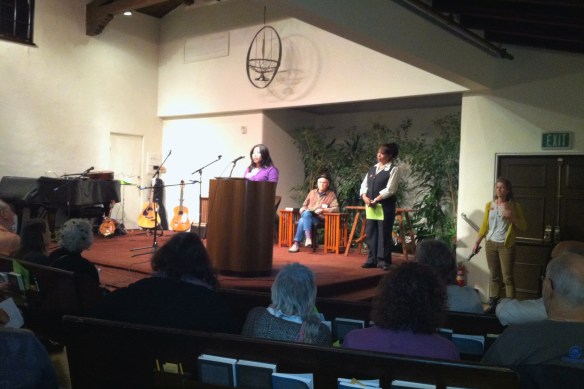
Local 11 lead organizer and former hotel worker Soledad Garcia speaking at the Celebration with a Vision last week

Local 11 lead organizer and former hotel worker Soledad Garcia speaking at the Celebration with a Vision last week

Santa Monica Airport litigation: The FAA’s problem is no remedy, no right

In litigation as in life people waste time trying to avoid what matters, and a good example of that was the response that the federal government filed Friday to the City of Santa Monica’s lawsuit seeking to confirm the City’s control over the Santa Monica Airport.

On behalf of the Federal Aviation Administration, U.S. attorneys moved to dismiss the City’s lawsuit on various procedural and jurisdictional grounds, including that some claims should have been filed in a different court, some were outside of jurisdiction of federal courts, and that some were not “ripe” for adjudication — as if there is no controversy yet because the City has not already sent bulldozers to tear out the airport’s runway.

In court, procedural challenges are always the first line of defense – but you have to wonder: does the FAA want Santa Monica to send in the bulldozers? This dispute is going to end up in court somewhere, sometime, and we may as well get to the substance sooner rather than later.

The substance in the case of Santa Monica vs. United States is a clause in a 1948 agreement, called an “Instrument of Transfer” (IOT), between the federal government and Santa Monica. The IOT returned the airport to Santa Monica’s control after the federal government had leased it from the City during World War II (so that the army could protect Douglas Aircraft). The feds transferred many airports to cities after the War, and the IOT’s, including the one for Santa Monica Airport, contained a clause that the cities agreed to operate the airports in perpetuity. It is the enforceability of this perpetuity clause that will determine the future of the airport land.

Because I am involved in Airport2Park.org, the movement to turn the airport into a park, friends often ask me whether I believe Santa Monica will be able to close the airport. I’m not a litigator or expert on the laws at issue in the case, and you are welcome to take what I say with all the grains of salt you want, but I believe that the perpetuity clause is not enforceable, and the courts will confirm the City’s control over the airport land.

I believe this for two reasons. I’ll admit that the first is somewhat circumstantial — it is that if the FAA could stop the City from closing the airport it would not have entered into the settlement agreement with the City in 1984 that says that the City won’t close the airport before July 1, 2015, implying strongly that the City has that right to do so.

Somewhere deep in the FAA’s collective consciousness I suspect that there was in 1984 and is today a realization that there is no way that the courts – or if not the courts, politicians – are going to require, because of a pro forma clause in a 1948 contract, that a city continue to operate, at a financial deficit, a dangerous nuisance surrounded by homes, businesses, and schools. The 1984 agreement, at a minimum, should be seen as superseding any earlier agreement. The FAA is operating from a level of desperation, something the agency is familiar with because for all its bluff it hasn’t been able to stop hundreds of airports around the country from being closed.

Even if that is not the case, and the FAA believes in its cause, the second reason the City will win is not circumstantial — it is that even if the courts reject the City’s arguments that the 1948 perpetuity clause is unconstitutional or otherwise invalid (arguments that sound good to me!), and uphold the clause, the FAA doesn’t have a remedy to stop the City from closing the airport.

And as they teach you in law school, there is no right without a remedy.

The reason the FAA doesn’t have a remedy is stated right in the government’s response, on page 12, when the U.S. attorneys state that the “operative language” in the IOT if the City doesn’t comply with its obligations (i.e., operate the airport) is that the federal government has an interest in all rights “transferred by this instrument.” This means, and the IOT is specific about this, that if the City does not comply with its obligations, the rights or property transferred to the City under the IOT can revert, at the government’s option, to the government. That is the government’s remedy — it’s not as if the FAA could obtain an injunction to require the City to continue to operate the airport. It’s the reversion or nothing.

The problem for the FAA is that there’s nothing left of the rights transferred in 1948 to revert, because all the government had then was a lease that expired long ago and equipment and improvements that are long gone. This is what makes the Santa Monica Airport situation different from the typical postwar airport transfer — the feds never owned the land. There is nothing to revert.

As I said, I don’t know anything about the procedural or jurisdictional claims in the government’s motion to dismiss, but this is a case where Santa Monica could lose every motion and every argument, and then still win in the very last sentence of the final decision of the last court that considers the case.

Thanks for reading.

Northward view at Santa Monica Airport. Imagine this a park.

Northward view at Santa Monica Airport. Imagine this a park.

Slow News Weeks for the President and Me

The New York Times reported on Sunday that the number and intensity of national and international crises over the holidays was low enough that President Obama could, for the first time since becoming president, enjoy a relaxing family vacation in Hawaii.

I felt the same way about news in Santa Monica. Sure there was news, notably the reversal by city staff on the City’s obligation to preserve the Chain Reaction sculpture, but not too much. Like the president I took a vacation (in his case, from preserving national and world order, in my case, from blogging about Santa Monica). I’ve never been to Hawaii, but it can’t be better than Santa Monica in winter.

As for what news there was, I am more than curious about what response the Federal Aviation Administration (FAA) will make to the City’s airport lawsuit. The deadline is this Friday, Jan. 10; as reported in The Lookout, Federal District Judge John F. Walter denied the FAA’s request for a longer extension of time to respond to the complaint. Notably Judge Walter accepted the City’s contention that time was of the essence, given that the City wants to know what its rights are before July 1, 2015, the date its 1984 agreement with the FAA expires.

I’m not reading any tea leaves based on that, but if the FAA moves to dismiss the lawsuit (which is what, according to the Lookout article, City Attorney Marsha Moutrie expects), there may soon be a hearing on the merits, as the City will have to prove to the judge that it has a cause of action suitable for “declaratory relief” (which means asking the court to make a decision before there is an actual conflict between the parties). How the judge would rule on that would, needless to say, be an indication about the strength of the City’s case.

One analytical thing I did do over the holidays was to try to catch up with outside reading. While Santa Monica has many unique or at least unusual circumstances, sometimes we consider ourselves more in control of what happens here than we are, and forget the context in which the city exists. I like to read about the context.

To that end, there’s a newsletter that I subscribe to called Better! Cities & Towns (BCT), which covers urban planning and development. I like BCT because while it focuses on real-world projects it also publishes articles with relevant data about what’s going on in America. The December issue was a particularly good one.

Take, for instance, the issue of making developers build more family-friendly housing instead of the singles and one-bedroom apartments they want to build. There’s a sense that this problem arises from a self-willed decision by the developers not to build bigger units — based, according to some, on greed. But what if developers (motivated, it goes without saying, by profit) were merely responding to a market for smaller units that is the result of demographic change?

According to an article in the December BCT, “Demographic Wave Transforming the Market,” that is exactly what is happening. The article presents forecasts from a new book, Reshaping Metropolitan America, by Arthur C. Nelson, a planning professor at the University of Utah who has been studying cities for 30 years. According to the forecasts, which are consistent with other studies, between 2010 and 2030 the U.S. will add about 26.3 million households, but the net number of households with children will increase by only about 3.5 million, meaning that the number of households without children will increase, on a net basis, by almost 23 million. Of that increase, nearly 14 million will be single-person households. There is also data showing that the average number of children in households with children is declining.

While these households with no or few children will be located everywhere — in cities, in suburbs, and in rural areas — due to the boom in housing in far-flung suburbs before the 2008 crash, and due to empty nest Baby Boomers vacating their homes, there is and will be a large existing inventory of family-friendly homes, located mostly in the suburbs. While some new single-family homes will be built, they can’t be built in already-developed urban areas, like Santa Monica, where all lots in R-1 zones already have houses.

This doesn’t mean that Santa Monica should not seek to get larger, family-friendly apartments and condos built, with amenities that will attract families who don’t want to move to the exurbs and can’t afford to buy existing single-family homes here from downsizing Baby Boomers. We need to make sure that Santa Monica continues to have a full-range of housing types and a community that is diverse by every standard – that diversity is part of our history and part of what makes us a great place to live. But we won’t get that unless we understand the demographic changes that make America a different place from what it was 50 years ago, and why it is that developers today can rent or sell all the small units they can build.

On another subject, some of those opposed to development in Santa Monica are so skeptical of any benefits coming from development that they assume that any politician who votes for even the most regulated developments must be on the take or otherwise beholden to developers. Many also believe that development creates costs that taxpayers have to bear. But two articles in the December BCT show how in-fill developments economically benefit cities.

One article, “Smart Growth Costs Less, Yields more Revenue for Cities and Towns,” reported on a study summarizing 17 separate studies around the country showing that infill urban development results in lower capital costs for cities, lower costs of providing services, and higher tax revenues. One study found, for instance, using data from Raleigh, North Carolina, that a six-story downtown building produced 50 times the property tax as a Walmart, and that even a three-story residential building produced more property tax than a major shopping mall.

Another article, “Per-acre Tax Advantage is Persuasive Across the Political Spectrum” shows how compact, walkable places generate higher land values and taxes per acre, and lower per acre infrastructure costs; for instance, one study showed that “mixed-use downtown development takes three years to pay back infrastructure costs, while a suburban counterpart takes 42 years.” The title of the article refers to the fact that for the first time both liberal (from the organization Smart Growth America) and conservative (from the Cato Institute) analysts are coming to the same conclusion, that the costs of both capital infrastructure and the delivery of governmental services are lower, and tax revenues are higher, in infill urban developments as opposed to suburban developments.

This doesn’t mean that development, like all economic activity in the complex world we live in, doesn’t need to be regulated, but in an era when cities are going bankrupt and even those cities that are solvent are struggling to provide services (and, yes, fulfill their real obligations to fund pensions), do you think that those responsible for a city’s budget – both politicians and staff – need to be bribed to take a look at proposals to bring more investment into their towns? Or do you think that maybe they’re doing their jobs?

Thanks for reading.

Infill development in downtown Santa Monica

Infill development in downtown Santa Monica