Growing a park at the airport: step by step

It’s been about a month since Santa Monica sued the Federal Aviation Administration (FAA) to confirm the City’s rights to control the future of Santa Monica Airport. The FAA still has a month or so to answer the City’s complaint, but in the meantime a lot has been going on that’s relevant to whether the airport will become a park.

For one thing, the FAA is losing political support, which could be critical as decisions are made in Washington. Although our representative in Congress, Henry Waxman, has said he won’t make any pronouncements about what he thinks the future of the airport should be until he feels he knows the wishes of his constituents, that has not stopped him from taking an increasingly aggressive attitude toward the FAA’s indifference to the rights and safety of those who live near the airport.

As reported in the Lookout News, the congressman, in response to concern from residents that a jet could overshoot the runway and devastate homes, recently wrote the National Transportation Safety Board (NTSB) requesting that the NTSB accelerate its review of the tragic crash in September that killed Mark Benjamin and three others.

Meanwhile, U.S. Rep. Karen Bass, whose district borders the airport and includes West L.A. and Mar Vista, sent a letter Nov. 7 to the FAA calling for the agency to consider allowing Santa Monica to close the airport after expressing her conviction that the “airport represents a danger to the health and safety of surrounding residents.”

While the FAA is committed to defending aviation, it has to pick and choose which battles to fight and how hard to fight them. Notwithstanding its efforts, hundreds of airports have closed in past decades, and it must have some institutional knowledge about when a cause is more likely lost than winnable. The FAA is used to congressmen and women who want something from it, like funding for a new radar tower. When the representatives no longer support a local airport, then the FAA has to start wondering whether it’s worth using its resources to defend it.

While all of this is going on at the rarefied Congressional level, Airport2Park.org, the local group formed to advocate for turning the airport into a park, is picking up support locally. The Westside Neighborhood Council of the City of L.A. passed a resolution two weeks ago supporting A2P’s efforts, if the airport closes, to build a park there.

At the same time there’s been other news in Southern California that is relevant to turning the airport into a park – news about two other park projects.

First, in the big picture department, last week the L.A. Times reported on a proposal in Long Beach to turn a piece of underused freeway into a park, to serve a neighborhood that is “boxed in by refineries, rail yards and truck routes.” According to the Times, “city officials are considering a radical makeover of west Long Beach that would involve ripping out a one-mile section of one of the Southland’s first freeways, now mostly used by truckers, and replacing it with a long ribbon of green space.”

I bring this up because I still hear from people who think that turning the airport into a park is a fantasy. Meanwhile, all over the world cities are doing great things with the gritty leftovers from the industrial era. I.e., if Long Beach can turn a mile-long piece of freeway into a park, then Santa Monica can do the same thing with the airport’s mile-long runway, which fewer people use than the freeway.

The other story is a cautionary tale that falls in the “avoid this” department. Perhaps you’ve been reading about the troubles that the City of Irvine has had with financing the “Great Park” that it planned to replace the 1,300-acre El Toro air base. Irvine expected developers to pay for the park, and built 200 acres with the initial cash it got, but after the 2008 market crash there was no money to finish the park. Now Irvine is debating an offer from a developer to pay for a scaled-down version of the park in return for the right to build about 4,600 homes.

The lesson: don’t rely on developers to build important public infrastructure. There is no free lunch. Design a park that’s worth spending taxes on. Get over the idea that the public realm isn’t worth paying for, and we’ll have a public realm that is worth paying for.

Thanks for reading.

The park created in Chicago on the former Meigs Field.

The park created in Chicago on the site of the former Meigs Field.
Mixing partisanship with an open-mind: Ken Genser

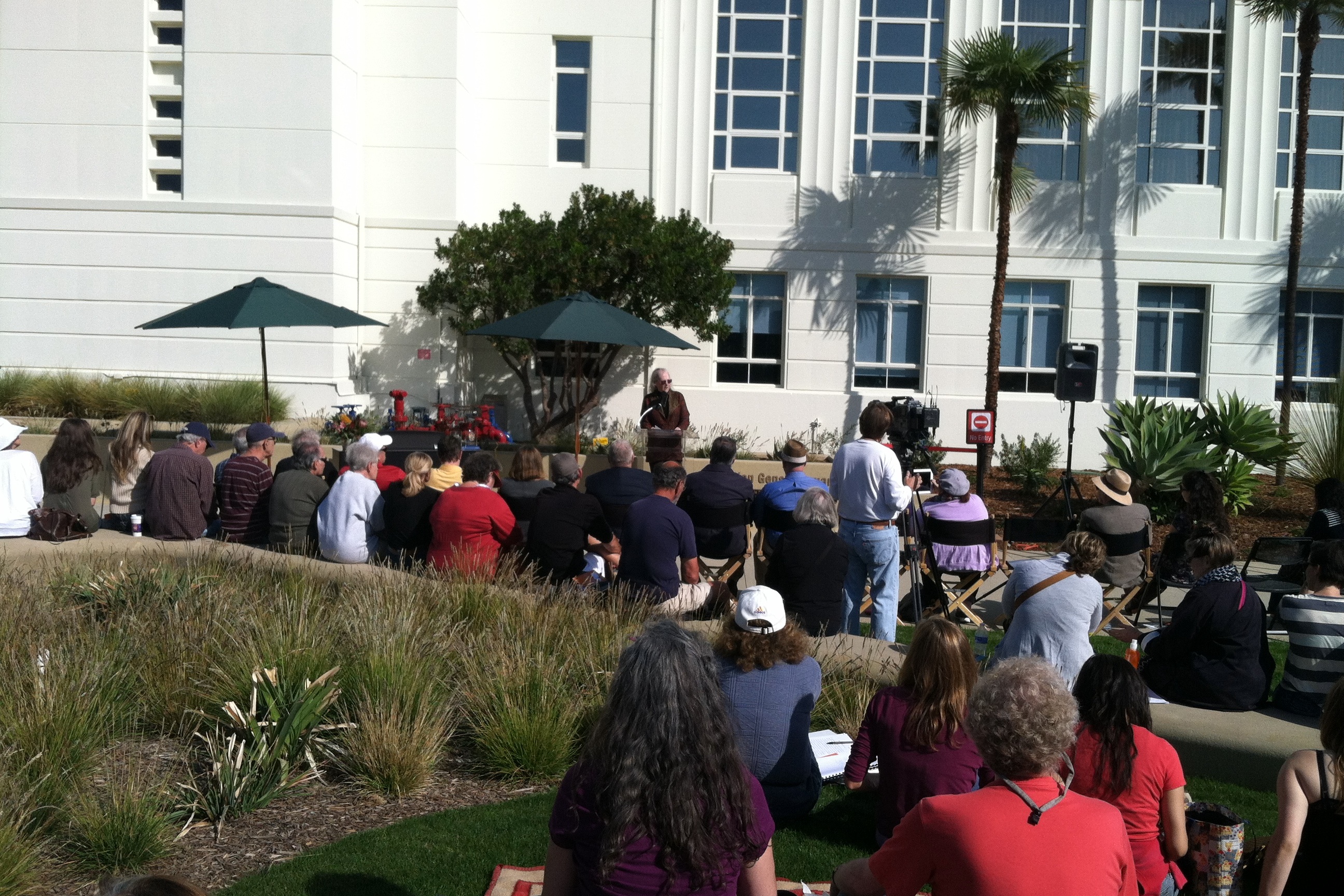
Yesterday’s dedication of Ken Genser Square in front of City Hall was a beautiful occasion — both because the new plaza is beautiful and because it was a fine gathering of the friends of the former mayor and 21-year council member, and of his co-laborers in the vineyards of Santa Monica activism and politics.

Naturally I thought of my relationship with Ken over the 17 years I knew him, and my recollections of a complicated human being. I never knew Ken on any kind of significant personal level, but we interacted a lot over the years, beginning in 1993 when he as a council member was on the working group for the Civic Center Specific Plan and I was an actively involved resident, and then in 1994 when we worked on the campaign to defeat the initiative Tom Hayden and anti-development groups had put on the ballot to overturn the plan.

What I always thought defined Ken as a politician, at least in the earlier years I knew him (and, yes, even one of Ken’s closest friends, Patricia Hoffman, noted at the dedication ceremony how Ken had mellowed over the years he was in office), was a fascinating combination of fierce partisanship coupled with, when it came to policy, a wonderfully open mind.

SMRR Co-Chair and longtime friend of Ken Genser speaks at the dedication of Ken Genser Square.

Patricia Hoffman, SMRR Co-Chair and longtime friend of Ken Genser, speaks at the dedication of Ken Genser Square.

Ken’s partisanship most significantly took place in the context of the internal politics of Santa Monicans for Renters Rights (SMRR). Ken was the primary standard-bearer for the more anti-development faction within SMRR that arose in the ’80s, and was the first council member who explicitly represented that wing when he was elected in 1988. (I say more anti-development because all factions within SMRR advocate regulating development stringently.)

From then and on through the ’90s Ken worked — as I said, “fiercely” — to have SMRR endorse more anti-development candidates. As with politics in any organization of like-minded people, there is a lot of the “narcissism of small differences” and elbows are known to be thrown. Arguably Ken’s greatest political triumph came in 1999 when Richard Bloom, in a special election, won election to the council, creating what was then called a “no growth” majority on the council.

That was Ken the partisan politician. When it came to policy, Ken couldn’t be pigeon-holed, and often broke with his supporters. I mentioned the Civic Center Plan in 1994; there was also the downtown Target in 2001 (Ken and Pam O’Connor were the only council members who voted to approve it), and Ken did not support Measure T, the RIFT initiative, in 2008. These were the three most contentious development issues over past 20 years, and in none of them was Ken on the anti-development side.

It simply was that Ken would examine the reasons he was skeptical in general about development, and when those reasons didn’t apply to the facts at hand, he wouldn’t oppose the project. His analysis of the Target project was telling — he didn’t see that opposing development downtown made much sense, and he saw Target’s benefits (such as providing discount shopping within Santa Monica) outweighing any downside it might have.

While Ken lost the Target vote, his vote in favor of the project foreshadowed the demise of the anti-development majority, since it seemed to free up, ultimately, two other members of the bloc, Bloom and Michael Feinstein, to take more nuanced views about development also.

All of this needs to be seen in the context that development has been tightly controlled in Santa Monica in the decades after the big office parks were approved in the ’80s, a policy success that belonged to Ken as much as to anyone else.

Politically, I had a mixed relationship with Ken. He had two opportunities to vote for me for the Planning Commission, in 1995 and in 1999, and neither time did I get his vote. But we were in agreement when it came to the Civic Center, Target, and Measure T. (There were a lot of other issues we agreed about that didn’t concern development — which was good, because it was always better to have Ken on your side than against you.)

While it’s useless to play the game of “what would Ken do” when it comes to evaluating the issues of today, it is worth recalling some of his last pronouncements on development issues. Ken died about six months before the completed LUCE came before the council, but during its development Ken warned that the document was relying on discretionary review at nearly every level of project size.

Ken’s view was that to the greatest extent possible the City should legislate what the City wanted or would accept from developers, and then let the developers figure out how to make their projects work within those parameters. If they couldn’t work, that was their problem. But trying to balance development with negotiated benefits was always going to create problems, and should be restricted to the biggest projects.

As Santa Monica turns to its new proposed zoning ordinance that seems like good advice.

Thanks for reading.

(To read more what I wrote about Ken, back when I wrote for the Lookout News, click here.)

Ken Genser at the opening of the Annenberg Beach House in 2009.

Ken Genser at the opening of the Annenberg Beach House in 2009.

Immigrant farm laborer tourists unite!

If you used to read the column I wrote for The Lookout News you may recall that one factor in my being one of the luckier of all human beings is that my sister and parents bought property about 30 years ago in Umbria, the “green heart” of Italy. This means that to visit family I’ve had a rather touristic place to go.

Last week I did something I’d always wanted to do — visit my sister during the olive harvest. Maybe it was a crazy trip — two days consumed in flying to spend five days in Italy — but I had the requisite frequent flyer miles, I wasn’t going to be missed too much at home or in the office (the latter these days you take with you on your computer anyway), and so I went.

Call it “immigrant-farm-laborer-tourism,” something Tom Wolfe might have written a novel about, but for four days I picked olives. In fact, as I learned, you don’t pick olives, but instead rake them. It’s not digging ditches labor, or harvesting field crops labor, but by the end of the day I had stretched muscles I was no longer aware I possessed.

Yours truly raking olives from a tree.

Yours truly raking olives from a tree.

Nearly everyone where my sister lives has olive trees, much like people here with backyards have vegetable gardens, and much of the conversation last week was about picking them and getting them to the frantoio, the press where they get turned into oil. As with the produce from a vegetable garden, when you consider the time you spend the price of what you purportedly grow for free is exorbitant, but the satisfaction in mixing your labor with the product is priceless . . . and the product is at another level of quality.

I’m a city-lover who loves visiting the country, and one reason is that as lovely as the country is, you get reminded why people live in cities. There’s no traffic to speak of in the Umbrian countryside, but nonetheless it’s a 20-25 minute drive to a supermarket or to an ATM. I.e., it’s not a convenient life.

And there’s not much economic opportunity. You can imagine how back in the pre-industrial day, which in much of Umbria wasn’t long ago, everyone in large farm families could pitch in for a few weeks and harvest olives, and the family would have enough oil for the year (and some to sell), but these days it’s hard to pick olives on an economical basis. The olives wouldn’t sell for enough money to pay wages that include everything that goes into a living, 21st century wage.

And so for a couple of centuries all over the world country folks have been heading to town. It’s been well noted that in the past decade for the first time the number of humans living in cities exceeded the number living in the country. When they get to those cities, former agricultural workers find economic opportunities, but their low skill levels typically limit them to the lowest level jobs, with compensation insufficient to pay the higher cost of living in the city, which includes public costs, too.

Their seeking better opportunities in the city then leads to various urban crises — housing crises, education crises, transportation crises, and numerous social problems associated with poverty. Think the Lower East Side 100 years ago. Or much of L.A. today.

To be blunt . . . not making enough money is a problem. It’s often said we have an affordable housing crisis — but what if it’s not, given the cost of building housing, that rents are too high, but that wages are too low? Shouldn’t people who work make enough to afford a decent place to live?

Which brings up the latest big news in Santa Monica — the deal UNITE HERE, the hotel workers union, has struck with OTO, the developer of the two hotels proposed for the corner of Fifth and Colorado.

For almost 50 years, from the passage of the National Labor Relations Act (NLRA) in 1935 until the advent of Reaganism, a strong labor movement kept wages high and created a “working middle class.” Meanwhile American industry dominated the world as management and labor worked together. (By the way, if you think that strong unions and high wages are incompatible with high production and profits, look at Germany.)

But nearly 40 years of Republican domination of the National Labor Relations Board essentially rewrote the NLRA to remove the right to organize.

The labor movement has found new life, however, in the L.A. area over the past two decades, in organizing service workers. By raising the wages and benefits of these workers, the unions have benefited our entire society. Congratulations to UNITE HERE Local 11 for the deal they have reached with OTO, which follows the deal the local made for the hotel at 710 Wilshire, and which will no doubt be followed by deals with all new hotels in Santa Monica.

Congratulations, too, to OTO, for not following today’s corporate conventional wisdom and ideology and for showing its willingness to make a union deal.

Finally, let’s hear it for those politicians and political organizations in Santa Monica, notably Santa Monicans for Renters Rights, and activists and organizations like Santa Monicans Allied for Responsible Tourism and the Santa Monica branch of Clergy and Laity United for Economic Justice, who have supported the union’s efforts over the years.

This is nothing for unions to be shy about. Business uses the political process, and so should labor.

Thanks for reading.

This photo has nothing to do with the article -- it's just a cool picture of fog in the valley of the Tiber River, as seen from my sister's village.

This photo has nothing to do with the article — it’s just a cool picture of fog in the valley of the Tiber River, as seen from my sister’s village.

Storming FAA beach

For a while now the groups of residents seeking to close the Santa Monica Airport have been counseling caution in dealing with the Federal Aviation Administration (FAA). The City of Santa Monica was so bruised by losing its case against the FAA over big corporate jets that the groups, the chief of which are Community Against Santa Monica Airport Traffic (CASMAT) based largely in the Santa Monica neighborhoods of Sunset Park and Ocean Park, and Concerned Residents Against Airport Pollution (CRAAP) based largely in the L.A. neighborhoods of Mar Vista and Venice, proposed strategies and tactics that — t’ai chi ch’uan style — avoided a head-on clash with the FAA.

You know what t’ai chi masters say is the way to stop an oncoming train from running you over, don’t you? It’s “step off the track.”

The FAA’s train was a covenant in a 1948 “Instrument of Transfer” by which the federal government released its wartime interest in the airport; the covenant on its face required Santa Monica to operate the airport in perpetuity. In all the decades of litigation over the airport the feds had never tried to keep the airport operating by invoking this clause, but a few years ago — getting desperate? — FAA administrators grabbed hold of the covenant and threatened Santa Monica with dire consequences if the city tried to close the airport in 2015, after the city’s agreement to keep the airport open until then, contained in a 1984 Settlement Agreement with the FAA, expired.

In the t’ai chi philosophy of martial arts one defeats one’s foe by yielding and “sticking” to them rather than opposing force with force, and in true t’ai chi fashion the tactics of the anti-airport groups involved two gambits. One focused on a parcel of land, called the “Quitclaim Parcel” because the City obtained it by way of a quitclaim deed from the federal government in 1949, which was not covered by the Instrument of Transfer, and the other on the leases to aviation companies at the airport that expire in 2015.

The tactics were (1) that the city would take back the Quitclaim Parcel, which would reduce the airport’s runway from 5,000 to 3,000 feet and preclude big corporate jets from using the airport without directly challenging the “perpetuity” covenant, and (2) that the city would simply not renew the aviation leases, thus drastically reducing the functionality of the airport.

Although I had several times written in my Lookout column that the airport should close when the 1984 Settlement Agreement expired, I didn’t get to know the people in the anti-airport groups until I ran for City Council in 2012. I met them during the campaign, and what impressed me about them from the start was how practical they were.

It’s easy for residents to make demands on the city without always considering legal, economic and other realities, but the anti-airport groups never took anything for granted. They researched everything about the airport, from its history, including the legal history of each parcel that makes up the airport, to operations — such as analyzing flight data to reveal that about half of all takeoff and landings at the airport came from flight schools that operated out of leased city-owned buildings.

Then, knowing that fighting the FAA in court would be expensive and grueling, they came up with their strategies based on the Quitclaim Parcel and the leases. They demanded action from the City, but the actions they demanded were measured and cautious.

So what happened?

Well, blow us all away, but forget yielding and sticking. Last Thursday the City of Santa Monica went to battle against the FAA more like Marines landing on a beach. As I’m sure readers know, the City filed suit against the FAA seeking to quiet title on the airport land, asserting, among other arguments based on the language of the documents and, in some cases, the FAA’s own policies, that the perpetuity covenant in the Instrument of Transfer violated the City’s constitutional rights under the Fifth and Tenth Amendments of the Bill of Rights.

If you haven’t read the Complaint, I urge you to do so. It’s written in plain, non-legal language. The arguments based on the facts — and I can’t wait to read the legal briefs supporting them — are powerful.

SMO Complaint (10-31-13) page 1 cropped

A few things are clear. The City — and that includes the council members, City Manager Rod Gould and his staff, and City Attorney Marsha Moutrie and hers — not only listened to the community groups, but also studied the history of the airport they and others (notably environmental lawyers at UCLA) had unearthed.

As a member of Airport2Park.org and looking forward the great park the City will build at the airport, I’m thrilled by the bold action the city took.

But I also want to mention that the city’s complaint preserves the city’s rights to take back the Quitclaim Parcel (which it explicitly clarifies as not coming under the Instrument of Transfer) and terminate the airport leases.

In a future post I’ll go into the complaint in more detail, but for now — Bravo!

Thanks for reading.